
Building regulations 2025 - new non-domestic buildings: energy standard improvements - modelling report
Research output to identify and assess potential improvements in energy and emissions performance for non-domestic buildings constructed in Scotland set via Section 6 of the Scottish Building Standards (energy). This was to inform the setting of targets within the next set of energy standards.
Part of
Appendix C Analysis of Opportunities and Constraints
C.1 Heating Fuel Choice
With the adoption of the NBHS, ASHPs are increasingly seen as the default choice for new buildings. Figure 71 shows the floor area of buildings recorded in the EPC database by heating fuel/source. Air source heat pumps are now found to be the most prevalent heat generator type, followed by natural gas, which is now not be permitted in new buildings.
Electric heat pumps delivering water temperatures of less than 80ºC are reported as achieving the highest level of technology readiness (International Energy Agency, 2022), and beyond the challenges posed by delivering the higher temperatures required by domestic hot water there are not foreseen to be further significant constraints to their adoption, beyond that related to access and availability of the heat source; refer to Table 127 for a further discussion on the key factors.
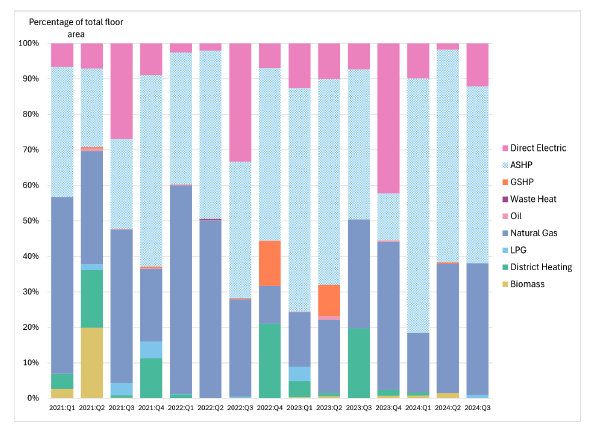
Bioenergy, including wood burners and peat-burning, are permitted under the NBHS; however, these are not anticipated to be used in a significant number of buildings and are likely to be limited to use in rural and Island locations. Over the most recent four quarters recorded in the EPC database (Quarter 4 2023 to Quarter 3 2024); biomass heating was used in an average of 1% of the building floor areas.
A key constraint on the installation of electrically fuelled heating, whether direct-electric or via a heat pump, is the strength of the local electricity grid. Figure 72 illustrates the level of network constraint in the distribution networks across Scotland; ‘red, amber, green’ ratings illustrating the level of network constraint. There are significant areas where the network is shown to be constrained (red), which indicates that there may need to be grid reinforcement to support the use of electric heating solutions. A constrained electricity grid would have the greatest impact on a building proposing to use a direct-electric heating solution, as this would require a higher peak power supply, whereas using a heat pump would help to reduce the peak load.
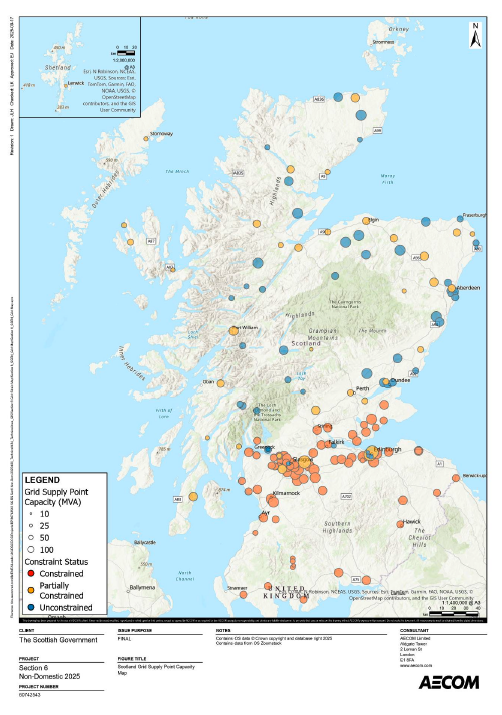
Derived from: SP Energy Networks (SP Energy Networks, 2025) and SSE Electricity Networks (Networks, 2025)
New buildings are permitted to connect to district heat networks regardless of the network’s heat generator, under the requirements of the NBHS. The opportunity to decarbonise heat using district heat networks is well recognised, with the Scottish Government setting targets to increase the supply of heat from heat networks to 2.6 TWh by 2027, 6 TWh by 2030 and 7 TWh of output by 2035 (Scottish Government, 2023). These are equivalent to approximately 3%, 8% and 9% of current non-electrical heat consumption respectively (Scottish Government, 2024).
Therefore, there is expected to be an increasing opportunity for buildings to connect to district heat networks; however, this will be geographically constrained to where networks are economically feasible. The First National Assessment of Potential Heat Network Zones identified potential heat network zones across Scotland, with Glasgow City, Fife, Edinburgh and South Lanarkshire offering the greatest potential heat demands (Buro Happold, 2022). It is likely that future district heat networks will be focussed on urban areas where the greater heat demand density allows for economic heat network operation.
Beyond the inherent geographical restriction associated with district heat networks, additional building-level constraints precluding a new building connecting to a heat network are not anticipated.
Table 127: Summary of site constraints for low-carbon heating sources.
Low-Carbon Heat Source
Heat Pump: Air-source (ASHP)
Limitations & Site Constraints
Requires access to external air; may be challenging for units within larger buildings. However, this is a relatively unusual barrier and can be overcome through a coordinated design.
Low-Carbon Heat Source
Heat Pump: Water-source (WSHP)
Limitations & Site Constraints
Requires access to a suitable body of water which is rarely available.
Low-Carbon Heat Source
Heat Pump: Ground-source (GSHP)
Limitations & Site Constraints
Requires suitable ground conditions, this can be viewed as a large unquantified project risk until ground investigations can be undertaken. The costs and uncertainty may discourage the use of this technology.
Low-Carbon Heat Source
Heat Pump: Sewer-source (SSHP)
Limitations & Site Constraints
Requires access to a suitable sewer and cooperation from sewer owner/operator[9]. Such reliance on a third party may be deemed to be an unacceptable project risk.
Low-Carbon Heat Source
Biomass boiler
Limitations & Site Constraints
Requires suitable access for fuel delivery and storage. Ongoing maintenance and operational requirements may be deemed to be burdensome for building occupants/owners.
Low-Carbon Heat Source
District heating network
Limitations & Site Constraints
Requires building to be located close to existing, or near-future planned heat network. Opportunities for heat network development are likely to be limited to urban locations where heat demand density can support economic operation.
Low-Carbon Heat Source
Solar water heating
Limitations & Site Constraints
Generally, only suitable for domestic hot water provision although innovative systems can provide space heating as well.
Under the current Section 6 (2022) methodology, the choice of heating fuel in the actual building determines the heating efficiency and fuel used in the notional building. For most heating fuel types in the actual building, the notional building uses a natural gas fired boiler with SCOP of 93%; the exception being where the actual building uses an electric heat pump where the notional building also uses a heat pump, but with a SCOP of 300%.
Therefore, when a building uses direct electric heating (in the form of panel heaters), the heating energy efficiency in the actual building (SCOP = 100%) is better than the notional building (SCOP = 93%), as this strategy benefits from having no delivery losses. This would not be the case if the direct electric heating was in the form of a central electric boiler feeding an LTHW system, in which case there would be in-building delivery losses, typically in the range of 5 to 10%.
Similarly, buildings using district heating will have in-building delivery losses, typically between 5% and 10%, meaning that, all else being equal, the heating energy efficiency could be poorer (SCOP between 90% and 95%) than the notional building.
| Heating type in actual building | Generator efficiency (%) | Typical in-building delivery losses (%) | Resulting Heating SCOP (%) | Notional building heating SCOP (%) |
|---|---|---|---|---|
| District heating & Central electric boiler | 100% | 5 to 10% | 90 – 95% | 93% (Natural gas) |
| Direct electric | 100% | 0% | 100% | 93% (Natural gas) |
The choice of heating source is not solely made based on Section 6 performance, although it will likely be a factor in the decision. It may have more significance in buildings seeking higher BREEAM ratings, where currently Excellent and Outstanding ratings have mandated levels of energy performance, measured using the metrics from Section 6 compliance modelling. Such comparative performance metrics may lead to the unintended consequence of favouring direct electric heating, in the form of panel heaters or similar, over other solutions that result in lower carbon and/or energy consumption in absolute terms. However, there are several factors that are expected to mitigate this risk, including:
- The running costs associated with different heating sources. Typically, direct electric heating will be the most expensive to run, which would discourage its widespread use.
- Electricity grid constraints (as previously discussed), which may significantly increase the capital costs associated with direct electric heating, due to the requirement for grid reinforcement and upgrade. Using a heat pump will reduce the peak electricity load from the building, helping to mitigate the impact on the local electricity grid.
C.2 Lighting
It is anticipated that LED luminaires may reach an efficacy of 143 lm/W by 2030 (Modern Place, 2025). There are not anticipated to be significant building level constraints that would impact a building’s ability to adopt LEDs with the highest efficacies, beyond those that are currently experienced and for which the NCM already makes allowance. For example, Paragraph 201 in the NCM Modelling Guide explains the approach to take where intrinsically safe, or anti-ligature, fittings must be used, such that the actual building is not penalised (Building Standards Division, 2023).
C.3 Onsite Electricity Storage
The current Section 6 methodology limits the benefit of PV-generated electricity to that which can be ‘usefully’ used on site. In SBEM, the useful PV electricity generation is calculated monthly as the lesser of the total PV generated electricity, or the total of the regulated and unregulated electricity demands. This mitigates the risk that designers and developers could green-wash poor designs by installing over-sized PV arrays, where much of the generated electricity is exported to the Grid. SBEM calculations can currently only calculate monthly energy demands and usage (i.e., twelve data points per year), so the energy balance calculation is limited to this resolution. The implied assumption in the equation used is that the building’s energy demand occurs at the same time as the PV generation. This is most valid where buildings have daytime only energy demands, whereas it is likely to be less valid for buildings that have 24-hour energy demand profiles (for example hospitals). DSM packages calculate hourly energy demands and so provide greater granularity in the calculation of ‘useful’ PV electricity generation. SBEM output data cannot therefore be used as a proxy to calculate suitable battery storage capacity, noting that this should ideally be calculated based on a prediction of operational energy consumption for the building, rather than a compliance calculation.
Figure 73 illustrates the proportion of useful PV generation; in approximately half of the scenarios modelled, 95% or more of the PV-generated electricity is useful (i.e. 5% or less of the generated electricity is exported to the Grid). This suggests that in most scenarios, achieving Section 6 compliance is not a strong driver towards using on-site energy storage.
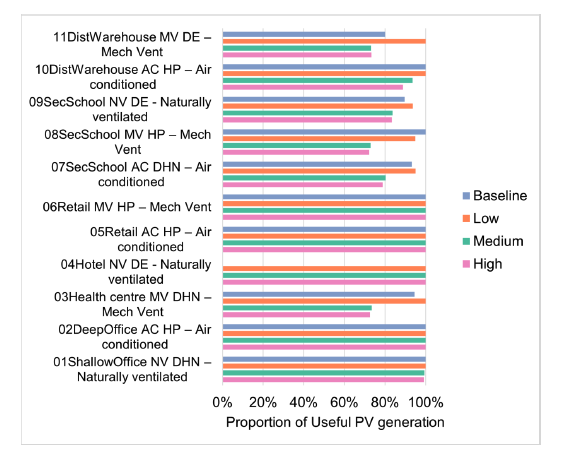
Table 129 shows the relative costs of using grid supplied electricity compared to PV generated electricity (simultaneous generation and consumption) and PV generated electricity stored in batteries for later use.
The values in Table 129 have been derived based on the following inputs:
- Grid supplied electricity cost data taken from UK Government published Energy Prices data (Department for Energy Security and Net Zero, 2025).
- PV:
- Capital cost of £1,365 per kWp (Department for Energy Security and Net Zero, 2025)
- Batteries:
- Capital cost of £637 to £933 per kWh (AECOM Professional Services LLP, 2025).
- Typical battery lifespan of between 6,000 and 10,000 cycles.
- Round trip efficiency (RTE) of 90% (Solarquarter, 2024).
| Parameter | Grid supplied electricity: Very small | Grid supplied electricity: Extra large | Grid supplied electricity: Average | PV generated | PV generated and stored |
|---|---|---|---|---|---|
| Energy cost per kWh (p/kWh) | 31.36 | 22.09 | 26.41 | 6.07 | 16.98 |
| Compared to average grid supplied electricity (p/kWh) | - | - | - | -20.34 | -9.43 |
| Compared to average grid supplied electricity (%) | - | - | - | -77.0% | -35.7% |
This shows that when solar PV generated electricity can be used immediately, this incurs the lowest cost at 77% cheaper than the average cost of electricity from the grid, whilst buying electricity from the National Grid is the most expensive. The additional cost associated with the installation of batteries increases the cost of PV-generated and stored electricity, although is typically 36% cheaper than the average cost of electricity from the national grid.
Therefore, adding batteries to a PV installation slightly increases the cost of PV-generated electricity, but does allow a greater proportion of the generated electricity to be used in the building, which achieves greater energy cost savings.
Adding batteries can be beneficial in cases where building owners are keen to maximise their building’s resilience and reduce the reliance on the National Grid. Following on from this, battery storage can be helpful in areas with a constrained electricity grid.