
Fair Work First: policy evaluation
An independent evaluation of the Scottish Government's Fair Work First conditionality policy, seeking to understand whether the policy has been delivered as intended.
8. Potential Changes and Future
This chapter presents views from buyers and funders as to how straightforward or challenging it might be if the currently ‘desirable’ Fair Work First criteria were to be made mandatory, along with insights from evaluation participants on how Fair Work First policy could be improved.
It also sets out the details and potential implications of wider legislative changes, including the Tertiary Education and Training (Funding and Governance) (Scotland) Act 2026, and the Employment Rights Act 2025.
Reminder of survey base sizes:
- Survey of buyers and funders (base=88)
- Survey of employers (base=260)
- Survey of workers (base=888)
Findings summary
Views are divided among surveyed buyers, funders and employers when asked how straightforward or challenging they would find it to make the currently desirable Fair Work First criteria mandatory as part of contracts and grant arrangements.
In terms of potential future improvements, there is a call from surveyed buyers and funders for clearer, more proportionate and tailored guidance. Surveyed employers meanwhile would like to see a “reduction in bureaucracy”, particularly when it comes to repeating submissions across different funding or procurement processes. Suggestions included standardisation, centralised systems, and lighter-touch reporting for established organisations.
The introduction of the Employment Rights Act 2025 may strengthen or even surpass parts of Fair Work First, though some interviewed stakeholders expect Fair Work First to remain relevant for its broader, non‑statutory principles.
8.1 Making currently desirable criteria mandatory
Surveyed buyers and funders were asked for their views on how straightforward or challenging they would find it to make the currently desirable Fair Work First criteria mandatory as part of contracts and grant arrangements.
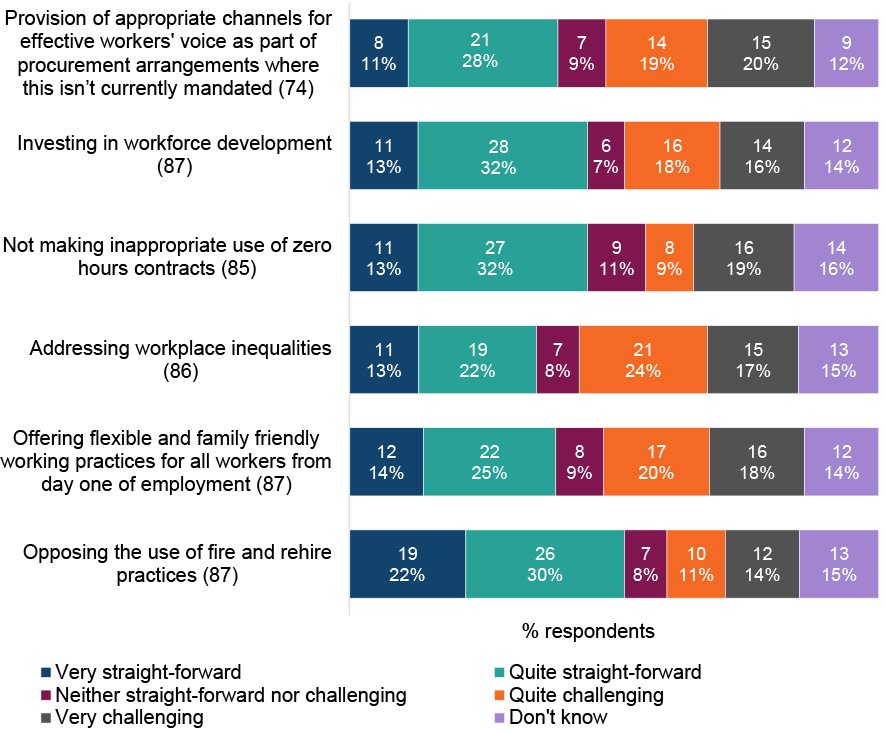
Views are clearly divided with respect to each criterion. Opposing the use of fire and rehire practices appears on balance to be the most straightforward to implement, as mentioned by more than half of surveyed buyers and funders (45 respondents, 52%)– Figure 46.
As noted in section 3.6.1, key challenges identified by some buyers and funders include difficulty determining what constitutes sufficient supporting evidence (especially for effective workers’ voice or workforce development) and how to assess supporting evidence consistently, particularly where this is qualitative in nature
Figure 46 How straightforward or challenging it would be to make the ‘desirable’ Fair Work First criteria mandatory (survey of buyers and funders)
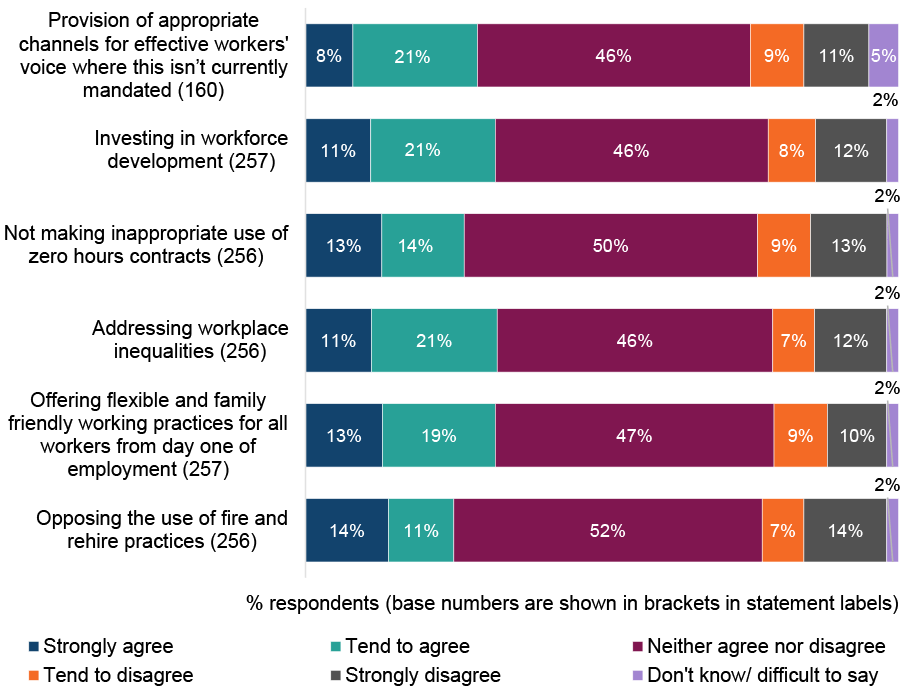
Surveyed employers were asked to what extent they agree or disagree that – hypothetically – mandating each of the Fair Work First criteria would strengthen their own organisation’s commitment to each of these areas. For each criterion, either the majority or a large minority are ambivalent, though between a quarter and a third agree that mandating each criterion would strengthen their commitments (Figure 47).
Figure 47 Extent of agreement/disagreement that making Fair Work First criteria mandatory would strengthen commitment to each practice area (survey of employers)
One interviewed employer cautioned the need for proportionality, warning that if Fair Work First criteria continue to expand, smaller organisations may struggle to meet them or may choose not to apply for funding at all.
8.2 How Fair Work First policy could be changed or improved
8.2.1 Views of buyers/funders
Surveyed buyers and funders were asked what changes or improvements – if any – they would suggest for the future delivery of Fair Work First policy.
Overall, there is a call for clearer, more proportionate and tailored guidance, for example:
- Clearer terminology definitions (such as what counts as “inappropriate” use of zero hours contracts and when zero hours contracts might be deemed appropriate).
- More flexibility around treatment of apprentices in relation to the real Living Wage, such as apprentices employed by SMEs or where they are paying “sector agreed rates” (it should be noted that limited exceptions are currently available as per the Scottish Government’s Fair Work First Guidance).
- Whether evidence should be demonstrated in relation to the whole employer organisation or specifically in relation to the contract/project team.
- How to validate or “prove” employers’ commitments – with some calling for the policy to be strengthened around validation and expectations around trade union involvement (especially in relation to effective voice conditionality as part of grant funding).
Other suggested improvements from buyers/funders:
- A need to minimise duplication of evidence requests, such as use of shared evidence registers.
- Introducing a minimum funding threshold where Fair Work First criteria are applied, so smaller employers entering into smaller arrangements are not asked to make disproportionately greater commitments.
- Policy development would benefit from stronger links to sector taskforces and ongoing stakeholder intelligence, such as the Cultural Fair Work Task Force.
“What would I do to improve Fair Work First? I’m not sure I’ve got a great answer. Do I think it’s too much? No. Could it be more? Probably, but if it’s more, it’s more on top of more, and where does the tipping point come?”
Buyer/funder
8.2.2 Views of employers
Surveyed employers were also asked what changes or improvements they would like to see to Fair Work First.
Many employers would like to see a “reduction in bureaucracy”, particularly when it comes to repeating submissions across different funding or procurement processes. Suggestions included standardisation, centralised systems, and lighter-touch reporting for established organisations.
Employers would also value a more flexible, proportionate approach to Fair Work First that reflects differences in organisational size, sector, and operating context rather than a “one size fits all” approach. This is to benefit (for example) smaller workforces in terms of the financial, administrative and operational burdens; and rural economy sectors (such as agriculture or tourism) that may be more reliant on casual or seasonal staff, traditionally lower paid, or less able to adopt digital technologies.
Other suggestions for improvement from individual employers include the following:
- Consider whole workforce pay structures, including uplifts for more senior roles and not just entry-level wages.
- Factor inflationary uplifts into contracts and grant values to ensure sustainability and credibility in line with increases in the real Living Wage.
- Place more focus on longer term (rather than shorter term) grant funding, to support workforce stability, planning, and job security.
- Provide clearer and more consistent guidance around how to meet Fair Work First criteria – particularly effective workers’ voice, such as trade union recognition – and especially for smaller organisations.
- Provide more practical support, including case studies, training, webinars, and advisory support to help organisations implement Fair Work First more effectively.
- Reconsider real Living Wage requirements for apprentices, which some feel creates affordability challenges.
- Take steps to ensure that employers genuinely comply with Fair Work First – such as through monitoring and accountability mechanisms – to tackle a perceived problem of some employers paying lip service or being dishonest having an advantage.
- Shift the focus away from the real Living Wage to instead focus on “wage for the job” and maintaining pay differentials, since a single wage threshold may distort internal pay structures.
8.2.3 Views of wider stakeholders
Worker representative bodies emphasised the need to strengthen effective voice through clearer trade union recognition, arguing that ambiguity should be removed and collective bargaining positioned as the default mechanism for effective voice where public funding is involved.
Another stakeholder suggested that Fair Work First be more firmly embedded in legislation or statutory guidance, to move from an aspirational framework to a more enforceable and durable policy.
8.3 Legislative changes
8.3.1 Tertiary Education and Training (Funding and Governance) (Scotland) Act 2026
In addition to wider reforms as set out in the Tertiary Education and Training (Funding and Governance) (Scotland) Act 2026, from April 2027, fundable post-16 education bodies in Scotland will be expected to adopt all seven Fair Work First criteria (rather than just two) as a condition of receiving Scottish Funding Council (SFC) grants. In acknowledgement of the fact that these bodies will be at different stages of implementing the five currently non-mandatory Fair Work First criteria, the SFC aims to take forward appropriate transition periods for planning, as noted in Scottish Parliament Chamber and Committees Q&A. Therefore, an individual body may be given a longer lead-in time to implement a specific criterion where they, in partnership with recognised trade unions or work representatives, can make a case to do so.
One buyer/funder hypothesised that when all seven criteria become mandatory in this sector, the feedback from trade unions could be more varied and might shed light on what the institutions are doing less well.
8.3.2 Employment Rights Act 2025
The Employment Rights Act 2025 – applicable to Great Britain (England, Scotland and Wales) – received Royal Assent on 18 December 2025. The Act aims to tackle low pay, poor working conditions and poor job security. It forms part of the UK government’s Make Work Pay plan which aims to grow the economy, raise living standards and create opportunities. At the time of writing, the Plan to Make Work Pay and Employment Rights Act: timeline update states this is set to take place between 2026 and 2027, involving extensive consultation. While Fair Work First is a distinct Scotland-based policy involving criteria to be applied within procurement and grant-making, the Employment Rights Act embeds similar principles as part of statutory employment rights.
The introduction of the Act is expected to have implications for Fair Work First by setting certain statutory minimums that go beyond the currently “desirable” criteria of Fair Work First. However, possible challenges are expected. For example, Scottish Care’s published paper from November 2024 – the Potential Implications of the UK Employment Rights Bill – raises concerns that have been reflected through this evaluation, namely “challenges faced by Scotland's social care sector, including recruitment and retention difficulties, financial pressures, and the need for greater investment in workforce development”. Similarly, the Scottish Council for Voluntary Organisations (SCVO) noted in January 2025 that compliance costs could put pressure on third sector employers, urging the UK government to ensure funding for these new costs, particularly given that the Scottish Government cannot itself legislate on employment law.
Stakeholders interviewed for the evaluation are of the view that the Employment Rights Act could significantly strengthen areas already covered by Fair Work First, particularly through statutory underpinning. One stakeholder commented that trade union access, pay gap action plans and employment security could make Fair Work commitments easier to evidence and harder to avoid.
Employer representative bodies raise concerns about cumulative regulatory and cost pressures, with SMEs seen as particularly exposed to operational and financial challenges arising from new statutory rights, whilst also expressing uncertainty about how Fair Work First would adapt in response to the Act.
Some worker representative bodies suggest that the Act could overtake or render aspects of Fair Work First redundant, especially where statutory rights may go further than voluntary or conditional frameworks such as on effective voice and trade unions. Other stakeholders argue that Fair Work First would still have a role beyond full rollout of the Employment Rights Act, noting that Fair Work First covers “broader principles that go beyond minimum legal compliance”, but may require updating as part of the policy to remain relevant.