
Fair Work First: policy evaluation
An independent evaluation of the Scottish Government's Fair Work First conditionality policy, seeking to understand whether the policy has been delivered as intended.
3. Process Effectiveness
This chapter examines Fair Work First processes in detail. It begins with overarching insight on what is working well and less well, then levels of understanding of Fair Work First guidance, criteria and processes.
The chapter then examines discrete Fair Work First processes within procurement and – separately – as part of grant arrangements. This includes how buyers and funders apply Fair Work First criteria (including reasons why certain criteria are applied or not) and the types of wider process challenges they can face in these contexts.
Employer processes and challenges are then examined, followed by an examination of the burden of evidence from the perspective of buyers, funders and employers, access to Fair Work First information and guidance and how that could be improved.
Reminder of survey base sizes:
- Survey of buyers and funders (base=88)
- Survey of employers (base=260)
- Survey of workers (base=888)
Findings summary
Changes to Fair Work First policy in October 2021 and July 2023 (summarised previously) appear to have stimulated surveyed buyers and funders to more frequently apply the criteria of paying at least the real Living Wage, and providing appropriate channels for effective workers’ voice, such as trade union recognition.
The most frequently reported challenge associated with Fair Work First among surveyed buyers and funders is how to verify employers’ commitments and evidence. Among surveyed employers, the main challenges include cost pressure resulting from having to pay higher wages, uncertainty over future increases to the real Living Wage, and difficulties being able to plan and invest in fair work practices due to short funding cycles (a point raised by third sector employers particularly).
Existing evidence combined with views from interviewed stakeholders indicate that Fair Work First criteria can be more difficult to meet in some sectors such as care and hospitality, which are typically characterised by low pay, unsociable hours, variable shift patterns and high-pressure points. Stakeholders also make the point that smaller employers can face comparatively greater resource constraints than larger employers, with reduced infrastructure to embed elements such as clear pay structures and effective voice mechanisms.
Almost all surveyed buyers and funders consider the information and guidance they have accessed about Fair Work First to be helpful for implementing the criteria and associated processes. However, a minority describe guidance as dense, fragmented, complex and containing gaps. Similarly, while most employers have found information easy to use, some find it repetitive or difficult to consolidate into a clear picture of expectations, especially what constitutes “strong evidence” in relation to the criteria they are asked to meet.
3.1 Understanding of Fair Work First guidance, criteria and processes
Surveyed buyers and funders generally rate their organisation/department/function’s understanding of Fair Work First guidance, criteria and processes moderately high. On a scale from 1 ‘no understanding’ to 10 ‘complete and full understanding’, the average (mean) rating is 7.6 and the most common (modal) response is 8 (base=82).
Among surveyed employers in receipt of contracts or grants, levels of understanding of guidance, criteria and processes are also generally high, with 27% describing it as excellent, 55% good, 16% fair and 2% poor (base=258).
Differences by survey sub-group
In terms of statistically significant differences between survey sub-groups, the proportion of employers giving an answer of “excellent” or “good” is higher among the following sub-groups:
Organisation type: public sector and education organisations (95%) compared with private sector organisations (77%).
Organisation size: no statistically significant differences.
Contract/grant holders: no statistically significant differences.
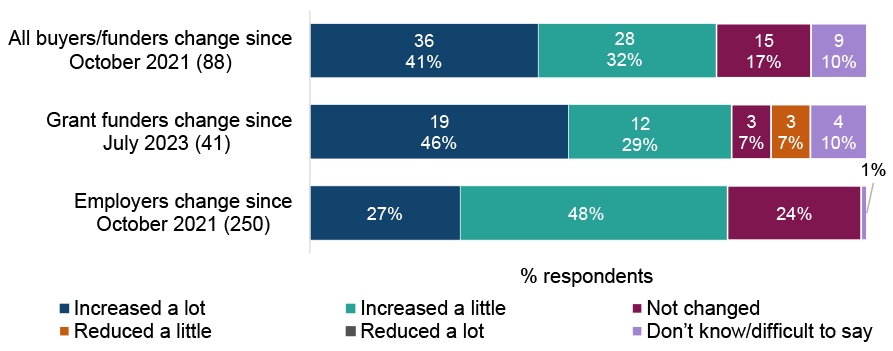
Understanding of Fair Work First guidance, criteria and processes also appear to have strengthened over time across different audiences. Almost three quarters of surveyed buyers and funders (64 respondents, 73%) say their understanding has increased since October 2021 when changes to Fair Work First were introduced (explained in section 1.2). Among a subset of these (grant-awarding organisations) 31 (75%) say their understanding has increased since July 2023 when conditionality was introduced to grants. Among employers, three quarters (75%) say their understanding has increased since the changes in October 2021 (Figure 1).
Figure 1 Extent to which understanding of Fair Work First guidance, criteria and processes has changed over time (survey of buyers/funders and employers)
Differences by survey sub-group
In terms of statistically significant differences between survey sub-groups, the proportion of employers giving an answer of “increased a lot” or “increased a little” is higher among the following sub-groups:
Organisation type: no statistically significant differences.
Organisation size: large organisations (84%) compared with medium organisations (64%).
Contract/grant holders: no statistically significant differences.
3.2 Fair Work First processes in procurement
3.2.1 Applying the real Living Wage criterion within procurement
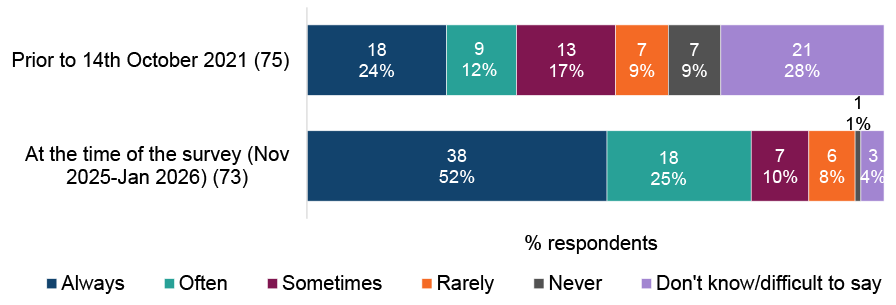
Buyers and funders surveyed for this evaluation were asked how often they asked employers to self-declare or provide evidence of paying at least the real Living Wage within procurement prior to 14 October 2021, and then at the time of the survey.
The results reveal a statistically significant increase in frequency, with more than half of buyers and funders (38 respondents, 52%) saying they always do this now compared with 18 (24%) prior to October 2021. That said, a small proportion (7, 9%) still rarely or never ask employers for this information (Figure 2).
It is important to note that this cohort includes both Scottish Government and non-Scottish Government buyers. For the latter, applying the real Living Wage is not mandatory (at a national level, however, local mandates may exist within individual public bodies) but encouraged where “relevant and proportionate”, as per Scottish Government Fair Work First Guidance. These groups have not been separated as part of the analysis in order to preserve anonymity of Scottish Government respondents.
Figure 2 How often buyers/funders ask employers to self-declare or provide evidence of paying at least the real Living Wage within procurement (survey of buyers and funders)
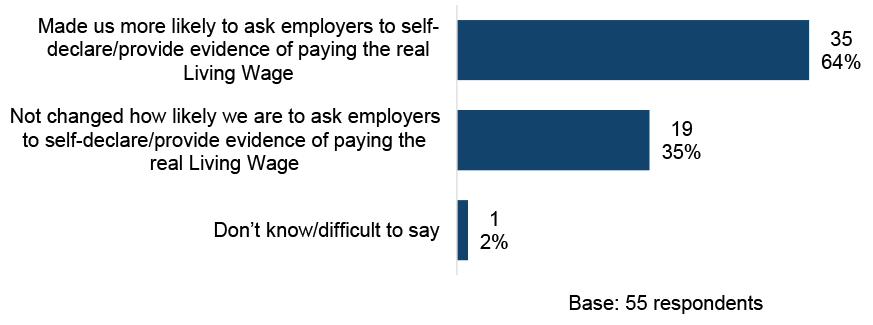
Almost two thirds of surveyed buyers and funders (35, 64%) say the Fair Work First policy change in October 2021 has made them more likely to ask employers to self-declare or provide evidence of paying the real Living Wage, providing a first indication of the difference that Fair Work First policy has made (Figure 3).
Figure 3 Impact of the October 2021 policy change on buyers/funders asking about the real Living Wage within procurement
Of those surveyed buyers and funders who say the policy has made them more likely to ask employers to self-declare, they mainly made the change due to wanting to align with Scottish Government requirements and procurement guidance.
Among buyers and funders saying Fair Work First has not changed how likely they are to ask employers to self-declare or provide evidence of paying the real Living Wage, the main reasons given are that these requirements are already embedded within procurement policies, grant governance processes, framework agreements and standard tender documentation. This tends to stem from their own ethical procurement objectives and a pre-existing commitment to fair work principles. Use of Scottish Government procurement frameworks is also seen as providing a level of assurance to buyers and funders that Fair Work First criteria have already been covered.
3.2.2 Applying the desirable (non-mandatory) Fair Work First criteria within procurement
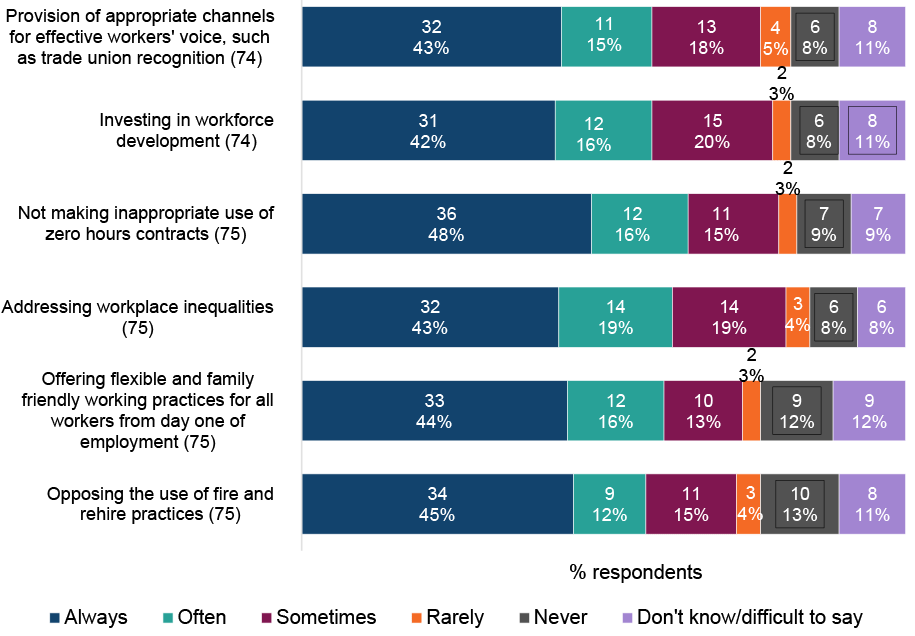
Surveyed buyers and funders were asked how often they ask potential suppliers to self-declare or provide evidence of their commitments in relation to the six desirable (non-mandatory) Fair Work First criteria within procurement. The results point to relatively strong (if not necessarily routine) application, with more than half always or often asking about each of the desirable criteria, and close to a third doing so less frequently or never (Figure 4).
The pattern is broadly consistent across the six desirable criteria, with surveyed buyers and funders reporting a unform approach regardless of the criteria.
Figure 4 How often buyers and funders ask employers to self-declare or provide evidence in relation to the desirable (i.e. non-mandatory) Fair Work First criteria within procurement (survey of buyers and funders)
The main reported reason for surveyed buyers and funders asking about the desirable criteria is to align with Scottish Government policy, statutory guidance and ministerial priorities; or to align with their own organisational priorities, as well as ethical and sustainability policies. To that end, there is a desire to ensure suppliers meet acceptable legal and employment standards in the interests of supporting fair treatment of workers, delivery of quality services, and building a more rounded view of supplier practices.
Many surveyed buyers and funders say they routinely embed the desirable criteria into tender invitation documentation or framework agreements, aiming to be consistent and asking all suppliers the same questions to ensure fair and transparent application of the criteria.
“We ask all potential suppliers for any contract to evidence how they meet all seven of the Fair Work First criteria in order to comprehensively progress Fair Work First policy.”
Buyer/funder
Among the small cohort of surveyed buyers and funders rarely or never asking about the desirable criteria, some do not consider these criteria relevant to the types of procurement activity they undertake, particularly where contracts involve consultants, sole traders, or small owner-managed suppliers. Others tend to only apply these criteria to large or workforce-intensive service contracts.
A minority of surveyed buyers and funders do not include the desirable criteria simply because they are not mandated, or because they rely on existing Scottish Government procurement frameworks and therefore assume supplier compliance with Fair Work First has already been covered.
3.2.3 Ways in which buyers/funders ask employers to demonstrate their commitments
Surveyed buyers and funders currently use a variety of approaches to ask employers to demonstrate their commitments to Fair Work First criteria as part of procurement processes. On average, two different approaches were mentioned per respondent.
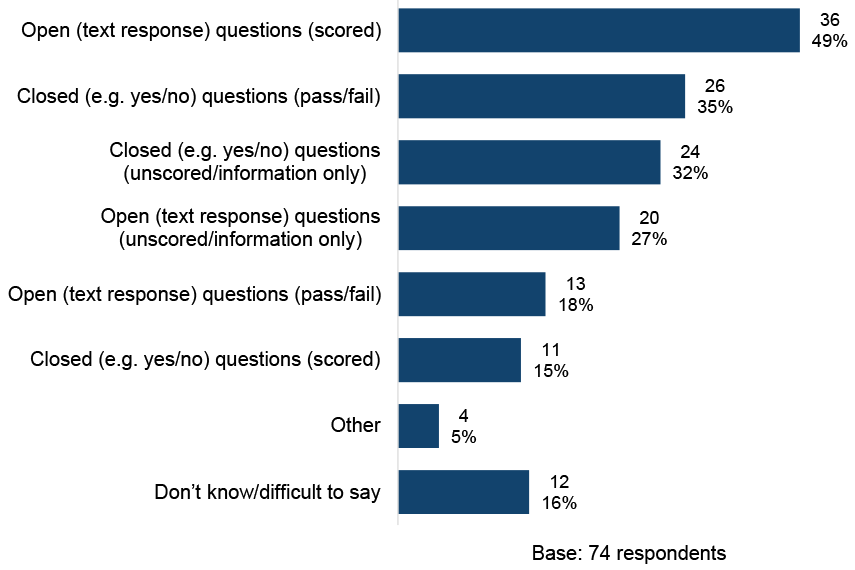
The most common approach to assessment, used by approximately half of surveyed buyers and funders (36 respondents, 49%), is to include scored open‑response questions. This approach requires employers to provide more considered and detailed answers. Just over a third (26, 35%) of surveyed buyers and funders use closed (yes/no) questions which are assessed on a pass/fail basis (Figure 5).
Figure 5 Approaches to asking employers to demonstrate their commitments to Fair Work First criteria in procurement (survey of buyers and funders)
“We have a standard question and don’t deviate. It includes lots of preamble, links and scoring criteria. We ask for a maximum of 200 words per theme then we score each theme on the response.”
Buyer/funder
Surveyed buyers and funders were then asked to explain how they decide on which approach(es) to use to understand employers’ commitments. The main driving factors are proportionality, relevance and risk, making it important to take account of the value, size and complexity of the procurement or grant, which sector employers are based in, and the perceived extent to which workforce practices are likely to affect service delivery. Some mentioned agreeing the assessment approach on a “case-by-case” basis. Others mentioned using standard Scottish Government templates to support consistency in approach.
“What we choose to ask employers to respond to will vary from tender to tender. For example, if buying taxi services that will be different to buying management consultancy. The real Living Wage is more appropriate to ask of the former.”
Buyer/funder
Weightings given to Fair Work First questions within procurement also vary, which may tie in with an approach based on proportionality, relevance and risk as noted above. Among those surveyed buyers and funders that score responses to these questions, most (23, 62%) assign a 5% evaluation weighting, while just under a quarter (9, 24%) assign a 10% weighting. The remaining minority assign either less than 5% or above 10% to Fair Work First (base=37).
3.2.4 Buyer/funder process challenges
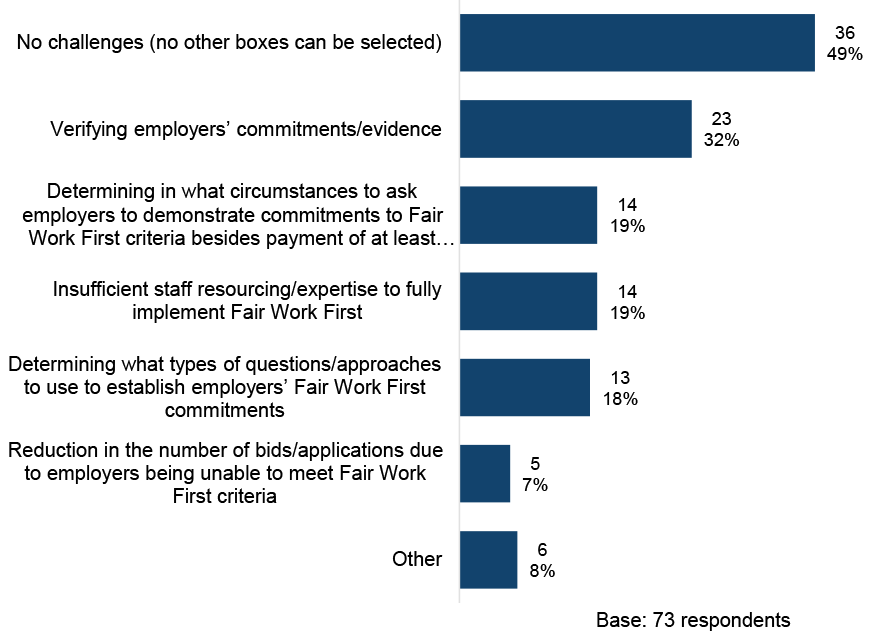
Surveyed buyers and funders were asked what types of challenges (if any) they have faced when implementing Fair Work First within procurement. Approximately half (37 respondents, 51%) mentioned at least one challenge, with the most frequently mentioned (by 23, 32%) being verifying employers’ commitments/evidence (Figure 6). It is noteworthy from this chart that there is limited evidence to suggest that the Fair Work First criteria has reduced the number of bid submissions - only 5 (7%) of surveyed buyers and funders have experienced this.
Figure 6 Challenges faced in implementing Fair Work First within procurement (survey of buyers and funders)
Further probing during follow-up interviews reveals that surveyed buyers and funders have limited capacity to undertake detailed due diligence or ongoing contract monitoring when it comes to Fair Work First within procurement, meaning they typically rely on supplier self-declaration rather than verification or auditing (though that was not presented as an argument for more verification or auditing being needed).
Indeed, some buyers and funders noted during follow-up interviews that smaller suppliers tend to find Fair Work First criteria disproportionately complex or burdensome to provide evidence against requirements (discussed further from the employer perspective in section 3.5.4). Further, some buyers and funders identified issues in particular sectors. For example, in social care, where it was highlighted that supplier budget constraints can limit the extent to which employers can go beyond minimum requirements. Buyer/funder approaches to managing these challenges included adopting proportionate approaches and signposting suppliers to guidance.
Other interviewed buyers and funders described structural and market-related challenges, including the time required to adapt templates, assess sector-specific risks, and balance Fair Work First with their own wider policy obligations.
There are also reported instances of contract managers or evaluation panel members lacking confidence or expertise in assessing Fair Work First criteria, making it difficult to assess tender responses.
“Procurement professionals often lack the knowledge, expertise, and time to really understand and evaluate how effective suppliers’ policies are for the people who work for the supplier. We don’t have the resource to follow up and ensure suppliers are actually implementing them.”
Buyer/funder
“We don’t mandate the real Living Wage because we don’t want to push out the suppliers we want, i.e. those really unique companies who don’t pay it but whose services we need.”
Buyer/funder
3.3 Fair Work First processes as part of grant arrangements
3.3.1 Existing evidence on the effectiveness of conditionality arrangements
The introduction of real Living Wage and effective voice conditionality as part of Fair Work First signals that the Scottish Government is using the policy to increase workers’ wages – prioritising low pay workers – and to ensure workers have an effective voice.
For an employer to meet real Living Wage conditionality in a public sector grant, the BRIA makes clear that this will bring an additional cost to those organisations where they currently pay their workers below this threshold. However, it adds that Fair Work First recognises that applying for public sector grants in Scotland is a choice, noting that if an organisation determines that the cost outweighs the benefit, it may decide not to seek a grant.
Research by the Just Transition Commission in 2025 – Just Transition Conditionalities: Building a Toolkit for Scotland – regarding the use of conditionalities on access to public support and finance, highlights that attaching conditions to public funding can act as a powerful lever for aligning employer behaviour with national goals. This, the research found, can help to ensure that public investment delivers wider social and economic outcomes beyond core service delivery.
In that sense, conditionality intends to work by strengthening expectations around fair work, job security and community benefit, helping ensure that transitions – economic or sectoral – are managed in ways that protect workers and maximise public value. However, the Just Transition Commission report also notes that conditionality requirements could be unattainable for SMEs with limited capacity and resources; furthermore, that a balance must be struck between a conditionality programme that encourages good business practice, and one that remains flexible and proportional to ensure SMEs are supported to adapt their behaviour.
3.3.2 Applying real Living Wage and effective workers’ voice criteria as part of grant arrangements
Surveyed grant funders were asked to state how often they asked employers to self-declare or provide evidence of each of the following prior to 1 July 2023 (when conditionality was introduced), and then again at the time of the survey:
i. Paying at least the real Living Wage.
ii. Providing evidence of effective workers’ voice, such as trade union recognition
For context, it is important to note from the Scottish Government’s Fair Work First Guidance that buyers and funders can ask employers applying for grants below £100,000 to self-declare that they pay the real Living Wage. For grants of £100,000 and above, buyers and funders are expected to ask employers for more information, such as evidence of accreditation, anonymised pay bands or an accountant’s certificate.
With respect to effective workers’ voice, such as trade union recognition, employers with fewer than 21 employers are only expected to provide evidence of individual voice. Employers with more than 21 employers are expected to provide evidence of at least one channel at both levels (individual and collective).
Despite what is set out in the Fair Work First Guidance, some grant funders’ evidence‑triggering thresholds may be higher than those indicated, based on proportionality, funders’ capacity to serve, and a commitment to keeping arrangements under review. Therefore, depending on the value of grant funds awarded and the individual funder’s evidence-triggering threshold, this will influence how often funders ask employers to provide evidence and undertake checks.
Data from the survey of grant funders points to an increase over time in the proportions asking employers to: i) self-declare or provide evidence of paying at least the real Living Wage; and ii) provide evidence of effective workers’ voice, such as trade union recognition.
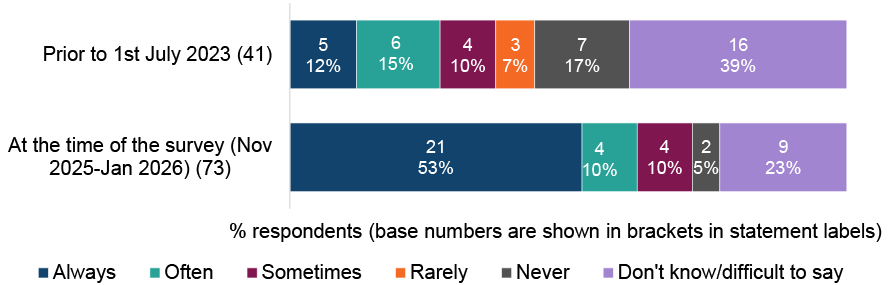
A small minority of surveyed grant funders (5 respondents, 12%) reported that they always asked employers to self-declare or provide evidence of paying at least the real Living Wage when reflecting on their approach prior to July 2023, compared with 21 (53%) saying they do so at the time of the survey.
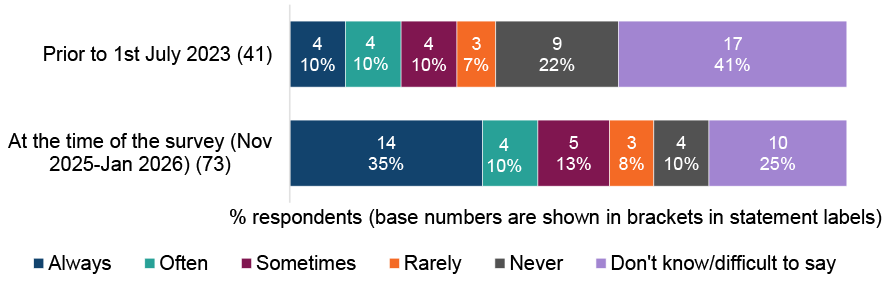
A similar minority of surveyed grant funders (4, 10%) reported that they always asked employers to provide evidence about effective workers’ voice, such as trade union recognition, when reflecting on their approach prior to July 2023, compared with just over a third (14, 35%) saying they do so at the time of the survey (Figure 7).
In both cases, proportions given for the time of the survey may be affected by size of grants awarded and the evidence-triggering thresholds those organisations adopt.
A large minority of grant funders were unsure or found it difficult to say. This may be due to the individual respondent relying on recall or not being able to access this information; or it could be that practices vary from grant to grant, making it difficult for the respondent to provide a clear answer.
Figure 7 How often grant funders ask employers to: i) self-declare or provide evidence of paying at least the real Living Wage; and ii) provide evidence of effective workers’ voice, such as trade union recognition (survey of buyers and funders)
Real Living Wage
Effective workers’ voice, such as trade union recognition
3.3.3 Applying the desirable (non-mandatory) Fair Work First criteria as part of grant arrangements
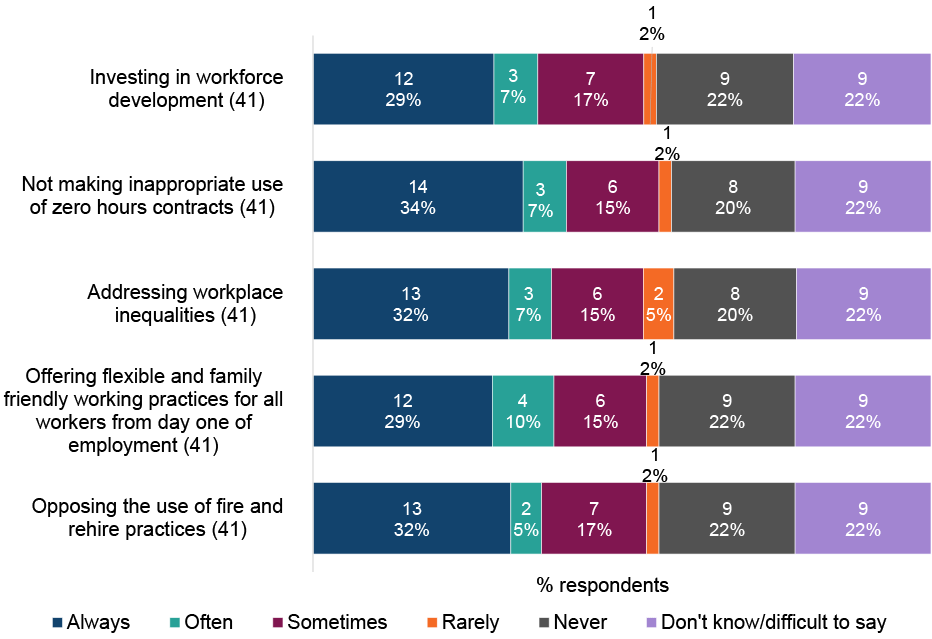
Turning attention to the five desirable (i.e. non-mandatory) Fair Work First criteria as part of grant arrangements, surveyed grant funders were asked how often they specifically ask employers to self-declare or provide evidence of their commitments.
As with procurement, the results reveal a mixed picture, with around a third always doing so (Figure 8). Similar to procurement, the pattern is broadly consistent across the desirable criteria, with most surveyed grant funders reporting a uniform approach regardless of the criteria.
Figure 8 How often grant funders ask employers to self-declare or provide evidence in relation to the desirable (i.e. non-mandatory) Fair Work First criteria as part of grant arrangements (survey of buyers and funders)
The main reason for some surveyed grant funders applying the desirable criteria is to align with Scottish Government policy direction. The criteria are understood to be generally built into grant application forms, with applicants then asked to self-declare or provide evidence as a condition of funding. These grant funders place importance on consistency and proportionality, with some relying on previously submitted evidence for repeat applications, or limiting checks where further assurance would be disproportionate to the value of the grant.
“We have a standardised process across our programme and ask about all of the desirable criteria every time when issuing grants.”
Buyer/funder
Wider strategic and social objectives also appear to encourage grant funders to apply the desirable criteria. These include promoting best practice, addressing poverty, raising local economic standards, or supporting workforce development and fair employment practices. Some link the criteria to broader action plans or strategic missions, using grant funding as a lever to encourage fair work, skills development, and business growth. Consultation with policy colleagues and integration into new funding rounds are further reasons for applying the desirable criteria.
The main reasons for the minority of surveyed grant funders rarely or never applying the desirable criteria relate to their voluntary status and funders’ own capacity constraints. Some emphasise that gathering evidence against the two required criteria alone can already prove challenging. Others would like to see better direction on how to apply these criteria, or cite potential implications for grant terms and conditions, exceptions arrangements and monitoring.
3.3.4 Ways in which grant funders seek evidence of employers’ commitments
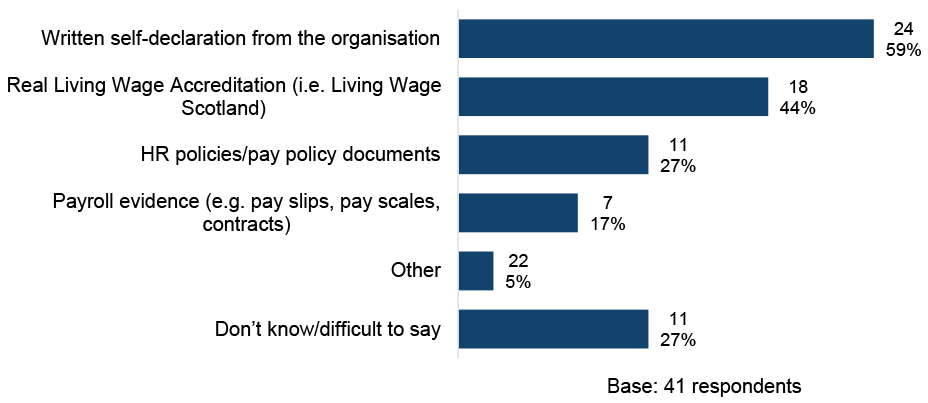
Surveyed grant funders currently use a variety of evidence sources to verify employers’ commitments to paying at least the real Living Wage. More than half (24 respondents, 59%) mentioned accepting a written self-declaration and 18 (44%) mentioned real Living Wage Accreditation. Just over a quarter (27%) said they didn’t know or found it difficult to say. A possible reason for this is not having fixed criteria/standards on what they are willing to accept, which is also signalled within Figure 11, further below.
Figure 9 Sources of evidence grant funders use to verify employers’ commitments to paying the real Living Wage (survey of buyers and funders)
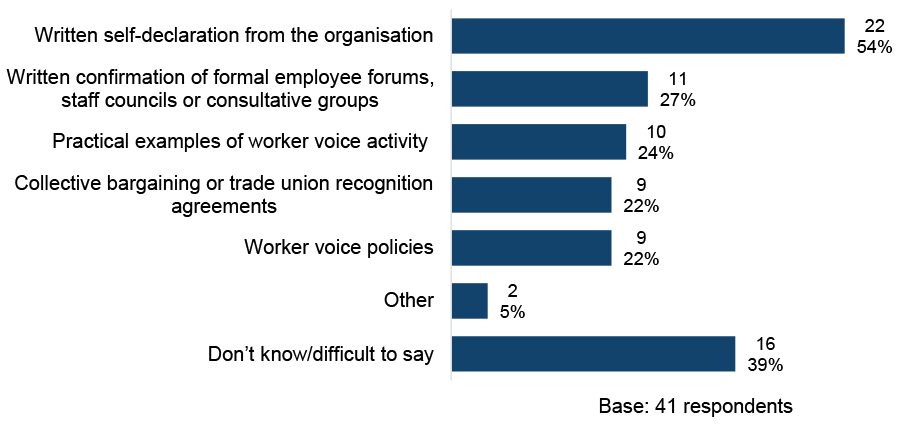
With respect to verifying employers’ commitments to providing appropriate channels for effective worker voice, more than half of surveyed grant funders (22, 54%) accept a written self-declaration, while a minority accept other forms of evidence (Figure 10). More than a third (16, 39%) said they didn’t know or found it difficult to say. Again, this could come down to not having fixed criteria/standards on what they are willing to accept.
Figure 10 Sources of evidence grant funders use to verify employers’ commitments to providing appropriate channels for effective workers’ voice, such as trade union recognition (survey of buyers and funders)
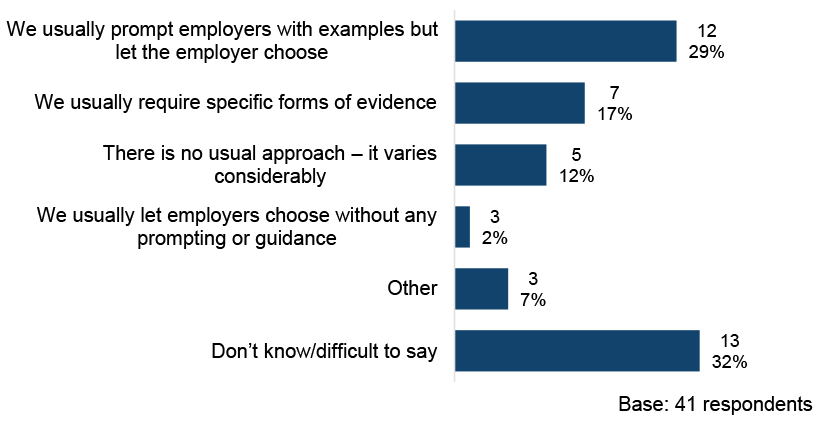
When asked which single approach they usually follow to inform employers about evidence to submit against Fair Work First criteria, the picture among grant funders is mixed. Just under a third (13, 32%), found it difficult to say or specify a single common approach, while 12 (29%) usually prompt employers with examples but let the employer choose (Figure 11).
Figure 11 Single approach usually followed by grant awarding organisations to inform employers about evidence to submit against Fair Work First criteria (survey of buyers and funders)
3.3.5 Grant funder process challenges
Surveyed grant funders were asked what types of challenges (if any) they have faced when implementing Fair Work First as part of grant arrangements. For more than a third (14 respondents, 37%) the experience appears to be smooth, with no challenges. For those that did highlight challenges, most mentioned at least one challenge, with the two most frequently mentioned (each mentioned by 11, 29%) being: i) determining in what circumstances to ask employers to demonstrate commitments to Fair Work First criteria besides payment of at least the real Living Wage; and ii) verifying employers’ commitments/evidence (Figure 12 – note here a low base of 38 respondents).
Figure 12 Challenges faced in implementing Fair Work First as part of grant arrangements (survey of buyers and funders)
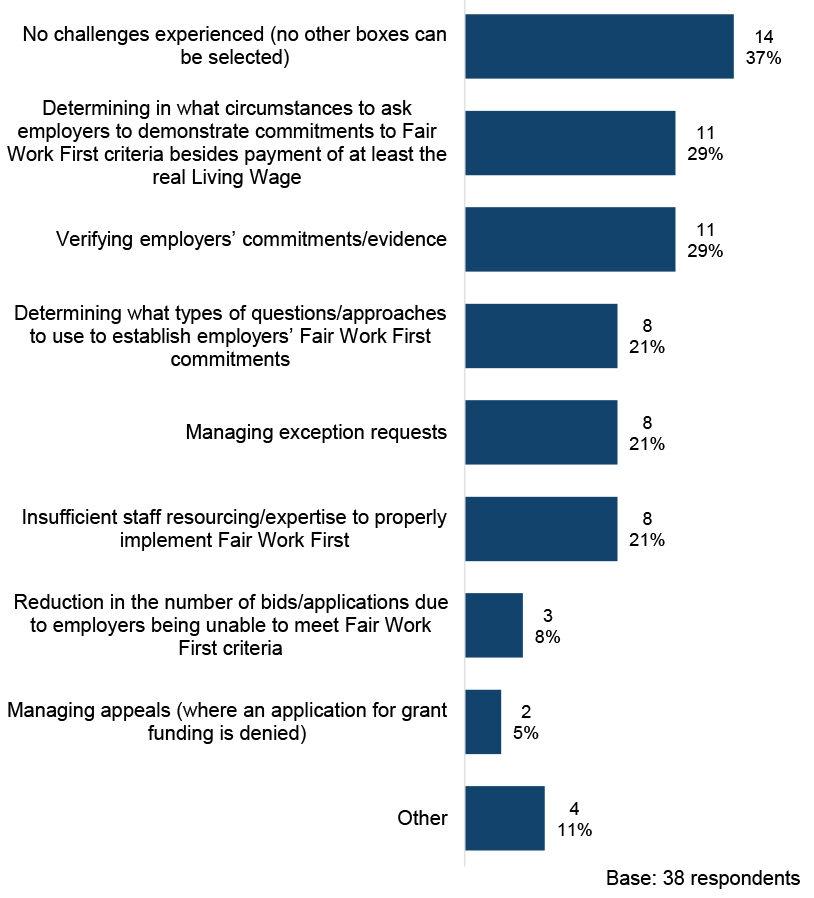
During further probing of surveyed grant funders on the challenges faced when implementing Fair Work First, they mentioned both the challenge of determining what constitutes sufficient evidence, as well as capacity/resource constraints affecting the assessment and validation process. Other difficulties reported include communicating requirements and navigating exceptions with applicants (particularly with micro organisations and third sector employers) and managing employers’ expectations in relation to exception processes and the time required to complete them.
3.4 What is working well and less well for buyers and funders
The initial round of 12 stakeholder interviews, supported by views from five buyers and funders interviewed following the survey, paint a picture of what is working well and less well as part of Fair Work First processes.
3.4.1 What is working well
- Fair Work First has helped to increase awareness of fair work among buyers and funders, helping to embed these principles more broadly and deeply across teams and across enterprise, investment, and grant-making functions.
- Fair Work First has supported improved quality and depth of conversations between buyers, funders and employers, in terms of the rationale, intended benefits and challenges associated with the criteria and how to meet them.
- Engagement with employers has matured over time, with evidence that buyers and funders are increasingly reflective and adapting their practices.
- The real Living Wage is viewed as the most effective and measurable aspect of Fair Work First, giving buyers and funders a clear, concrete indicator of progress by employers and contributing to more organisations paying the real Living Wage.
3.4.2 What is working less well
- Confusion over evidence requirements – especially for effective workers’ voice – can cause operational difficulties, including disputes between trade unions and employers, leading to some tensions and unproductive negotiation loops.
- Fair Work First does not map neatly onto all business models, particularly those relying on freelancers, short-term project structures or special purpose vehicles (e.g., film production companies), creating uncertainty about when requirements should apply and what constitutes compliance for organisations without stable workforces.
- Fair Work First processes can in some cases feel overly complex, bureaucratic and duplicative, with different parts of government requiring similar evidence in different formats.
- Data collection and reporting requirements can feel inconsistent, with some buyers and funders receiving ad-hoc requests from within their own organisations, changes from year to year, and unclear expectations about what evidence is required and when.
- Policy feedback loops appear weak, with some concerns that buyer and funder insights and sector-level challenges are not reaching ministers or policy leads, leaving recurring issues unaddressed.
3.5 Employer process experiences and challenges
3.5.1 Existing evidence base on employer process experiences
Evidence from employers consulted to inform the BRIA found a mix of experiences in relation to Fair Work First. Some said they found it easy to meet requirements (often because the criteria already formed part of their organisational culture) whilst others faced challenges. The BRIA grouped challenges into three themes:
- Resources (cost, capacity and managing change).
- People (gaining buy-in from workers and senior management).
- Prescriptiveness of the requirements (especially challenging for smaller organisations, those employing seasonal staff for short periods, those employing staff on a range of working hours, and those which recognise multiple unions).
The BRIA and wider evidence – including views from stakeholders interviewed for this evaluation – point to certain types of businesses facing disproportionate challenges to meeting Fair Work First criteria, namely:
- Smaller organisations, due to reduced resources (including HR support), reduced ability to evidence relevant initiatives and processes, and limited infrastructure required to embed elements such as effective voice and pay structures.
- Large public bodies, specifically around sign-off of effective voice statements.
Some stakeholders argue that employers in sectors such as care, hospitality and the third sector, can face disproportionate challenges to meeting the criteria, due to characteristics such as:
- Low pay.
- Unsocial working hours and patterns.
- Challenges in delivering training in the context of variable shift patterns and high operational pressure points.
- High levels of work intensity and stress.
- Weaker management capacity.
- Comparatively less contact with public procurement than sectors such as construction, advanced manufacturing, energy etc., meaning reduced leverage in relation to Fair Work First.
In hospitality for example, research by the Fair Work Convention on Levers for fair work in hospitality in Scotland identified that while some employers find meeting the condition of the real Living Wage “straightforward”, others face a “serious challenge” combined with “reducing staff numbers to fund the increased pay”. The report also noted concerns about future uplifts in the real Living Wage in the context of difficult financial challenges facing the industry. This latter point also came out strongly from employer feedback as part of the survey and follow-up interviews for this evaluation.
Additionally, the Independent Culture Fair Work Task Force Report and Recommendations documented challenges faced by Scotland’s creative workforce, particularly the significant contingent of freelance workers and reports of unpaid work required to secure and support freelance contracts.
3.5.2 Overarching views of employer representative bodies
The following findings stem from interviews with employer body stakeholders.
Perceptions of what is working well
- Fair Work First policy intent and requirements appear to have been better communicated than other forms of conditionality (mentioned specifically in relation to grants).
- Clear criteria with supporting guidance has helped focus employer attention and set transparent expectations, especially for voluntary organisations that already aspire to be fair work employers.
- Fair Work First guidance helps to distinguish between large, established public bodies and smaller organisations, with recognition that major public bodies (e.g. local councils) should not require the same level of scrutiny as smaller or unfamiliar organisations. (However, some individual employers do not feel that the guidance is sufficiently tailored and could go further in this regard).
Perceptions of what is working less well
- Affordability remains the primary barrier to Fair Work compliance among employers, particularly those that would like to pay the real Living Wage but lack the financial resources.
- Real Living Wage requirements for apprentices are seen as unworkable for some employers – viewed as counterproductive to broader workforce development aims and a push to increase numbers of apprentices.
- For smaller employers, evidence and compliance requirements can be difficult to meet due to insufficient resources and administrative capacity to gather, document, and submit the required information.
- Also for smaller organisations, Fair Work First can be seen as “another thing to comply with” alongside various other procurement requirements (e.g. insurance, data security etc.).
- Many third sector employers have very small teams, making some criteria (especially effective workers’ voice) difficult or impractical to meet – something it is felt that buyers and funders do not always fully understand.
- Annualised contract cycles are perceived as undermining job security by creating precarity as an unintended consequence.
3.5.3 Employer process experiences
Most employers interviewed following the survey describe Fair Work First requirements as a routine and expected element of public sector procurement or grant arrangements in Scotland. Most feel that the burden of evidence being requested is proportionate and manageable, especially where submitting written statements.
This supports the point made in the BRIA that employers have a choice to apply or not; furthermore, that employers broadly accept what is asked of them and do not consider evidence requirements unreasonable. Some employers mentioned working on multiple tenders per year where they need to meet Fair Work First criteria, whilst for others this can be as little as once a year or linked to major contract renewals.
Employers say they are most often asked to provide a written statement to evidence their Fair Work First commitments. A small minority described more varied approaches, including the need to supply supporting documentation or, in one case, an annual discussion with the buyer or funder. Examples of evidence employers say they supply include:
- Proof of Living Wage accreditation.
- Documentation showing channels used for effective workers’ voice.
3.5.4 Employer process challenges
Less than a third of surveyed employers (31%) appear to have had a completely smooth experience meeting Fair Work First criteria, saying they encountered no challenges. Most reported at least one challenge (on average each employer reported two challenges).
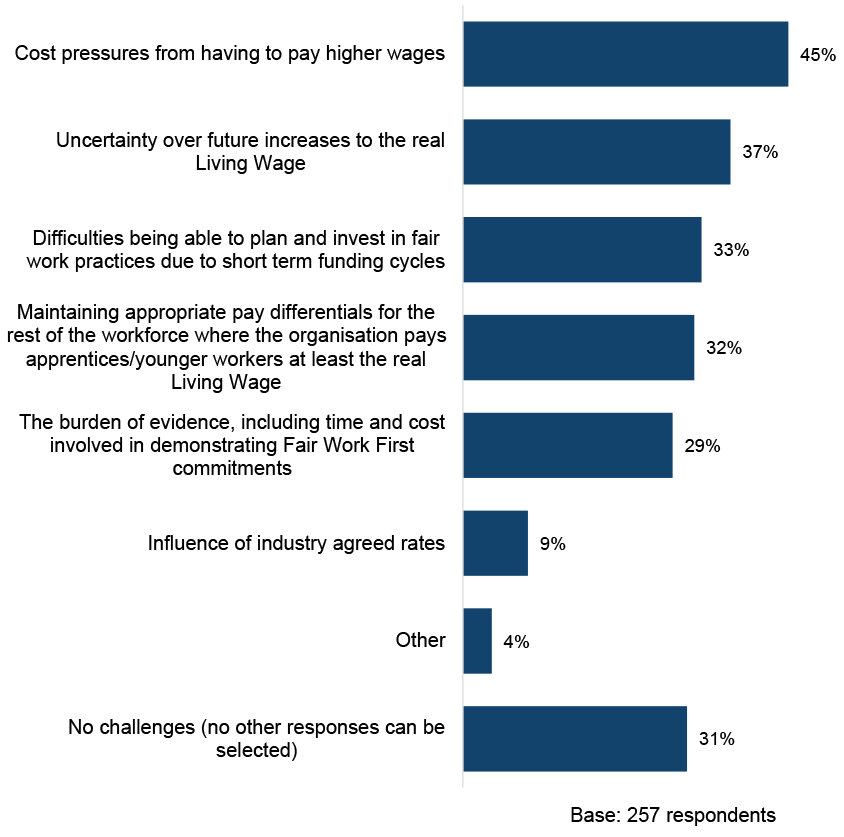
The most frequently mentioned challenge is cost pressures from having to pay higher wages (45%) followed by uncertainty over future increases to the real Living Wage (37%) and difficulties being able to plan and invest in fair work practices due to short funding cycles (33%) – Figure 13.
Figure 13 Process challenges faced as part of Fair Work First (survey of employers)
Differences by survey sub-group
In terms of statistically significant differences between survey sub-groups, the proportion of employers reporting “cost pressures from having to pay higher wages” is higher among the following sub-groups:
Organisation type: third sector and other (59%) compared with public sector and education (36%) and private sector (35%) – likely where third sector employers have many lower paid workers, making the cost pressure more acute.
Organisation size: no significant differences.
Contract/grant holders: contract and grant holders (56%) compared with contract holders only (39%).
The proportion of employers giving an answer of “uncertainty over future increases to the real Living Wage” is higher among the following sub-groups:
Organisation type: third sector and other (50%) compared with public sector and education (27%) and private sector (27%).
Size band: large, medium and small organisations (40%, 39%, 42% respectively) compared with micro organisations (21%) – likely due to greater numbers of staff meaning the extra financial burden has a compound impact.
Contract/grant holders: contract and grant holders (48%) compared with contract holders only (30%).
The following themes emerge from employers being asked to elaborate on challenges faced.
Financial strain: Several surveyed employers mentioned the financial strain caused by rising wage costs without corresponding increases in funding or contract values. Others described cumulative cost pressures, including National Insurance and inflation, pushing organisations towards financial insecurity.
“Our government grant has remained the same whilst the real Living Wage increases each year. We are therefore required to run a redundancy programme each year to afford the real Living Wage.’’
Employer, small, registered charity
Payment of the real Living Wage to apprentices: This is another common concern, with a reported unintended consequence being the need to pause or cease apprenticeship recruitment.
Pay compression: A large minority of employers raised concerns about pay compression, noting that rapid increases in entry‑level wages stemming from increases to the NMW and real Living Wage reduces differentials with higher‑skilled roles, harming morale and making progression less attractive.
Administrative burden: Reports of “significant administrative burdens” associated with evidencing Fair Work First compliance, inconsistent buyer/funder requirements, and duplication of reporting – appear to be particularly challenging for micro‑employers. (Note with respect to Figure 13 that 39% of micro employers compared with 29% overall mentioned the burden of evidence as a challenge).
“There isn’t consistency on how evidence should be provided or any co‑ordination across government… we have to provide this information multiple times and in multiple formats.”
Employer, medium, registered charity
Sector-specific structural issues: A small minority of employers mentioned sector‑specific challenges such as fixed multi‑year contracts in creative industries or fluctuating income in rural and outdoor services, making it difficult to pay at least the real Living Wage. Employers in social care and the third sector described the issue of funding gaps, with a knock-on impact being reduced hours, restrictions on recruitment and – in the worst-case scenario – redundancies.
Other challenges: A small minority mentioned pressure to pursue real Living Wage accreditation, while some charities feel forced to subsidise workforce costs from limited reserves.
3.6 The burden of evidence
3.6.1 How easily buyers/funders can manage evidence requirements
Surveyed buyers and funders were asked how straightforward or challenging they find it to do each of the following:
- Assess and confirm evidence of employers’ compliance with Fair Work First criteria.
- Respond to Scottish Government data collection requests.
- (Grant funders only) Monitor Fair Work First commitments over the lifetime of a grant agreement.
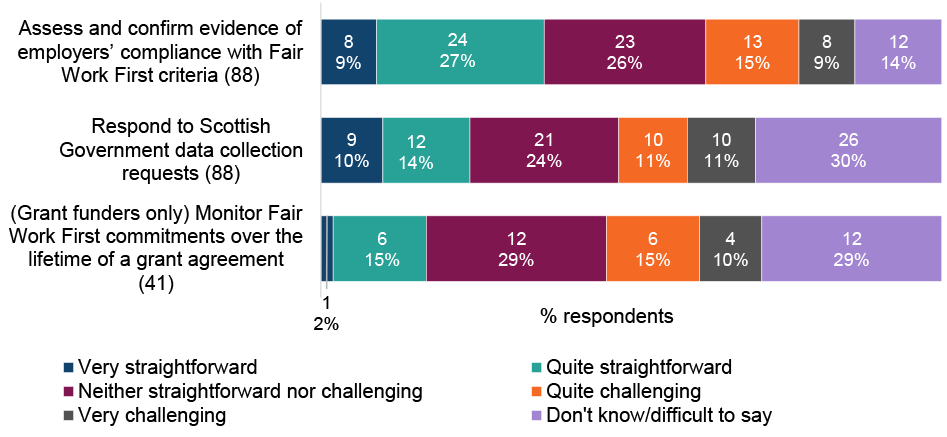
With respect to all three areas, experiences are mixed and suggest that buyers and funders would welcome more help or guidance. Only a minority in each case find these processes very or quite straightforward, and up to a quarter find them very or quite challenging (Figure 14).
Figure 14 Ease/difficulty of managing specific evidence requirements (survey of buyers and funders)
Reasons for surveyed buyers and funders findings these processes very or quite straightforward include having established internal procedures backed up by clear internal guidance, as well as making use of online tools and standardised data collection templates which help ensure consistency and reduce administrative burdens.
Several buyers and funders mentioned that Fair Work First requirements are already well embedded as part of their procurement or grant processes, and that they make use of clearly defined evaluation questions, standard clauses in grant offer letters, and consistent reporting mechanisms. Several note that certain Fair Work First criteria – especially payment of at least the real Living Wage – are relatively straightforward to evidence, with established monitoring processes allowing information to be captured efficiently at application and reporting stages.
“We have implemented clear processes as part of our grant management at application, contract and reporting stages to gather the required evidence. As we apply Fair Work First criteria across all grants, it allows for a consistent approach and it’s now easier to pull out the required data for collection requests.”
Buyer/funder
Among surveyed buyers and funders finding processes very or quite challenging, responses point to practical obstacles in gathering, assessing, and verifying Fair Work First information, especially as part of grant processes. These include capacity and resource constraints, “outdated systems” and manual data collation processes which make monitoring and reporting burdensome.
Some buyers and funders reiterated the point that they find it difficult to determine what constitutes sufficient supporting evidence (especially for effective workers’ voice or workforce development) and how to assess supporting evidence consistently, particularly where this is qualitative in nature and in some cases can feel unwieldy.
3.6.2 How easily employers can fulfil evidence requirements
Surveyed employers in receipt of contracts or grants were asked how straightforward or challenging they find it to do each of the following:
- Provide evidence of their organisation’s compliance with Fair Work First criteria to public bodies in Scotland that ask for it.
- Report on their organisation’s Fair Work First commitments over the lifetime of a contract or grant agreement.
- (Grant recipients only) Seek confirmation of compliance by a recognised trade union or other appropriate workers' representative.
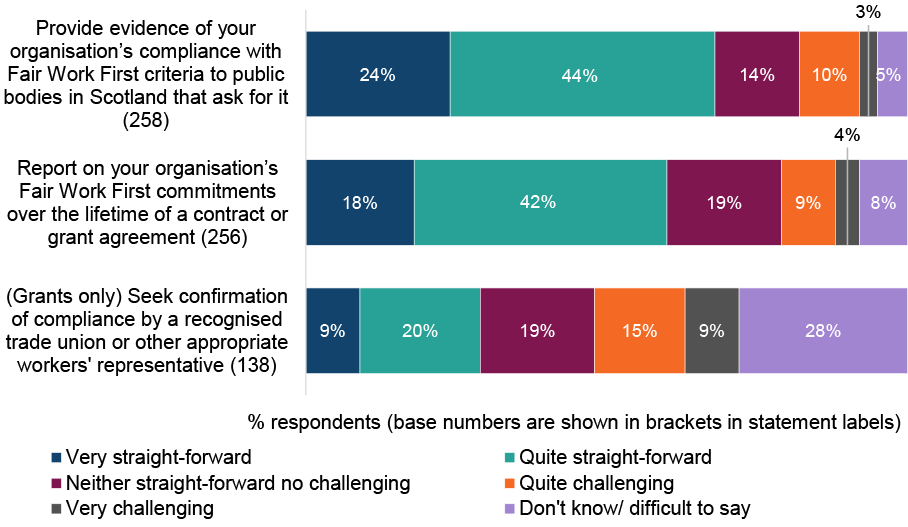
With respect to the first two statements, most employers (68% and 60% respectively) find these activities very or quite straightforward, with the remainder having somewhat mixed experiences.
With respect to the third statement, grant funders find this comparatively less straightforward (Figure 15).
Figure 15 Ease/difficulty of enacting specific Fair Work First processes (survey of employers)
Differences by survey sub-group
In terms of statistically significant differences between survey sub-groups, the proportion of employers finding it very or quite challenging to provide evidence of compliance to public bodies is higher among the following sub-groups:
Organisation type: public sector and education organisations (32%) compared with private sector organisations (14%) and third sector and other organisations (8%).
Organisation size: no statistically significant differences.
Contract/grant holders: contract and grant holders (21%) compared with contract holders only (11%).
When asked how easy or challenging the organisation finds it to report on the organisation’s Fair Work First commitments over the lifetime of a contract or grant agreement,
The proportion of employers finding it very or quite challenging to report on their organisation’s Fair Work First commitments over the lifetime of a contract or grant agreement is higher among the following sub-groups:
Organisation type: no statistically significant differences.
Size band: no statistically significant differences.
Contract/grant holders: contract and grant holders (17%) and grant holders only (16%) compared with contract holders only (8%).
There are no statistically significant differences by sub-group in the proportion of grant holders finding it challenging to seek confirmation of compliance by a recognised trade union or, other appropriate workers representative.
Buyers and funders interviewed following the survey consider smaller suppliers or sole traders to face disproportionate hurdles to providing requested information. They feel that larger employers tend to be better placed due to having stronger tender writing teams, ready-made content and greater capacity to enact feedback from past submissions. However, one buyer/funder noted that larger organisations often require more time to coordinate internal approvals or seek trade union engagement.
“SMEs struggle more with effective voice – especially in industries that aren’t very unionised. They might not have thought of providing other channels to set that up.”
Buyer/funder
“There can be a tendency for larger organisations to ‘dump’ multiple policy documents into their application which means wading through a good deal of material to access relevant data. There is also a strong tendency to provide weblinks to material which can only be accessed on organisations’ staff intranet pages.”
Buyer/funder
One buyer/funder made the point that – in their experience – academic institutions tend to be better able to navigate complexities in the criteria, such as teasing apart appropriate (relative to inappropriate) uses of zero hours contracts.
3.6.3 How buyers/funders use Fair Work First evidence and data
Buyers and funders interviewed following the survey described how they use Fair Work First evidence and data from employers.
Two mentioned that this helps to measure progress against good governance frameworks or broader strategic goals such as Scottish Government ‘anchor’ objectives. Another mentioned running their own reports on employer practices across the different Fair Work First criteria to meet internal monitoring requirements. A fourth mentioned that they only report the data as part of the mandatory annual procurement report.
One buyer/funder added that reporting against Fair Work First has lessened over time as interest levels of senior colleagues and wider stakeholders has changed. This suggests that Fair Work First may not always be high on the radar of senior managers given competing and complementary sets of data to monitor for different purposes.
“We’re asked to report on lots of things like community benefits far more now than Fair Work First. It’s probably a reflection of ‘policy flavour of the month’.”
Buyer/funder
3.7 Planned changes to buyer/funder processes
Just under a fifth of surveyed buyers and funders (17 respondents, 19%) say they intend to make changes to Fair Work First processes, while 31 (35%) are not planning changes and the remainder (40, 45%) found it difficult to say (base=88).
Those expecting to make changes plan such steps as streamlining guidance, revising evaluation questions, and introducing more structured approaches to capturing data within existing systems.
Some buyers and funders are also looking to increase the weighting of Fair Work First criteria in procurement exercises, strengthen alignment with trade unions, and ensure Fair Work First requirements are more clearly reflected in grant terms and conditions.
A smaller minority described plans to align Fair Work First with broader priorities such as community benefits, equalities and Net Zero, and to develop more consistent internal guidance and training.
3.8 Access to information about Fair Work First
3.8.1 Types of information accessed by buyers/funders and employers
Most surveyed buyers and funders (68 respondents, 60%) have accessed Scottish Government-produced sources of information relating to Fair Work First since autumn 2021 (and in the case of grant funders only, since July 2023) with a view to increasing their understanding of criteria and processes. Employers appear even more likely to have accessed sources of information, with 70% having done so since autumn 2021.
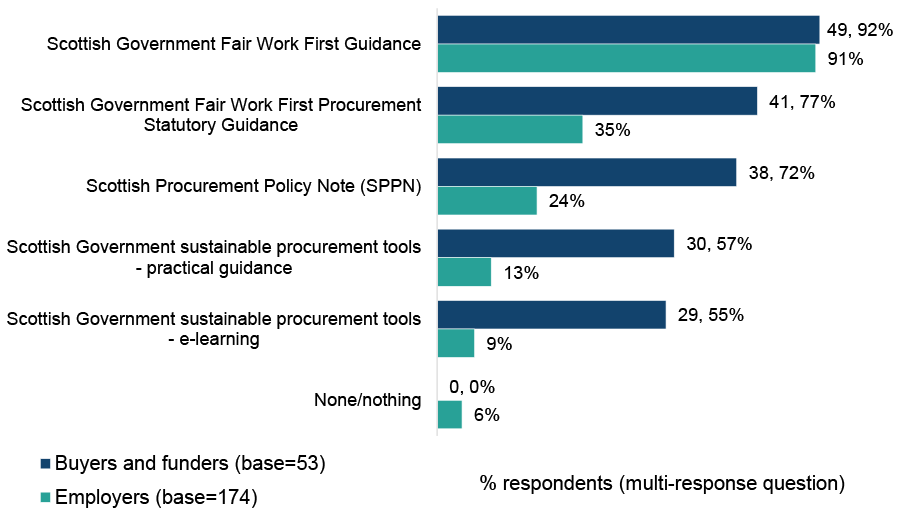
Among those surveyed buyers and funders saying they have accessed Scottish Government produced sources, almost all (49, 92%) say they have accessed the Fair Work First Guidance, whilst accessing other sources to a lesser extent. The picture is similar among employers, with 91% having accessed the Fair Work First Guidance and other sources to a lesser extent (Figure 16).
Figure 16 Scottish Government sources of information accessed to increase understanding of Fair Work First (surveys of buyers/funders and employers)
Differences by survey sub-group
In terms of statistically significant differences between survey sub-groups, the proportion of employers accessing the Scottish Government Fair Work First Guidance is higher among the following sub-groups:
Organisation type: no statistically significant differences.
Organisation size: large organisations (98%) compared with micro and small organisations (85% and 89% respectively).
Contract/grant holders: contract and grant holders (100%) compared with contract holders only (87%) and grant holders only (91%).
The proportion of employers accessing the Scottish Government Fair Work First Procurement Statutory Guidance is higher among the following sub-groups:
Organisation type: public sector and education, as well as private sector organisations (60% and 41% respectively) compared with third sector and other organisations (23%).
Size band: large organisations (60%) compared with micro and small and medium organisations (21%, 30% and 26% respectively).
Contract/grant holders: contract holders only (49%) compared with grant holders only, and both contract and grant holders (24% and 31% respectively).
Surveyed buyers, funders and employers have also accessed a range of wider (non-Scottish Government) sources for guidance, advice and expertise in relation to either Fair Work First or fair work more generally.
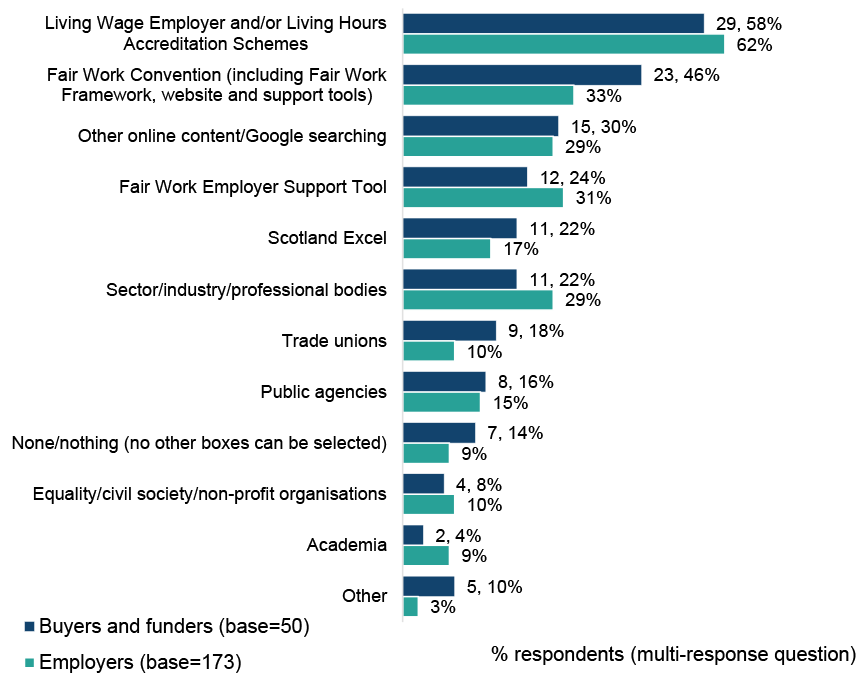
More than half of surveyed buyers and funders (29, 58%) have accessed the Living Wage and/or Living Hours Accreditation Schemes, while 23 (46%) have accessed the Fair Work Convention website and resources. Among employers, the Living Wage and/or Living Hours Accreditation Schemes is also a key source for almost two thirds (62%), with other sources accessed to a lesser extent (Figure 17).
Figure 17 Wider sources of information accessed to increase understanding of Fair Work First (survey of buyers/funders and employers)
Differences by survey sub-group
In terms of statistically significant differences between survey sub-groups, the proportion of employers accessing the Living Wage Employer and/or Living Hours Accreditation Schemes is higher among the following sub-groups:
Organisation type: third sector and other organisations (70%) compared with public sector and education, as well was private sector organisations (62% and 55% respectively).
Organisation size: large and small organisations (72% and 67% respectively) compared with micro organisations (44%).
Contract/grant holders: no statistically significant differences.
3.8.2 Ways in which buyers/funders have found sources of information and guidance helpful
Almost all surveyed buyers and funders (50 respondents, 92%) have found the information they have accessed to be helpful for implementing Fair Work First criteria and processes (47% a little and 45% a lot) (base=53).
The Scottish Government’s Fair Work First guidance, its statutory guidance for procurement and Scottish Procurement Policy Notes (SPPN) are frequently praised by surveyed buyers and funders as comprehensive, clear, and practical, particularly at explaining criteria, supporting consistency, and providing examples or model questions.
Updates to this guidance, including the November 2024 refreshed Fair Work First Guidance, are praised for improving clarity and usefulness. Alongside this, the Sustainable Procurement Tools, assessment tools, and e-learning modules are viewed as helpful for building understanding across teams and supporting proportionate application of Fair Work First, especially within procurement.
In addition to formal guidance, respondents also value wider external and interactive sources for supporting skills development, shared understanding, and a more co-ordinated approach to Fair Work First implementation. These include the Fair Work Framework and reports, the Living Wage Foundation, sector-specific resources and practical toolkits. Direct engagement, such as discussions with Scottish Government policy teams, peer learning in conjunction with other public bodies, as well as attendance at seminars or targeted sessions, are all cited as particularly helpful for buyers and funders when seeking clarification and ideas for practical application.
3.8.3 How buyers/funders think information and guidance could be improved
While most surveyed buyers and funders find Fair Work First guidance to be clear and useful, a number of issues are apparent.
A minority consider the information and guidance to be dense, wordy, fragmented or complex. This can make it time-consuming to use, and difficult to identify what is most relevant or how it should be applied in non-standard situations, for example in relation to the following:
- Bids involving use of consortia/special purpose vehicles.
- Use of subcontractors.
- International bidders.
- Micro organisations.
- Certain sectors such as care and hospitality sectors (where buyers and funders are mindful of lower wages, higher staff turnover and more limited resources being a potential barrier).
- Third sector (where buyers and funders are mindful of comparatively greater competitive pressures and funding instability).
- Short term project structures.
Some noted confusion around definitions, such as distinctions between grant recipients and fundable bodies, and inconsistencies in Living Wage accreditation registers. There are also reported search and navigation issues in the guidance, while extensive hyperlinking between documents can lead to more confusion for some buyers and funders, rather than clarity.
“Fair Work First Guidance is very wordy. eLearning is a useful tool but includes lots of links (and links within each new document) which leads you down many rabbit holes. There’s a lot of information to absorb…it’s not very interactive.”
Buyer/funder
There is a strong call for guidance to be simplified or made more concise, with clearer explanations of minimum requirements and exceptions, along with more practical examples or case studies to support consistent interpretation and application. There are also calls for guidance to be better tailored to specific contexts and audiences, such as private care providers and workers themselves, as well as clearer guidance on proportionate application.
Suggestions for improvement also include:
- More practical worked examples and case studies.
- Information on how criteria should be scored.
- Information on what constitutes acceptable evidence.
- How to differentiate between size, sector, or maturity of employer when applying the criteria.
3.8.4 Employer ease/difficulty of accessing Fair Work First information, advice and guidance
Surveyed employers were asked how easy or difficult they find it to access Fair Work First guidance. Almost three quarters (71%) find it easy (24% very easy, 47% quite easy), 21% neither easy nor difficult, 2% quite difficult and 7% unsure (base=260).
Differences by survey sub-group
In terms of statistically significant differences between survey sub-groups, the proportion of employers giving an answer of “very easy” or “quite easy” is higher among the following sub-groups:
Organisation type: public sector and education organisations (83%) compared with private sector organisations (65%).
Organisation size: no statistically significant differences.
Contract/grant holders: no statistically significant differences.
Most employers find accessing Fair Work First information straightforward, particularly via the Scottish Government website, internet searches, embedded links in tenders, and official toolkits. These sources are widely viewed as authoritative, clearly written and easy to navigate. A large minority specifically highlighted Scottish Government, public agencies and procurement bodies as the most trusted and useful sources, valuing the credibility and clarity of this information.
A minority of surveyed employers also value direct support from Scottish Government staff, trade unions and sector bodies, which helps them to interpret guidance effectively. They also praise online tools such as the Fair Work Employer Support Tool for its usability.
While many surveyed employers find sufficient information to be available to meet their needs, it can seem repetitive or difficult to consolidate into a clear picture of expectations. As with buyers and funders, they would welcome greater clarity on what constitutes “strong evidence”.
A minority of employers – particularly micro‑businesses, charities and rural or seasonal employers – consider available information and guidance is difficult to interpret because it feels more geared towards larger organisations – especially relating to effective workers’ voice and associated evidence expectations.
“Using online search engines gives you a variety of information quite easily. The difficult bit is knowing when or if you have read enough.”
Employer, micro, private sector
There is a call among some employers for information and guidance to be better tailored to different sectors and settings, for example to reflect the realities of rural or creative sector businesses, seasonal businesses or startup environments.
3.8.5 Types of clarification questions buyers/funders receive from employers
To provide an additional lens on where information and guidance might be better targeted, surveyed buyers and funders were asked what the most common questions are – if any – that employers ask relating to the Fair Work First criteria they are asked to meet. These mostly relate to how Fair Work First criteria should be interpreted or evidenced in practice, such as:
- How to demonstrate compliance with the real Living Wage (particularly where organisations are not formally accredited).
- How criteria apply to apprentice or freelancer workers, sole traders or very small organisations in general.
- What constitutes sufficient evidence for effective workers’ voice.
- Questions relating to allowable exceptions, particularly relating to payment of at least the real Living Wage.
Nonetheless, several buyers and funders say they receive few or no questions, attributing this to clear, well-established tender documentation, familiarity having been built up among employers over several years, and the availability of supporting guidance.