
Fair Work First: policy evaluation
An independent evaluation of the Scottish Government's Fair Work First conditionality policy, seeking to understand whether the policy has been delivered as intended.
6. Worker Outcomes
With a focus on the views of workers who took part in the evaluation, this chapter explores the types of outcomes workers have felt in relation to the seven Fair Work First practice areas (i.e. in their eyes they are not perceived as “criteria”), as well as an intersectional lens on worker outcomes, and whether surveyed buyers and funders currently attempt to measure the impact of Fair Work First policy on workers.
It should be kept in mind when reading this chapter that surveyed workers are not necessarily all employed by those organisations responding to the separate survey of employers. As such, it is not possible to make direct links between reported worker experiences and reported employer practices.
Reminder of survey base sizes:
- Survey of buyers and funders (base=88)
- Survey of employers (base=260)
- Survey of workers (base=888)
Findings summary
Most surveyed workers self-report a range of fair work outcomes where they work. In particular: 96% say they are paid at least the real Living Wage; 63% agree that their employer provides appropriate collective voice channels; and 78% agree that their employer provides appropriate individual voice channels.
Fair pay is important for surveyed workers, meaning being paid appropriately for their role and for the contribution they make. Some expressed concern that pay increases at the lower end of the wage scale have the effect of reducing differentials compared with roles that have greater responsibility or skill.
Surveyed workers have experienced a range of formal channels used by their employer to facilitate effective voice, though workers in smaller organisations note that effective voice tends to occur more informally through regular, direct access to senior staff.
There is limited evidence of the impact of Fair Work First on workers’ intersecting protected characteristics. Workers interviewed following the survey are generally of the view that their employer creates a working environment that treats all workers fairly and equally. Interviewed stakeholders suggest that employers may have limited understanding of intersectionality in terms of being able to confidently identify and address inequalities. For their part, employers interviewed following the survey were generally unable to identify particular groups of staff who had benefited from changes in the working environment as a result of Fair Work First.
For most survey questions a higher proportion of workers with a physical or mental health condition or illnesses (lasting or expected to last for 12 months or more) agree that certain fair work arrangements are in place, and/or that they have improved where they work since autumn 2021, compared with workers that do not.
6.1 Understanding of fair work
Among surveyed individual workers, more than half (53%) confirmed they were aware of the concept of “fair work” prior to taking part in the survey (base=887).
Furthermore, just under two thirds (62%) said that – as far as they are aware – their employer has a fair work (or similar) statement in place (base=888).
Differences by survey sub-group
In terms of statistically significant differences between survey sub-groups, the proportion of workers aware of the concept of fair work prior to taking part in the survey is higher among the following sub-groups:
Organisation type: workers in third sector and other organisations (69%) compared with workers in public sector and education organisations (49%) and private sector organisations (51%).
Organisation size: workers in micro and small organisations (77% and 64% respectively) compared with workers in medium organisations, large organisations and very large organisations (50%, 53% and 50% respectively).
Workers taking part in a follow-up interview were also asked to describe what fair work means to them personally. Respondents generally emphasised fair pay as being central, meaning being paid appropriately for their role and for the contribution they make. They also mentioned a range of other practices – which are broadly reflected in the Fair Work First criteria – as being important to them. These include (in alphabetical order):
- A supportive and flexible working culture.
- Access to training and clear progression routes.
- Being listened to and feeling valued.
- Fair employment terms.
- Job security and stability.
- Opportunities for development and progression.
6.2 Fair work outcomes for workers
Surveyed workers were asked the extent to which they agree or disagree with specific statements about their place of work, with each statement aligned to one of the Fair Work First practice areas. The findings paint a broadly positive picture of fair work outcomes experienced by workers based within organisations in receipt of contracts or grants.
6.2.1 Payment of at least the real Living Wage to all workers
Most (but not all) workers surveyed for this evaluation say they are paid at least the real Living Wage, and a smaller proportion are confident that this applies to all their colleagues.
- 96% of workers say they are paid at least the real Living Wage (2% said no and 2% don’t know/difficult to say) (base=887).
- 83% believe – to the best of their knowledge – that all workers in their organisation are paid at least the real Living Wage (3% said no and 14% don’t know/difficult to say) (base=886).
Differences by survey sub-group
In terms of statistically significant differences between survey sub-groups, the proportion of workers saying they are paid at least the real Living Wage is higher among the following sub-groups:
Organisation type: workers in public sector and education organisations (98%) and private sector organisations (97%) compared with workers in third sector and other organisations (90%).
Organisation size: workers in large organisations and very large organisations (both 98%) compared with workers in medium organisations (91%).
Further sub-group differences are reported in section 6.3.2 – Differences based on surveyed workers’ protected characteristics.
A recurring issue is pay compression, with workers echoing points previously reported on from employers, that pay increases at the lower end of the wage scale have the effect of reducing differentials compared with roles that have greater responsibility or skill.
Some workers questioned whether being paid the real Living Wage translates into sufficient income for colleagues with variable hours, part-time contracts or working on zero hours contracts, especially where additional costs such as pension contributions, travel, or unpaid overtime reduce effective hourly pay. Several workers also mentioned limited transparency around pay structures and uncertainty about how the real Living Wage is applied across different roles.
6.2.2 Provision of appropriate channels for effective workers' voice
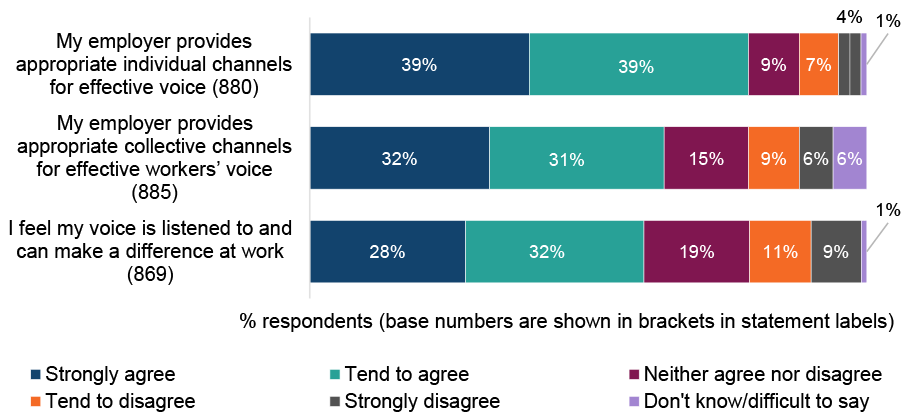
Most surveyed workers agree that their employer offers appropriate provisions for effective workers’ voice (Figure 37):
- 78% of workers agree that their employer provides appropriate individual channels (such as 1:1 engagement, staff surveys etc.).
- 63% agree that their employer provides appropriate collective channels (such as trade union recognition, staff consultative forums, involving trade union/worker representation in decision making structures etc.).
- 60% agree that their voice is listened to and can make a difference at work.
Figure 37 Extent of agreement/disagreement relating to employer offering appropriate provisions for effective workers’ voice, such as trade union recognition (survey of workers)
Differences by survey sub-group
In terms of statistically significant differences between survey sub-groups:
Firstly, the proportion of workers agreeing that their employer provides appropriate collective channels for effective workers’ voice is higher among the following sub-groups:
Organisation type: workers in public sector and education organisations (72%) and private sector organisations (62%) compared with workers in third sector and other organisations (41%).
Organisation size: workers in large organisations and very large organisations (71% and 77% respectively) compared with workers in micro organisations, small organisations and medium organisations (14%, 18% and 18% respectively).
Secondly, the proportion of workers agreeing that their employer provides appropriate individual channels for effective workers’ voice is higher among the following sub-groups:
Organisation type: workers in private sector organisations and third sector and other organisations (both 85%) compared with workers in public sector and education organisations (72%).
Organisation size: workers in micro organisations (100%) compared with workers in small organisations (86%) and medium organisations (72%).
Further sub-group differences for this question are reported in section 5.2 – Wider influencing factors, including trade union recognition.
Surveyed workers have experienced a range of formal channels used by their employer to facilitate effective voice, including trade union and equality network engagement, visible senior leadership engagement, staff forums, employee representative groups, surveys, town halls, focus groups, and regular one-to-one meetings. Workers in smaller organisations note that effective voice tends to occur more informally through regular, direct access to senior staff.
“We are a very small team. Our individual and collective voices are important to the organisation, and we have opportunities on a daily, weekly, and quarterly basis to be heard – by both our CEO and our Board. Staff input is important in both strategic and operational matters.”
Worker, other voluntary/third sector organisation
Workers interviewed following the survey largely confirm that they find it easy to raise concerns or make suggestions relating to fair work practices with their employer. Many describe having clear and accessible routes to doing so, for example via one-to-one meetings with line managers, access to human resources, existence of suggestion schemes, whistleblowing policies etc. These are seen as important ways to ensure staff can raise issues or ideas in a structured and protected way.
However, a small number of workers say that while they personally feel able to raise issues, they are concerned that others, particularly newer staff, might feel less confident using formal channels.
Some workers raise concerns about the effectiveness, consistency, and credibility of effective voice channels. Common issues include limited follow-up by their employer to staff surveys, perceptions that feedback is ignored or decisions predetermined, lack of genuine anonymity, and variation between departments or line managers.
Other issues include environments where worker voice feels tokenistic or actively undermined, citing poor communication, compressed meeting times, or lack of consultation on changes. Organisational pressures such as reduced funding, restructures, or mergers are understood to have weakened opportunities for meaningful engagement.
“My organisation runs an annual staff survey and invites staff to participate in focus groups. There was some follow up information provided regarding the findings of the focus group; however, I would like to hear how things have progressed, so I think there are areas where communications could improve.”
Worker, public sector
For a minority of workers, difficulties in achieving formal trade union recognition, combined with part-time working patterns, are described as limiting staff influence and resulting in frontline workers being consulted too late in decision-making processes.
6.2.3 Investing in workforce development
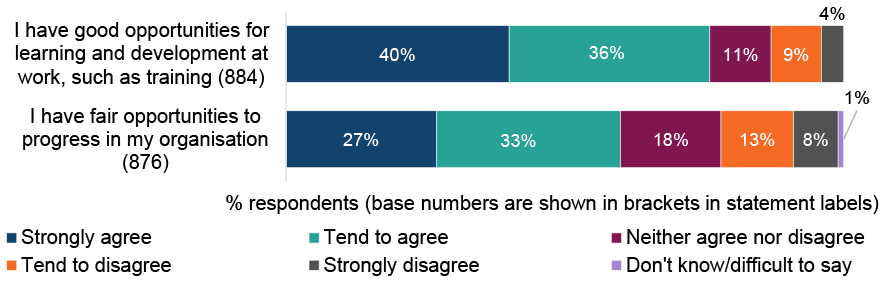
Most surveyed workers appear confident that their employer invests in workforce development (Figure 38):
- 76% agree that they have good opportunities for learning and development at work, such as training.
- 60% agree that they have fair opportunities to progress in their organisation.
Figure 38 Extent of agreement/disagreement relating to employer investment in workforce development (survey of workers)
Differences by survey sub-group
In terms of statistically significant differences between survey sub-groups, the proportion of workers giving an answer of “strongly agree” or “agree” to having good opportunities for learning and development at work is higher among the following sub-groups:
Organisation type: workers in private sector organisations (86%) compared with workers in public sector and education organisations (71%) and third sector and other organisations (77%).
Organisation size: workers in micro organisations and small organisations (95% and 81% respectively) compared with workers in medium organisations and very large organisations (both 71%).
The proportion of workers giving an answer of “strongly agree” or “agree” to having fair opportunities to progress in their organisation is higher among the following sub-groups:
Organisation type: workers in private sector organisations (75%) compared with workers in public sector and education organisations (51%) and third sector and other organisations (59%).
Organisation size: workers in large organisations (76%) compared with workers in small, medium and very large organisations (58% and 66% and 52% respectively).
Qualitative insights point to a varied landscape of investment in workforce development, shaped strongly by funding, capacity, and organisational culture.
Learning and development opportunities mentioned by surveyed and interviewed workers include staff having access to training budgets, graduate and apprenticeship schemes, mentoring, coaching and leadership programmes, as well as structured performance or development reviews. These workers value active encouragement from management to build skills and avoid stagnation.
That said, some interviewed workers have experienced issues, including reduced or inconsistent training budgets, workload pressures leaving little time for development, or limited progression opportunities (particularly in small organisations).
Some raise concerns about limited development opportunities, particularly for frontline or customer-facing roles. Furthermore, mandatory training offered by employers is perceived in some cases as too basic or insufficient to meet the practical challenges staff face.
Concerns are also raised about inequitable access to training, perceived favouritism, lack of transparency in progression, and limited support from line managers despite stated organisational commitments. Some workers note that workforce reductions, employer financial pressures, and reliance on contractors have further restricted development opportunities, leaving staff to self-fund or pursue learning in their own time.
6.2.4 Not making inappropriate use of zero hours contracts
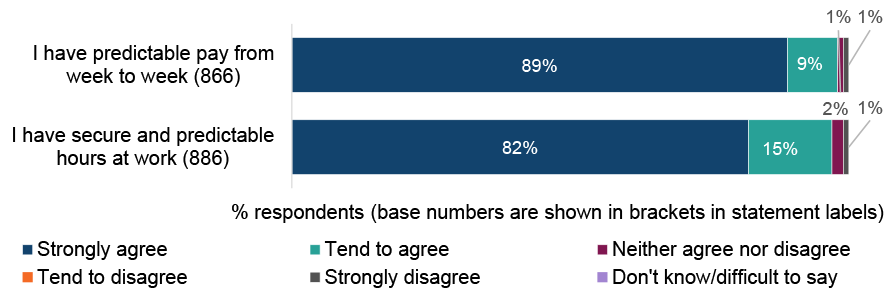
Almost all surveyed workers believe that their employer offers job security (Figure 39):
- 98% agree that they have predictable pay from week to week.
- 97% agree that they have secure and predictable hours at work.
Figure 39 Extent of agreement/disagreement relating to employer use of zero hours’ contracts (survey of workers)
Some interviewed workers note that where casual, seasonal or relief staff are used, these arrangements generally involve set hours or voluntary shifts, rather than open-ended zero hours arrangements, and are not seen as exploitative. In some cases, they say that staff working under these alternative arrangements are also entitled to benefits such as pension contributions and holiday pay.
“We've never really used zero hours contracts in the 18 years that I've been here. We do have seasonal staff, so that's maybe not as secure. But then when you speak to those people, it's what they want.”
Worker, registered charity
In contrast, a small number described negative experiences associated with zero hours contracts, including insecurity, reduced hours, lack of consultation, and limited progression into more secure roles.
Some feel that zero hours arrangements have been open to “misuse” where they work, with concerns including staff working regular patterns over long periods without guaranteed hours, or their employer relying on agency staff or contractors who themselves use zero hours contracts. For these workers, the reported effects include negative impacts on income stability, personal wellbeing, and the ability to plan financially, alongside perceptions that zero hours contracts primarily benefit employers rather than workers.
“I work in a large organisation and in my section, we use a lot of agency staff. Supervisors, etc, say they would like to reduce this and say they can't get permanent staff as people get paid more to be with an agency but when you talk to agency staff, especially in the 'office' section of our department, they would prefer to be contracted for the job security it offers.”
Worker, public sector
“Our hours have been drastically cut with no consideration of what that means for non-salaried staff, and absolutely no consultation with us. We are treated as ‘casuals’ despite many of us having been here for 3-6 years. We are all on insecure zero hours contracts and there are few opportunities to move into more security.”
Worker, registered charity
6.2.5 Addressing workplace inequalities
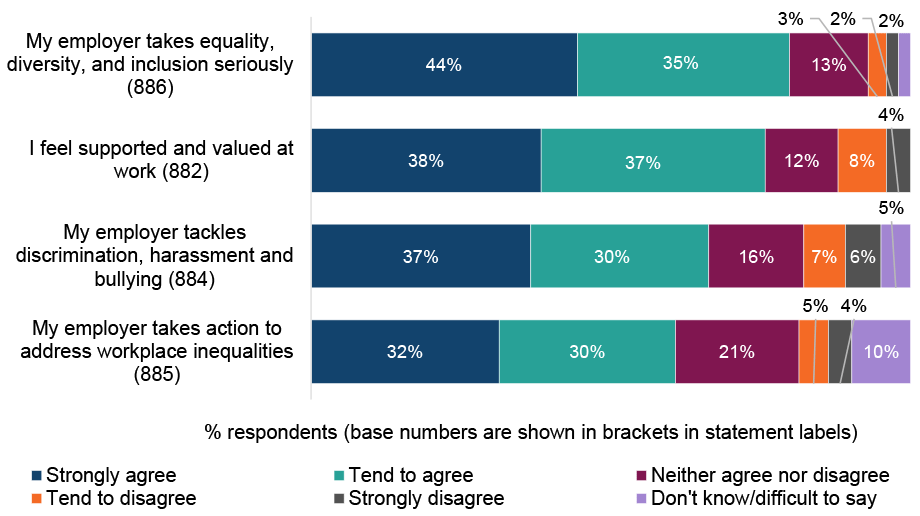
Most surveyed workers agree that their employer takes steps to address workforce inequalities (Figure 40):
- 79% agree that their employer takes equality, diversity and inclusion seriously.
- 75% agree that they feel supported and valued at work.
- 67% agree that their employer tackles discrimination, harassment and bullying.
- 62% agree that their employer takes action to address workplace inequalities.
Figure 40 Extent of agreement/disagreement relating to employer addressing workplace inequalities (survey of workers)
Differences by survey sub-group
In terms of statistically significant differences between survey sub-groups (and to convey the general pattern with respect to all four statements), the proportion of workers giving an answer of “strongly agree” or “tend to agree” is higher among the following sub-groups:
Organisation type: with respect to all four statements – higher among workers in private and third sector/other organisations compared with workers in public sector and education organisations.
Organisation size: with respect to all four statements – higher among workers in micro organisations compared with workers in very large organisations.
Organisation size: with respect to feeling supported and valued at work – higher among micro organisations compared with all other size bands.
Workers interviewed following the survey say that their employer creates a working environment that treats workers fairly and equally regardless of background or personal characteristics. For some, this is expressed as a general sense of fairness from day-to-day at work.
Some interviewed workers mentioned specific measures such as the use of pronoun badges and pronouns on email signatures, while one mentioned that working with LGBTQ colleagues has helped create a culture and feeling of inclusivity.
However, other workers raised concerns about inconsistency between policy and practice. Common issues include perceptions of their employer paying “lip service” or making tokenistic gestures, uneven implementation of equality initiatives by managers, and a lack of accountability for bullying or harassment.
Some workers have experienced or observed what they see as bias or favouritism, while others mentioned unequal pay and slow or ineffective responses to complaints or reasonable adjustment requests.
“Things have got better, but when training was given about equality, a lot of people saw this as a box ticking exercise. It is a horrible attitude to have which leads to an uncomfortable work environment.”
Worker, private sector
6.2.6 Offering flexible and family friendly working practices
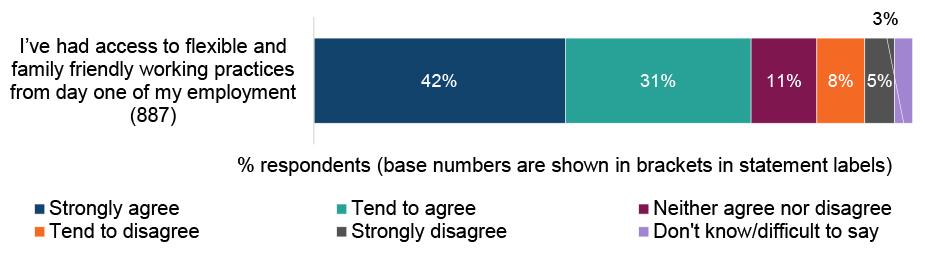
Almost three quarters of surveyed workers (73%) agree that they have had access to flexible and family friendly working practices from day one of their employment (Figure 41).
Figure 41 Extent of agreement/disagreement relating to offering flexible and family friendly working practices (survey of workers)
Differences by survey sub-group
In terms of statistically significant differences between survey sub-groups, the proportion of workers giving an answer of “strongly agree” or “tend to agree” is higher among the following sub-groups:
Organisation type: workers in private sector organisations and third sector and other organisations (77% and 84% respectively) compared with workers in public sector and education organisations (64%).
Organisation size: workers in micro organisations and small organisations (95% and 83% respectively) compared with workers in medium organisations, large organisations and very large organisations (67%, 75% and 69% respectively).
Flexibility is considered by interviewed workers as being a key factor shaping wellbeing, work-life balance and retention, with most workers saying that their employer has gone to great efforts to embed flexibility as part of their organisational culture.
However, the provision of flexibility is frequently described by workers as dependent on role, service needs or line manager discretion, leading to uneven experiences across teams and departments.
Some workers have experienced reduced flexibility or refusals of special requests, particularly where workloads are high or services require fixed coverage. Others believe that staff without children or those on fixed-term contracts experience comparatively fewer benefits, creating perceptions of inequity despite supportive policies being in place.
One worker responding to the survey made a point about home working which highlights a possible tension between flexible working practices and what might suit individual employees relative to the employer (see quotation below):
“Since COVID-19, my organisation has realised the value of allowing employees to work in a manner that suits the employee best, and is active in allowing remote working to keep going, as many organisations are now forcing staff back into the office.”
Worker, private sector
“My employer has a family friendly policy, but in practice workers – particularly female workers – are penalised for having childcare commitments and my employer is quick to discipline employees for issues with attendance. This leads to female workers in particular experiencing high levels of stress and anxiety and on occasion having to give up work - even permanent contracts - due to being unable to manage childcare with the demands of the workplace.”
Worker, public sector
6.2.7 Opposing the use of fire and rehire practices
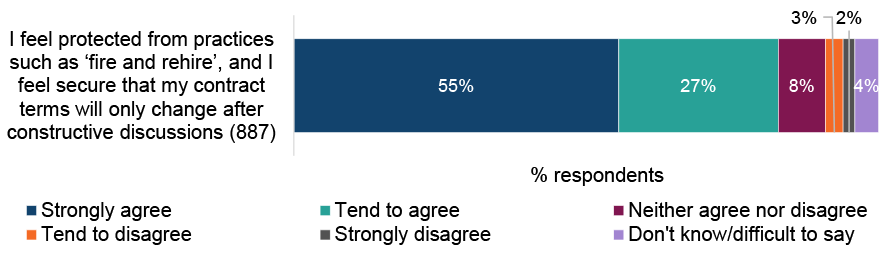
Most surveyed workers (82%) agree that they feel protected from practices such as “fire and rehire”, and feel secure that their contract terms will only change after constructive discussions (Figure 42).
Figure 42 Extent of agreement/disagreement relating to feeling protected from the use of fire and rehire practices (survey of workers)
Differences by survey sub-group
In terms of statistically significant differences between survey sub-groups, the proportion of workers giving an answer of “strongly agree” or “tend to agree” is higher among the following sub-groups:
Organisation type: workers in private sector organisations (86%) and third sector and other organisations (88%) compared with workers in public sector and education organisations (78%).
Organisation size: workers in large organisations (91%) compared with workers in medium organisations and large organisations (83% and 79% respectively).
Workers interviewed following the survey mostly describe having stable contracts and that their employer is committed to retaining staff where possible through alternatives such as changes to hours, secondments, or fixed-term arrangements linked to funding.
6.3 Equality analysis
6.3.1 Intersectionality
Whilst subject to many different definitions, the concept of intersectionality has long been used to articulate and analyse the lived reality of those who experience multiple and compounding inequalities. The analysis framework and term "intersectionality" was originally coined by American critical legal race scholar Kimberlé Williams Crenshaw in 1989 who used the term to refer to the double discrimination of racism and sexism faced by Black women.
Stakeholders interviewed at the outset of the research – including those from equality organisations – consider evidence relating to Fair Work First’s impact on workers relating to their protected characteristics, including intersecting characteristics, to be limited, with little visible change. They mainly put this down to the policy lacking strong incentives in relation to protected characteristics, with the guidance perceived as insufficiently intersectional to drive this type of meaningful change, and offering little tailored support for addressing the experiences of specific groups.
Several stakeholders suggested that employers also likely have limited understanding of intersectionality in terms of being able to confidently identify and address inequalities. This, they feel, could be a barrier to employers enacting change, such as for black women or disabled women. Additionally, they argue that public policy work on racial inequality or disability inclusion is often carried out separately from the Fair Work agenda, limiting the potential for integrated progress.
Employers interviewed following the survey were asked if they had been able to identify particular groups of staff who have benefited from the change in working environment as a result of Fair Work First, referring to protected characteristics and how they combine together to help shape people’s identities and experiences. Potentially backing up stakeholders’ hypotheses, employers were generally unable to identify particular groups who had benefited from the changes, though one employer did mention real Living Wage increases have had a positive impact on lower‑paid staff, which they felt (only when prompted) might include those with intersecting characteristics.
Additionally and as stated in section 6.2.5 (addressing workplace inequalities), workers interviewed following the survey are generally of the view that their employer creates a working environment that treats all workers fairly and equally, regardless of background or personal characteristics, and found it difficult to distinguish between certain groups of workers being more or less impacted than others.
6.3.2 Differences based on surveyed workers’ protected characteristics
Whilst not a true assessment of intersectionality, it is worth noting that the survey of workers has revealed some statistically significant differences in workers’ experiences and perceptions based on certain protected characteristics. Identified statistically significant differences from the survey data are summarised below.
Age
With respect to age, the proportion of surveyed workers saying they are paid at least the real Living Wage is higher among workers aged 50-64 (98%) compared with 16-24-year-olds (91%) – a statistically significant difference. This appears to be backed up by research by the Living Wage Foundation in 2023 – Precarious pay and uncertain hours – which revealed a ‘U-Shaped’ trend in both insecure work and low paid insecure work. Those at the lower and upper ends of the age distribution were found to be at greatest risk, and those in the middle (from around 25-50) were found to be at lowest risk.
Additionally, the proportion of surveyed workers saying they have experienced a positive work culture is statistically significantly different among workers aged 16-24 (86%) compared with all other age groups (53%-63%). Whilst the reasoning is not fully clear, it may be that younger people are more likely to be clustered into working arrangements that naturally produce more structured, supportive, and socially positive work environments, while older workers may be more exposed to greater organisational dysfunction, responsibility or long‑term cultural fatigue.
Disability
A higher proportion of surveyed workers who do not have a physical or mental health condition or illness (lasting or expected to last for 12 months or more) compared with workers who do have a long-term condition, agree that their employer takes various steps to: i) provide appropriate individual channels for collective voice; ii) invest in workforce development; iii) address workplace inequalities; iv) offer flexible and family-friendly working practices; and v) oppose fire and rehire practices.
The same pattern appears elsewhere. A higher proportion of surveyed workers who do not have a physical or mental health condition or illness compared with workers who do have a long-term condition perceive a change since autumn 2021 in their employer’s commitment relating to the following: i) providing appropriate channels for effective workers’ voice; ii) commitment relating to investing in workforce development; and iii) commitment relating to addressing workplace inequalities.
These barriers appear to be backed up by existing research, for example a study by Inclusion Scotland – No Clear Path: Disabled People and the barriers to Fair Work – which found that barriers to fair work for disabled people include discrimination, inaccessible workplaces, lack of flexibility and delayed or inadequate support.
6.4 Measuring the impact of Fair Work First on workers
Surveyed buyers and funders were asked whether their organisation takes steps to measure the impact of Fair Work First criteria on workers within organisations in receipt of contracts or grants. This appears to be a rare practice, with just 5% saying yes, 44% saying no and 55% unable to say (base=88). Among those that do take steps to measure the impact, approaches include incorporating Fair Work measures within outcome frameworks, assurance models or regular reporting cycles, as well as using dashboards or tracking tools to monitor changes in Fair Work First commitments over time.