
Fair Work First: policy evaluation
An independent evaluation of the Scottish Government's Fair Work First conditionality policy, seeking to understand whether the policy has been delivered as intended.
4. Employer Outcomes Part 1 – Fair Work First Understanding and Commitments
This chapter reports on employers’ understanding of Fair Work First. It then examines their self-reported levels of commitment to each of the seven Fair Work First criteria in turn and how that commitment has changed over time. For a more rounded picture – workers’ own perceptions of their employer’s Fair Work First commitments are included.
Given the difficulty establishing a counterfactual for this study (explained in section 1.6.2), the survey of workers included questions asking workers to reflect on how they perceived their employer’s commitments to have changed since autumn 2021. These questions were only asked of workers employed by their current organisation as far back as autumn 2021. It is acknowledged that these were not easy questions for all workers to answer, hence the high proportion of “don’t know/difficult to say” response options throughout this chapter from workers.
It should be kept in mind when reading this chapter that surveyed workers are not necessarily all employed by those organisations responding to the separate survey of employers.
Reminder of survey base sizes:
- Survey of buyers and funders (base=88)
- Survey of employers (base=260)
- Survey of workers (base=888)
Findings summary
Surveyed employers’ understanding of Fair Work First appears to be generally strong and has improved since policy changes were introduced in October 2021 and July 2023.
There is also an increase in the proportion of surveyed employers self-reporting that they have “fully embedded” all seven Fair Work First criteria when reflecting on their approach prior to October 2021 and comparing that with the time of the survey.
Surveyed workers observing improvements in their employer’s commitment to paying at least the real Living Wage point to deliberate organisational action over time, including movement from minimum wage to the real Living Wage, introduction of cost-of-living increases, and pay rises following job evaluation exercises. With respect to effective workers’ voice, such as trade union recognition, workers reported observing strengthened formal mechanisms and increased leadership openness as having contributed to improved workers’ voice.
4.1 Employer understanding of Fair Work First
Surveyed employers appear confident in their own knowledge about Fair Work First. Almost a third (32%) consider their understanding to be excellent, while more than half (54%) describe it as good, 12% fair and 1% poor, while 2% are unsure (base=260).
Differences by survey sub-group
In terms of statistically significant differences between survey sub-groups, the proportion of employers giving an answer of “excellent” or “good” is higher among the following sub-groups:
Organisation type: third sector and other organisations (92%) compared with private sector organisations (81%).
Organisation size: small organisations (89%) compared with micro organisations (79%).
Contract/grant holders: no statistically significant differences.
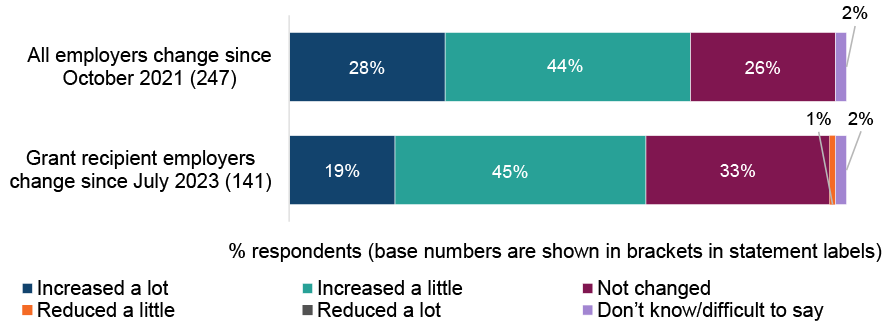
Most surveyed employers (72%) say their understanding of Fair Work First has increased since autumn 2021 (when changes were introduced as explained in section 1.2). Among grant recipients, almost two thirds (64%) say their understanding has increased since July 2023 when conditionality was introduced (Figure 18).
Figure 18 Extent to which understanding of Fair Work First has changed over time (survey of employers)
Differences by survey sub-group
In terms of statistically significant differences between survey sub-groups, the proportion of employers giving an answer of “increased a little” or “increased a lot” is higher among the following sub-groups:
Organisation type: no statistically significant differences.
Organisation size: large employers (79%) compared with micro employers (62%).
Contract/grant holders: no statistically significant differences.
4.2 Employer commitments – general observations
Surveyed employers were asked to state their organisation’s level of commitment to each of the seven Fair Work First criteria as it was prior to 14 October 2021, and then at the time of the survey (November 2025-January 2026).
A clear limitation here is the reliance on employers making assumptions about the past since no baseline data were collected at that timepoint. As all percentages are self-reported, some caution is also needed given the possible risk of over-confidence bias, and/or social conformity bias (the possible assumption that a positive change over time is expected, therefore given in the survey).
Notwithstanding these risks, the results reveal the surveyed employers were already generally committed to each of the Fair Work First criteria prior to October 2021. Self-reported levels of commitment across all criteria have also strengthened since October 2021, with notable increases in the proportions saying they have fully embedded these practices (with or without impact monitoring).
The charts in the remainder of this chapter provide more granular details for each criterion in turn.
|
Fair Work First criterion |
%-point increase |
|---|---|
|
Table 2 summarises the percentage-point increase in employers saying each of the Fair Work First criteria are “fully embedded” at the time the surveys were undertaken, compared with October 2021. The biggest increase is with respect to payment of at least the real Living Wage (increase of 20%). This is followed by offering flexible and family friendly working practices from day one of employment (increase of 19%) and providing appropriate channels for effective workers’ voice (increase of 18%). |
|
|
Paying all workers at least the real Living Wage |
+20% |
|
Providing appropriate channels for effective workers’ voice, such as trade union recognition |
+18% |
|
Investing in workforce development |
+12% |
|
Not making inappropriate use of zero hours contracts |
+8% |
|
Addressing workplace inequalities |
+12% |
|
Offering flexible and family friendly working practices from day one of employment |
+19% |
|
Opposing fire and rehire practices |
+6% |
Among the minority of surveyed employers reporting a reduced commitment over time, most attribute this to financial pressures linked to annual real Living Wage increases, which they say – as noted previously – have risen faster than contract values or funding uplifts. Long‑term or fixed‑price contracts are deemed especially challenging, leaving employers unable to adjust prices to accommodate rising employment costs.
“If payment of the real Living Wage is to be a contractual requirement, it would seem reasonable that contract pricing mechanisms should allow for adjustments in line with changes to the real Living Wage.”
Employer, medium, private sector
Other employers clarified that they had not actively reduced their commitments but had simply not changed their long-established practices or did not have trade union recognition to drive this. One employer mentioned reduced internal monitoring as a contributing factor behind their response, rather than scaling back practices per se.
To strengthen the evidence base, surveyed workers were also asked for their own perceptions on the extent to which their employer’s commitments to each of the seven Fair Work First criteria have changed since autumn 2021.
It was anticipated that these would be difficult questions for workers to answer, reflected by the fact many felt unable to say. However, it is clear that surveyed workers believe their employers have become more committed, especially so in relation to offering flexible and family friendly working practices (39% say this has improved where they work), paying all workers at least the real Living Wage (35% say improved) and providing appropriate channels for effective workers’ voice (33% say improved).
Again – and as with data from employers – the charts in the remainder of this chapter provide more granular details for each criterion in turn.
4.3 Paying all workers at least the real Living Wage
4.3.1 Headline changes
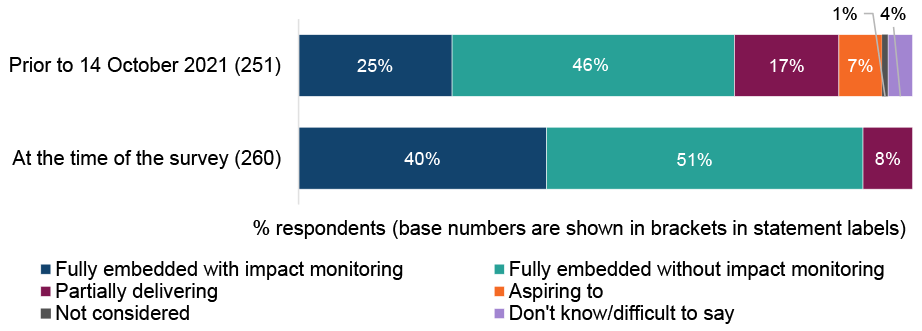
Results from the employer survey suggests a strengthening of commitment over time with respect to payment of at least the real Living Wage. The vast majority (91%) say this criterion is fully embedded at the time of the survey, compared with 71% when reflecting on their approach prior to autumn 2021 (when changes to Fair Work First were introduced as explained in section 1.2) – an increase of 20% (Figure 19).
Figure 19 Time-based comparison of employer commitment to paying all workers at least the real Living Wage (survey of employers)
Differences by survey sub-group
In terms of statistically significant differences between survey sub-groups, the proportion of employers giving an answer of “fully embedded” is higher among the following sub-groups:
Organisation type: third sector and other organisations (97%) compared with private sector organisations, as well as public sector and education organisations (87% and 86% respectively).
Organisation size: small organisations (95%) compared with large employers (84%).
Contract/grant holders: no statistically significant differences.
4.3.2 Workers’ perceptions of change in employer commitment
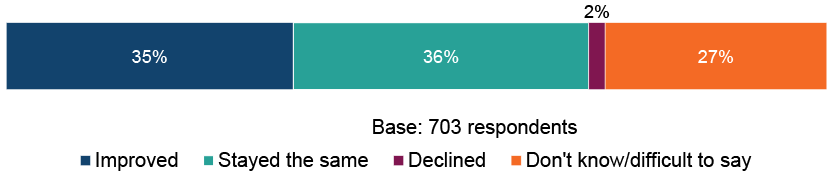
Just over a third of surveyed workers (35%) believe their employer’s commitment with respect to paying at least the real Living Wage has improved since autumn 2021 when changes were introduced. A small minority of 2% say it has declined (Figure 20).
Figure 20 Workers’ perceptions of change since autumn 2021 in their employer’s commitment relating to paying all workers at least the real Living Wage (survey of workers)
Differences by survey sub-group
In terms of statistically significant differences between survey sub-groups, the proportion of workers identifying an improvement is higher among the following sub-groups:
Organisation type: no statistically significant differences.
Organisation size: workers in medium organisations (42%) compared with workers in large organisations and very large organisations (32% and 34% respectively).
Surveyed workers were asked what improvements they had observed in their employer’s commitments to paying all workers at least the real Living Wage. The question was asked in a general sense and not specifically due to Fair Work First, which it was felt may have been more difficult to answer.
A common message is that their employer brings a long-standing commitment to paying at least the real Living Wage, often embedded in organisational values. Workers have also observed deliberate organisational action over time, such as movement from minimum wage to the real Living Wage, introduction of cost-of-living increases, and pay rises following job evaluation exercises. In some cases, these changes are attributed to staff pushing for improvements, organisational reviews of pay and roles, or the influence of funding conditions (including Fair Work First) or commissioning clauses.
Workers saying their employer’s commitment has stayed the same, explained that their employer was already paying at or above the real Living Wage and has maintained this standard consistently. In these cases, the absence of change is viewed positively, reflecting an already strong position rather than a lack of progress.
Some workers raised concerns about their employers’ ability to afford to pay the real Living Wage and that this affects their employer’s ability to commit. These include pressures created where funding has not increased in line with the real Living Wage (leading to instances of reduced hours) or their employer being reliant on reserves. A small minority of workers took the opportunity here to express concerns about the cost of living rising more quickly than the real Living Wage, or that pay rises across different job grades do not rise at the same rate as the real Living Wage, thus “devaluing skills.”
4.3.3 Employer case study 1 – Scottish Union of Supported Employment
The Scottish Union of Supported Employment (SUSE) is Scotland’s national representative body for Supported Employment providers and all those committed to ensuring that disabled people and individuals with long term health conditions have genuine access to meaningful, sustainable work. Bringing organisations, practitioners, and employers together, SUSE works to strengthen the quality and impact of supported employment through campaigning, capacity building projects, and practical support that helps make workplaces more accessible.
SUSE has long-embedded fair pay as a core principle, which CEO David Cameron says helps to demonstrate ethical leadership and the practical benefits that come from valuing people properly. Cameron is supportive of Fair Work First in helping to drive fair pay, which in turn strengthens advocacy of this and other fair work principles to its own members.
“Fair Work First has made us think more about those areas to ensure we are doing the best we can.”
David Cameron, CEO
SUSE has committed to providing annual cost of living increases for its staff, linking these to the Consumer Price Index to minimise the risk of anyone falling behind financially. Cameron says that although these increases were sometimes agreed later than planned and required backdating, the SUSE’s leadership viewed them as “essential rather than optional”.
SUSE extends its fair pay principles to project based roles, especially those delivered by disabled consultants and people with lived experience. These contributors are paid at competitive market rates, reflecting SUSE’s belief that specialist expertise, whether accessibility consultancy or lived experience insight, should be valued on the same terms as any other professional skillset.
SUSE advocates where possible against practices that risk leading to underfunding or suppression of wages (such as undercutting budgets) on the basis that appropriate salaries are key to project quality. It makes the case that fair pay is essential to attracting staff with the skills, autonomy, and credibility required for complex roles, particularly those involving employer engagement, caseload management, or strategic communication.
“Commissioners can sometimes express surprise when a voluntary sector organisation includes a particular salary level in a funding bid.”
David Cameron, CEO
The benefits of this approach are evident in SUSE’s low staff turnover. When employees do move on, this is typically for career progression reasons or to pursue specialist opportunities rather than dissatisfaction with pay. This stability, as Cameron says, enhances continuity, experience within the team, and overall service quality.
4.4 Provision of appropriate channels for effective workers’ voice, such as trade union recognition
4.4.1 Headline changes
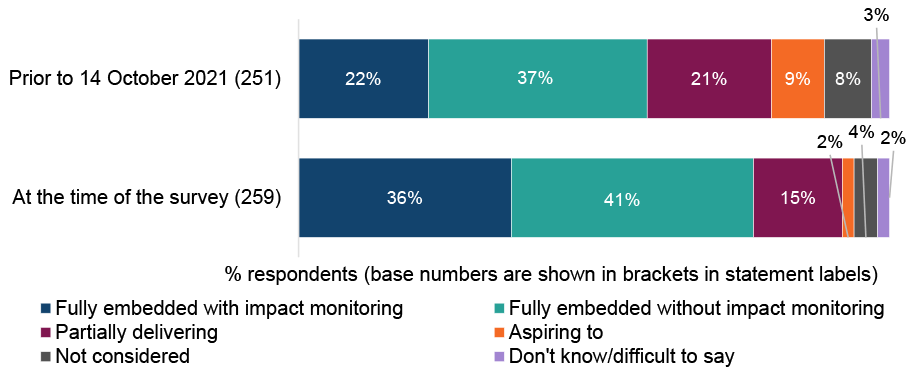
The employer survey points to a strengthening of commitment over time with respect to provision of appropriate channels for effective workers’ voice, such as trade union recognition (18% increase in the proportion of employers saying this criterion is fully embedded) – Figure 21.
Figure 21 Time-based comparison of employer commitment to providing appropriate channels for effective workers’ voice, such as trade union recognition (survey of employers)
Differences by survey sub-group
In terms of statistically significant differences between survey sub-groups, the proportion of employers giving an answer of “fully embedded” is higher among the following sub-groups:
Organisation type: public sector and education organisations (96%) compared with private sector organisations and third sector and other organisations (76% and 74% respectively).
Organisation size: large organisations (85%) compared with micro employers (68%).
Contract/grant holders: contract and grant holders (90%) compared with contract holders only and grant holders only (75% and 73% respectively).
Further sub-group differences for this question are reported in section 5.2 – Wider influencing factors, including trade union recognition.
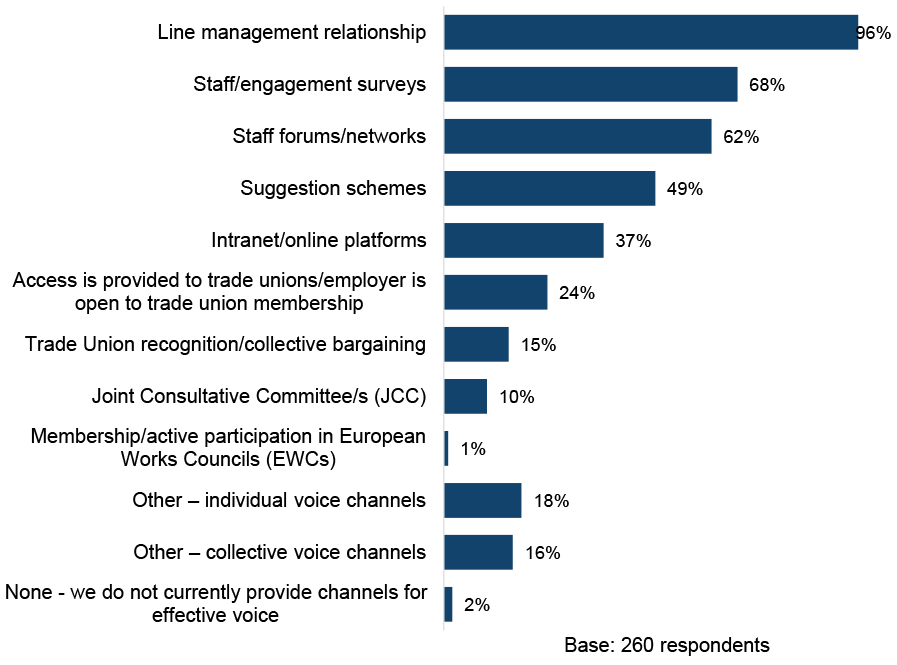
Additionally for this criterion, surveyed employers were also asked to describe the ways in which they provide appropriate channels for effective workers’ voice. Each mentioned four on average, with the most common being through line management relationships (mentioned by 96%), via staff engagement surveys (68%) or via staff forums/networks (62%) – Figure 22.
Figure 22 Ways in which employers provide appropriate channels for effective workers’ voice, such as trade union recognition (survey of employers)
Differences by survey sub-group
In terms of statistically significant differences between survey sub-groups, the proportion of employers providing each of these options is higher among the following sub-groups:
Organisation type: public sector and education organisations compared with private sector organisations and third sector and other organisations.
Organisation size: large organisations, medium organisations and small organisations compared with micro organisations.
Contract/grant holders: no statistically significant differences.
Further sub-group differences for this question are reported in section 5.2 – Wider influencing factors, including trade union recognition.
4.4.2 Workers’ perceptions of change in employer commitment
A third of surveyed workers (33%) believe their employer’s commitment with respect to providing appropriate channels for effective workers’ voice, such as trade union recognition, has improved since autumn 2021 (when changes to Fair Work First were introduced as explained in section 1.2). A small minority (6%) say it has declined (Figure 23).
Figure 23 Workers’ perceptions of the change since autumn 2021 in their employer’s commitment relating to providing appropriate channels for effective workers’ voice, such as trade union recognition (survey of workers)

Differences by survey sub-group
In terms of statistically significant differences between survey sub-groups, the proportion of workers identifying an improvement is higher among the following sub-groups:
Organisation type: workers in private sector organisations and third sector and other organisations (44% and 47% respectively) compared with workers in public sector and education organisations (23%).
Organisation size: workers in small organisations, medium organisations and large organisations (46%, 42% and 41% respectively) compared with workers in very large organisations (25%).
Surveyed workers were asked what improvements they had observed in their employer’s commitments to provision of appropriate channels for effective workers’ voice, such as trade union recognition. The question was asked in a general sense and not specifically due to Fair Work First, which would have been more difficult to answer.
Observed improvements are commonly linked to the introduction of strengthened formal mechanisms and include a clearer route for raising issues, greater feedback sharing and, in some cases, more visible action taken as a result.
Increased leadership openness is also viewed by some workers as having contributed to improved workers’ voice. Workers refer to senior leaders being more visible, holding all-staff meetings, and actively seeking feedback during periods of organisational change.
Interviewed workers saying their employer’s commitments have stayed the same generally mention well-established and effective processes, such as trade union consultation on policies or changes to terms and conditions of employment.
4.4.3 Employer case study 2 – Dundee and Angus College
Dundee and Angus College serves more than 18,000 students across its main campuses in Dundee and Arbroath, offering a wide range of academic, vocational and professional courses, supporting progression into employment or higher education.
The college sees fair work as central to its identity, values and culture, helping to ensure staff contributions are fully recognised. Fair Work First – as part of procurement and grant arrangements – has supported this well, placing a stronger spotlight on the types of approaches already embedded. For Steve Taylor, Vice Principal Support Services & Operations, Fair Work First Policy and criteria play a key role in strengthening staff engagement and the college’s reputation.
A recent key challenge the college faced was needing to deliver £2.5 million in savings, largely through staff reductions. Throughout this difficult process, the college demonstrated its commitment to the principles of effective workers’ voice to guide its approach. This meant engaging with staff openly about what the college needed to achieve, working closely and transparently with relevant trade unions, and ensuring communication was honest, sensitively handled and timely. Staff involvement not only helped to manage the internal impact of the cuts but also to convey the impact to the Scottish Government regarding sector wide funding.
“Ultimately this was about making cuts and reducing staffing but doing so in ways that ensured staff were engaged and involved. It really created a kind of shared experience that benefitted both individuals and the college through a really difficult time.”
Steve Taylor, Vice Principal Support Services & Operations
The impact of the college’s fair work approach helped to identify alternative options for making savings though open and transparent dialogue, which allowed staff to genuinely influence decisions.
“I think our approach and the opportunities generated through real involvement meant the impact on students and staff is less than it would have been otherwise, because staff are the experts in their areas and they can point to places and ways where savings could best be made.”
Steve Taylor, Vice Principal Support Services & Operations
Encouraging and supporting effective voice resulted in new ideas being generated to improve income and minimise the impact of cost or staff reductions. These included new and more efficient curriculum proposals, alternative ways of working, and engagement with partners and other stakeholders to make better use of resources.
In total over 200 different contributions were received and almost half of the initial plans were amended to reflect staff feedback and the joint sharing of expertise.
As local EIS/FELA union branch chair Stephen Oakley stated about the importance of open and honest communication and joint working:
“The college has faced a series of significant challenges that demanded clarity, cooperation, and a shared commitment to the wellbeing of our staff, students, and wider community. This progress has been made possible through the collective efforts of the Senior Leadership Team and the College Executive and trade unions whose openness, professionalism, and willingness to engage meaningfully have been central to rebuilding confidence and ensuring stability. Our work has demonstrated that even in a period of national uncertainty for the further education sector, partnership remains the most effective route to lasting solutions.”
Stephen Oakley, Dundee and Angus College EIS/FELA Branch Chair & Operations
4.5 Investing in workforce development
4.5.1 Headline changes
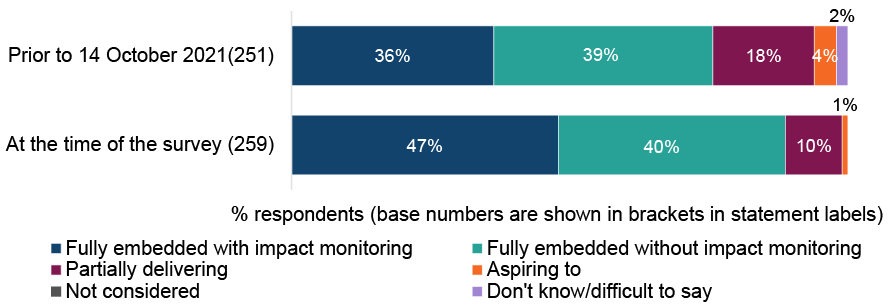
Again, the employer survey points to a slight strengthening of commitment over time with respect to investment in workforce development (12% increase in the proportion of employers saying this criterion is fully embedded) – Figure 24.
Figure 24 Time-based comparison of employer commitment to investing in workforce development (survey of employers)
Differences by survey sub-group
In terms of statistically significant differences between survey sub-groups, the proportion of employers providing an answer of “fully embedded” is higher among the following sub-groups:
Organisation type: no statistically significant differences.
Organisation size: large organisations, medium organisations and small organisations (96%, 93% and 88% respectively) compared with micro employers (74%).
Contract/grant holders: contract holders only (91%) compared with grant holders only (82%).
4.5.2 Workers’ perceptions of change in employer commitment
More than a quarter of surveyed workers (28%) believe their employer’s commitment with respect to investment in workforce development has improved since autumn 2021 (when changes to Fair Work First were introduced as explained in section 1.2), while 15% say it has declined (Figure 25).
Figure 25 Workers’ perceptions of the change since autumn 2021 in their employer’s commitment relating to investing in workforce development (survey of workers)

Differences by survey sub-group
In terms of statistically significant differences between survey sub-groups, the proportion of workers identifying an improvement is higher among the following sub-groups:
Organisation type: workers in private sector organisations and third sector and other organisations (41% and 34% respectively) compared with workers in public sector and education organisations (20%).
Organisation size: workers in small organisations, medium organisations and large organisations (38%, 42% and 33% respectively) compared with workers in very large organisations (21%).
Surveyed workers were asked what improvements they had observed in their employer’s commitments to investing in workforce development. The question was asked in a general sense and not specifically due to Fair Work First, which would have been more difficult to answer.
Observed improvements include having access to a wider range of opportunities to develop skills or progress within the organisation than they did before. Exemplar mechanisms include having more access to e-learning, the introduction of internal training programmes, new leadership and management development initiatives, a decision to take on apprentices, and offering work experience schemes.
“My employer does her best for her staff, but she is unable to invest fully in workforce development due to the third sector not receiving adequate multi-year funding (which would allow us to have better development opportunities).”
Worker, registered charity
4.5.3 Employer case study 3 – The Union
The Union is an employee‑owned integrated marketing agency that has significantly evolved its approach to workforce development over the past six years – formalising progression, strengthening leadership diversity, and widening access to creative careers. Whilst having always valued inclusive leadership, recent developments have transformed The Union’s values into structured, measurable action.
The Union has responded to Fair Work First criteria through procurement, with Executive Director Louise Killough of the view that awareness of policy expectations have “cemented our commitment to ensuring we offer these practices”.
Marking a key milestone in its journey, The Union created a new leadership team which recognised talent already within the organisation and helped to create clearer progression pathways.
“The transition to employee ownership has given staff a direct stake in the organisation’s long-term direction It’s really impacted the business… it shows the progress in making these things real rather than just ticking a box.”
Louise Killough, Executive Director
The Union’s workforce strategy includes a commitment to nurturing new and diverse talent. Around 30% of employees are neurodiverse, while visible female leadership – including women with young children – has helped staff “see what’s possible” and contribute to “a more supportive developmental culture” according to Louise.
The company is also a co‑founder of the Unlocked programme, launched in 2023, which supports young people from schools, deprived areas, and non‑traditional educational backgrounds into advertising careers. The initiative was originally driven by the company’s Creative Director, Sheryl Thomson, who took it to the board, resulting in strong organisational backing and a new pipeline of entrants.
The Union hired its first modern apprentice and continues to work closely with schools, colleges, and community partners to help young people understand opportunities within the creative sector. Additionally, senior staff contribute actively to the Women in Advertising and Communications Leadership (WACL) network, supporting training and events aimed at strengthening future talent.
For Louise, structured progression, inclusive leadership, and sustained investment in diverse talent pipelines helps to benefit not only its people, but as a form of advocacy to its clients and the wider industry.
4.6 Not making inappropriate use of zero hours contracts
4.6.1 Headline changes
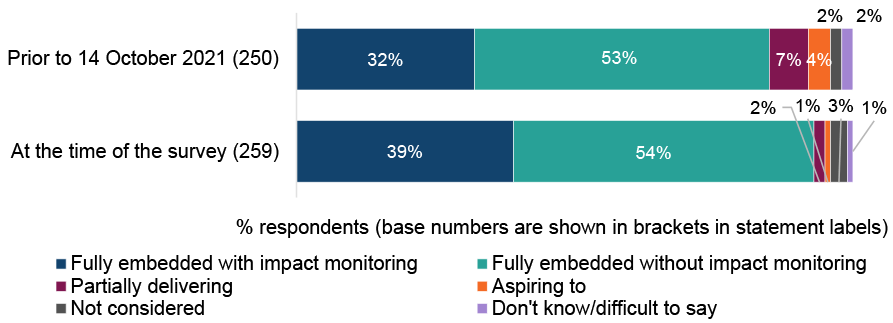
The employer survey points to a very slight strengthening of commitment over time with respect to no inappropriate use of zero hours contracts (an 8% increase in the proportion of employers saying this criterion is fully embedded) – Figure 26.
Figure 26 Time-based comparison of employer commitment to not making inappropriate use of zero hours contracts (survey of employers)
Differences by survey sub-group
In terms of statistically significant differences between survey sub-groups, the proportion of employers providing an answer of “fully embedded” is higher among the following sub-groups:
Organisation type: no statistically significant differences.
Organisation size: large organisations, medium organisations and small organisations (96%, 96% and 94% respectively) compared with micro organisations (86%).
Contract/grant holders: contract holders only (97%) compared with grant holders only (86%).
4.6.2 Workers’ perceptions of change in employer commitment
A small minority (12%) of surveyed workers believe their employer’s commitment with respect to no inappropriate use of zero hours contracts has improved since autumn 2021 (when changes to Fair Work First were introduced as explained in section 1.2). Almost half (48%) feel unable to say and 3% say it has declined (Figure 27).
Figure 27 Workers’ perceptions of change since autumn 2021 in their employer’s commitment relating to not making inappropriate use of zero hours contracts (survey of workers)

There are no statistically significant differences by the core sub-groups.
Surveyed workers were asked what improvements they had observed in their employer’s commitments to not making inappropriate use of zero hours contracts. The question was asked in a general sense and not specifically due to Fair Work First, which would have been more difficult to answer.
Many surveyed workers stated that – as far as they are aware – zero hours contracts are not used within their organisation, hence no perceived opportunity for improvement in practice. Permanent, salaried, or guaranteed-hours contracts are generally the standard, thus helping to create secure employment.
Some workers note that flexibility tends to be provided through part-time, flexible, or seasonal contracts, particularly where service delivery or rural contexts require this.
Workers unsure whether their employer’s commitment to zero hours contracts has changed generally mentioned having limited visibility beyond their own team or department.
“To my knowledge my employer does not offer zero-hour contracts. All colleagues are provided guaranteed hours of work.”
Worker, private sector
4.6.3 Employer case study 4 – Streamline
Based in Edinburgh, Streamline is an established provider of branded corporate clothing, workwear and merchandise, offering end-to-end solutions from design to distribution. Over the years, the company has built a reputation for consistency, strong client relationships and a people-centred work culture. The company’s commitment to fair work underpins how it operates and how it shapes support for its team of over 30 people.
Streamline places strong focus on job security and being transparent with employees about long-term business plans so staff understand the strategic direction. This includes open communications about financial performance, investment decisions and the long-term vision, which helps to build trust and reassures employees about the company’s stability and commitment to the team’s future. Streamline also gives team members secure and predictable contracts, with permanent contracts offered where possible. It also limits unnecessary use of temporary or agency work and does not use zero hours contracts.
“As the company is so open about sales, profit, and future investment, we can clearly see that the business is healthy and planning ahead. That transparency gives us real confidence in our job security.”
Lynn Ferguson, Key Account Manager
Streamline has demonstrated its commitments to Fair Work First criteria on several occasions as part of procurement frameworks and tenders. With these criteria strongly embedded in Streamline’s culture (the company is also signed up to the Armed Forces Covenant). Key Account Manager Lynn Ferguson explains how this helps when responding to what is asked at tender stage.
“We’re now more aware of what needs answering and logging – it has become more embedded in our tender process…Fair Work First acts as a good checklist that we are still doing the right things.”
Lynn Ferguson, Key Account Manager
Streamline also invests strongly in staff development and progression, helping to further affirm job security. The business sets aside training budgets for each employee, encourages internal recruitment, and provides clear career pathways.
Many new recruits join from the hospitality or the automotive sector, thus structured development helps to build the specific skills needed. Overall, these practices deliver tangible business benefits for Streamline. The company’s strong focus on job security and internal development helps to build a more motivated and committed workforce, retained knowledge, improved client service, and lower recruitment costs.
4.7 Addressing workplace inequalities
4.7.1 Headline changes
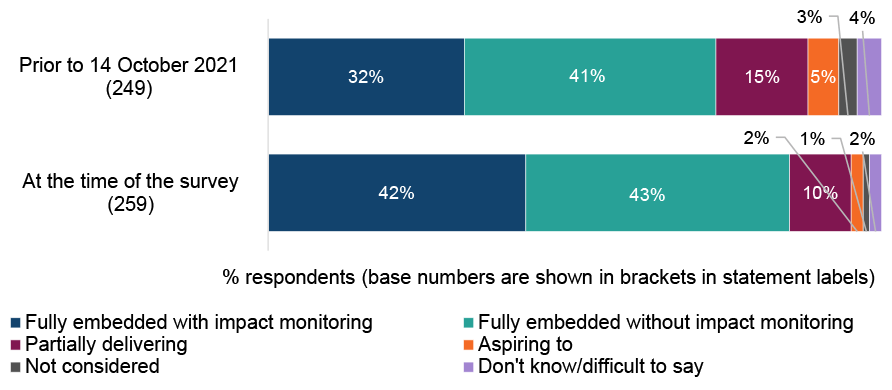
With respect to addressing workplace inequalities, the employer survey points to a slight strengthening of commitment over time (12% increase in the proportion of employers saying this criterion is fully embedded) – Figure 28.
Figure 28 Time-based comparison of employer commitment to addressing workplace inequalities (survey of employers)
Differences by survey sub-group
In terms of statistically significant differences between survey sub-groups, the proportion of employers giving an answer of “fully embedded” is higher among the following sub-groups:
Organisation type: no statistically significant differences.
Organisation size: large organisations, medium organisations and small organisations (88%, 93% and 91% respectively) compared with micro employers (67%).
Contract/grant holders: contract holders only (93%) compared with grant holders only (76%).
4.7.2 Workers’ perceptions of change in employer commitment
A quarter (25%) of surveyed workers believe their employer’s commitment with respect to addressing workplace inequalities has improved since autumn 2021 (when changes to Fair Work First were introduced as explained in section 1.2). A small minority (7%) say it has declined (Figure 29).
Figure 29 Workers’ perceptions of change since autumn 2021 in their employer’s commitment relating to addressing workplace inequalities (survey of workers)

Differences by survey sub-group
In terms of statistically significant differences between survey sub-groups, the proportion of workers identifying an improvement is higher among the following sub-groups:
Organisation type: workers in private sector organisations and third sector and other organisations (39% and 33% respectively) compared with workers in public sector and education organisations (16%).
Organisation size: workers in small organisations, medium organisations and large organisations (31%, 41% and 32% respectively) compared with workers in very large organisations (17%).
Surveyed workers were asked what improvements they had observed in their employer’s commitments to addressing workplace inequalities. The question was asked in a general sense and not specifically due to Fair Work First, which would have been more difficult to answer.
Interviewed workers generally described strong or long-standing commitments by their employer to addressing workplace inequalities, such as:
- Disability support and reasonable adjustments.
- Family-friendly policies, reasonable adjustments.
- Increased focus on equality, diversity, and inclusion through training committees, dedicated roles, and updated policies.
- Mandatory training on equality, diversity, and inclusion to form a shared baseline of awareness across the workforce.
- Non-discriminatory pay structures.
- Steps to tackle the gender pay gap.
- Visible leadership support.
Workers feel these practices have helped to embed workplace cultures where inclusion and fairness are actively promoted.
“My employer has always been very aware of inequalities in general and consistently done what we can to challenge any inequalities we are aware of in a supportive way. As a team, we are very diverse and inclusion is key for us in delivery.”
Worker, registered charity
Surveyed workers were asked what improvements they had observed in their employer’s commitments to addressing workplace inequalities. The question was asked in a general sense and not specifically due to Fair Work First, which would have been more difficult to answer.
Observations include the introduction of new initiatives and structures that increase the visibility of equality, diversity and inclusion, such as dedicated internal committees to whom staff can raise issues and contribute to organisational discussions. These spaces are seen as supporting fairness by giving underrepresented groups greater visibility.
Others mentioned a gradual increasing awareness on the part of their employer regarding neurodiversity and celebration of different languages.
Leadership support is also a driving factor, with workers noting that changes in senior leadership can influence how they perceive their organisation’s attitude to equality.
4.7.3 Employer case study 5 – Loco Home Retrofit
Founded in 2021, Loco Home Retrofit CIC is a multistakeholder cooperative built on respect, inclusion, and shared responsibility. With around 300 household members and a small core workforce of six employees, the organisation ensures that its staff play a meaningful role not only in service delivery but in shaping how the organisation evolves.
“Staff are involved in planning and decision‑making both as employees and members, which enhances transparency and creates real job satisfaction.”
Chris Carus, Managing Director
Loco Home Retrofit has been awarded both contracts and grants from public sector organisations in Scotland, and whilst Fair Work First criteria were already deeply embedded, Managing Director Chris Carus believes the policy reflects and reinforces core standards that employers should have in place.
A key challenge, however, is what he sees as the “precarious nature” of roles in the retrofit sector (due to such factors as short-term funding cycles and fluctuating demand) which can have implications for recruiting and retaining people. This, he feels, reflects something of a “blind spot” in such policy drivers.
When concerns were raised at an industry-wide level around insulation failures in UK homes, Loco Home Retrofit involved employees and its member households in focus groups and workshops to evaluate risks and redesign safeguards. This approach enabled its staff to work together with members to shape complex policy, improve their confidence and decision‑making capability.
For Chris, the cooperative model – and the central role of employees within it – has become a key differentiator that helps where public trust can be lacking.
“Being able to state the services are developed under homeowners’ leadership is commercially powerful because transparency is scarce in the industry. Our team can help to deliver and communicate this message, strengthening credibility and reinforcing our values.”
Chris Carus, Managing Director
4.8 Offering flexible and family friendly working practices from day one of employment
4.8.1 Headline changes
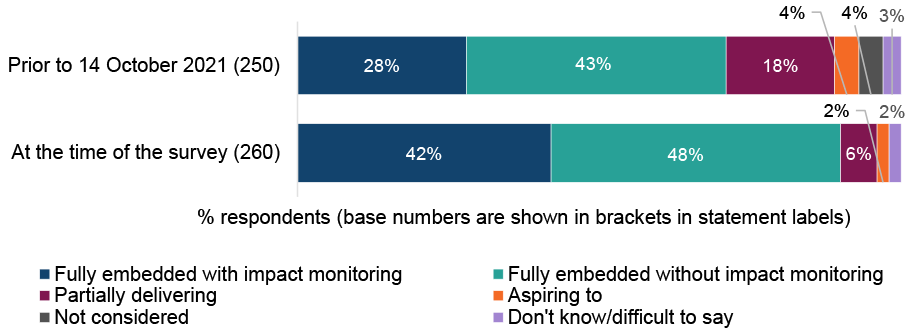
The employer survey points to a strengthening of commitment over time with respect to offering flexible and family friendly working practices from day one of employment (19% increase in the proportion of employers saying this criterion is fully embedded).
Figure 30 Time-based comparison of employer commitment to offering flexible and family friendly working practices from day one of employment (survey of employers)
Differences by survey sub-group
In terms of statistically significant differences between survey sub-groups, the proportion of employers giving an answer of “fully embedded” is higher among the following sub-groups:
Organisation type: no statistically significant differences.
Organisation size: small organisations (94%) compared with micro organisations and medium organisations (86% and 83% respectively).
Contract/grant holders: contract holders only (94%) compared with grant holders only (87%).
4.8.2 Workers’ perceptions of change in employer commitment
Almost four in ten surveyed workers (39%) believe their employer’s commitment with respect to offering flexible and family friendly working practices has improved since autumn 2021 (when changes to Fair Work First were introduced as explained in section 1.2). A small minority (7%) say it has declined (Figure 31).
Figure 31 Workers’ perceptions of change since autumn 2021 in their employer’s commitment relating to offering flexible and family friendly working practices from day one of employment (survey of workers)

Differences by survey sub-group
In terms of statistically significant differences between survey sub-groups, the proportion of workers identifying an improvement is higher among the following sub-groups:
Organisation type: workers in private sector organisations and third sector and other organisations (44% and 47% respectively) compared with workers in public sector and education organisations (34%).
Organisation size: no statistically significant differences.
Surveyed workers were asked what improvements they had observed in their employer’s commitments to offering flexible and family-friendly working practices. The question was asked in a general sense and not specifically due to Fair Work First, which would have been more difficult to answer.
Surveyed workers described having experienced significant change in flexible and family-friendly working practices where they work, linked particularly to the onset of the COVID-19 pandemic in 2020. These include expanded hybrid and remote working arrangements, more flexible working policies, improved parental and carers’ leave, and greater acceptance of varied working patterns.
Wider observed improvements include greater trust of workers and discretion at local management level (for example, workers feeling more empowered to approve shift swaps, adjust hours and alternate working patterns to support their teams, without needing senior approval).
Workers interviewed following the survey mentioned the introduction of clearer policies, including day one rights to request flexible working. Condensed hours and alternative working patterns, including trials of four-day working weeks, are among examples of increased flexibility offered. Several workers said that flexible working used to exist informally before being formalised through updated policies.
4.8.3 Employer case study 6 – Esteem
Glasgow-based Esteem Training Limited specialises in designing and delivering Construction Modern Apprenticeships, as well as leadership and management training. Clients over 40 years have ranged from Scotland’s largest construction and civil engineering firms to family owned and specialist contractors. In March 2022, Esteem became a 100% employee-owned business.
For Operations Director, Ian Grigg, a key aspect of fair work – which has been long-embedded in the culture of the organisation – is about creating an environment where staff can feel secure, supported, comfortable in their roles, and able to maintain a healthy balance between work and life. This enables Esteem to deliver the excellent customer experience that it is known for.
“Fair work matters because staff who feel valued are better equipped to give candidates the best possible learning journey.”
Ian Grigg, Operations Director
Esteem supports staff with diverse needs, whether that’s caring responsibilities, disabilities or simply different working preferences. The business believes that there is more to life than work and has operated a four-day week since 2020, closing on Wednesdays. It offers flexible work patterns, while staff returning after long periods of absence can do so at a pace that suits them, with adjustments.
“By giving people the freedom to structure their four-day, 32‑hour week in a way that works for them, whether that’s shorter days, early starts, late finishes or weekend hours, we support their wellbeing while still meeting the needs of the organisation.”
Ian Grigg, Operations Director
Further demonstrating inclusive recruitment in action, Esteem partners with the Scottish Refugee Council, supporting refugees into employment – an experience it has shared with other organisations.
Implementing some aspects of Esteem’s flexible and trust-based system has not been without challenge. For example, the four-day week was introduced during the COVID-19 pandemic, which made the change feel even more unfamiliar, with many people initially feeling guilty or uncertain about taking the Wednesday off.
Additionally, helping new starters adjust to a system where they manage their own time and deliver their 32 hours flexibly requires careful induction and ongoing support. Increased flexibility can occasionally make coordinating meetings more complex, although in practice the business finds that staff are able to prioritise.
Esteem also recognises that new challenges may emerge as expectations around work life balance continue to evolve. To stay one step ahead, the organisation runs an annual Culture & Wellbeing Survey, while the Employee Ownership Trust carries out a twice-yearly pulse check. These mechanisms give staff a safe space to raise concerns, share ideas and flag any early signs of cultural strain, keeping communication open so the business can act or simply acknowledge feedback as needed.
Esteem’s message to other organisations would be that when fair work is done well, people feel appreciated and trusted, and that leads to higher motivation and better performance. Having invested strongly in the business over the years, Ian believes that a form of Fair Work First accreditation would help to differentiate businesses that go the extra mile and could be based on the supply of evidence and assessment.
“Fair work is about investment that strengthens culture, boosts performance, and improves the bottom line.”
Ian Grigg, Operations Director
4.9 Opposing fire and rehire practices
4.9.1 Headline changes
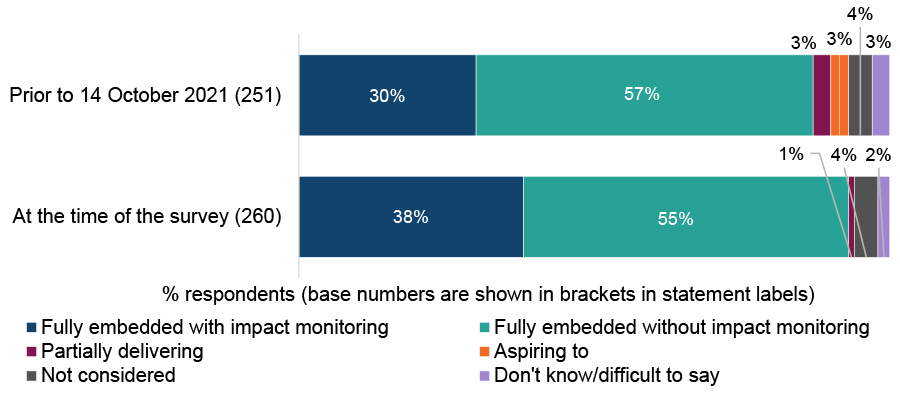
With respect to opposing the use of fire and rehire practices, the employer survey points to a very slight strengthening of commitment over time (6% increase in the proportion of employers saying this criterion is fully embedded) – Figure 32.
Figure 32 Time-based comparison of employer commitment to opposing fire and rehire practices (survey of employers)
Differences by survey sub-group
In terms of statistically significant differences between survey sub-groups, the proportion of employers giving an answer of “fully embedded” is higher among the following sub-groups:
Organisation type: no statistically significant differences.
Organisation size: large organisations, medium organisations and small organisations (96%, 98% and 94% respectively) compared with micro employers (86%).
Contract/grant holders: contract holders only (97%) compared with grant holders only (88%).
4.9.2 Workers’ perceptions of change in employer commitment
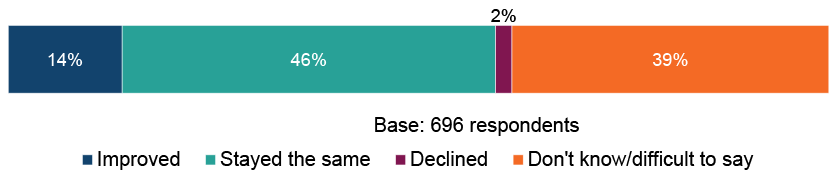
A minority of surveyed workers (14%) believe their employer’s commitment here has improved since autumn 2021 (when changes to Fair Work First were introduced as explained in section 1.2). A small minority (2%) say it has declined (Figure 33).
Figure 33 Workers’ perceptions of change since autumn 2021 in their employer’s commitment relating to opposing fire and rehire practices (survey of workers)
Differences by survey sub-group
In terms of statistically significant differences between survey sub-groups, the proportion of workers identifying an improvement is higher among the following sub-groups:
Organisation type: workers in private sector organisations (16%) and third sector and other organisations (22%) compared with workers in public sector and education organisations (10%).
Organisation size: workers in small organisations (20%) compared with workers in very large organisations (12%).
Surveyed workers were asked what improvements they had observed in their employer’s commitments to opposing fire and rehire practices. The question was asked in a general sense and not specifically due to Fair Work First, which would have been more difficult to answer
For many workers, fire and rehire is not used within their organisation and is perceived as contrary to their employer’s organisational values. Some survey respondents drew attention to formal opposition to such practice by their employer through in-house policies, Fair Work First statements or trade union agreements.
“We did not follow this practice previously, but since Fair Work First came into place, there is a greater level of awareness by my employer that this is unacceptable practice and that may have shaped some decisions.”
Worker, public sector
4.10 How grant-holders’ commitments have changed since July 2023
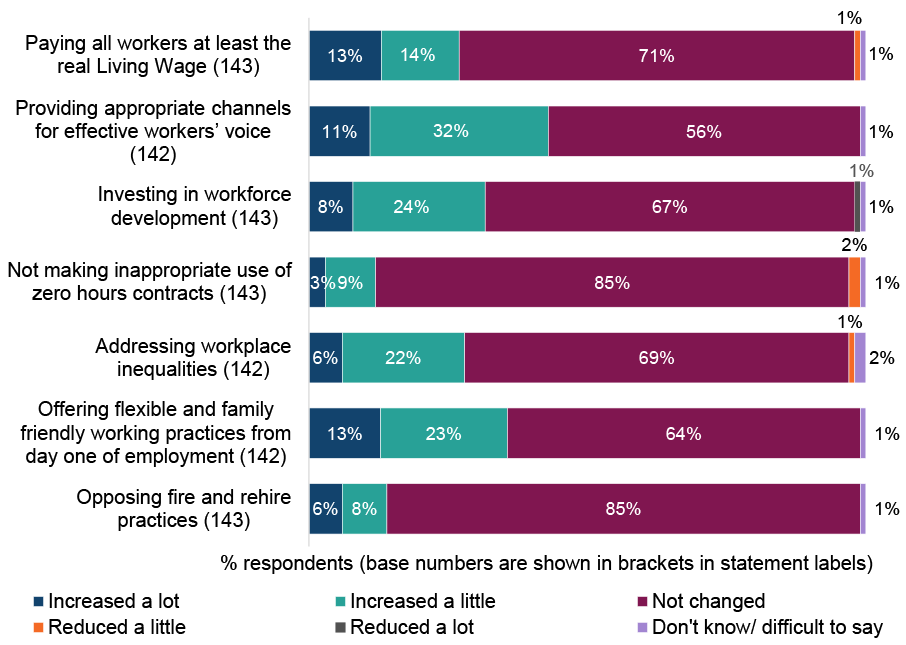
Among surveyed employers in receipt of grants, almost all report that their level of commitment to each of the Fair Work First criteria has either increased (a minority) or remained unchanged (the majority) since the introduction of conditionality on 1 July 2023. The biggest increase relates to providing appropriate channels for effective workers’ voice (43% say they are more committed) - Figure 34.
Figure 34 Extent to which level of commitment to Fair Work First has changed among organisations in receipt of grants since 1 July 2023 (survey of employers)
4.11 How employers track commitment progress
Employers in receipt of grants who were interviewed following the survey were asked how they measure their progress against Fair Work First criteria. They mainly describe such activities as running staff surveys or gleaning evidence from staff forums or discussions.
Some monitor wage levels annually in relation to changes in the real Living Wage, and one said they actively track gender pay ratios.
“We have internal performance indicators around workforce and employment so if any of our practices to do with Fair Work First criteria are not right, we will usually see increased staff turnover, absences, recruitment difficulties etc. We also run employee surveys to find out what employees think and that sort of information internally is important to what we do.”
Employer, large, public sector