
Fair Work First: policy evaluation
An independent evaluation of the Scottish Government's Fair Work First conditionality policy, seeking to understand whether the policy has been delivered as intended.
5. Employer Outcomes Part 2 – Factors Influencing Fair Work Commitments
This chapter provides evidence about the difference that Fair Work First has made to employers’ fair work commitments, drawing on insights from existing data, as well as interviews with buyers/funders, employers and workers. It then considers other wider influencing factors on employers’ commitments.
Reminder of survey base sizes:
- Survey of buyers and funders (base=88)
- Survey of employers (base=260)
- Survey of workers (base=888)
Findings summary
Among surveyed employers agreeing that Fair Work First has increased their commitment to fair work practices, most elaborated through the survey and follow-up interviews that it has strengthened, reinforced, formalised or sharpened existing embedded practices. They describe the criteria as a helpful structure that keeps fair work visible in strategic discussions and prompts regular internal reviews of policies.
Furthermore, two thirds (67%) of surveyed employers say that Fair Work First is one of multiple drivers influencing fair work practices, thus a clear contributory factor but very rarely (for less than 5%) the only one.
5.1 The difference Fair Work First has made to employers’ commitments
5.1.1 Headline measures
To provide further evidence, employers surveyed for this evaluation were asked to what extent they agree or disagree that Fair Work First has made their organisation more committed to each of the seven criteria.
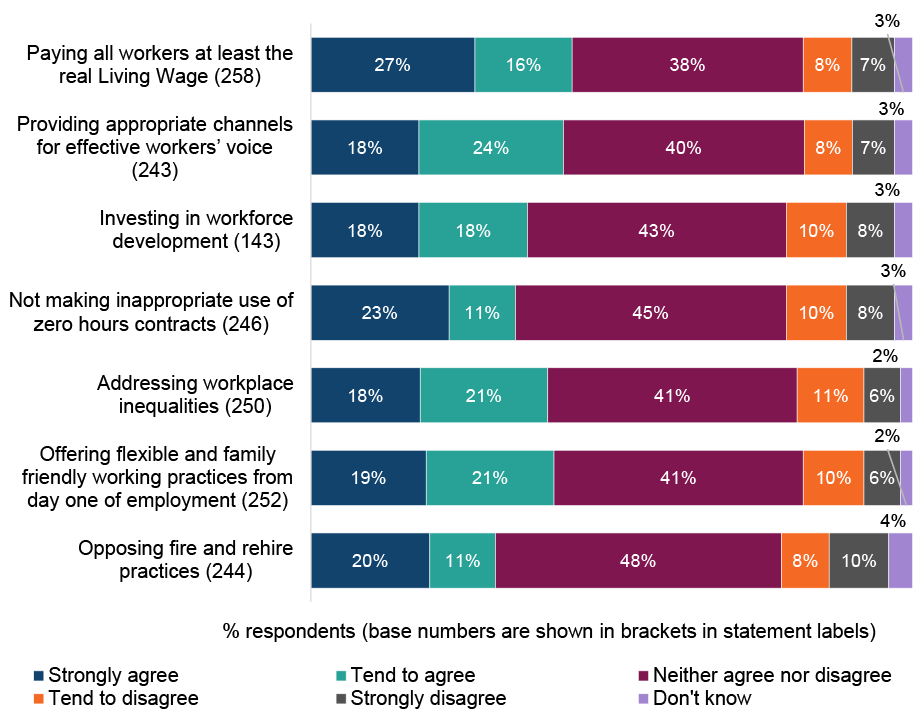
In all cases, the largest proportion of employers fall in the middle – neither agreeing nor disagreeing – suggesting that the policy may have made some difference to practices within these organisations, but that disentangling its effects from other influencing factors could be potentially difficult.
That said, a large minority generally agrees that Fair Work first has made a difference to each criterion, ranging from 31% in the case of opposing fire and rehire practices, to 43% in the case of paying all workers at least the real Living Wage (Figure 35). The pattern is consistent across the seven criteria, with most employers reporting a uniform view of the impact that Fair Work First has had regardless of the criteria.
Figure 35 Extent of agreement/disagreement that Fair Work First has increased commitment to each of the seven practice areas (survey of employers)
Differences by survey sub-group
In terms of statistically significant differences between survey sub-groups, the proportion of employers giving an answer of “agree” or “strongly agree” is higher among the following sub-groups:
Organisation type: with respect to paying all workers at least the real Living Wage – third sector and other organisations (52%) compared to public sector and education organisations and private sector organisations (30% and 29% respectively).
Organisation size: with respect to investing in workforce development – micro organisations (47%) compared to large organisations (27%).
Organisation size: with respect to opposing fire and rehire practices – micro organisations (40%) compared to large organisations (24%).
Contract/grant holders: with respect to four of the five desirable criteria – contract holders only (37-44%) compared to both contract and grant holders (16-26%).
Some stakeholders interviewed for the evaluation are sceptical as to the influence of Fair Work First in relation to adoption of the desirable (non-mandatory criteria) on the basis that employers will generally prioritise “what they are required to do” first and foremost.
5.1.2 Reasons for employers agreeing that Fair Work First has increased their commitment to fair work practices
Among employers agreeing that Fair Work First has increased their commitment to fair work practices, most say it has strengthened, reinforced, formalised or sharpened existing practices rather than transforming them or driving wholesale change. They describe the criteria as a helpful structure that keeps fair work visible in strategic discussions and prompts regular internal reviews of policies.
“Fair Work First serves as a timely reminder to re‑evaluate regularly.”
Employer, small, public sector
In particular, Fair Work First has helped these employers to:
- Increase the level of commitment to the real Living Wage by extending this to all staff, including apprentices and younger workers, and to review pay structures and differentials.
- Make improvements – or accelerate change – to effective workers’ voice, such as introducing more formal (rather than informal) engagement mechanisms as staffing levels grow, making use of staff surveys, forums for discussion and more structured consultation with their workforce.
- Enhance commitments to flexible and family‑friendly working, such as introduction of hybrid models and improved support for caring responsibilities.
- Offer more or better training, supervision and progression opportunities, particularly for younger workers.
- Become more appreciative of equality, fairness and the importance of a positive organisational culture, leading to pay‑gap analysis and stronger inclusion practices.
- Eliminate zero hours contracts, limit the use of temporary contracts, and extend fair work principles to freelancers and contractors.
“Fair Work First has prompted us to review our pay scales for interns… and to ensure payments to third parties and contractors are at or above the real Living Wage.”
Employer, small, registered charity
“Fair Work First has made us recognise a need for a more formal and recorded means of gaining employees’ feedback… We also introduced more flexible working patterns and working from home options.”
Employer, small, private sector
“Fair Work First has strengthened our organisational commitment to fair, inclusive and people‑centred employment practices… encouraging greater consistency and transparency.”
Employer, medium, registered charity
“When something becomes a contractual requirement, you naturally pay closer attention to it, especially when you need to evidence what you’re doing and be honest with yourself about the impact.”
Employer, medium, registered charity
5.1.3 Reasons for employers disagreeing that Fair Work First has increased their commitment to fair work practices
Among the minority of employers disagreeing that Fair Work First has increased their commitment to fair work practices, most put this down to such practices being already deeply embedded or mature within their organisations, with long‑standing commitments to fair pay, worker voice, staff development and ethical practice. In these cases, employers could not identify a “value-add” of Fair Work First.
“We were already committed to all of these things, because it’s the right thing to do.”
Employer, small, registered charity
A small minority mentioned that Fair Work First has not stimulated change because they engage with it mainly to comply with what is asked. Others feel that Fair Work First has limited relevance to their organisation based on their size or model – such as some micro‑enterprises who feel (as noted previously) that the policy favours larger organisations with well-established HR systems, or employee‑owned firms.
Others point to a lack of clear evidence that Fair Work First has influenced their policies or behaviours, or cited shrinking contract values meaning they need to prioritise other things.
“As bureaucracy has increased while contract values have decreased, so has investing in staff development – something has to give.”
Employer, small, private sector
5.1.4 Buyer/funder lens on the difference Fair Work First has made to employer commitments
For their part, buyers and funders interviewed following the survey are more nuanced in their views on whether Fair Work First has led to real and meaningful change among employers.
One buyer/funder mentioned that Fair Work First has been in place “for such a long time now” that its impact becomes hard to truly measure. In contrast, another buyer/funder interviewee made the point that Fair Work First could be a deciding factor when it comes to an employer winning or not winning a contract or grant.
Two other buyers and funders who took part in interviews were more cynical in their view, as the following quotations illustrate:
“If you were to look under the veneer of bigger, glossy companies, you might find they are not doing all the things they promise.”
Buyer/funder
“It’s easy to get around the questions because Fair Work First has no teeth. If you want to be a good employer, you’ll do those good things anyway, but if you don’t, then you’ll find ways around it.”
Buyer/funder
5.1.5 Workers’ views on the difference Fair Work First has made to their employer’s commitments
Surveyed workers were also asked whether they believe that Fair Work First policy has played a role in increasing their employer’s commitment to fair work practices.
It was anticipated that this would be a difficult question for workers to provide an informed response to, potentially due to lack of knowledge of the policy for many workers and/or it being difficult to disentangle perceived impact from wider factors influencing workplace environments. While most (53%) felt unable to say, a third (33%) answered that yes – in their view, Fair Work First has played a role. In contrast, 14% answered no (base=884).
Workers answering “yes” were asked in what ways they believe Fair Work First has played a role in increasing their employer’s commitment to fair work practices. Common messages echo those of employers, that the policy has helped to reinforce, formalise or extend employers’ existing commitments to fair work, particularly payment of the real Living Wage, new or enhanced forms of employee engagement, or offering flexible working arrangements.
Whilst many acknowledge that their employer was already demonstrating many of these practices prior to Fair Work First being implemented, they emphasise that the policy appears to have strengthened accountability and encouraged their employer’s ongoing review of workplace practices. Others mentioned that Fair Work First has encouraged their employer to strengthen internal policies and raise the bar on expectations of suppliers.
“I believe my workplace has always been aligned to the spirit of Fair Work First, but having it documented strengthens the commitment and confirms that commitment to all involved.”
Worker, private sector
“Fair Work First has pushed our employer through legislation to increase the minimum wage for the lowest paid, however this has had a detrimental effect on everyone else's wage as the organisation has not been able to afford to increase theirs.”
Worker, registered charity
5.1.6 Influence of mandating certain Fair Work First criteria
The employer survey sought to understand the extent to which mandating certain Fair Work First criteria as part of procurement or grant arrangements drives employers’ fair work commitments. The results reveal that – for the most part – it does, but in combination with other factors helping to stimulate change.
For employers in receipt of contracts, 2% say that mandating payment of at least the real Living Wage is the only driver to their organisation’s current commitment to fair work. More than two thirds (67%) say it is one of multiple drivers, 23% say it is not a driver at all and 7% are unsure (base=162).
Differences by survey sub-group
In terms of statistically significant differences between survey sub-groups, the proportion of employers saying that Fair Work First “is the only driver” influencing payment of at least the real Living Wage is higher among the following sub-groups:
Organisation type: no statistically significant differences.
Organisation size: micro organisations (10%) compared with medium organisations and large organisations (0% for both).
Contract/grant holders: no statistically significant differences.
For employers in receipt of grants, the picture is very similar. Just 4% say that a requirement to pay at least the real Living Wage, as well as provide appropriate channels for effective workers’ voice, such as trade union recognition, are the only drivers to their organisation’s commitment to fair work. More than two thirds (68%) say conditionality is among multiple drivers, 19% say conditionality is not a driver at all, and 10% are unsure (base=142).
5.2 Wider influencing factors, including trade union recognition
Surveyed employers were asked – aside from Fair Work First – what other factors have contributed to their organisation’s current level of commitment to fair work.
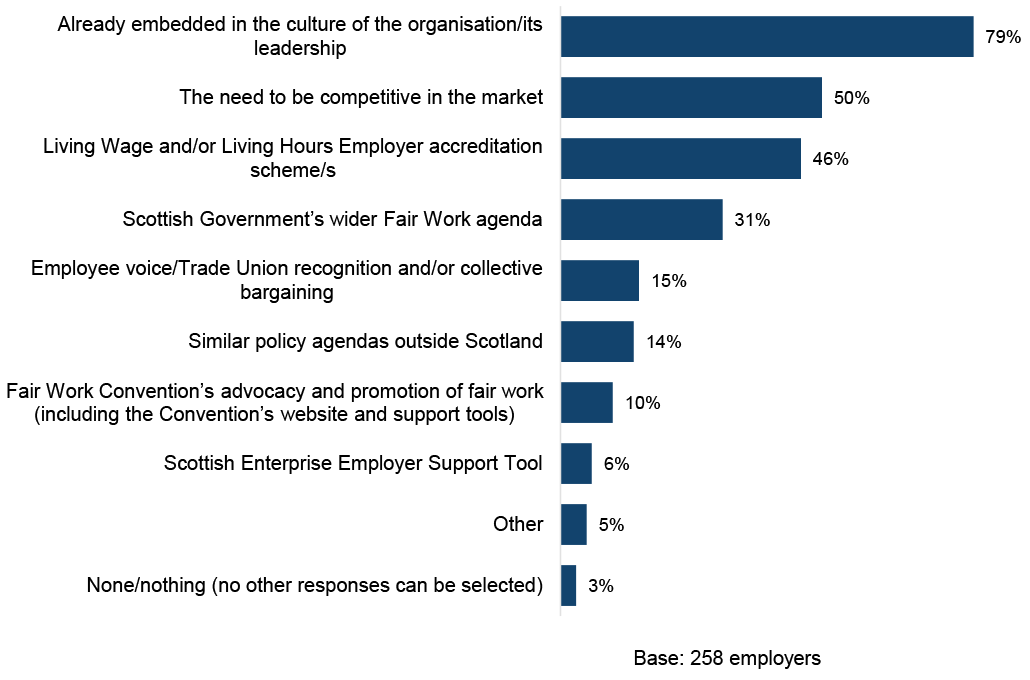
The results reveal a whole host of influencing variables. On average, employers selected between two and three, with the most common being that fair work is already embedded in the culture of the organisation and its leadership (mentioned by 79%), the need to be competitive in the market (mentioned by half, 50%) and the Living Wage and/or Living Hours Employer accreditation scheme/s (46%) – Figure 36.
Figure 36 Other factors that have contributed to employers’ current level of commitment to fair work (survey of employers)
Differences by survey sub-group
In terms of statistically significant differences between survey sub-groups, the proportion of employers saying that commitment to fair work is already embedded in the culture of the organisation/its leadership is higher among the following sub-groups:
Organisation type: third sector and other organisations (84%) compared with private sector organisations (74%).
Organisation size: micro organisations (87%) compared with small organisations (79%).
Contract/grant holders: grant holders only (87%) compared with contract holders only (71%).
The proportion of employers influenced by the need to be competitive in the market is statistically significantly different as follows:
Organisation type: private sector organisations (57%) compared with third sector and other organisations (43%).
Organisation size: large organisations (63%) compared with small and micro organisations (47% and 36% respectively).
Contract/grant holders: contract holders only (56%) compared with grant holders only (42%).
Further analysis of findings from the employer survey provides some insight into the potential influence that trade union recognition has on fair work commitments.
Firstly, linking to Figure 21, there is a statistically significant difference in the proportion of surveyed employers that have fully embedded effective workers’ voice at the time of the survey between those that do recognise a trade union (91%) and those that do not (71%).
Secondly and linking to Figure 22, a greater proportion of employers recognising a trade union say they provide appropriate channels for effective workers’ voice through each of the various listed mechanisms compared with those that do not – for most of these mechanisms the differences between the two groups are statistically significant.
These findings also appear to be backed up by the survey of workers (explored further in section 6.2). In terms of statistically significant differences between survey sub-groups:
- The proportion of workers agreeing that their employer provides appropriate collective channels for effective workers’ voice is higher among workers whose employer recognises a trade union (76%) compared with workers whose employer does not recognise a trade union (53%).
- The proportion of workers agreeing that their employer provides appropriate individual channels for effective workers’ voice is higher among workers whose employer does recognise a trade union (88%) compared with workers whose employer does not recognise a trade union (76%).
It is not possible to conclude whether trade union recognition does or does not influence the availability and types of effective voice channels (collective and/or individual) nor whether certain fair work commitments would have happened as a result of trade union recognition had Fair Work First never existed. It may be that trade union recognition encourages employers to take additional steps to improve workplace conditions.
5.3 The attribution challenge
The preceding sections in this chapter have provided self-reported evidence of the difference Fair Work First has made to employers’ fair work commitments and identified that the policy is one of multiple influencing factors shaping those commitments. However, directly attributing meaningful change to Fair Work First remains extremely difficult.
Stakeholders interviewed during the early stage of the evaluation – including, but not limited to, members of the Research Advisory Group – point to a number of key attribution challenges, such as:
- Multiple overlapping influences on employers (e.g. existing practices and motivations, accreditation decisions, sector and labour market conditions and wider economic pressures).
- Deadweight, i.e. employers already doing what Fair Work First policy asked them to do (on the one hand, surveyed employers self-report fair work practices as being generally well-embedded, although they do emphasise that the policy has helped to strengthen them).
- Lack of clear on-going monitoring data and mechanisms since Fair Work First policy was first introduced.
- Organisational structures often being slow to change, for example due to bureaucracy and power dynamics.
- With respect to effective workers’ voice, such as trade union recognition, a particular difficulty in measuring the “effectiveness” of voice channels and a lack of robust policy enforcement to ensure genuine worker influence.
On balance, interviewed stakeholders are generally of the view that Fair Work First has likely contributed indirectly to fair work practices, for example by encouraging buyers and funders to embed the real Living Wage as a funding criterion, raising public body expectations, and creating a step-change where employers know they cannot access funding without demonstrating compliance or progress.
Findings gathered as part of the evaluation appear to support this. The survey of buyers and funders has clearly identified that their own understanding and application of Fair Work First criteria has strengthened, while surveyed employers in turn have self-reported that their commitments to the criteria have increased since policy changes were introduced, and surveyed workers largely paint a picture of positive change and fair work experiences where they work.