
Fair Work First: policy evaluation
An independent evaluation of the Scottish Government's Fair Work First conditionality policy, seeking to understand whether the policy has been delivered as intended.
7. Wider Impact and Unintended Consequences
This chapter considers the lasting impact of Fair Work First for employers and workers, including spillover benefits and unintended consequences.
Reminder of survey base sizes:
- Survey of buyers and funders (base=88)
- Survey of employers (base=260)
- Survey of workers (base=888)
Findings summary
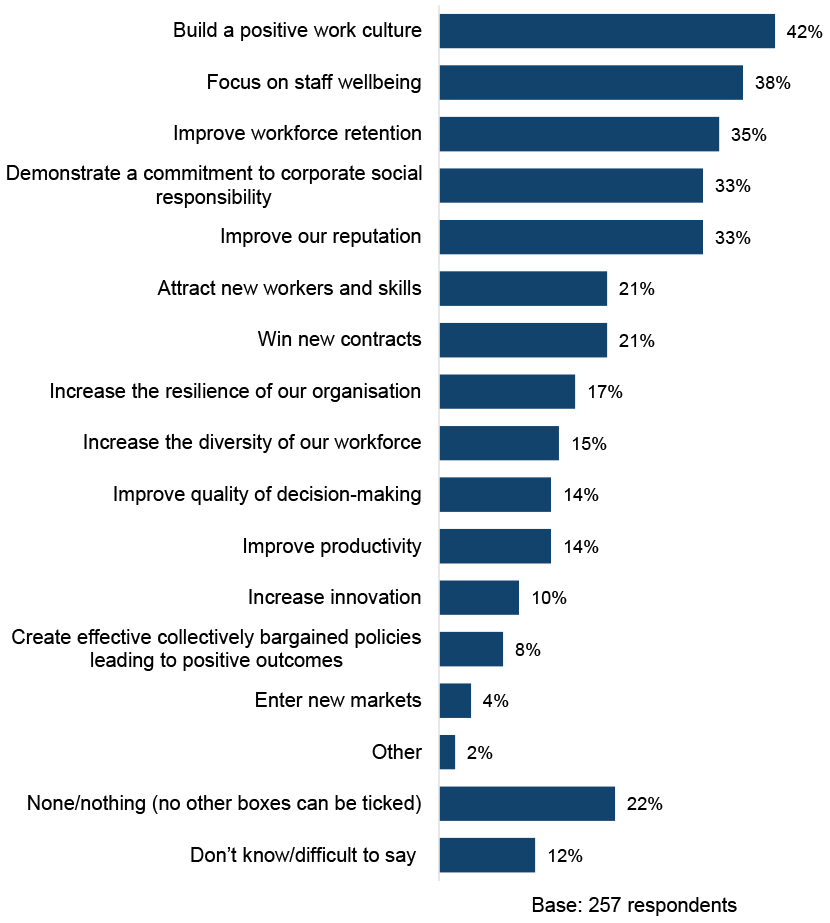
Surveyed employers were asked what Fair Work First has helped their organisation to do. The top three wider impacts include building a positive work culture (42%), focusing on staff wellbeing (38%) and improving workforce retention (35%).
As evidence of spillover benefits from Fair Work First, 78% of surveyed employers have included evidence of their fair work commitments to support when bidding for a contract and/or funding from a non-public sector organisation.
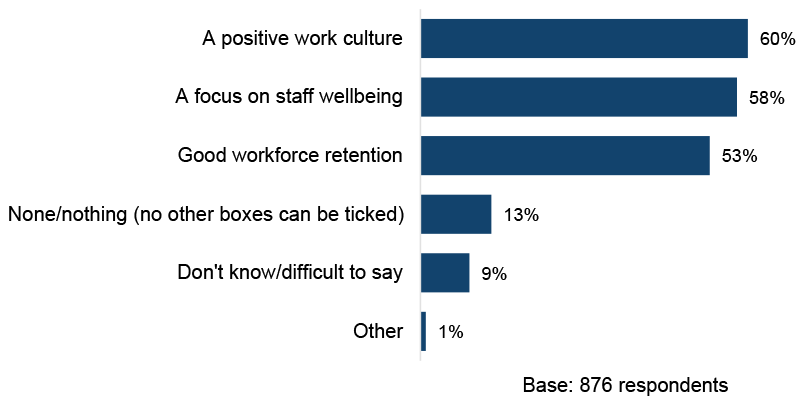
From the worker perspective, 60% of those surveyed mentioned experiencing a positive culture where they work, 58% have felt improved staff-wellbeing and 53% mentioned good workforce retention.
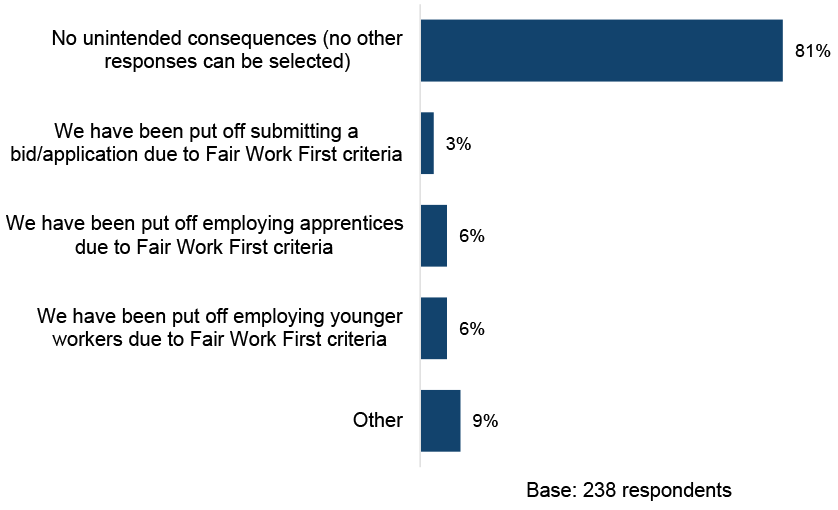
For most surveyed employers, Fair Work First has not triggered any unintended consequences that they could identify. However, 6% reported being put off employing apprentices due to the application of the real Living Wage criterion; and 6% reported being put off employing younger workers for the same reason.
In relation to the real Living Wage, some interviewed stakeholders and employers – especially those in sectors with lower average wages – describe significant financial pressures created when wage requirements rise faster than contract or grant increases, reducing capacity for expansion and growth.
7.1 Wider impact for employers
7.1.1 Previous evidence
To set the scene, survey and consultation activity to inform the BRIA highlights a range of positive impacts for employers of paying at least the real Living Wage and providing appropriate channels for effective workers’ voice. These are summarised as follows:
Paying at least the real Living Wage:
- Making the organisation more attractive to staff particularly in competitive sectors/areas.
- Enabling the organisation to attract high calibre staff and reduce staff turnover.
- Aligning with the value of the organisation – namely acting with fairness and integrity, doing the right thing, and paying workers decently.
- Wanting to support local communities and have a social impact.
- Increased productivity, efficiency, sustainability.
- Better workplace culture with positive relationships with staff and contractors.
- Strengthened reputation.
- Brand and competitive advantage.
Providing appropriate channels for effective workers’ voice, such as trade union recognition:
- Improved organisational communication and culture.
- Improved worker morale and job satisfaction – feeling heard, valued and included.
- Increased engagement and commitment.
- Better business/organisation performance – greater innovation and problem solving, better decision making, better identification of potential improvements and risk.
- Enhanced reputation.
- Smoother recruitment and retention – being a more attractive employer.
7.1.2 What Fair Work First has helped surveyed employers to do
Employers surveyed for this evaluation were asked what (from a pre-defined list) Fair Work First has helped their organisation to do. The results reveal a wide range of organisational benefits, each experienced by a minority of employers. The top three are building a positive work culture (mentioned by 42%), focusing on staff wellbeing (38%), and improving workforce retention (35%) – Figure 43.
Figure 43 Ways in which Fair Work First has helped employers (survey of employers)
Employers interviewed following the survey were asked to elaborate on the positive business outcomes they have experienced which they believe to be a direct result of Fair Work First.
Most reiterated the point that Fair Work First has not introduced fundamentally new practices but instead reinforced, formalised or validated approaches already in place. This includes helping them to evidence, organise and reflect on these practices more systematically.
“Many of the principles were already part of our approach… the initiative has helped us think more critically about how effective our measures are.”
Employer, medium, private sector
These employers do identify a connection between Fair Work First and improved staff morale, wellbeing, and a sense of being valued. They attribute this to a greater emphasis on fair pay, job security, flexibility, and a supportive working environment. Even where fair work practices were already in place prior to Fair Work First being implemented, employers are keen to state that Fair Work First has reinforced those commitments.
“Employees feel more valued and listened to… strengthening trust, teamwork and workplace culture.”
Employer, medium, private sector
Interviewed employers also mentioned that Fair Work First has helped them to make implicit values or abstract principles more explicit, through embedding them more consistently across the organisation through everyday decision-making and behaviours.
Fair Work First is also frequently described by employers as providing a useful framework or benchmark against which they can assess their employment practices, such as aligning staff surveys or with broader fair work objectives. Employers feel this supports more structured reflection, monitoring and continuous improvement, as well as ensuring they are held accountable to their stated values.
Additionally, interviewed employers perceive Fair Work First as encouraging more open communication and greater involvement of staff in decision-making processes, helping to strengthen trust between management and workers, and building a more collaborative workplace environment.
Whilst it cannot be attributed solely to Fair Work First, several interviewed employers cited the real Living Wage as having a tangible impact on worker satisfaction and perceptions of financial security and fairness. A small number of employers referred to measurable improvements in employee satisfaction following the introduction or extension of real Living Wage practices.
“We saw a 15% uplift in employee satisfaction… after the real Living Wage was introduced.”
Employer, large, registered charity
Several employers attribute Fair Work First to their increased investment in training, apprenticeships and internal career development practices, which in turn has helped to support workforce capability, progression and motivation.
Other business impacts of Fair Work First as reported by employers include being:
- Able to more confidently communicate practices both internally to staff and externally to clients and stakeholders.
- Able to standardise policies and practices (leading to improved clarity and consistency on matters such as pay, flexibility and support for the workforce).
- More competitive, and thus better placed to win future contracts.
“We wouldn’t have won [a contract] if we weren’t a real Living Wage employer.”
Employer, medium, private sector
Interviewed employers emphasised long-lasting benefits from their fair work commitments in the areas of retention, recruitment and productivity.
They note that higher wages, supportive policies and a strong organisational reputation have helped attract higher quality candidates and reduce staff turnover, while improved working conditions and clearer progression pathways have strengthened loyalty and internal development. They say that these improvements have also contributed to higher productivity, noting that better skilled and more motivated staff are able to take on more complex roles and deliver stronger performance.
Staff morale has similarly improved, with some interviewed employers describing a shift from earlier challenges associated with high levels of sickness absence and low motivation, to a more positive, stable and committed workforce.
“Paying higher wages means we can attract better talent. It’s also good for our reputation amongst our membership – we can show we are leading the way in Fair Work First principles.”
Employer, micro, registered charity
7.2 Impact on trade union relationships
Surveyed employers that recognise a trade union were asked to what extent Fair Work First has changed their relationship with the trade union(s) they recognise.
Of the 68 responding employers, 14% believe that Fair Work First has improved that relationship, 69% say the relationship has not changed as a result, 1% say it has worsened and 16% are unsure.
When probed for their reasons, most mentioned that their relationship with trade unions has remained positive, stable, collaborative, constructive and well-functioning, with no significant shifts attributable to the policy. For some, this partly comes down to limited engagement with trade unions, often due to low membership or lack of demand from staff.
Among those employers for whom Fair Work First has improved their trade union relationship, they say the policy has provided a framework or language to demonstrate good practice and communicate their commitments to trade unions. A small minority report modest process improvements, such as clearer structures for engagement or better shared understanding between employers and trade unions.
“Fair Work First has helped us to review our terms of reference and brought structure and clarity to trade union engagement.”
Employer, large, public sector
A small minority of employers mentioned tensions emerging with trade unions where it appears to them that trade unions “over-extend” Fair Work First criteria, leading to conflict more than constructive dialogue.
“Trade unions have tried to weaponise Fair Work First criteria.”
Employer, large, public sector
7.3 Wider impact for workers
Surveyed workers were asked what types of wider impacts of fair work practices (if any) they have experienced.
From a pre-defined list of three impact areas, the findings point to wider benefits being realised by most of those surveyed. More than half mentioned experiencing a positive work culture, improved staff-wellbeing and good workforce retention (Figure 44).
Figure 44 Wider impacts of fair work practices experienced (survey of workers)
Differences by survey sub-group
In terms of statistically significant differences between survey sub-groups, the proportion of workers saying they have experienced a positive work culture is higher among the following sub-groups:
Organisation type: workers in private sector organisations and third sector and other organisations (78% and 74% respectively) compared with workers in public sector and education organisations (44%).
Organisation size: workers in micro (76%), small (73%), medium (59%) and large (79%) organisations compared with workers in very large organisations (46%).
Workers interviewed following the survey describe fair work practices contributing to a supportive workplace culture where people feel content in their roles, a sense of wellbeing and overall satisfaction.
Wellbeing strategies, mental health support, and practical initiatives such as gym access, counselling provision and cycle to work schemes are identified as contributing positively to personal wellbeing in the workplaces of interviewed workers.
Indicators of a good place to work identified by interviewed workers include such factors as long staff tenure and employer responsiveness to staff survey feedback, manifest through support offers being adapted to better meet staff needs.
However, some workers feel that fair work arrangements are unevenly applied within their organisations or operated as a “tick box” exercise rather than being fully embedded in day-to-day working. Several expressed a desire to see greater consistency and sustained investment in staff wellbeing.
“I have personally experienced a positive workforce culture, have seen people stay here because they feel supported and valued and our policies and support for staff wellbeing have expanded over the past five years. But I know that this is not the case for all of my colleagues and it does depend on which part of the organisation you work in.”
Worker, public sector
Funding constraints and short-term funding cycles, particularly in the public and third sectors, are frequently identified by workers as limiting the ability of their employers to provide job security, workforce stability, and long-term development opportunities.
“Given the nature of my work it is funded year to year so that makes it difficult to feel secure and want to develop in the one place. This is linked to the unstable nature of the sector I work in and is really not something my employer can control directly without further financial input from funders.”
Worker, other voluntary/third sector
7.4 Spillover benefits
Spillover benefits of Fair Work First as identified by buyers and funders interviewed for this evaluation are as follows:
- A general ripple effect – employers are encouraged to think more regularly about what they are doing in terms of fair work practices and how to enhance those commitments and (in turn) improve their ability to demonstrate that as part of bid processes.
- More SMEs are encouraged to take part in supplier development programmes to help them think about how to meet the criteria and demonstrate that commitment as part of applications.
- Fairer pay is arguably helping to lead to more consistent service provision, such as transport and security contracts, due to these employers being able to retain good workers.
More than three quarters (78%) of surveyed employers say they have included evidence of their fair work commitments when bidding to a non-public sector organisation (53% where they were asked to do so, and 25% even where not asked to do so) (base=251).
This finding indicates that Fair Work First practices are not purely limited to public sector contracts, but that non-public sector buyers and funders also appear to be placing value on fair work, and that employers are able to identify wider benefits of being a fair work employer can bring.
One employer interviewed following the survey mentioned being asked by a non-Scotland based public sector organisation about their commitment to paying the real Living Wage and use of zero hours contracts, suggesting that buyers and funders outside Scotland could be taking inspiration from Fair Work First policy.
7.5 Unintended consequences
For most surveyed employers (81%), Fair Work First has not triggered any unintended consequences that they could report.
However, 6% report they have been put off employing apprentices due to Fair Work First criteria; 6% have been put off employing younger workers for the same reason; and 3% have been put off submitting a bid/application due to Fair Work First criteria being applied (Figure 45).
Figure 45 Unintended consequences of Fair Work First (survey of employers)
Surveyed and interviewed employers were asked to say more about unintended consequences which they believe are a direct result of Fair Work First. These are grouped by theme, below.
Contributing to financial pressures
A prominent unintended consequence relates to paying workers at least the real Living Wage. Many employers – especially those in sectors with lower average wages – describe significant financial pressures created when wage requirements rise faster than contract uplifts.
This mismatch is seen as creating an unsustainable squeeze, especially for smaller employers and within the third sector when having to absorb rising wage costs without corresponding increases in grants or contract values. This creates difficult trade-offs and – in some cases – appears to have contributed to redundancy processes.
“We are having to implement redundancies to afford the real Living Wage increase each year as our government grant [is] static.”
Employer, medium, registered charity
Pay compression
Also relating to the real Living Wage, employers reiterated the point about reduced differentiation between entry-level and more experienced roles. This has reportedly led to concerns about morale, retention, and progression, particularly where experienced or skilled staff are paid similarly to entry-level roles.
“Our café worker has been with us two years… then we had a 16-year-old… it doesn’t seem fair that they both get paid the same.”
Employer, small, registered charity
Reinforcing these concerns, the same issue emerged from the survey of workers.
“Fair Work First has pushed our employer through legislation to increase the minimum wage for the lowest paid, however this has had a detrimental effect on everyone else's wage as the organisation has not been able to afford to increase theirs.”
Worker, registered charity
Reduced capacity for expansion and growth
Closely linked to financial pressures, some employers say they have become more cautious about recruitment, expansion and workforce planning. Short-term or uncertain funding combined with Fair Work First expectations has, in some cases, limited capacity for growth and reduced flexibility in creating new roles or investing in staff.
Adverse effect on apprenticeships
Another pay-related unintended consequence relates to apprenticeships or entry-level roles. Several employers – especially in construction – mentioned that exceptions are required to sustain apprenticeship provision and, without them, they would need to reduce their offering of such opportunities.
Disproportionate administrative burden
Another unintended consequence relates to increased administrative workload which appears to disproportionately affect smaller employers. In these cases, evidencing Fair Work First commitments can require significant time and resource, often duplicating existing processes. Linked to this, a stakeholder interviewed for the research mentioned the perceived risk that employers can “easily present superficial forms of voice” or that meeting the criteria could become a “tick box exercise” – the latter also mentioned by some surveyed workers.
Competitive disadvantage
Some employers are concerned that where they invest strongly in fair work practices, they may not in fact have a competitive advantage compared with organisations that only superficially comply. They put this down to a lack of monitoring or enforcement which – in their view – can undermine fairness and create an uneven playing field.
“Some of our competitors don’t have to pay the real Living Wage, which makes our service more expensive.”
Employer, large, public sector
There are also concerns that some organisations may be winning contracts despite not genuinely adhering to Fair Work First criteria, thus meaning employers that work hard to implement fair work practices are disproportionately negatively affected.
“Without some form of verification then Fair Work First is somewhat toothless.”
Employer, medium, registered charity
Other unintended consequences
- Some buyers and funders are concerned that where they feel the need to ask for additional supporting evidence from employers, this can become problematic by delaying funding decisions or creating additional costs for applicants.
- One stakeholder interviewed for the evaluation is concerned that Fair Work First policy could be pushing greater use of freelancers or even “volunteer” roles replacing paid work, involving long hours or significant responsibility which runs counter to fair work principles.
- Another stakeholder suggested that focusing the policy on the real Living Wage risks diverting necessary attention away from wider issues such as pay progression and income distribution.
- An additional stakeholder suggested that the effective workers’ voice criterion could be encouraging greater use of internal staff forums instead of adopting trade union recognition – which risks weakening effective worker voice.