
Understanding the drivers of changes in demand for disability benefits in Scotland since 2010: A quick scoping review
This quick scoping review identifies and summarises research that examines the different drivers of demand for disability benefits in Scotland and the UK since 2010.
3. Changes in demand for disability benefits in Scotland since 2010
This section of the report addresses the secondary (contextual) research questions on how demand for disability benefits has changed in Scotland and who is in receipt of disability benefits and how has this changed over the last 15 years. It sets out recent trends in relation to disability benefits in Scotland since 2010. As described in section 5.3 disability benefits have been subject to several major reforms over recent years, including the move from DLA to PIP and the introduction of ADP in Scotland. It is important to understand changing trends in disability benefits in the context of these wider reforms and changes in disability benefit caseload across the UK.
Summary: The number of working-age adults and children receiving disability benefits in Scotland has increased substantially since the early 2010s. The rise in disability benefit take up has been particularly pronounced in both Scotland and the UK since the Covid-19 pandemic with a spike in applications in Scotland following the introduction of ADP and CDP. The age profile of new recipients of working-age disability benefits in Scotland has changed and now includes a larger proportion of younger people. There has also been an increase in the proportion of people receiving working-age disability benefits due to mental and behavioural disorders and circulatory diseases.
3.1 How has demand for disability benefits changed over the last 15 years, in the UK and Scotland?
Across Great Britain the overall number of people receiving disability benefits has increased substantially over recent years.[20] This is illustrated in Figure 3.1 below which shows that overall, across all age categories the number of people receiving disability benefits has increased from 4.4 million in May 2005 (7.4% of the population) to 6.9 million in May 2025 (10.8% of the population).[21] Over the period covered in Figure 3.1 there have been several reforms to the UK benefits system. Several reports[22], [23], [24], [25], [26] highlight the notable rise in disability benefit caseloads that occurred across the UK in 2015-16 when the transition from DLA to PIP took effect (see section 5.3).
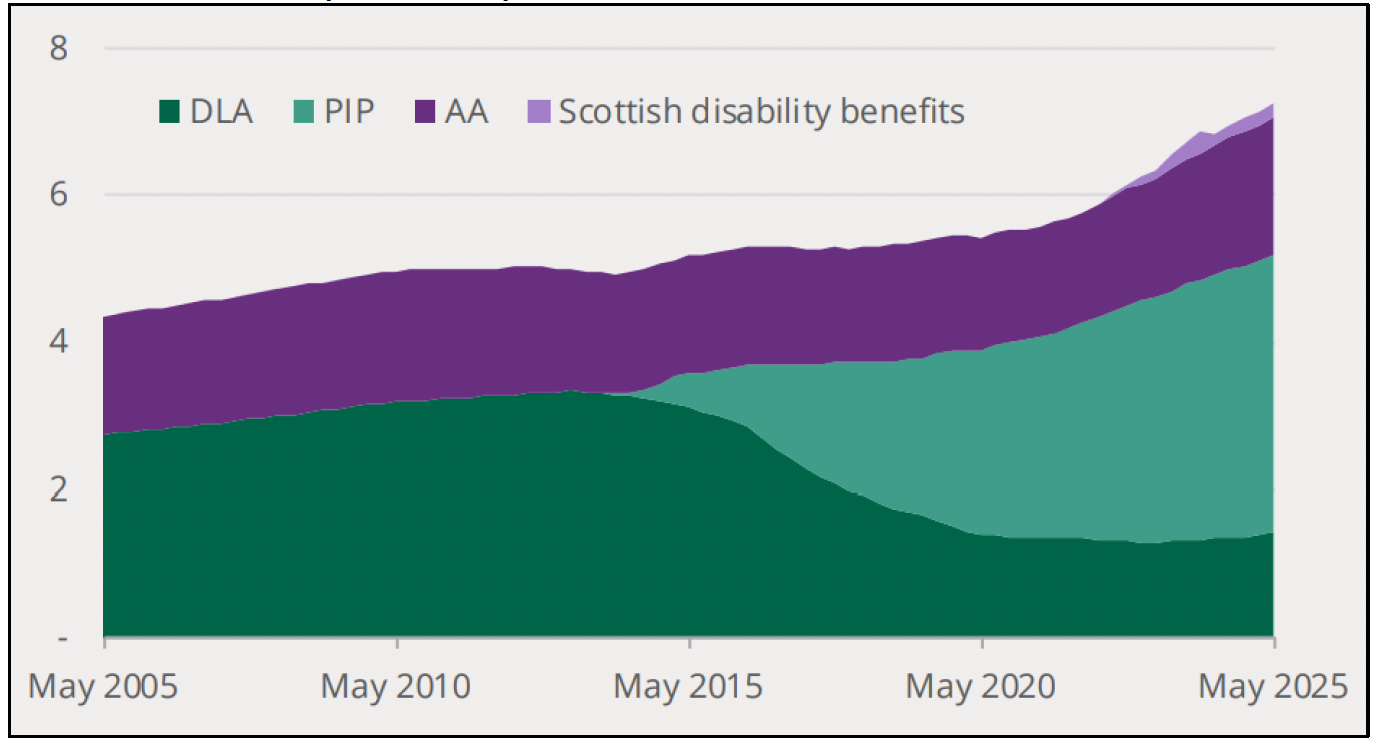
Source: House of Commons Library (2025) UK disability statistics: Prevalence and life experiences
As well as reforms to the benefits system, several studies highlight the growth of disability benefit caseloads post-Covid at the GB level. Analysis by the IFS on working-age disability and incapacity benefits showed that before the pandemic there had been a steady increase in the number of working-age disability benefit recipients, rising from around 1.5 million in 2002–03 to 2.3 million in 2019–20 (roughly 50,000 extra per year). However, the rate of increase has accelerated sharply since then growing by 1 million to 3.3 million between 2019–20 and 2023–24 (roughly 250,000 per year) (see Figure 3.2 below). Forecasts from the OBR and SFC suggest that the number of working-age people receiving disability benefits will grow considerably faster that the number of people receiving incapacity benefits over the coming years.[27]
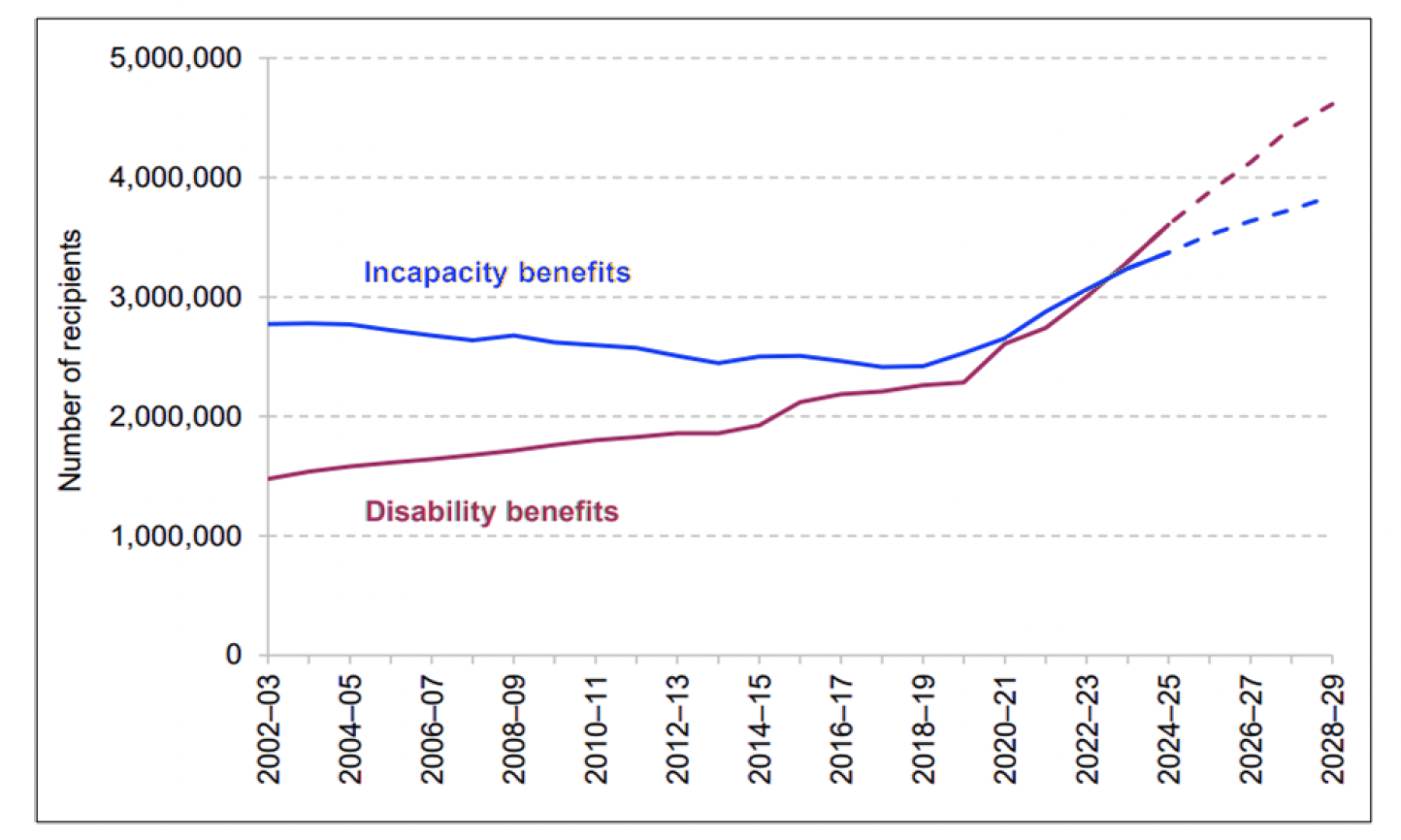
Source: Ray-Chaudhuri, S. Waters, T (2024) Recent trends in and the outlook for health-related benefits (adapted for accessibility)
Similarly, to the rest of the UK the number of adults receiving disability benefits in Scotland has also increased relatively rapidly since the end of the Covid-19 pandemic. It is worth noting that this post pandemic period also saw the phased introduction of ADP in Scotland. The number receiving PIP or ADP in Scotland increased by 51% between March 2022 and January 2025 (from 310,545 to 468,470[28] (see Figure 3.3 below).
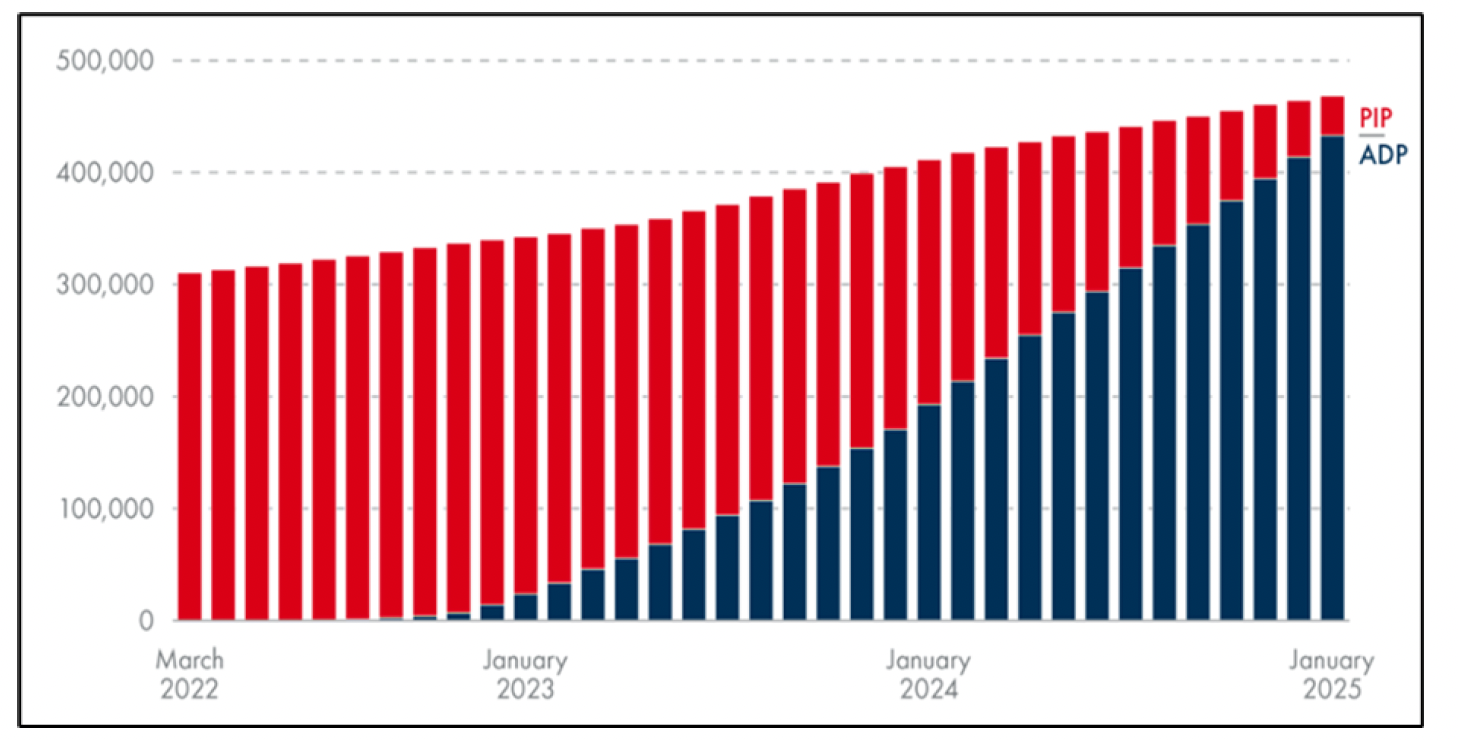
Source: SPICe (2025) Disability Benefit Reform – implications for Scotland (adapted for accessibility)
There has also been a large increase in the number of children in Scotland receiving CDP or Disability Living Allowance for Children (DLAc).[29] Figure 3.4 shows that the number of children receiving either CDP or DLAc in Scotland has increased substantially between November 2021 and August 2024.
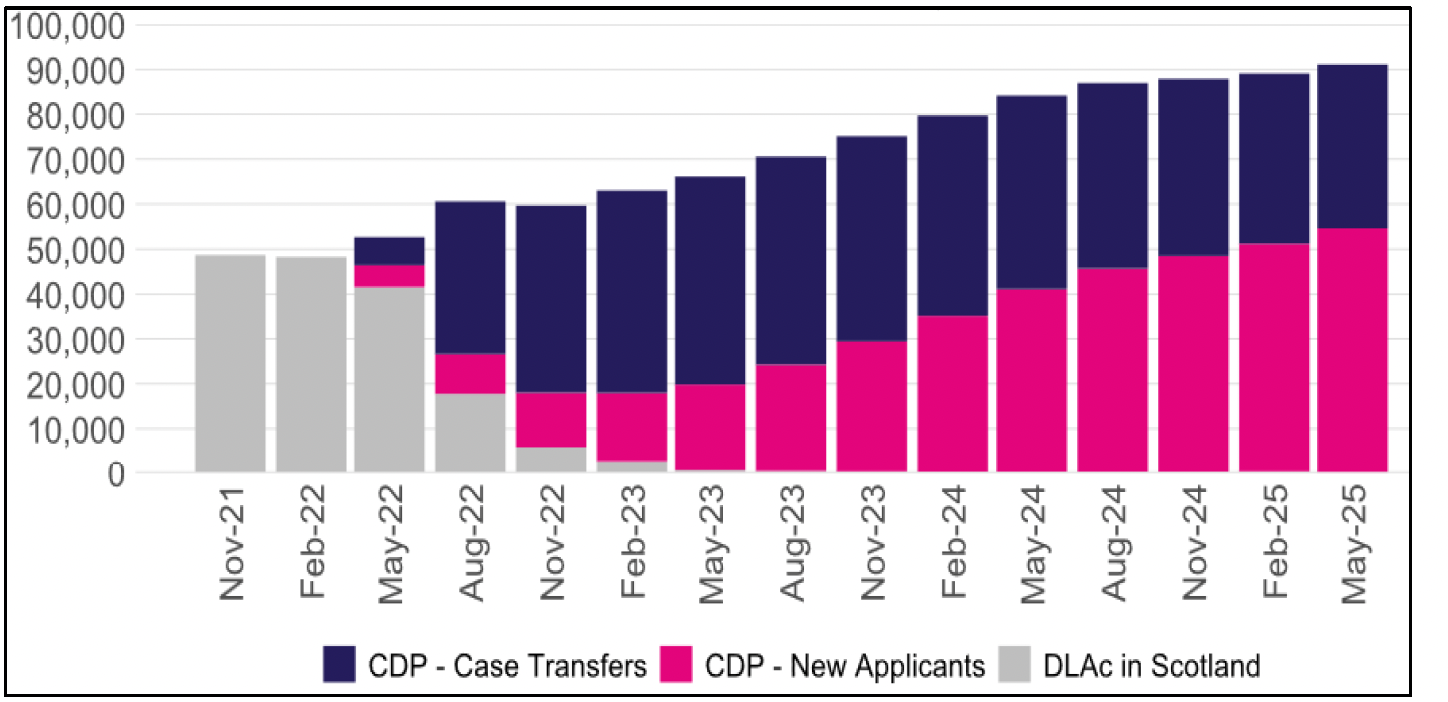
Source: Social Security Scotland Analysis (unpublished analysis)
In addition to the overall disability benefit caseload increasing in Scotland, the number of monthly disability benefit awards has also been increasing. Whilst the number of new awards has fluctuated monthly, overall there has been a steady increase in the number of new awards. Figure 3.5 below shows the number of new monthly awards for PIP and ADP between April 2018 and July 2024, in addition to the overall upward trend in awards. Figure 3.5 also shows a large spike in new awards following the introduction of ADP, this peaked in November 2023[30] and has since fallen in 2024 and 2025.
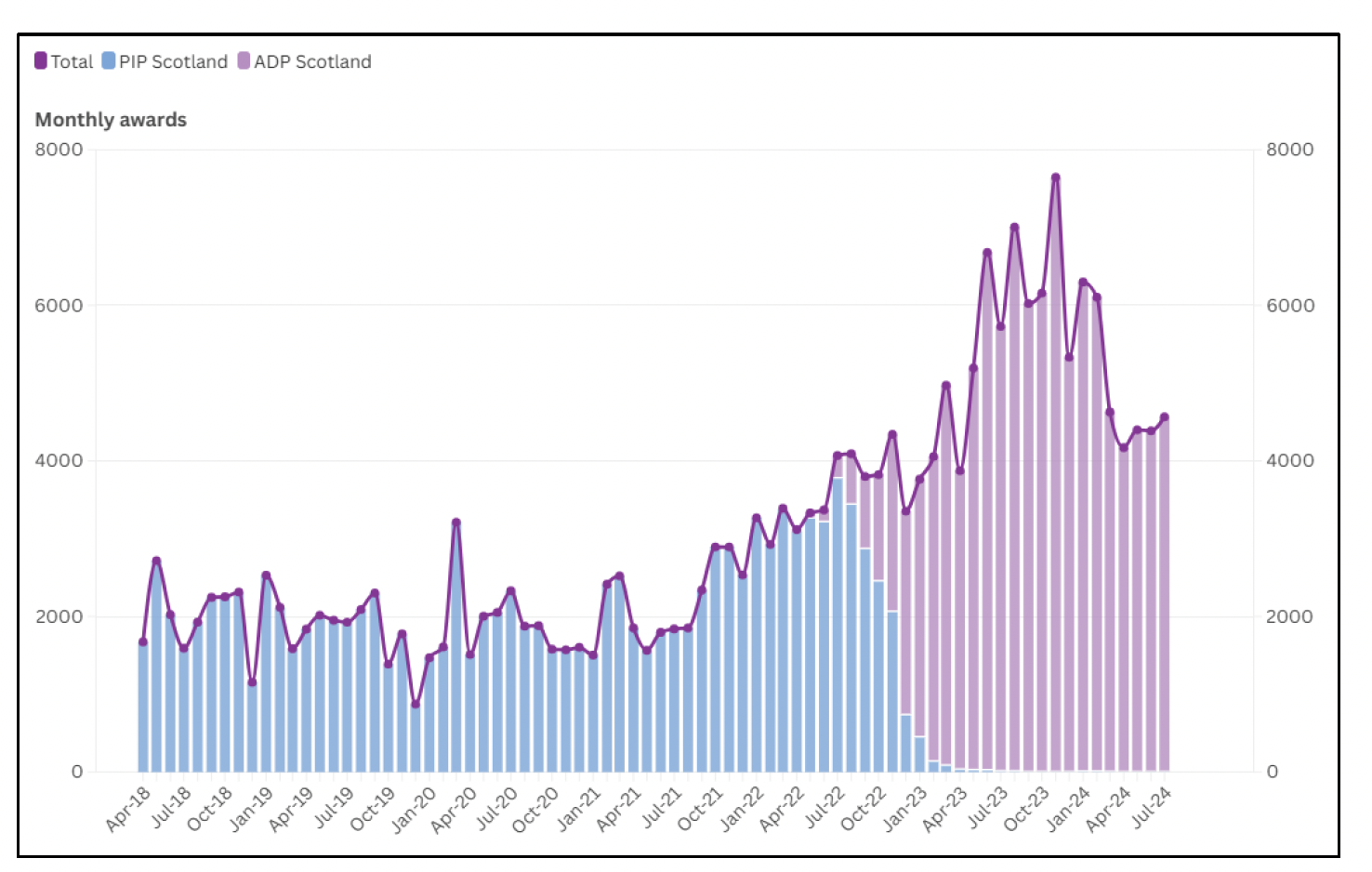
Source: Congreve, E. (2024) New awards of disability benefits for adults: Comparing Scotland with England and Wales, Scottish Health Equity Research Unit
3.2 Who is in receipt of disability benefits (adults and children) and how has the profile of people applying for, and receiving disability benefits changed over the last 15 years?
Analysis carried out by the Institute for Fiscal Studies (IFS)[31] examined the age profile of new recipients for PIP and ADP in Scotland. The analysis examined changes in the age profile between March 2017 to July 2019 and March 2022 to July 2024. It showed that the overall age distribution of new disability benefit recipients now includes a larger proportion of younger people particularly in the 16-18, 19-24 and 25-34 age groups (See Figure 3.6 below).
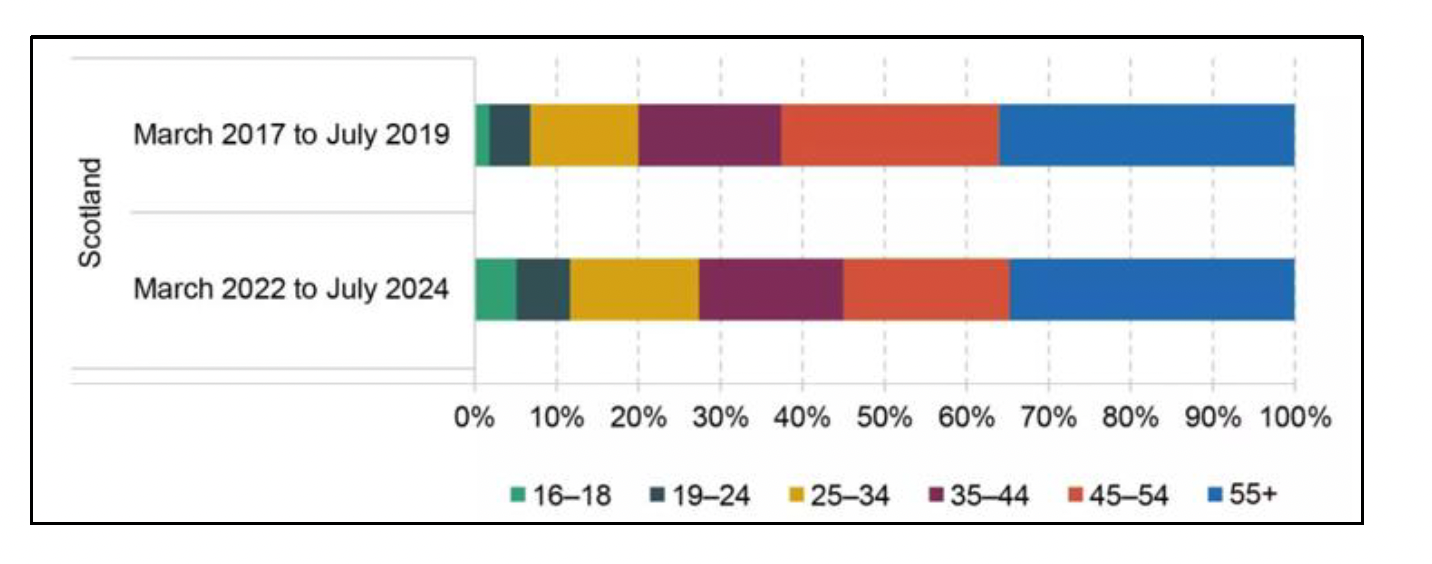
Source: Adapted from IFS analysis based on calculations using DWP’s Stat-Xplore and Social Security Scotland in What has happened to disability benefits in Scotland? An update
The IFS analysis also examined the primary health conditions of new disability benefit recipients. There was a rise in the proportion of new recipients between March 2017 to July 2019 and March 2022 to July 2024 receiving disability benefits for ‘mental and behavioural disorders’ and circulatory diseases (see Figure 3.7).

Source: Adapted from IFS analysis based on calculations using DWP’s Stat-Xplore and Social Security Scotland in What has happened to disability benefits in Scotland? An update
Between June 2023 and September 2025, the overall CDP caseload increased by 43% (67,000 to 95,810). The latest statistics show that the most common category of condition was ‘Mental and Behavioural disorders’, which has accounted for around 75% of the caseload since June 2023 and was 74% in September 2025.[4] Within the mental and behavioural disorders category, there have been increases in the number of children receiving CDP as a result of the impact of Autism and Attention Deficit Hyperactivity Disorder (ADHD). Over this time period the number of children receiving CDP with the primary disability condition recorded as Autism increased by 49% (26,685 to 39,690) and the number of children receiving CDP with the primary disability condition recorded as ADHD increased by 62% (7,575 to 12,250). See Figure 3.8 below.
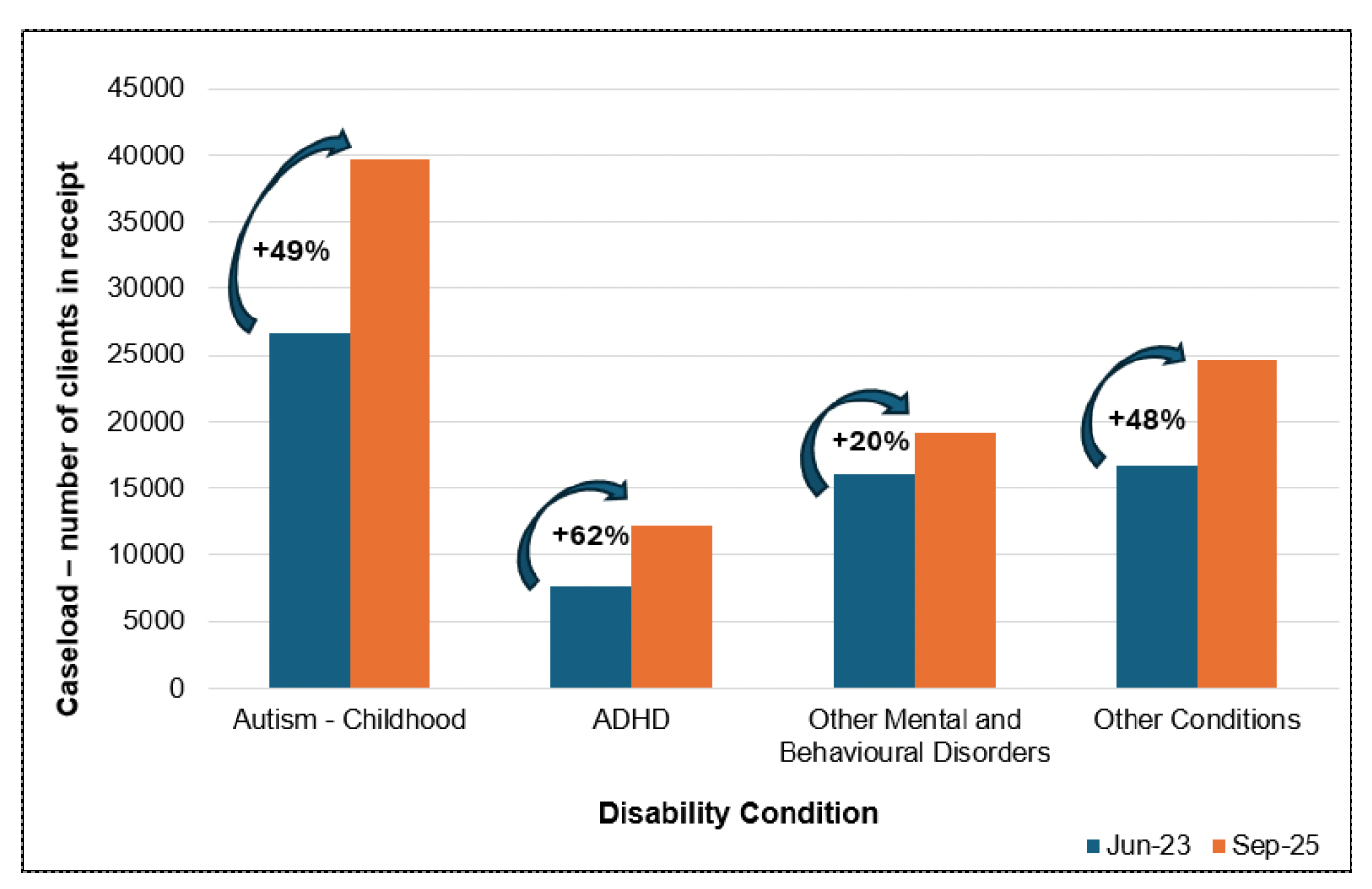
Source: Social Security Scotland Analysis (unpublished analysis)
Further discussion of who is in receipt of disability benefits and how this has changed can be found in section 5.1.
3.3 The international context
One of the reasons that the rise in disability benefits caseloads in Scotland and the UK is of particular interest is that this rise does not appear to have been mirrored in other similar countries.[32] Analysis by the IFS[33] found that the share of people claiming health-related benefits has remained similar to pre-pandemic levels or declined in other comparable countries. Whilst the IFS acknowledge that benefit systems vary across different countries they argue that ‘Nonetheless, the change in the caseload since the pandemic should still be instructive’. Denmark is the only other country, identified in the IFS analysis, where there has been a significant rise in health-related benefit claims and this rise is still ‘much smaller than in the UK’. The IFS suggested that it is likely that: ‘there are UK-specific factors driving the recent upsurge in claims’ and that these drivers are likely to go beyond the after-affects of the pandemic and the cost of living crisis.
Contact
Email: socialresearch@gov.scot