
Understanding the drivers of changes in demand for disability benefits in Scotland since 2010: A quick scoping review
This quick scoping review identifies and summarises research that examines the different drivers of demand for disability benefits in Scotland and the UK since 2010.
2. Introduction
The Scotland Act 2016 devolved new powers over social security to the Scottish Parliament. In 2020 non-means tested disability benefits were devolved to Scotland and in 2022 the Scottish Government introduced a new benefit, Adult Disability Benefit (ADP) to replace Personal Independence Payment (PIP).
There has been a large increase in the number of working-age adults and children receiving disability benefits in Scotland and the UK over the last 15 years. Across the UK, amongst working-age adults this grew from 1.5 million in 2002-03 to 3.3 million in 2023-24.[3] There was also a large rise in the number of people in receipt of disability benefits following the Covid-19 pandemic, and a spike in applications in Scotland following the introduction of Adult Disability Payment (ADP) in 2022-23.[4] The Scottish Fiscal Commission (SFC) anticipate that demand for disability benefits will continue to grow, with the number of people receiving ADP in Scotland forecast to increase from 379,000 in 2024-25 to 703,000 in 2030-31.[5]
Over recent years there have been a growing number of publications which consider the underlying drivers of this increase. However, there has not been a systematic analysis of this evidence for Scotland. Such an analysis is necessary for a more comprehensive understanding of the complex and interrelated drivers of these trends, to help inform future potential policy responses.
2.1 Research aims and objectives
The aim of this quick scoping review is to identify and summarise research that examines the different drivers of demand for disability benefits in Scotland and the UK. The primary research question was:
- What are the drivers of changes in the overall number and profile of people applying for and receiving disability benefits over the last 15 years in Scotland and the UK?
The review provides information about the volume and characteristics of the evidence that was found, and an overview of what it tells us. The focus is on the period since 2010 as this includes the major welfare reforms that have taken place over the last 15 years and avoids the potentially distorting effects of the 2008 financial crisis.
The report also addressed two secondary research questions. These are addressed first, in section 3 as they set the context for the primary research question. The secondary research questions were addressed at a high level and so did not follow the quick scoping review methodology and include additional sources. These were:
- How has demand for disability benefits in Scotland and the UK changed over the last 15 years?
- Who is in receipt of disability benefits (adults and children) and how has the profile of people applying for, and receiving disability benefits changed over the last 15 years in Scotland and the UK?
Several areas were out of the scope for this review. It does not examine devolved or reserved disability benefit expenditure, or the drivers of disability benefit trends in other comparator countries. It does not explicitly seek to make detailed comparisons between the UK and Scotland, but several sources provide comparative insights which are necessary for understanding experiences following the devolution of disability benefits. Disability benefits for those over pension age - Pension Age Disability Payment (PADP) and Scottish Adult Disability Allowance (SADLA) in Scotland and Attendance Allowance in England and Wales - are not included because PADP and SADLA have only recently been rolled out in Scotland (see Figure 2) Therefore, the focus of this review is on children and working-age adults.
The review was conducted by the Office of the Chief Social Policy Adviser, with support from the Scottish Government Library Services. Oversight and quality assurance was provided by a Research Advisory Group comprised of analysts from Scottish Government and Social Security Scotland, alongside policy officials from Social Security Policy. The evidence synthesis was supported by Emily Cunningham, a PhD intern from the University of Stirling.
2.2 Background and definitions
The main devolved disability benefits are designed to assist with the additional living costs people experience because they are disabled. They are not means-tested and are available to all disabled people regardless of household income or work/employment status.[6] In Scotland disabled people over the age of 16 can apply for ADP, and children, adults with parental responsibilities and rights, carers and guardians can apply for Child Disability Payment (CDP) for disabled children under 16, through Social Security Scotland.
As noted above, a number of non means-tested disability benefits were devolved to the Scottish Government in 2020. CDP was introduced in 2021 to replace Disability Living Allowance (DLA) for children, and ADP replaced PIP in 2022. In England, Wales and Northern Ireland PIP is the main disability benefit for working-age adults and DLA is the main disability benefit for children (under 16).[7] People can also receive PIP or ADP alongside work-related benefits, often referred to in the literature as ‘incapacity benefits’.
In contrast to disability benefits, ‘incapacity benefits’ are work-related and designed to provide extra income support for people with long-term conditions who are out of the labour market for an extended period of time, or who have ‘limited capability’ to work (and may still be in work) because of their health or disability, and are typically means-tested.[8], [9] These benefits are not devolved and across the UK include, but are not restricted to, Universal Credit Health (limited capability for work, and limited capability for work- and work-related activity) and Employment Support Allowance (ESA).[10]
Disability and ‘incapacity benefits’ are often referred to together, including in the literature analysed in this report, as ‘health-related benefits’ and can be conflated, despite their different purposes and eligibility criteria.[11] Incapacity benefits are not the focus of this paper and trends in incapacity benefits differ to disability benefits and may have a different set of underlying drivers.[12], [13] However, publications which include drivers of demand for incapacity benefits are included in instances where it is necessary or relevant to improving understanding of the drivers of disability benefits. ‘Health-related’ benefits are referred to throughout the report, and in these cases mean the source examined both disability and incapacity benefits.
2.3 Terminology
The Scottish Government and Social Security Scotland adhere to the ‘social model’ of disability, which was developed by disabled activists to provide a different way of understanding disability. However, much of the language in this report is based on the ‘medical model’ of disability[3] and is terminology typically used by the Department for Work and Pensions (DWP). Examples include terms such as ‘incapacity’ in reference to work-related benefits, ‘claimants’ (as opposed to ‘applicant’ for people making an application for a benefit and ‘client’ or ‘recipient’ for those in receipt of the benefit), and ‘health-related’ benefits, which combines benefits that are provided for quite different purposes. Scottish Government policy explicitly recognises that the use of stigmatising language stops people applying for the entitlements they are eligible for and is not in line with the social model of disability. It therefore does not use this language within the devolved social security system or its media and publications. However, these terms were cited in most of the sources. To ensure that findings are correctly represented, where these terms were used in the original source this is retained and reflected in this evidence synthesis.
Section 5.1 on demand driven by changing population health includes a range of terminology to describe mental health. When reporting on the primary condition, many of the sources referred to ‘Mental and Behavioural Disorders’. In this review, where this terminology is used in the original source, this is retained and reflected in the synthesis. However, in the narrative ‘mental health problems/ conditions’ is used.
Several terms used in section 5.2 on changes in the policy design and operation of the benefit system(s) are explained here. ‘Caseload’ describes the number of people who are in receipt of disability, incapacity or health-related benefits. Statistics relating to caseload in Scotland also include people who are in receipt of, or have been approved for, a payment, even if they have not yet received ADP or CDP.[14] There is also a discussion of ‘inflows’ / ‘onflows’ and ‘outflows’. Broadly, inflows / onflows are used to describe the numbers of successful applications, whereas the term outflows refer to the number of people no longer receiving the disability benefit.
2.4 Policy context
Figure 2 below shows a timeline of the devolved and reserved disability benefits included in this review, with disability benefits in the top half and incapacity benefits along the bottom half. The sources examine disability benefits delivered in Scotland and the UK since 2010. The report mainly examines evidence on PIP and ADP but also includes evidence on DLA, DLA for children and CDP. When discussing sources which examined incapacity benefits, it is mainly ESA and UC Health that are examined in studies, although some also consider the legacy Incapacity Benefit (IB).
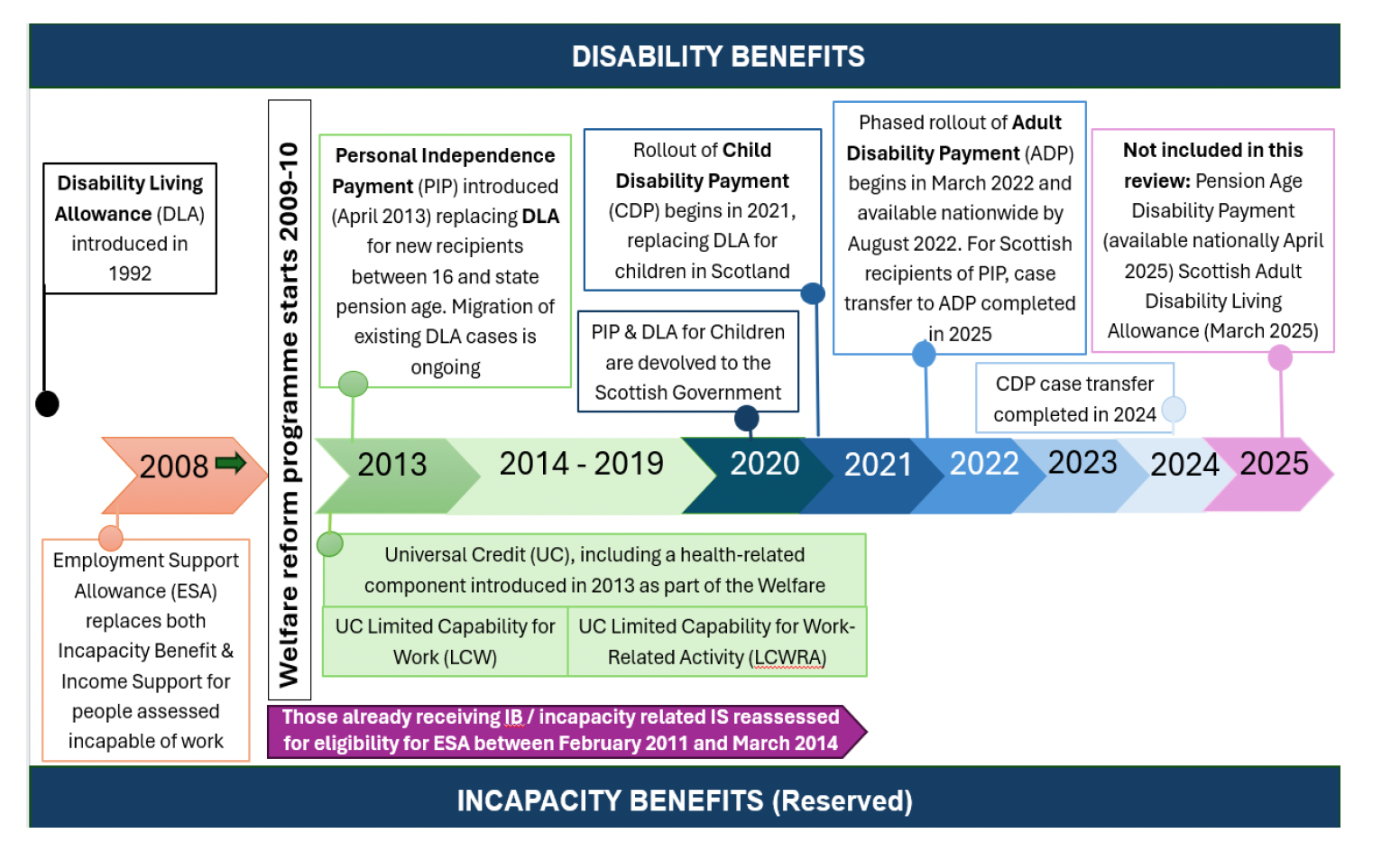
Figure 2: Timeline of disability benefits included in this review
The start of the timeline shows that Disability Living Allowance (DLA) was introduced in 1992.
Time period from 2008 onwards
- Employment Support Allowance (ESA) replaces both Incapacity Benefit & Income Support for people assessed incapable of work
- The Welfare reform programme starts 2009-10
During the year 2013
- For disability benefits - Personal Independence Payment (PIP) introduced replacing DLA for new recipients between 16 and state pension age. Migration of existing DLA cases is ongoing
- For incapacity benefits - Universal Credit (UC), including a health-related component introduced as part of the Welfare Reform Act 2012. This includes UC Limited Capability for Work (LCW) and UC Limited Capability for Work-Related Activity (LCWRA)
- Those already receiving incapacity benefits / incapacity related IS reassessed for eligibility for ESA between February 2011 and March 2014
During the year 2020
- For disability benefits – PIP & DLA for Children are devolved to the Scottish Government
During the year 2021
- For disability benefits – Rollout of Child Disability Payment (CDP) begins, replacing DLA for children in Scotland
During the year 2022
- For disability benefits - Phased rollout of Adult Disability Payment (ADP) begins in March 2022 and available nationwide by August 2022. For Scottish recipients of PIP, case transfer to ADP completed in 2025
During the year 2024
- For disability benefits - CDP case transfer completed in 2024
During the year 2025
- For disability benefits - Pension Age Disability Payment (available nationally April 2025) Scottish Adult Disability Living Allowance (March 2025) – neither of these are included in the review
The Scotland Act 2016 devolved new powers over social security to the Scottish Parliament and gave the Scottish Government the power to create new benefits and top up existing ones.[15] Some ill health and disability benefits were amongst those devolved, including the transfer of DLA, PIP, Attendance Allowance (AA), Severe Disablement Allowance and Industrial Injuries Disablement Benefit.
Social Security Scotland was set up in September 2018 as an executive agency of the Scottish Government to administer devolved social security payments in accordance with the principles in the 2018 Act and Charter.[16], [17] Social Security Scotland began the delivery of CDP in July 2021 and ADP in August 2022. The caseload transfer to CDP was completed in 2024 and completed for ADP in 2025 (Annex 2 includes a detailed summary of ADP and CDP).
The ethos underpinning the devolved benefits system is a commitment to treat people with dignity, fairness and respect. Social Security Scotland is working to reduce the stigma associated with accessing benefits and have involved people with lived experience of receiving financial support throughout the design and development of devolved benefits.[18] This new approach to delivering social security includes:
- support with the application process - the Social Security Scotland Local Delivery service supports people to apply for benefits, and the Scottish Government and Social Security Scotland have strategies in place to raise awareness, reduce stigma and promote take-up of disability benefits. Disabled people can also access a free Independent Advocacy Service;
- additional application routes - people can apply for ADP online, in person, using a paper form, or over the phone;
- replacing assessments with person-centred consultations - consultations are only carried out if necessary or requested by the client and choice is offered on format, with the majority taking place over the phone;
- a change in approach to decision making - only one piece of supporting information from a professional is sought when making a decision, unlike PIP where ‘evidence’ is sought to confirm everything in the application.
- the nature, and frequency of reviews - ADP recipients have their eligibility reviewed relatively infrequently (usually between two and 10 years, depending on when a recipients’ needs are likely to have changed[19]).
2.5 Structure of the report
Section 5.1 of the quick scoping review examines findings on whether changes in demand for disability benefits have been driven by changes in population health, section 5.2 - 5.7 considers demand driven by changes in the design and operation of the benefit system(s), section 5.8 considers the wider economy and labour market as a driver and section 5.9 examines the evidence on changing behaviours and attitudes (towards disability and disability benefits). Finally, section 5.10 considers the extent to which demand for disability benefits may have been driven by demographic changes.
Section 6 includes a discussion of the findings, and the strengths and limitations of the review. The report concludes by bringing together evidence from across the report in section 7, which discusses the evidence on the key drivers of demand for disability benefits and identifies evidence gaps.
Contact
Email: socialresearch@gov.scot