
Scottish economic insights: March 2026
Provides a summary of latest key economic statistics, forecasts and analysis on the Scottish economy.
Economic outlook
Latest forecasts
The global economic environment has changed notably since the end of February and the start of the conflict in the Middle East. The disruption to oil and gas supplies from the region, mainly due to the effective closure of the Strait of Hormuz, presents significant risks to the inflation outlook. At this stage, there remains uncertainty over how long the impacts of ongoing military action in the region will last and the likelihood of the global economic impacts spilling over into wider channels with disruption to wider trade flows and supply chains and impacting on business and investment confidence over the year ahead. The impact of artificial intelligence (AI) on the economic outlook is also unclear with both upside and downside risks – Box 4 summarises the latest evidence on the uptake of AI in Scotland.
Most key latest forecasts were undertaken before the conflict started and reflected the geopolitical risks and trade policy uncertainty at the time, current weaknesses in demand and loosening labour markets, but an economic outlook of broadly stable inflation and gradually loosening monetary policy.
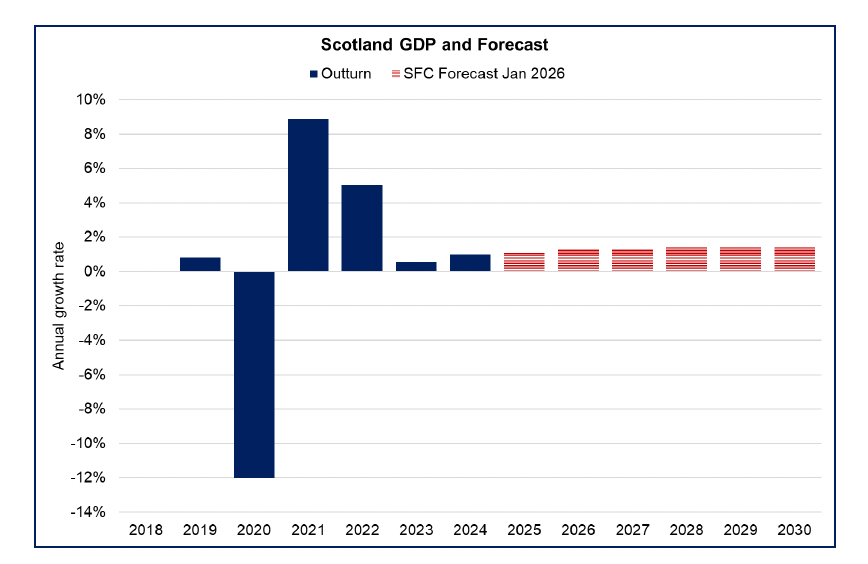
At a global level, in January, the IMF forecast economic growth to remain steady in 2026 with growth remaining unchanged at 3.3% in 2026 before easing slightly to 3.2% in 2027. At a UK level, at the start March, the OBR forecast UK GDP growth of 1.1% in 2026 and 1.6% growth in 2027 and 2028. The OBR noted that the conflict in Iran, which began after their pre-measure economy forecast was closed on 12 February, could have “very significant” implications for both the global and UK economies, particularly given the associated rise in energy prices. In Scotland, the Scottish Fiscal Commission in January, forecast Scottish growth to remain broadly stable at 1.3% in 2026 and 2027.[40],[41],[42]
In March, the OBR forecast UK inflation to fall to around 2% in April this year and remain broadly stable through the forecast period, with markets pricing in one to two further interest rate cuts this year from its current rate of 3.75%. However, the significant increase in oil and gas prices risks inflation remaining higher than forecast and that interest rates will remain higher than they were previously expected at the start of the year. The Bank of England now expect inflation to remain between 3% and 3.5% over the second and third quarters of this year.
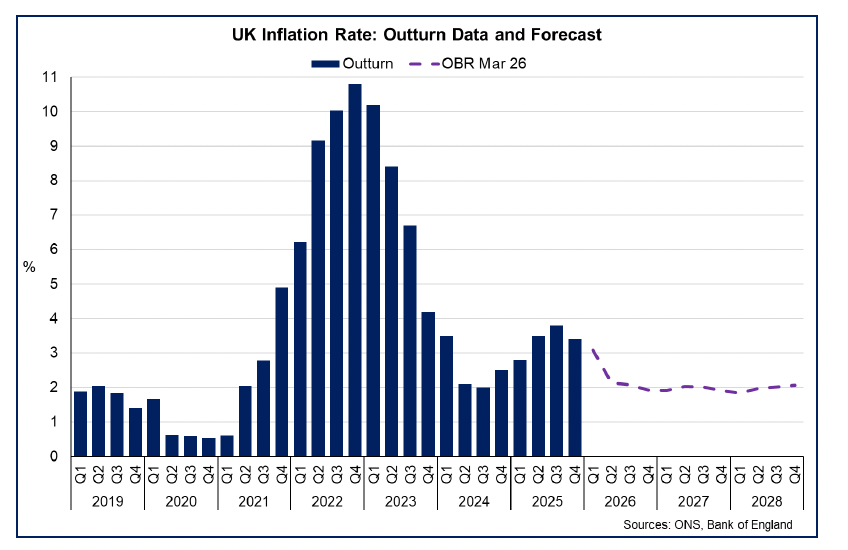
There remains significant uncertainty in the outlook for inflation which will depend on how long energy prices remain at elevated levels. In the longer term, under a scenario where there is a sustained oil and logistics supply shock for a year or more and in which there are spillovers from energy into wider commodity markets and continued geo-political tension, we would see greater impacts on economic output channels at a global and domestic level, with potential for a marked slowdown in economic activity.
Box 4: AI technologies: Adoption by Scottish businesses and potential influence on the economic outlook
Artificial Intelligence (AI) is increasingly being adopted into operations of Scottish businesses, with recent survey evidence showing increases in adoption across sectors. As AI technologies are being more widely adopted across the economy, anticipation around its potential impacts on productivity and the economic outlook also grows. The path is still highly uncertain but there are some initial projections on its future impact.
This Box provides latest data insights on how Scottish businesses are adopting AI technologies and their expectations on their workforce. This box also sets out some of the assumptions around how AI is influencing the economic outlook.
AI adoption by Scottish businesses
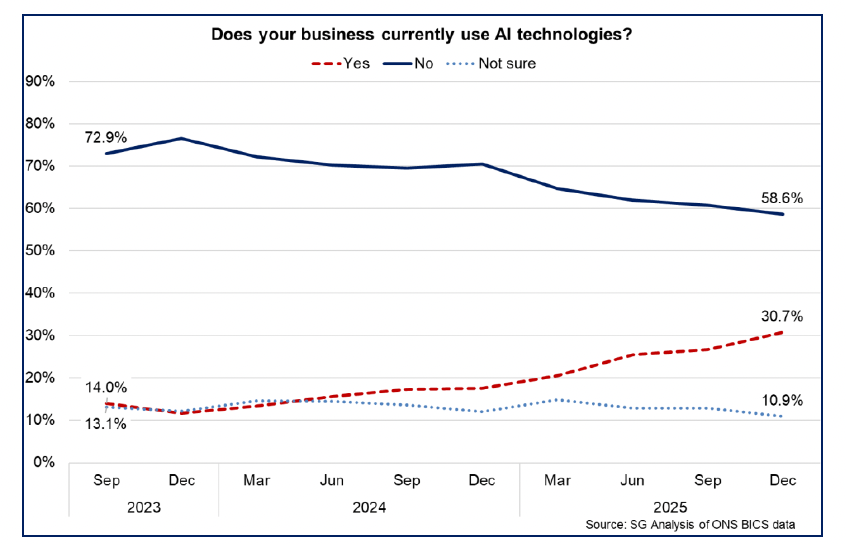
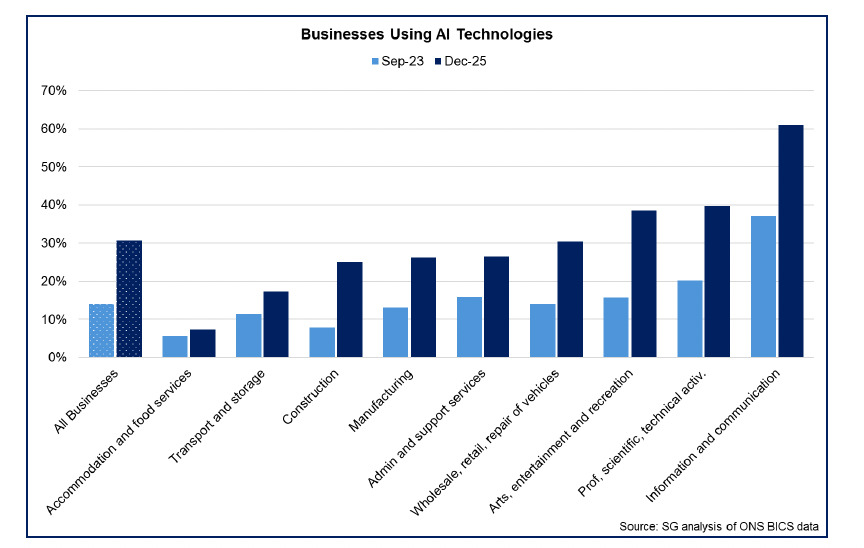
Latest Business Insights and Conditions survey (BICS) data for December 2025 shows that a rising share of Scottish businesses report to be using AI technologies (30.7%, up from 14.0% in September 2023), with larger businesses more likely to report AI usage than smaller businesses (47.0% compared with 28.9%). The Fraser of Allander Institute’s (FAI) Scottish Business Monitor for Q4 2025 suggests that the share may be even higher, showing that 50.4% of responding firms report to be using AI technologies to some degree in their operations.
Expectedly, BICS data shows that the Information and Communication sector continues to report the highest share of businesses using AI (60.9%). Nonetheless, increases in the shares of businesses adopting AI have been observed across all sectors in recent years, reflecting the broad application the technology can have to different business operations.
While the types of AI being used by businesses in Scotland vary, the most frequently reported technologies continue to be Large Language Models (LLMs) for text generation (16.8%) and Machine Learning for data processing (12.3%), followed by visual content creation (11.3%).
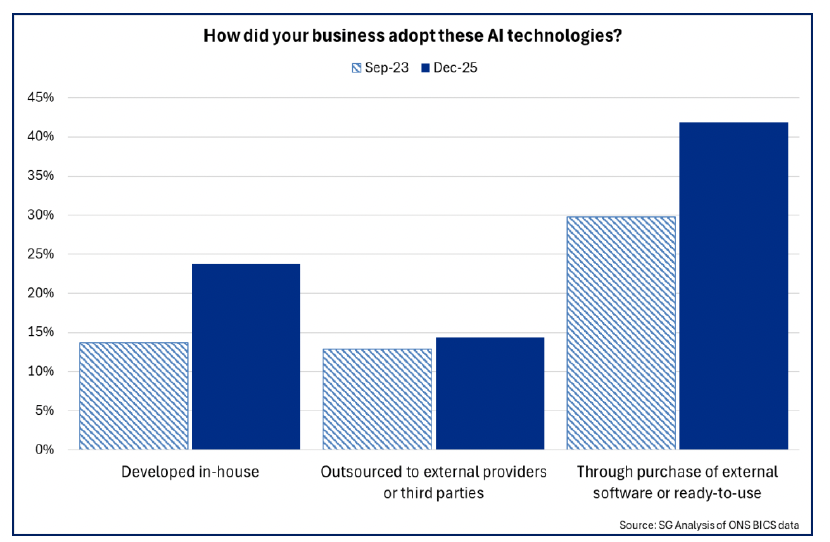
Most businesses continue to report adopting AI through purchases of external software or ready-to-use AI technologies (41.8%) which highlights the importance of specialised skills and experienced suppliers when it comes to making AI accessible to businesses. Nonetheless, a rising share of businesses report to be developing AI in-house (23.7%, up from 13.7% in September 2023).
The most frequently reported reason for Scottish businesses adopting AI continues to be to improve business operations (53.1%) and this is consistent across sectors.
There are some challenges reported by businesses seeking to introduce AI into their business operations. The most frequently reported reason for delays into adopting AI is limited skills, expertise or knowledge of AI (11.0%), followed by no identified use cases (8.5%). However, 43.5% of respondents report to not have been prevented or delayed in adopting AI. 5.4% of businesses report to have been prevented or delayed in AI adoption due to concerns about government regulations or industry standards. The most commonly reported regulatory concern was difficulty of compliance with regulations (89.5%), followed by cost of compliance with regulations (47.6%).
Workforce impacts of AI adoption by Scottish businesses
The majority of Scottish businesses report no change on workforce headcount as a result of adopting AI technologies (51.9%), with only 4.5% of businesses reporting reduced headcount and 1.4% reporting increased headcount. However, in terms of expected impacts, 13.3% report to be expecting a reduction in headcount in the future, with 45.3% expecting no change. A large share of businesses however are still not sure of the future impacts on headcount (40.7%), reflecting the underlying uncertainty around labour market impacts from AI adoption.
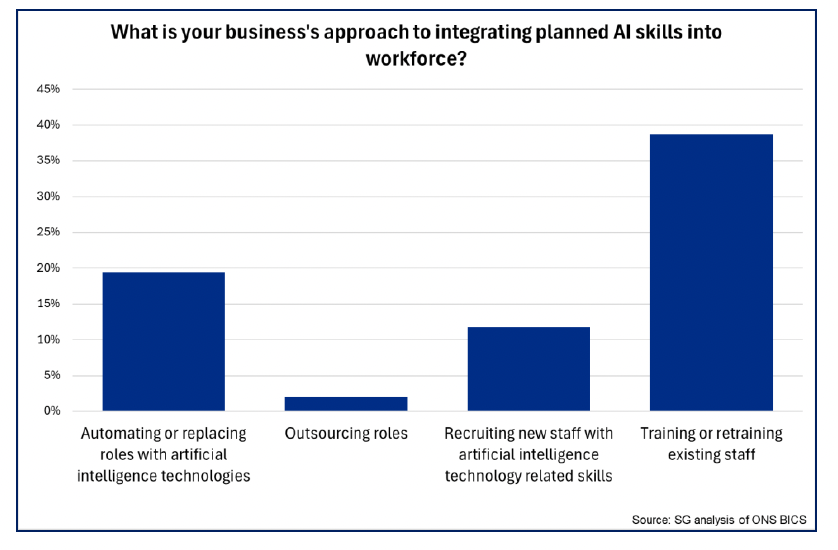
Nonetheless, the largest share of businesses report that their aim with integrating planned AI related skills into the workforce is to train or re-train existing staff (38.7%), with a smaller share reporting the aim to be automating or replacing roles (19.4%). A further 11.8% report the aim to be to recruit new staff with AI related skills.
AI potential influence on economic outlook
The evidence from BICS shows that AI adoption among businesses is steadily growing, consistent with broader global trends in AI-driven capital expenditure, particularly in the US. This, together with the surge in equity investment into the tech and communications sector, highlights the growing importance of AI in the global economy. Expectations of gains from AI adoption and investment are being reflected in the economic outlook, with AI broadly expected to deliver economic growth via productivity gains.
While these gains are yet to be realised in productivity statistics, economy-wide gains are expected to build gradually. The OBR state that while there remains significant uncertainty around both the scale and timing of potential productivity gains form AI, these could materialise following a J-curve pattern over the next decade. In such a scenario, productivity gains would build gradually over time, reaching 0.1 percentage points by year five, before starting to deliver gains exponentially. This would be in line with other general purpose technologies requiring significant investment before delivering gains.
The OBR also model an alternative scenario which is considered less likely but still possible, whereby gains follow an S-curve pattern, occurring more quickly but stabilising over time. Overall the OBR’s central estimate is that AI will boost UK productivity growth by around 0.2 percentage points within their forecast horizon.[43]
The Bank of England similarly project potential productivity growth to pick up over their forecast period but also highlight the risks from AI on their projections. If realised productivity gains are higher than expected, a looser monetary policy stance would be required whereas if the gains are lower, a tighter stance would be required.[44]
There continues to exist great uncertainty around future gains from AI investment and adoption. Downside risks to the economic outlook from AI remain present, with fears that potentially disappointing gains from AI investment could trigger abrupt financial market correction, leading to spillovers throughout the global economy.[45]
End of Box 4
Contact
Email: economic.statistics@gov.scot