
Scotland's wellbeing economy: July 2025
This report describes how the Scottish Government is taking a broader view of what it means to be a successful economy, society and country. It describes our approach to wellbeing and references various practical examples of where this approach has been delivered in Scotland and internationally.
5. The 4P’s model for policy development
5.1 The 4P’s Model
The 4P’s model has been developed by the Wellbeing Economy Alliance (WEAll) and consists of the following four principles: Purpose, People-powered, Prevention and Pre-distribution. Applying these four principles will help shape policies and practice that support a transition to a wellbeing economy.
Purpose means clearly identifying the overarching purpose that we are collectively aiming to achieve, and how an individual policy fits into that goal.
People-powered recognises the need to create policies and programmes that are reflective of national, regional and community needs. This inclusive approach enables people to influence decision making and agenda setting.
Prevention looks at tackling issues at their root causes and addressing systemic issues from the outset. A preventative, early, upstream intervention approach can reduce the need for further spending and remedial action, ultimately reducing ‘failure demand’.
Pre-distribution is focused on embedding human rights and equality into economic structures, so positive impacts are more fairly distributed, and benefits are experienced across society.
To enable the development of policies that support progress towards the NSET vision of a fair, green and growing wellbeing economy - the application of the 4P’s model as an overarching policy development framework, alongside using Scottish Government’s guidance and resource where applicable, is recommended.
5.2 Applying the Wellbeing Economy Principles into the Policy Cycle
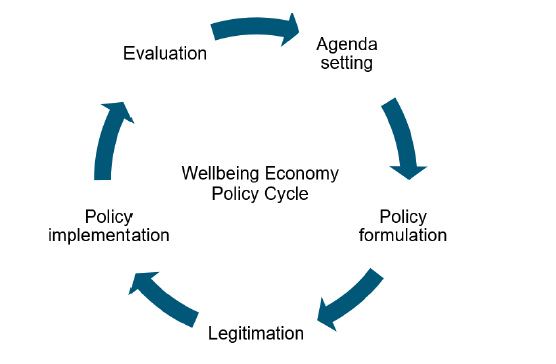
Using the 4Ps framework for policy development can drive progress towards a fair, green, and growing wellbeing economy.
A full overview of how policy development fits into the cycle above is given in annex A.
5.3 4P’s Wellbeing Economy Policy Framework: Purpose
Contribution to a wellbeing economy
- Setting a clear purpose and vision for economic policy and activity that is outcome-oriented and focused on collective wellbeing. For Scotland, this translates into establishing which National Outcomes a policy is designed to achieve and including in delivery monitoring metrics that measure impact on wellbeing for people, place and planet.
- Other relevant guidance includes the values set out in the NPF (treat people with kindness, dignity and compassion, to respect the rule of law, and to act in an open, transparent way); and In the Service of Scotland principles (to act with integrity, and be inclusive, collaborative, innovative and kind).
Guidance questions
- Can you clearly state your policy’s purpose and align it with Scotland’s National Outcomes and Scottish Government priorities?
- How does your policy address an identified need while also considering its impact on people’s long-term collective wellbeing?
- Does your policy make connections to other parts of government and wider society?
- What monitoring and evaluation systems are in place to measure the impacts of delivery on outcomes, including to assess and respond to unintended consequences for any groups in society?
Scottish Government approaches
- National Performance Framework
- National Strategy for Economic Transformation Measurement Framework
- In the Service of Scotland
- Climate Change Act 2009
- Scottish Child Payment
- Best Start, Bright Futures: tackling child poverty delivery plan
5.4 4P’s Wellbeing Economy Policy Framework: People-powered
Contribution to a wellbeing economy
- Taking an open, transparent, participatory approach to developing strategy and policy, involving those who might be impacted, empowering people and diverse communities.
- Advancing economic and democratic engagement to support increased ownership of policymaking, including stakeholders, workers, interest groups, communities and individuals across Scotland.
- This must include those disadvantaged and under-represented in society, supporting them to meaningfully engage, so the policy respects and fulfils human rights and people are treated with fairness, dignity and respect.
Guidance questions
- Is your policy being shaped by the participation of people, including under-represented groups and all geographical regions?
- How can you ensure that your policy is transparent and accountable to the public, and is responsive to feedback? Are you able to report back to contributors how their input has been reflected?
- What opportunities are there for cross-sector collaboration to build capacity and enable individuals and communities to be actively involved in supporting policy development and delivery?
Scottish Government approaches
- Christie Commission and Public Service Reform
- Scottish Approach to Service Design
- Creating Person-Centred Services
- Participatory Budgeting
- Participation Handbook
- Community Empowerment Act
- Fairer Scotland Duty
- Citizens Assembly of Scotland
- Institutionalising Participatory and Deliberative Democracy Working Group
5.5 4P’s Wellbeing Economy Policy Framework: Prevention
Contribution to a wellbeing economy
- Focusing interventions on upstream parts of the system to avoid creating or perpetuating negative impacts on outcomes in people’s lives, building long-term resilience and preventing higher costs of reacting to acute problems in the future.
- Addressing the underlying and wider root causes that contribute to poverty, inequality or environmental damage.
- Finding ways to shift towards preventative spending, recognising the acute pressures on resource and the demands that reactive spending creates.
Guidance questions
- Is your policy based on thorough analysis of both long-term and immediate causes and contributing factors?
- Does your policy respond to both by including measures to prevent negative outcomes before they arise?
- Have you worked with analysts to forecast the potential financial savings by shaping preventative policy intervention, including the timescales for this return on investment?
- What existing policies or programmes can be enhanced to support prevention measures?
Scottish Government approaches
- Improving Public Services
- Circular Economy Act
- Scottish National Investment Bank
- COVID Recovery Strategy
- Just Transition Plans
- Scotland’s Baby Boxes
- Mental Health Strategy
- Business Purpose Commission
5.6 4P’s Wellbeing Economy Policy Framework: Pre-distribution
Contribution to a wellbeing economy
- Embedding inclusion, equality and fairness into economic policy, working with and empowering communities and individuals to remove barriers to participation.
- Taking a human rights approach linked to legal obligations under the Equality Act (Public Sector Equality Duty), existing and proposed human rights legislation, and effective impact assessments (equality and Fairer Scotland Duty).
- More equitably sharing wealth, opportunities and resources from the beginning reduces the reliance on redistribution policies such as welfare payments).
Guidance questions
- In what ways does the policy either perpetuate or help address current inequalities, as well as unequal opportunities experienced by people with intersecting protected characteristics?
- What opportunities are there to support the involvement of Inclusive and Democratic Business Models when collaborating and co-delivering policies and services?
- Does your policy contribute to sustainable and inclusive economic growth, ensuring equal access to opportunities and resources for all?
- Does your policy enable channels for feedback to help inform further actions if needed?
- Are you working with delivery partners and empowering communities to have ownership of policies?
Scottish Government approaches
- Economy Centre of Expertise in Equality and Human Rights
- Equality Act 2010
- The Equality Act 2010 (Specific Duties) (Scotland) Regulations 2012
- Equality Impact Assessment
- Human Rights Bill
- Scotland Act (1989)
- Fair Work Action Plan 2022
- Anti-Racist Employment Strategy 2022
- Community Wealth Building
- Pathways Fund
- Inclusive Democratic Business Models
- Sustainable Procurement Tools
- Child Poverty (Scotland) Act
5.7 Monitoring and Using Scottish Government Resources for Policies
Measuring progress and performance
- Establishing clear outcomes and metrics for measuring if and how our economy is delivering wellbeing for people, place and planet.
- Taking an evidence-based (qualitative and quantitative), whole-systems view to understand the key drivers of wellbeing outcomes, how they interrelate, and which have the greatest impact.
- Monitoring, evaluating and encouraging continuous learning, being open to innovative and experimental approaches.
- Recognising the potential difficulty of attributing impact on long-term wellbeing outcomes to specific policy interventions, it is important to include metrics that can help assess the impact of delivery on short-term, medium-term and long-term changes. This will need to be considered in collaboration with analysts as appropriate to the specific policy.
Approaches and resources
- National indicators
- Wellbeing Economy Monitor (national and local levels)
- Equality Evidence Finder
- Evaluating policy guide
- Green Book supplementary guidance: wellbeing (UK GOV)
Examples of application
Contact
Email: james.miller@gov.scot