
Scotland's wellbeing economy: July 2025
This report describes how the Scottish Government is taking a broader view of what it means to be a successful economy, society and country. It describes our approach to wellbeing and references various practical examples of where this approach has been delivered in Scotland and internationally.
3. Scotland’s Wellbeing Economy
3.1 What a Wellbeing Economy means for Scotland
It has been a longstanding ambition for the Scottish Government to help people live happier and healthier lives with higher living standards, to help businesses boost profitability, and build a more resilient Scottish economy that promotes the wellbeing of all of our people. This is reflected in the National Performance Framework, which sets out the strategic vision for national wellbeing in Scotland and the type of nation we want to be.
Building a fair, green, growing wellbeing economy is central to achieving the four interconnected priorities of eradicating child poverty, boosting economic growth, tackling the climate emergency and delivering high quality, sustainable public services. Advancing in all four will ensure positive impacts in the lives of people across Scotland and create a wealthier, fairer, and greener country.
Indeed, purposeful action to progress this long-term, system-wide transformation is a vital investment in the future sustainability, resilience and prosperity of Scotland’s economy and in the health, equality, and wellbeing of all its people.
3.2 The National Performance Framework
The National Performance Framework (NPF) is Scotland's wellbeing framework. It explicitly includes 'increased wellbeing' as part of its purpose and combines measurement of how well Scotland is doing in economic terms with a broader range of wellbeing measures. It gives Scotland’s public services a common set of outcomes to work towards and aims to create a more successful country, give opportunities to all people living in Scotland, increase the wellbeing of people living in Scotland, create sustainable and inclusive growth, reduce inequalities and give equal importance to economic, environmental and social progress.
With 11 National Outcomes, the NPF sets a vision and measures progress through 81 National Indicators. The Performance Overview tracker provides information on Scotland’s performance. Moreover, the National Outcomes align to the UN Sustainable Development Goals and localise them in the Scottish context.
Following the latest statutory review of the National Outcomes, and the subsequent Scottish Parliament inquiry, the Scottish Government has committed to a period of reform of the National Performance Framework to support the development and implementation of a more strategic and impactful framework for Scotland.
For now, no immediate changes will be made to the NPF (last updated in August 2024), and the NPF website has been archived. The current 11 National Outcomes are still in operation as is the duty (Community Empowerment Act) on public bodies ‘to have regard’ to them.
Work on NPF reform has commenced. We expect to be ready to launch the next iteration of the NPF around the start of the new parliamentary session and new government. Full implementation would be an ongoing exercise, as the implementation plan is executed, and website/user interface development would continue through 2026.
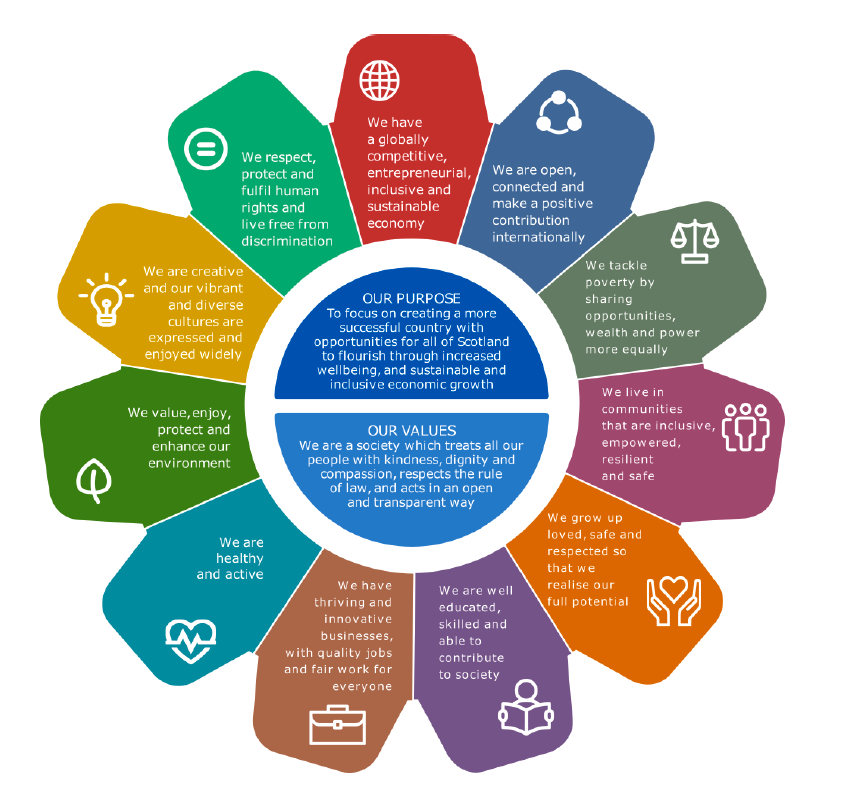
National Performance Framework in action
- Climate Ready Scotland: Climate Change Adaptation Programme 2019 – 2024 takes an outcomes-based approach and is derived from Scotland’s sustainable development goals and the NPF
- The Ending Homelessness Together: High Level Action Plan includes a section whch explicitly outlines how the plan supports the NPF
- The National Outcomes Framework for Volunteering illustrates the contribution volunteering makes to meeting NPF goals
- Scotland’s Forestry Strategy 2019 – 2029 outlines the relationship between the NPF and sustainable management of Scotland’s woodland
3.3 The Four Capitals
The Four Capitals (Environment, Community, Business and People) are included in wellbeing frameworks for understanding future collective wellbeing and resilience. The capitals refer to the resources or ‘assets’ upon which the economy and society survive and thrive. They generate wellbeing for current and future generations, and each must flourish in order to have a healthy, resilient economy and society. In the NPF the four capitals approach helps to value and measure future economic strength, and wellbeing and resilience are based on the wealth of resources across the four domains.
3.4 Examples of the Wellbeing Economy Approach in Scotland
Scotland is actively engaged in the transition to a wellbeing economy at international, national and local levels.
Wellbeing Economy Governments
Scotland is a founding member of the Wellbeing Economy Governments (WEGo) Group, in which member countries work together to understand how to bring wellbeing approaches into policymaking. The network enables cross-government engagement, learning and collaboration, utilising the advice of practitioners and experts to deepen understanding of how to use wellbeing frameworks and evidence to improve policymaking. The network also serves as a space to share relevant policy impacts and experience and regularly engages with other partners, including the OECD and WHO. In 2024 the group published its first annual report detailing its activity and engagement.
Wellbeing Economy Expert Advisory Group
The Wellbeing Economy Expert Advisory Group (WEEAG) was established in 2023 and includes members representing business organisations, academia, local government, think tanks and trade unions. The group provides strategic recommendations and advice to Scottish Ministers, adding value to existing initiatives relevant to building a Wellbeing Economy in Scotland including in policy, practical and legislative guidance, and through partnership working.
New Deal for Business Wellbeing Economy Sub-group
The Wellbeing Economy Subgroup of the New Deal for Business Programme was tasked with considering how business and the Scottish Government can better work together towards a wellbeing economy. The sub-group published a description of What Wellbeing Economy Means for Business. Building on the work of the Business Purpose Commission, this contains examples of how enterprises can contribute, recognising the importance of promoting the interests of employees, suppliers, communities, society and the environment, as well as customers and investors. It highlights practical actions businesses can take – such as paying the Real Living Wage, supporting employee health & wellbeing, and using resources sustainably – and signposts to further resources and frameworks that businesses could use. Other areas of focus for the group have included how government and business can work together to improve population health and tackle child poverty in Scotland.
Wellbeing Economy Monitor
The Wellbeing Economy Monitor brings together a range of indicators to provide a baseline for assessing progress towards the development of a wellbeing economy in Scotland. Based on the wellbeing outcomes in the NPF, the monitor focuses on some key areas where the economy and economic policy contribute to those outcomes. This includes measures such as healthy life expectancy, Fair Work, mental wellbeing, child poverty, greenhouse gas emissions and biodiversity.
Policy mainstreaming
Examples of Scottish Government policies that help advance wellbeing economy outcomes in practice include:
- Fair Work Action Plan
- Just Transition
- Green Industrial Strategy
- Community Wealth Building
- Land Reform
- Circular Economy
Community Wealth Building
Community Wealth Building (CWB) is an internationally-recognised economic development model aiming to help deliver a tangible wellbeing economy that creates the prosperity necessary to support people and communities. The CWB approach encourages actions across five interconnected pillars to tackle structural inequalities, support business growth, create and retain employment opportunities and give people a greater stake in the economy and increases sustainability and resilience through better management of assets, natural resources and maximising the impact of public spending. Applying a CWB lens to investment and spending activities of anchor organisations ensures we maximise the economic levers available and support economic growth which in turn supports the delivery of our public services by increasing tax revenue and reducing demand on services. CWB is about cementing and building existing practice and challenging ourselves to do things differently.
Local Wellbeing Economy Monitor
The Wellbeing Economy Toolkit is intended to provide a resource for those involved in developing economic strategy and place-based economic development policy. It is a practical guide that sets out a stage-by-stage diagnostic process designed to aid decision-making and prioritisation of economic interventions to facilitate the transition to local and regional wellbeing economies.
Wellbeing Economy Pilots
The Scottish Government and Clackmannanshire Council worked together during 2020-2022 to co-create a vision for a local wellbeing economy that is tailored to the specific needs and circumstances of Clackmannanshire. Guided by the NPF, and building on and progressing the sustainable, inclusive growth approach, a diagnostic process was developed. This aimed to identify the key drivers and priority interventions that are needed to support Clackmannanshire’s transition to a local wellbeing economy.
Contact
Email: james.miller@gov.scot