
Scotland's wellbeing economy: July 2025
This report describes how the Scottish Government is taking a broader view of what it means to be a successful economy, society and country. It describes our approach to wellbeing and references various practical examples of where this approach has been delivered in Scotland and internationally.
4. Scotland’s vision
The National Performance Framework sets out Scotland’s long term vision for the type of country we want to be. The Wellbeing Economy vision, of thriving across economic, social and environmental dimensions, sets out actions which progress towards this vision.
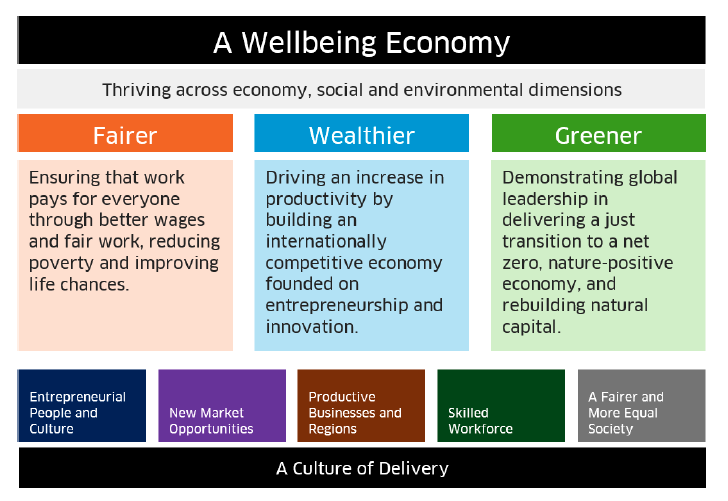
4.1 Vision
Thriving across economic, social and environmental dimensions.
4.2 Ambition
- Fairer - ensuring that work pays for everyone through better wages, reducing poverty and improving life changes
- Wealthier – driving an increase in productivity by building an internationally competitive economy founded on entrepreneurship and innovation
- Greener – demonstrating global leadership in delivering a just transition to a net zero, nature-positive economy and rebuilding natural capital
4.3 Programmes of Action
- Entrepreneurial people and culture
- New market opportunities
- Productive businesses and regions
- Skilled workforce
- A Fairer and More Equal Society
The National Strategy for Economic Transformation (NSET) continues to provide the overarching vision for a fair, green and growing economy in Scotland, with priority actions and practical steps to deliver economic growth outlined in the 2025 Programme for Government.
With a wealthier, fairer, greener Scotland as its goal and an ambition to tackle structural inequalities, NSET has a broader view of what it means to be a successful economy, society and country, looking beyond traditional attitudes and measures of prosperity such as GDP, and putting people and the environment at the heart of Scotland’s economy. Noting that the most productive economies also score highly on wellbeing indicators, the strategy highlights that a wealthier economy and a fairer economy go hand in hand. For example, fair working practices have positive impacts on individuals, businesses and our economy; and the transition to net zero generates substantial economic opportunities that Scotland is well-placed to benefit from.
4.4 A Fair, Green and Growing Economy
The 2024 Programme for Government (PfG) sets out the importance of “fair, green economic growth” to deliver across all four of the Scottish Government’s priorities, highlighting that “economic success drives our ability to deliver public services and reduce child poverty”.
Following on from this, the 2025 PfG is structured around the four priorities, with defined actions intended to help grow the economy, tackle the climate emergency, eradicate child poverty, and deliver high quality and sustainable public services, while acknowledging the interconnections between the priorities. It contains actions intended to ensure businesses can create jobs and grow the economy, improve living standards, contribute towards a just transition to net zero, and secure the growth and tax base needed to invest in public services. Addressing inequalities is embedded throughout the PfG and, in relation specifically to Economy, our intersectional approach is demonstrated through our actions in relation to fair and flexible working; devolved employability services that focus on the six priority family groups at risk of child poverty; and implementation of recommendations in the Pathways report on women in entrepreneurship. These actions set out in the 2025 PfG contribute to progress across the National Outcomes.
A fair economy means taking a human rights-based, social justice approach so that everyone has equal access to resources, opportunities and protections. This encompasses measures to reduce child poverty, promote fair and secure employment, address economic inactivity and remove barriers in the labour market, as well as enabling access to affordable housing, quality education and healthcare. We seek to share the benefits of increasing prosperity widely, consciously considering opportunities when developing policies to tackle structural inequalities and maximise positive impacts on women, racialised minorities, disabled people and other groups.
The elements of a green economy focus on environmental sustainability, including opportunities for protecting and restoring natural assets, reducing greenhouse gas emissions and transitioning to a circular economy. Scotland is well-placed to secure the economic opportunities of a just transition to net zero. The Green Industrial Strategy identifies ways to create an enabling environment for investment and growth, supporting green skills, jobs and innovative businesses, aligning actions which contribute to Scotland’s ambition to become a net-zero economy by 2045.
A growing economy is one which prioritises inclusive and sustainable growth, with resilient, innovative and prosperous businesses. An economy where responsible, purposeful businesses thrive, with the transformational benefits of a green economy attracting investment and enabling business and trade to flourish. It means economic powers and opportunity being distributed fairly across all of Scotland, empowering communities to take a greater stake in the economy. It means more wealth generated, circulated and retained within local communities, and Inclusive and Democratic Business Models, including social enterprises, encouraged.
Contact
Email: james.miller@gov.scot