
R100 Interim Evaluation
This report details findings of the R100 Programme Interim Evaluation, informed by the best practice set out in the Digital Appraisal Manual for Scotland (DAMS): https://www.gov.scot/publications/digital-appraisal-manual-for-scotland-guidance/
7 Business Survey
7.1 Overview
7.1.1 This chapter provides a summary of the responses received to the online business / organisation survey. As with the residential survey, the business survey included separate sub sections covering each of the following groups:
- Group 1: those who have been provided with broadband via R100 and have taken up the connection.
- Group 2: those who have been provided with broadband via R100 but have not taken up the connection
- Group 3: those who are scheduled to receive broadband via R100 but have not yet been connected
7.1.2 The survey also included questions which were specific to the individual group as well as questions which were asked to all groups or more than one group. The chapter initially focuses on the former, working through each group in turn, before a comparative section which reports the results of each group alongside one another to enable comparison between the responses.
7.1.3 It is noted that the sample sizes for the business / organisation survey were relatively small in comparison to the residential survey and therefore a note of caution is needed when interpreting the results.
7.2 Group 1 Business / Organisation Responses
Voucher and main contracts breakdown
7.2.1 Respondents to the survey were initially asked whether they had applied to the IVS or SBVS. It was assumed that those who indicated that they had not applied to either were beneficiaries of the R100 main contracts. The figure below shows the breakdown of responses between the IVS, IBVS, and the main contracts.
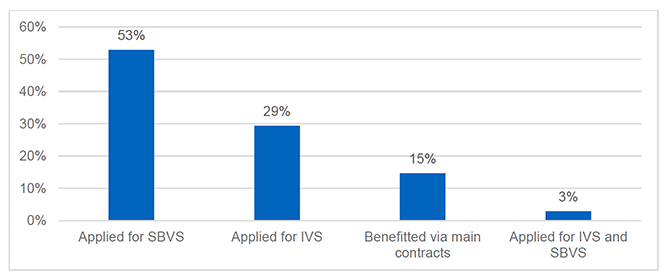
7.2.2 The majority of businesses / organisations in the sample (53%, n=18) had benefited from the SBVS, with 29% (n=10) benefiting from the IVS, 15% (n=5) benefitting from the main contracts, and one business / organisation (3%) applying for both the IVS and the SBVS.
7.2.3 Of those who indicated that they had applied for the IVS, nine (82%) said that their broadband still used the same means of connection as was funded via the IVS, with one stating that they subsequently applied for the SBVS and one stating that their broadband was now provided by a different means of connection.
7.2.4 Of those who indicated they had applied for the SBVS, 18 (95%) said that their broadband still used the same means of connection as was funded via the SBVS and one stated that their broadband was now provided by a different means of connection.
Key Point: In contrast to the overall programme, over 80% of Group 1 business / organisation in the sample were voucher beneficiaries compared to just 15% who had benefitted via the main contracts. This echoes the results of the resident survey and likely reflects the fact voucher recipients have already actively engaged with the R100 programme and therefore are potentially more receptive to the research.
Ease of voucher application process
7.2.5 Those who applied to the IVS or SBVS were asked how they found the process of obtaining broadband via the voucher (see Figure 7‑2).
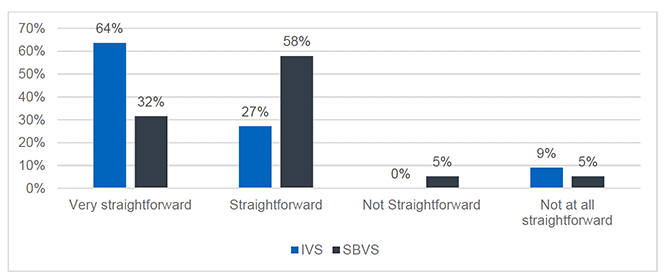
7.2.6 As with the residential sample, the majority of businesses / organisations in the sample (over 80% in each case) indicated that the application process was very straightforward or straightforward. In total, three businesses / organisations (one IVS applicant and two SBVS applicants) stated it was ‘not straightforward’ or ‘not at all straightforward’. In the open text responses provided by these respondents, a lack of awareness of the scheme, online material being too technical, difficulties in securing help when needed, and the importance of individualised help provided by Aberdeenshire council were highlighted:
- IVS applicant – “It took a while to find out there was a list of installers to use. I had problems all through installation and didn't manage to get any help”.
- SBVS applicant – “I knew nothing of the R100 programme or vouchers and would not have had any idea of where to find this information. Additionally, the information on the R100 website was confusing and cluttered. I was advised of the programme and given tailored advice on the connectivity solutions available for our premise by the Digital Engagement Team at Aberdeenshire Council. If it wasn’t for their support, I wouldn’t have done anything”.
- SBVS applicant – “I knew nothing about the voucher scheme, and hadn’t seen or heard anything about it, until I happened to attend a local community meeting at which an officer from Aberdeenshire Council was in attendance, presenting on digital connectivity support. He talked about the voucher scheme and advised that my properties were eligible because there was no plan to install fibre broadband. The officer from Aberdeenshire Council did heaps of work to look at my current connection and pull together information on all the different solutions that I could use the voucher for. If he hadn’t done that, I'd have had no idea where to even start. All the stuff online about the voucher was jargon heavy, and not straightforward about how it actually worked”.
7.2.7 A lack of awareness of R100 was also identified through the Group 2 and 3 survey responses and is discussed further below.
Key Point: As with the residential survey, the majority of business / organisation respondents felt that the voucher application process was straightforward. However, a small number of respondents highlighted difficulties including a lack of awareness, online material being too technical, and difficulties in securing help when needed.
Importance of superfast broadband to business operation
7.2.8 All Group 1 business / organisation respondents were asked to indicate how important superfast broadband is to the operation of their business / organisation. As shown in Figure 7‑3, all of the respondents rated the availability of superfast broadband as important with the majority of respondents (69%, n=22) selecting ‘10-very important’.
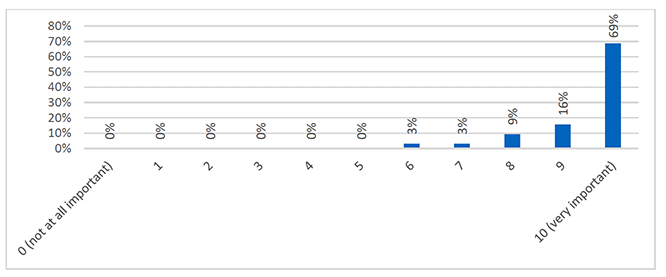
Key Point: All of the business / organisation respondents stated that superfast broadband was important to the operation of their business / organisation, with most stating it was very important.
Impact of broadband connectivity on business decisions, activities and performance
Impact of broadband on decision to move to businesses / organisation premises / start business / organisation at current location.
7.2.9 In total, 91% (n=29) of Group 1 businesses / organisations stated that they had been based at their current premises when superfast broadband (or quicker) was first installed. Two businesses / organisations said they had recently moved to their current address, and one said they had recently started the business / organisation. This group was asked whether they would have made these decisions if superfast broadband (or quicker) had not been available and all three respondents indicated that they would not.
Key Point: There is some evidence that the availability of broadband has contributed to the setting up and operation of some businesses in the areas affected. However, sample sizes are small and therefore it is difficult to draw any firm conclusions.
Impact of broadband on business activities
7.2.10 Group 1 business / organisation respondents were also asked to indicate whether the improvement in broadband had had a positive or negative impact on a range of business / organisation activities. The responses are shown in the table below.
| Positive impact | Made no difference | Negative impact | I don't know | Not applicable | |
|---|---|---|---|---|---|
| Accounting and financing activities | 66% | 21% | 0% | 0% | 14% |
| Accessing online networks and storage | 66% | 14% | 3% | 0% | 17% |
| Selling products or services, including online bookings/ tickets | 59% | 14% | 3% | 0% | 24% |
| Promotional activities, including via social media | 52% | 21% | 3% | 0% | 24% |
| Staff / volunteer training | 38% | 34% | 0% | 0% | 28% |
| The digital skill of your staff / volunteers | 34% | 41% | 3% | 0% | 21% |
| Your net zero commitments | 31% | 41% | 0% | 3% | 24% |
| Market research | 31% | 34% | 0% | 0% | 34% |
| Communicating with staff volunteers | 31% | 31% | 3% | 0% | 34% |
| Staff / volunteer retention | 17% | 45% | 0% | 0% | 38% |
| Staff / volunteer recruitment | 10% | 48% | 0% | 0% | 41% |
7.2.11 The largest positive impacts were associated with:
- Accounting and financing activities (66%, n=19 positive impact)
- Accessing online networks and storage (66%, n=19 positive impact)
- Selling products or services, including online bookings / tickets (59%, n=17 positive impact)
7.2.12 A negative impact was recorded against several of the activities. This was a result of one business / organisation. In their open text response, the following explanation was provided:
- “The ‘Superfast’ improved speed initially obtained was not sustained. A transmitter mast was subsequently damaged and has never been repaired. EE says that it will cost too much to repair. The speed is slower now that it was using a phone line for broadband” (Commercial business and SBVS recipient, Highlands)
7.2.13 Businesses / organisations who recorded a positive impact against the activities were also invited to provide further comment via an open text response. The comments received referenced the benefits in terms of accounting and bookkeeping, the ability to make calls, and the ability to work from home (with resultant carbon and cost savings in terms of travel):
- “Accounting has been easier, making and taking payments and uploading and downloading has improved greatly.” (SBVS recipient, Highlands)
- “Having a faster broadband connection just makes everything easier. From stock management, to bookkeeping and accounting, as well as being able to call customers and suppliers now through Wi-Fi calling or the digital calls.” (Commercial business and SBVS recipient, Aberdeenshire)
- “My business has been able to make full use of all digital online services since superfast broadband became available. This was vital during COVID-19 years, as it was the difference between being able to operate some business activities remotely and keep revenue coming into the business. Without that my business could not have survived.” (Commercial business and SBVS recipient, Scottish Borders)
- “In order to run a consultancy from rural Aberdeenshire, the enhanced broadband enables us to work from home without flying to Somerset!” (Commercial business and SBVS recipient, Aberdeenshire)
7.2.14 One business / organisation also emphasised the benefits in terms of providing broadband for visitors, while another emphasised the benefits in terms of monitoring farm activities:
- “Able to provide superfast broadband to guests which is expected by most people these days.” (Commercial business and SBVS recipient, Highlands)
- “We solely use the broadband for camera monitoring of cattle and sheet sheds on the farm.” (Commercial business, SBVS recipient, Argyll and Bute)
7.2.15 While recognising the significant benefits, several businesses / organisations also noted some negative aspects associated with reliability and higher costs:
- “Unreliability causes outages. Every time there is a squall, the broadband drops out - and squalls are pretty common in Shetland!” (Commercial business and IVS recipient, Shetland)
- “Hardware needs to be switched off approximately every 14 days then left for a time to re-set and switched back on. This is the aspect that de-values the whole system. Hardware outages are never welcome especially when the router doesn't come back on. Sometimes we can wait 24hours for the box to re-set” (Commercial business and SBVS recipient, Aberdeenshire)
- “The only negative aspects have been the need to seriously invest in a much more significant infrastructure (high speed networks and Wi-Fi) to take full advantage of the high-speed broadband service. This has resulted in a significant increase in electrical base load and energy use just at the time the energy crisis started to bite!” (Commercial business and SBVS recipient, Scottish Borders)
Key Point: The data suggests that the delivery of a broadband connection via R100 has provided a range of positive benefits for business activities. Unreliability does however continue to be an issue for some recipients.
Impact of broadband on business / organisation performance
7.2.16 In addition to business activities, respondents were also asked to indicate whether the improvement in broadband had had a positive or negative impact on business performance. The responses are shown in the table below.
| Positive impact | Made no difference | Negative impact | I don't know | Not applicable | |
|---|---|---|---|---|---|
| Productivity | 76% | 10% | 3% | 0% | 10% |
| Business performance / the performance of our organisation | 69% | 24% | 3% | 0% | 3% |
| Innovation | 52% | 31% | 3% | 0% | 14% |
| Turnover | 41% | 38% | 3% | 0% | 17% |
| The number of customers / visitors to our promises | 38% | 34% | 3% | 0% | 24% |
| Range of products / services provided | 34% | 45% | 3% | 3% | 14% |
| Cost of supplies | 34% | 45% | 3% | 0% | 17% |
| Access to new markets | 31% | 45% | 3% | 0% | 21% |
7.2.17 The largest positive impacts were associated with:
- Productivity (76%, n=22 positive impact)
- Business performance / the performance of our organisation (69%, n=20 positive impact)
- Innovation (52%, n=15 positive impact)
- Turnover (41%, n=12 positive impact)
- 7.2.18 One business / organisation selected ‘negative impact’ across all performance aspects. This respondent is the same respondent as referred to above.
Key Point: The data suggests that the delivery of a broadband connection via R100 has provided a range of positive benefits in terms of business performance, including improved productivity, innovation and higher turnover.
Impact of broadband on supplies / raw materials
7.2.19 Group 1 businesses / organisations were also asked whether there had been any change in where they get supplies / raw materials since the improvement in broadband connectivity. The majority of respondents (72%, n=21) stated that there had been no significant change, with two respondents stating that they now use more local suppliers and two respondents stating that they now use suppliers based further afield.
Key Point: The data suggests that the availability of broadband has a minimal impact on supplies / raw materials, although it may be the case that this is a longer-term impact.
About your current connection
7.2.20 Group 1 businesses / organisations were also asked to provide details of their broadband connection and comment on their levels of satisfaction with, and use of, the connection. The responses are reported alongside those from Group 2 and Group 3 in Section 7.4.10 below.
7.3 Group 2a Business / Organisation Responses
7.3.1 In total, 16 responses were received to the Group 2 survey. All of these were from businesses / organisations who were eligible for the voucher but had not taken it up. There were no responses from business / organisations who were eligible for the main contracts but had not taken up the connection. The section below therefore focuses on the former only. Given the sample size, a note of caution must be taken when interpreting the results.
Aware of the R100 / unaware of R100
7.3.2 Of the 16 responses received, 19% (n=3) were aware of the SBVS and 81% (n=13) were unaware. In the open text responses, one respondent queried why they had not been made more aware of the scheme:
- “Why did I not know about the voucher scheme? Where and when was it advertised? Did a home leaflet drop done in areas known to have poor broadband connection?” (Commercial Business, East Ayrshire)
Key Point: As with the residential sample, the majority of Group 2 businesses / organisations in the sample were unaware of the voucher scheme.
Current connection
7.3.3 Respondents were asked if they had a current broadband connection at the business / organisation. In total, 13 (81%) had a connection and 19% (n=3) did not.
Key Point: As with the residential sample, the majority of Group 2 businesses / organisations in the sample (over 80%) had an existing broadband connection.
Respondents without a current broadband connection
How business / organisation accesses the internet
7.3.4 Those who indicated that they did not have a broadband connection were asked how their business / organisation typically accesses the internet. Of the three businesses / organisations in this category, one said they did not access the internet, one said they accessed the internet via a satellite connection, and one did not respond.
7.3.5 Businesses / organisations were also asked what activities they use the internet for and whether there were things their business / organisation was missing out on by not being able to access the internet more often. Two responses were received as follows:
- “We use satellite internet, but it is very expensive, and we would be interested in broadband internet.” (Commercial business, Highlands)
- “The rental cabin that is the core of the business [is] advertised as not having a broadband connection.” (Commercial business, Highlands)
Likelihood of applying for a voucher / signing up to home broadband
7.3.6 Businesses / organisations who indicated that they i) were unaware of R100 and ii) did not have a current broadband connection were firstly asked if they intended to apply for a voucher / upgrade their contract or sign up to a new contract now that they knew about the scheme. Of the three respondents in this category, one said they would apply for the scheme, one said they would not, and one did not reply.
7.3.7 The business / organisation who said they would not apply was then asked to what extent a range of factors explained their decision. The respondent without a home broadband connection who had indicated that they were aware of R100 was also asked this question. Overall, one respondent selected ‘happy to use the internet elsewhere’ as a major factor, one selected ‘no need to go online / not interested’ as a major factor and one respondent selected ‘monthly cost of a broadband service is too high’ as a minor factor.
Key Point: A number of reasons why those without an existing broadband connection may not have signed up to R100 are identified via the data, including a lack of awareness, not needing to go online / having no requirement for a connection, and the high monthly cost of broadband connectivity. It is noted however, that sample sizes are small and it is therefore difficult to draw any firm conclusions.
Respondents with a current broadband connection
Likelihood of applying for a voucher / signing up to home broadband
7.3.8 Businesses / organisations who indicated that they i) were unaware of R100 and ii) had a current broadband connection were firstly asked if they intended to apply for a voucher / upgrade their contract or sign up to a new contract now that they knew about the scheme. Of the 10 organisations / businesses in this category, seven said they would apply for the scheme and three said they would not.
7.3.9 Those that said they would not apply were then asked to what extent a range of factors explained their decision not to apply for a voucher or upgrade / sign up to a new contract. Businesses / organisations who had indicated they had a home broadband connection and were aware of R100 were also asked this question. Overall, two businesses / organisations selected ‘applying for a voucher is too complicated’ as a major factor and two businesses / organisations selected ‘too expensive to upgrade’ as a major factor.
7.3.10 From an equality perspective, sole traders and family-run businesses may face additional barriers to accessing R100 due to administrative capacity and more limited awareness. This could result in reduced competitiveness for such businesses, exacerbating rural economic inequalities.
Key Point: The data suggests that amongst those with an existing broadband connection, a lack of awareness of R100 is a key barrier to take up, with 7/10 respondents who were previously unaware, stating that they intend to apply now that they know about the scheme. While sample sizes are small, amongst those for whom awareness was not a barrier, the complicated nature of the application and the expense involved in upgrading were provided as reasons. From an equality perspective, these issues may be more prevalent amongst smaller businesses which may exacerbate rural economic inequalities.
About your current connection
7.3.11 Respondents who indicated that they had a current broadband connection were also asked to provide details of their broadband connection and comment on their levels of satisfaction with, and use of, the connection. The responses are reported alongside those from Group 1 and Group 3 in Section 7.4.10 below.
Group 2a and Group 3 - Positive / negative aspects of current connection.
Group 2a and Group 3 respondents who had a current broadband connection were asked to indicate whether they agreed or disagreed with a series of statements on how their current broadband connection impacts them. Due to the small sample sizes, rather than reporting the responses separately for Group 2a and 3, the results for each group have been combined and are discussed in Section 0.
7.4 Group 3 Business / Organisation Responses
Voucher and main contracts breakdown
7.4.1 Group 3 respondents to the survey were initially asked whether they were scheduled to receive broadband via SBVS or the main contracts. The figure below shows the breakdown of responses received.
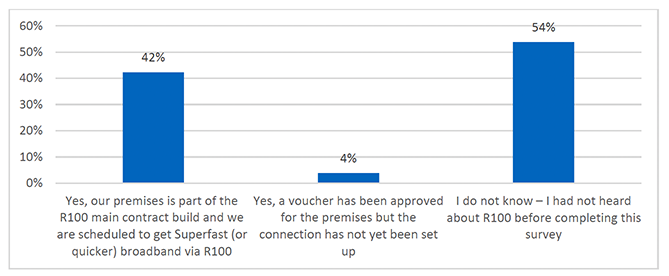
7.4.2 In total, over half of respondents (54%, n=14) were unaware of R100, while 42% (n=11) confirmed that were scheduled to get superfast broadband via the main contract and one respondent said that a voucher had been approved but not yet set up. A high proportion of respondents being unaware of the scheme echoes the findings from Survey 2a above.
Key Point: As with the residential response and the Group 2a business / organisation response, the majority of Group 3 business / organisation respondents in the sample were unaware of R100.
Current Connection
7.4.3 Respondents were asked if they had a current broadband connection at the premises. In total, 73% (n=19) said yes and 27% (n=7) said no.
Key Point: As with the residential response and the Group 2a business / organisations, the majority of Group 3 business / organisations in the sample had an existing broadband connection.
Respondents without a current broadband connection
How business / organisation accesses the internet
7.4.4 Those who indicated that they did not have a broadband connection were asked how their business / organisation typically accesses the internet. All seven respondents stated that they access the internet via 3G, 4G, or 5G connectivity on a smartphone.
7.4.5 Respondents were then asked what tasks they typically use the internet for and whether there were things their business / organisation was missing out on by not being able to access the internet more often. All seven respondents provided tasks for which they use the internet. These included marketing (including via social media), accounting, maintenance, emails, Teams meetings, supply purchases / communications with suppliers, bookings and communication with customers, and information and research. One respondent also noted that they use the internet to manage a hydroelectric station and one referenced undertaking Scottish Government reporting relating to agriculture online.
7.4.6 In terms of things businesses / organisations miss out on by not having a connection, the following was referenced:
- “Our guests do not book the cottage because there is no internet.” (Commercial business, Dumfries and Galloway)
- “We cannot efficiently run our renewable electricity generating business without broadband, as we have automation and remote operation upgrades waiting to be commissioned.” (Commercial business, Perth and Kinross)
- “We are unable to plan our expansion or offer new services to clients as Openreach do not engage or communicate in any way whatsoever.” (Commercial business, East Ayrshire)
7.4.7 Businesses / organisations were also given an opportunity to provide any other comments. A range of comments were provided, with several noting the poor reliability / speeds of mobile connections and the difficulties this presents:
- “The 4G coverage here is very poor and sometimes I have to wait until I go into town to get a proper signal.” (Commercial business, South Ayrshire)
- “Not only is there no internet but the mobile service is often poor as well.” (Commercial business, Dumfries and Galloway)
7.4.8 Several respondents also noted the difficulties they have experienced in trying to secure a connection previously:
- “We were connected up to satellite broadband … and it worked for a grand total of one day. They were unable to resolve and cancelled the contract. .... Phone signal is very poor in the area ... We are left with nothing and in cases have to go off the farm to carry out banking and taking payments. Any help greatly appreciated.” (Commercial business, Easy Ayrshire)
- "We were missed on the Broadband installation; we contacted the installer but were told that it was too hard/too late. There is an issue with our address." (Commercial business, Perth and Kinross)
Key Point: All those in the Group 3 sample who did not have an existing broadband connection, stated that they used the internet via 3G, 4G, or 5G connectivity on a smartphone and each identified specific business tasks for which use of the internet was a requirement. This is in contrast to the Group 2 sample, some of whom stated they did not use the internet / had no need for it (although it is noted that the sample sizes in each case are small). Businesses / organisations also identified things they were missing out on as a result of their lack of connection, including visitors choosing not to stay because of a lack of Wi-Fi; operating more inefficiently due to a lack of automation; and an inability to expand operations / offer new services.
Respondents with a current broadband connection
About your current connection
7.4.9 Group 3 respondents who indicated that they had a current broadband connection were asked to provide details of their broadband connection and comment on their level of satisfaction with, and use of, the connection. The responses are reported alongside those from Group 1 and Group 2a in Section 7.4.10 below.
Group 2a and Group 3 - Positive / negative aspects of current connection.
7.4.10 Group 2a and Group 3 respondents who had a current broadband connection were asked to indicate whether they agreed or disagreed with a series of statements on how their current broadband connection impacts them. Due to the small sample sizes, rather than reporting the responses separately for Group 2a and 3, the results for each group have been combined and are discussed in Section 0.
7.5 Comparative Analysis
7.5.1 As set out in the introduction, this section focuses on the questions which were asked of all three groups or more than one group within the survey and reports the results of each group alongside one another to enable comparison between the responses. It includes sections covering:
- broadband connection – including type of connection, speed and current provider
- satisfaction with broadband connectivity
- business / organisation use of broadband connection
- extent to which broadband connection provides for the needs of the business / organisation
- staff ability to meet digital technology needs of the business / organisation
- Group 2a and Group 3 – positive / negative aspects of current connection
7.5.2 It is noted that while all Group 1 respondents were asked questions about their current connection, only those respondents in Groups 2 and 3 who indicated that they had a current broadband connection were asked these questions. The direct comparison therefore overestimates the broadband connectivity of those in Group 2 and 3 as it does not include those who do not have an existing connection.
Broadband connection
Type of connection
7.5.3 Respondents in Group 1 and those in Group 2a and 3 who indicated that they had a current home broadband connection were asked a series of questions about their current connection. Figure 7‑5 below shows the type of connection used by those in each group.
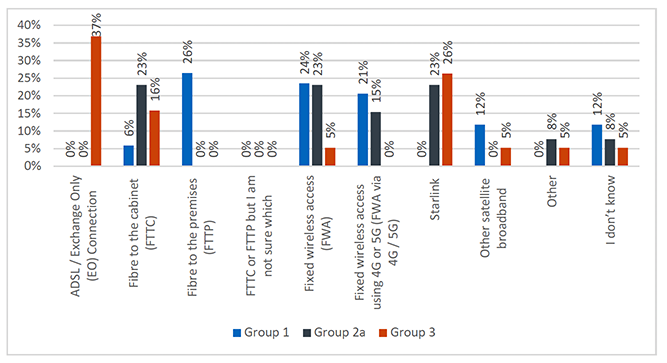
7.5.4 Amongst Group 1 respondents, the most common response was FTTP, followed by FWA. Amongst Group 2 respondents, FTTC, FWA and Starlink were the most common responses. In contrast, ADSL was the most common response amongst Group 3 respondents, followed by Starlink.
Key Point: The majority of Group 1 business / organisations in the sample have an FTTP or FWA connection whereas amongst Group 2a business / organisations in the sample there is a higher proportion of FTTC and Starlink and amongst Group 3 business / organisations in the sample, there is a higher proportion of ADSL and Starlink.
Speed of current connection
7.5.5 Group 1, 2a and 3 respondents were also asked to provide the speed of their current connection. The responses are shown in Figure 7‑6. It is noted that not all respondent’s provided a response.
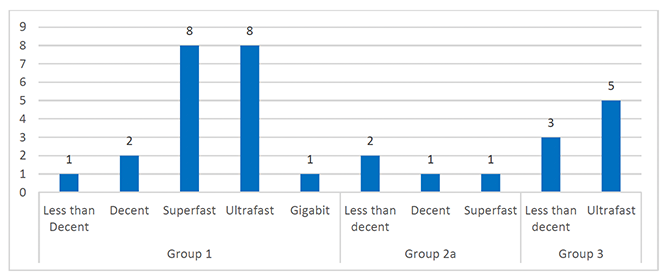
Key Point: While given the sample sizes, it is difficult to draw any firm conclusions, as would be expected Group 1 speeds do appear to be higher than those in Group 2a and Group 3.
Current provider
7.5.6 Respondents were also asked to provide the name of their current broadband provider. The results are shown in Figure 7‑7. It is noted that not all respondents provided a response.
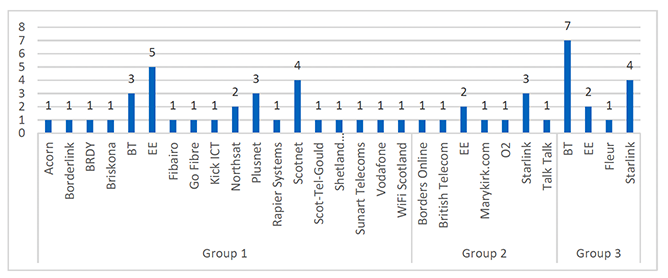
7.5.7 While the sample size is small and therefore difficult to draw firm conclusions, Group 1 businesses / organisations appear to benefit from a wider range of providers. It is also notable that Starlink features in Group 2 and Group 3, with a proportion of businesses / organisations in these groups opting to pay for a satellite solution due to the importance of a reliable connection.
Key Point: Group 1 businesses / organisations appear to benefit from a wider range of providers than those in Group 2a and Group 3.
Satisfaction with broadband connection
7.5.8 The figures below show levels of satisfaction amongst Group 1, Group 2 and Group 3 respondents with the speed, reliability and value for money of their current connection.
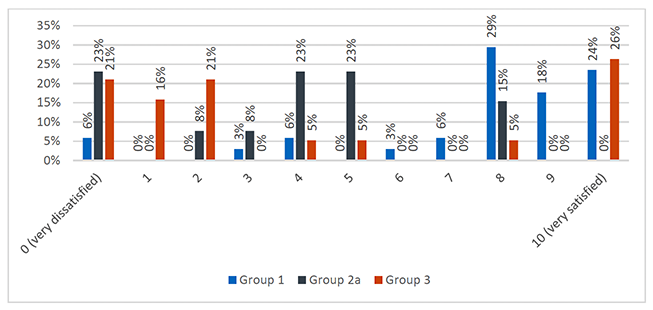
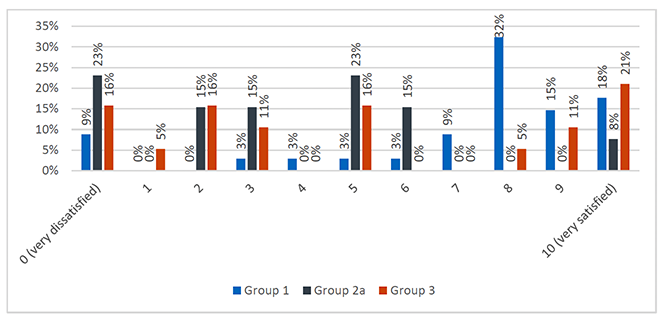
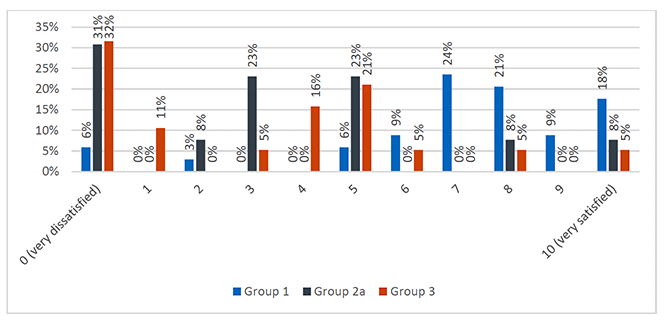
7.5.9 While sample sizes are small and therefore a note of caution is needed when interpreting the results, the data suggests that across all three measures, Group 1 respondents have higher levels of satisfaction:
- 71% (n=24) of Group 1 respondents rated their satisfaction with the speed of their connection as 8 or above, compared to 15% (n=2) of Group 2a respondents and 32% (n=6) of Group 3 respondents
- 65% (n=24) of Group 1 respondents rated their satisfaction with the reliability of their connection as 8 or above, compared to 8% (n=1) of Group 2a respondents and 37% (n=7) of Group 3 respondents
- 47% (n=24) of Group 1 respondents rated their satisfaction with the value for money of their connection as 8 or above, compared to 15% (n=2) of Group 2a respondents and 10% (n=2) of Group 3 respondents
7.5.10 With respect to value for money, as discussed above, a number of Group 2 and Group 3 respondents have opted for to pay for more expensive options (such as Starlink and other satellite-based connections) as a result of a lack of more reasonably priced alternatives which is likely to impact their satisfaction on this measure. A number of comments were made to this effect within the open text responses:
- “Our current broadband is Starlink, which is great and does everything we need our business broadband connection to do. However, our fixed broadband connection, which is FTTC on the Openreach network, is woeful and is not fit for purpose, hence our move to Starlink. The issue is that we are paying far above the typical rates for a business broadband service, because of the rural nature of our business, and the systemic lack of infrastructure improvements to the broadband network.” (charity / community organisation, scheduled voucher / main contract, Aberdeenshire)
- “Starlink works well but it’s really quite expensive.” (Commercial business, scheduled voucher / main contract, Perth and Kinross)
7.5.11 The high cost of such options also restricts their availability, with many likely to be unable to afford such solutions and as such are at higher risk of digital exclusion.
Key Point: Group 1 business / organisations have higher levels of satisfaction with speed, reliability and value for money than those in both Group 2a and Group 3. While some of the latter have resorted to higher cost solutions such as satellite, these are high-cost options.
Business / organisation use of broadband connection
Overall use
7.5.12 Figure 7‑11 shows the frequency with which businesses / organisations in Group 1, 2a and 3 use their current broadband connection. Across all three groups, frequency of use is high, with the highest rates amongst Group 2a respondents, although it is noted that the sample size for this group is small which may be impacting the results.
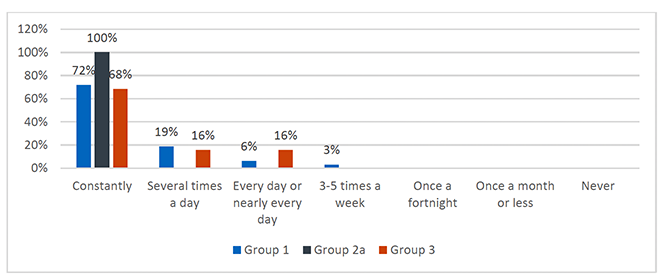
Key Point: Businesses / organisations across all three groups use their current broadband connection at a high frequency, emphasising the importance of connectivity for business activities and performance.
Use by business activity.
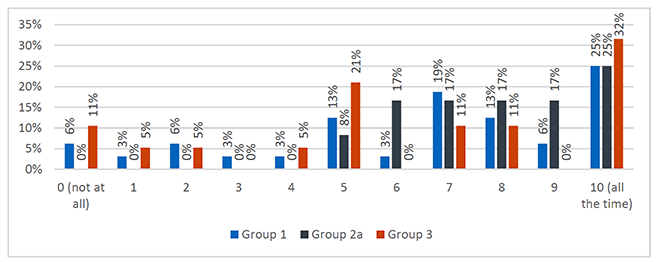
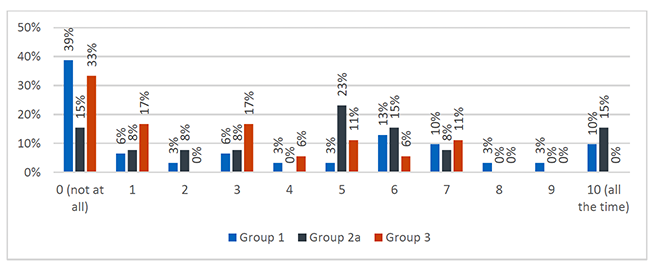
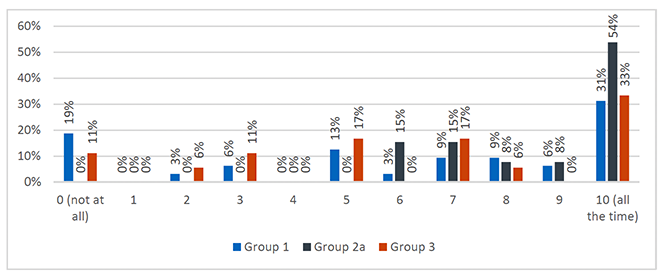
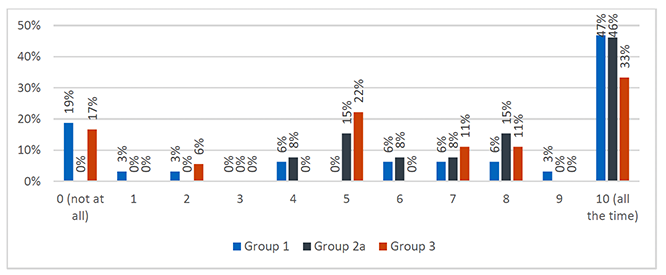
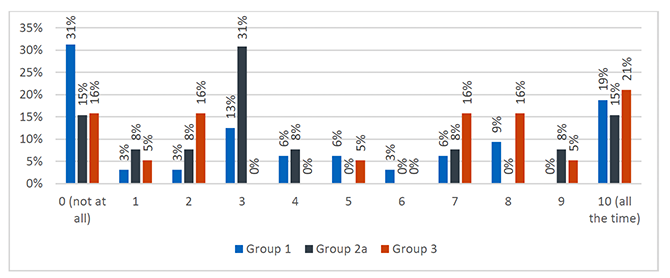
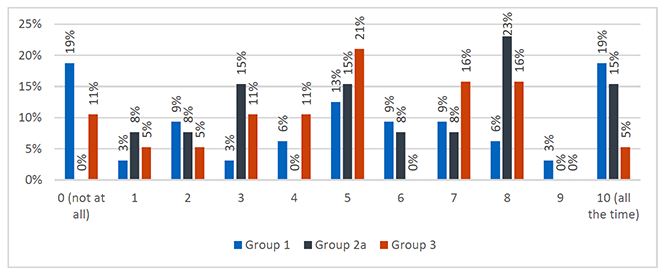
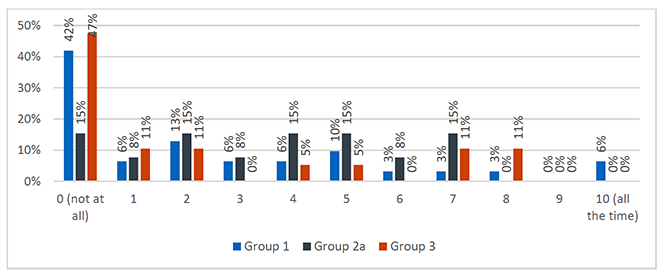
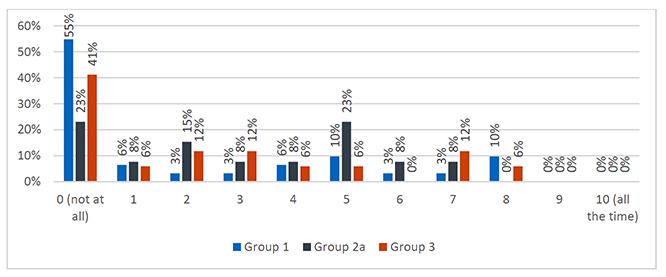
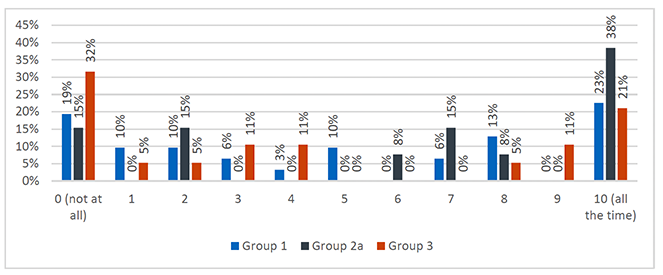
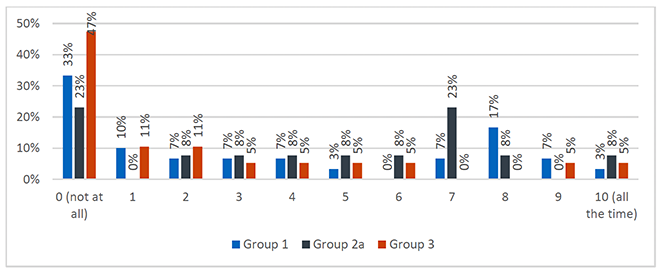
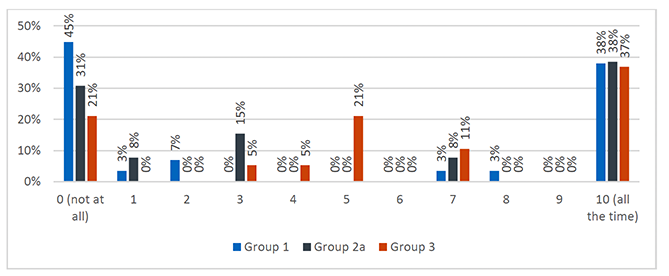
7.5.13 As well as providing an indication of their overall use, businesses / organisations were also asked to provide an indication of the frequency with which they use their current connection for a range of business activities. The results are shown in Figure 7‑12 to Figure 7‑23, with a summary of the findings for each activity provided in the bullet points below the graphs.
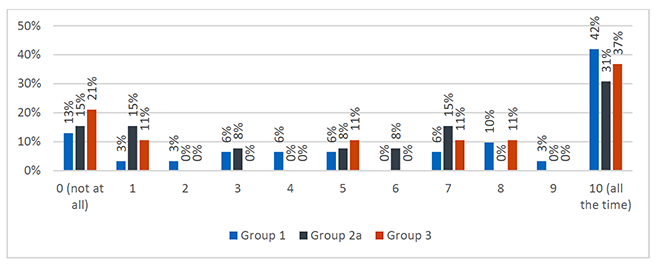
7.5.14 The data suggests:
- The activities for which businesses / organisations used their connection most frequently included ‘accessing online networks and storage’, ‘procuring / purchasing supplies’, ‘accounting and finance activities’ and ‘selling / providing products or services, including online bookings/ tickets’
- The activities for which organisations / businesses used their connection least frequently included ‘staff / volunteer recruitment’ and ‘staff volunteer / retention’, and ‘market research’ – with regard to the former, this is likely a result of the frequency with which this activity is undertaken
- In general, the frequency of use was similar across Group 1, 2a and 3, albeit some groups undertook some of the activities more frequently than others. Given the sample sizes, however, it is difficult to draw any firm conclusions between the groups.
Key Point: Businesses / organisations use their connection for a wide range of purposes across all three groups.
Extent to which current connection provides for the needs of the business / organisation
7.5.15 Businesses / organisations were also asked whether the speed and reliability of their current connection allowed their business / organisation to do everything it wants to do online. The results are shown in Figure 7‑24.
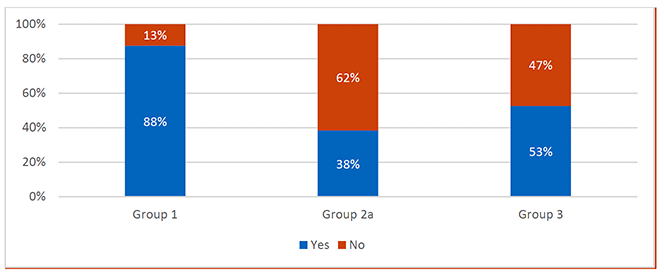
7.5.16 The majority of Group 1 business / organisations in the sample (88%, n=28) said that that their connection enabled their business / organisation to do everything it wants to do online. This compares to just 53% (n=10) of those in Group 3 and 38% (n=5) of those in Group 2.
7.5.17 Those who indicated their business / organisation was not able to do everything it wants to do were then asked what their business / organisation would like to be able to do which it cannot.
7.5.18 Businesses / organisations in Group 2 and Group 3 highlighted a range of aspects, including undertaking business tasks more quickly and productively; having a reliable and consistent connection; undertaking video conferencing and online calls; and undertaking data transfer tasks and using multiple devices at the same time.
- “The slow speed of our broadband connection often means that the computer has to wait while the broadband catches up. We would like to make our production systems more efficient, but we cannot because our broadband provision is so hopelessly slow.” (Commercial business, Group 2, Aberdeenshire)
- “Lack of speed and bandwidth make many online tasks much slower that should be the case, and the general user experience much poorer than would be the case with superfast broadband.” (Commercial business, Group 2, Fife)
- “Not waste so much time waiting for things to connect” (Commercial business, Group 3, Argyll and Bute)
- “Access information at speed, download files, video conferencing etc. Most of what are now considered to be standard business practices.” (Commercial business, Group 3, Perth and Kinross)
- “Have a reliable service that is fast enough for everyday living. The service we have relies on just one supplier, it is expensive and is often down for days at a time, with no reduction in charge.” (Commercial business, Group 3, Perth and Kinross)
- "Connectivity is very poor limiting online video conferencing. In large meetings [it] frequently cuts out and you have to reconnect.” (Commercial business, Group 2, East Ayrshire)
- “[We would like to] have a reliable telephone connection and be able to make voice calls.” (Commercial business, Group 2, Scottish Borders)
- “Get internet access consistently on a daily and hour by hour basis. It is totally inefficient and unreliable.” (Commercial business, Group 3, Aberdeenshire)
- "We cannot reliably fill in any online form. The broadband drops frequently. “Booking anything via internet is unreliable. Safer to go into Stranraer and use library." (Commercial business, Group 3, Dumfries and Galloway)
- “I need to transfer 3D CAD data to and from remote servers at reasonable speed.” (Commercial business, Group 3, Argyll and Bute)
- “Upload file, documents and pictures. Have a more stable connection. Use multiple devices at the same time.” (Commercial business, Group 3, Dumfries and Galloway)
7.5.19 Several Group 2 and 3 respondents also highlighted the need to provide a good connection for visitors:
- “Be able to access faster internet … our clients look for fast internet and may choose to go elsewhere if we cannot provide it.” (Commercial business, Group 2, Orkney)
- “I would like to be able to tell guests to our commercial property that fully efficient broadband is available.” (Commercial business, Group 3, Argyll and Bute)
7.5.20 While satisfaction amongst Group 1 businesses / organisations was higher, several Group 1 respondents stated that their business could not do everything online. A number of respondents highlighted difficulties with speed and reliability:
- “The speed is OK, but the reliability is not good enough to move on to VOIP telephones. The unreliability also causes problems for visitors e.g. in streaming TV or films.” (Commercial business and IVS recipient, Shetland)
- “Run zoom calls at a rate in which it doesn't lag. We are often unable to do large data transferals on the current connection too.” (Commercial business, main contracts recipient, East Lothian)
- "Connect at the speed provided when the initial connection was made. A signal transmitter was damaged a year ago resulting in reduced signal and EE refuse to fix it. The current broadband signal is slower than it was before superfast was rolled out. The money spent has therefore been entirely wasted on providing a worse service than previously existed by phone line” (Commercial business and SBVS recipient, Highlands)
7.5.21 One Group 1 voucher recipient also noted that her connection was poorer compared to others in her neighbourhood who had benefited from the main contracts:
- “Have a superfast broadband connection. Fibre has been installed in my neighbourhood but not to me, because I used the voucher scheme” (Commercial business and IVS recipient, Aberdeenshire)
Key Point: Group 1 businesses / organisations were more content with their broadband connection and its ability to meet the needs of their business / organisation.
Staff ability to meet digital technology needs of the business / organisation.
7.5.22 Respondents were also asked about the digital skills of their staff. The results are shown in Figure 7‑25.
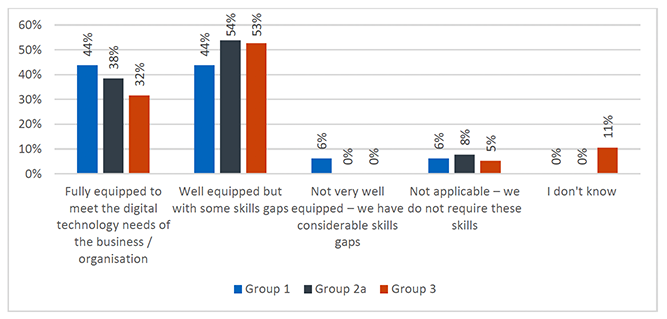
7.5.23 The data suggests that staff are generally well equipped in terms of digital skills with staff in Group 1 businesses / organisations marginally better equipped than those in Group 2a and Group 3 businesses / organisations. This may in part stem from the enhanced connectivity provided. However, given the small sample sizes and various factors which may influence digital skills, it is difficult to draw any firm conclusions.
Key Point: Staff are generally well equipped in terms of digital skills.
Group 2a and Group 3 - Positive / negative aspects of current connection.
Group 2a and Group 3 respondents who had a current broadband connection were asked to indicate whether they agreed or disagreed with a series of statements on how their current broadband connection impacts them. Due to the small sample sizes, rather than reporting the responses separately for Group 2a and 3, the results have been combined and are shown in the table below.
| Strongly agree | Agree | Neither agree nor disagree | Disagree | Strongly disagree | I don't know / can't say | |
|---|---|---|---|---|---|---|
| Our current broadband connectivity restricts our access to online servers | 32% | 32% | 16% | 10% | 3% | 6% |
| Our current broadband connectivity limits our ability to sell / provide products and / or services | 43% | 20% | 27% | 7% | 3% | 3% |
| It can be difficult to promote the business / organisation with our current broadband connectivity | 33% | 27% | 33% | 10% | 3% | 0% |
| Our current broadband connectivity contributes to lower levels of productivity | 30% | 30% | 23% | 7% | 10% | 7% |
| Our current broadband connectivity impedes the performance of our business / organisation | 34% | 25% | 25% | 6% | 3% | 6% |
| Our current broadband limits innovation | 32% | 26% | 26% | 10% | 3% | 3% |
| Our current broadband connectivity makes accounting and financing activities more difficult | 37% | 17% | 27% | 13% | 3% | 7% |
| Our current broadband connectivity negatively affects turnover | 13% | 40% | 33% | 10% | 3% | 3% |
| It is difficult to make improvements to our product / service offering due to our current broadband connectivity | 28% | 25% | 31% | 13% | 3% | 0% |
| Our current broadband connectivity limits our ability to make bookings | 23% | 20% | 37% | 13% | 10% | 7% |
| Our current broadband connectivity prevents us using lower-cost suppliers | 17% | 23% | 40% | 10% | 7% | 10% |
| Our current broadband connectivity limits our access to new markets | 13% | 23% | 50% | 7% | 3% | 13% |
| Our current broadband connectivity makes it difficult to communicate with staff / volunteers | 7% | 27% | 43% | 13% | 3% | 10% |
| Our current broadband connectivity limits our ability to undertake market research | 10% | 23% | 39% | 10% | 3% | 13% |
| Our current broadband connectivity has a negative impact on the number of customers / visitors coming to our premises | 13% | 16% | 48% | 10% | 6% | 3% |
| Our current broadband connectivity makes it difficult to recruit staff / volunteers | 3% | 20% | 53% | 10% | 7% | 20% |
| Our current broadband connectivity has a negative impact on the training we are able to provide staff / volunteers | 3% | 20% | 53% | 17% | 3% | 13% |
| Our current broadband connectivity makes it difficult to retain staff / volunteers | 10% | 10% | 60% | 7% | 10% | 13% |
The highest level of agreement was associated with the following statements:
- Our current broadband connectivity restricts our access to online servers – 65% (n=20) strongly agree or agree
- Our current broadband connectivity limits our ability to sell / provide products and / or services - 63% (n=19) strongly agree or agree
- It can be difficult to promote the business / organisation with our current broadband connectivity - 60% (n=18) strongly agree or agree
- Our current broadband connectivity contributes to lower levels of productivity - 60% (n=18) strongly agree or agree
Key Point: The data suggests that where Group 2 and 3 businesses / organisations have an existing connection, it is generally of a poor standard in terms of speed and reliability and as such contributes to a range of negative business outcomes.
Contact
Email: sean.murchie@gov.scot