
R100 Interim Evaluation
This report details findings of the R100 Programme Interim Evaluation, informed by the best practice set out in the Digital Appraisal Manual for Scotland (DAMS): https://www.gov.scot/publications/digital-appraisal-manual-for-scotland-guidance/
4 Logic Maps
4.1 Overview
4.1.1 Drawing on the benefits of enhanced digital connectivity identified within the wider literature, this chapter:
- sets out a series of logic maps specifying the range of potential outcomes and impacts which may result from the delivery of the R100 programme for different groups in society
- explores how the potential benefits will differ for each individual property affected, depending on the starting and end position in terms of broadband connectivity and the number of internet users based at the property / how the internet is used.
4.2 Logic maps
4.2.1 Logic maps are diagrams that show the underlying mechanisms through which an action leads to a certain result, by showing the logical steps along an anticipated route from inputs to outputs to outcomes to impacts. Logic maps are central to the evaluation process as they define different chains of causality that help the evaluator to scope and assess the benefits which could emerge from an investment.
4.2.2 Drawing on the findings from the literature review, four logic maps have been developed for the R100 programme, one for each of the following broad categories of beneficiary:
- residents
- businesses
- public service providers
4.2.3 The logic maps are provided in Figure 4‑2 below.
4.2.4 The main components of the logic maps are set out in Figure 4‑1 and include:
- Context: The problems and opportunities which R100 is seeking to address. This effectively forms the rationale for proceeding with the R100 i.e., the case for change which underpins the business case.
- Input: The investment and processes required to deliver R100.
- Outputs: The direct deliverable(s) from R100 i.e. the improvement in connectivity provided.
- Outcomes: Changes in behaviour which result from the changes in connectivity (outputs).
- Impacts: Societal changes which occur as a consequence of the changes in connectivity (outputs) and the changes in behaviour (outcomes) which stem from the intervention, e.g., reduced economic inactivity / unemployment, higher productivity, land-value uplift etc.
Plain text version:
Context
- Problems investment is seeking to address
Input
- Investment required to deliver R100
Output
- Resulting changes in connectivity
Outcomes
- Consequential changes in internet use
Impact
- Consequential social and economic impacts of the changes in use
4.2.5 It is important to recognise that outputs, outcomes, and impacts materialise at different times.
4.2.6 Whilst outputs are delivered upon project completion or once the investment is operational, outcomes and impacts take longer to materialise, with some longer-term impacts taking 10-15 years to become apparent. In addition, there is a time-lag in the availability of some secondary data sources for measuring outcomes and impacts with, for example, some datasets only produced every ten years in line with Census reporting periods. This acts to further extend the period between the investment being delivered and the time when it is possible to report on its full impacts.
4.2.7 This research is being carried out during the R100 rollout and many of those who have benefitted from R100 to date have only experienced the improved connectivity for a relatively short period of time.[74] As such, the research will not capture all of the benefits of the programme. It will, however, provide an indication of the emerging outputs and outcomes and the potential impacts of these.
Context
- No broadband
- Standard broadband
- Superfast broadband
Inputs
- R100 investment
- Fixed broadband/voucher scheme made available in area and connections provided
Outputs
- Superfast/ ultrafast/ gigabit broadband connectivity
Outcomes – Changes in Behaviour
Employment
- Shift to working from home / hybrid working or doing so more efficiently in existing jobs including working more hours - so reduced personal commuting
- Take up of new employment opportunities (entering the labour market), including new start-ups
- Take up of improved employment opportunities, including new Startups, with e.g., higher pay and / or improved work/life balance
Education and Skills
- Accessing online learning opportunities including some in protected groups
- Improve their digital skills
Public and Personal Services
- Accessing online health services, online banking, bill paying and other public services - so reduced personal travel for these purposes
Information
- Accessing information enabling more informed decisions, e.g., major purchases, travel, health, lifestyle, personal research
Shopping & Selling
- Online shopping
- Online selling (personal capacity)
Social, Media and Entertainment
- Keeping in touch with friends and family - emails video calls, social media channels etc.
- News and current affairs including social media
- Streaming live and on-demand TV channels / sharing content / music/ films/ gaming etc
Migration
- Remaining in the area rather than move away
- New residents move into the area with the removal of the key connectivity barrier
…both of which increase the local labour supply and community sustainability
Societal impacts of these changes
Economic Activity
- Increase in employment in R100 areas
- Reduced unemployment in R100 areas
- Higher wages in R100 areas with knock on impact of higher spend locally
- Increased online spend at the expense of local retail
Education and Skills
- Higher levels of educational attainment -with associated life opportunities and economic impacts
Health & Wellbeing
- Improved social inclusion /community cohesion/ reduced isolation -through access to online news, social media (including community / family groups), online gaming etc. -fosters feelings of connectedness and leads to reduced loneliness
- Earlier diagnosis /treatment with associated improved health outcomes, health cost savings and reduced absenteeism
- Quality of life / work-life balance benefits of home/ hybrid working
Property
- Increased house prices
- Development pressures
Carbon emissions
- Fewer trips made for commuting and accessing public and other services
- Increased domestic energy use from home-working
Context
- No broadband
- Standard broadband
- Superfast broadband
Inputs
- R100 investment
- Fixed broadband/voucher scheme made available in area and connections provided
Outputs
- Superfast/ ultrafast/ gigabit broadband connectivity
Outcomes for R100 area businesses
Staff
- More remote working by current staff, potentially increasing efficiency / turnover
- Businesses recruit new 'location-independent’ home-based staff, therefore benefitting from a wider labour market, increasing efficiency / turnover
Markets
- Businesses access a larger customer base through selling online and providing online services, increasing turnover
- Businesses increase online marketing / presence through websites /social media-increasing turnover
- Increased business and leisure tourism numbers through the removal of a connectivity barrier to visitor tourism (accommodation and visitor attractions through wifi)
- Promotional benefits of tourist visitors uploading content to social media via visitor facility wifi
Operating efficiency
- Businesses have easier day-to-day management through access to online information and services (e.g. online banking/bill paying / booking systems etc) and greater use of cloud storage
Relocations & Start-Up
- Relocation of businesses into the area adding to economic density and creating employment opportunities
- Formation of new online businesses
Non R100 Businesses / service providers
- Access to wider labour market via remote working
- Access to larger customer base (online goods / services)
Impact
Economic Impacts
- Increased employment
- Increased turnover
- Relocation of firms into areas
- Higher turnover / worker
- Higher wages
- Fall in number of unemployed claimants
…All lead to increased productivity at the local level but an associated displacement from non-R100 area
Carbon emissions
- More trips made due to more visitors into the area, although this depends on their counterfactual behaviour
- Reduced business travel
Context
- No broadband
- Standard broadband
- Superfast broadband
Inputs
- R100 investment
- Fixed broadband/voucher scheme made available in area and connections provided
Outputs
- Superfast/ ultrafast/ gigabit broadband connectivity
Outcomes
NHS
- NHS able to provide online services so can deliver more efficient patient care
- Multiple users at individual sites able to access content at the same time / information sharing
- Easier day-to-day management/ admin through access to online information and services and greater use of cloud storage - reducing costs and improving
Schools
- Ability to access and share a wider range of educational content and teaching resources more easily- online learning/homework
- Multiple users at the same school able to access content at the same time / information sharing
- Cross school and external collaboration
- Ability to provide remote learning opportunities
- Easier day-to-day management/ admin through access to online information and services and greater use of cloud storage - reducing costs and improving
Tertiary Education and skills
- Ability to access and share a wider range of educational content and teaching resources more
- Multiple users at the same site able to access content
- Cross campus and external collaboration
- Ability to provide remote learning opportunities
- Easier day-to-day management/ admin through access to online information and services and greater use of cloud storage - reducing costs and improving efficiency / information sharing
Other government agencies
- Multiple users at the same site able to access content at the same time
- Easier day-to-day management/ admin through access to online information and services and greater use of cloud storage - reducing costs and improving efficiency / information sharing
Impact
Education and Skills
- Higher levels of educational attainment -with associated life opportunities and economic impacts
Health & Wellbeing
- Shorter waiting times
- Earlier diagnosis and treatment and earlier discharges/ enhanced monitoring and hence reduced
- Improved health outcomes
Carbon emissions
- Fewer trips made with online resources replacing travel
4.3 Scale of Potential Benefits
4.3.1 The range of potential benefits experienced by a household or business affected by the R100 programme will depend on:
- their ‘base’ or starting position with respect to broadband connectivity
- their ‘end’ position in terms of broadband connectivity following the delivery of R100
- the number of people using the connection at the property
- the activities undertaken by these people e.g. email, making high-definition calls, streaming / uploading content etc
The length of time since R100 connectivity has been in place for a given area or premises – it is expected than some impacts will take longer to materialise than others.
4.3.2 Prior to the delivery of the R100 programme, some properties will have had no internet connection, and some will have some level of existing broadband connectivity. Post the delivery of R100, properties may benefit from superfast, ultrafast or gigabit broadband.
4.3.3 An initial review of data indicates that the majority of the properties scheduled to be affected will have had some level of broadband connectivity already. As such, for the majority of affected premises the benefits of R100 will be incremental rather than binary in nature i.e. the programme will enable people to do things online more easily.
Internet use and benefits by person type
4.3.4 As discussed above, the range of potential benefits experienced by a household or business will in part depend upon the activities undertaken by the people at the property.
4.3.5 The ONS collates information on internet use and activities by person type[75]. This data draws on information collected via the Opinions and Lifestyle Survey and the most recent dataset available is from 2020. It is recognised this will likely inflate use given the COVID-19 pandemic, but the data usefully shows comparisons between groups in society which are likely to remain applicable despite overall increases in use.
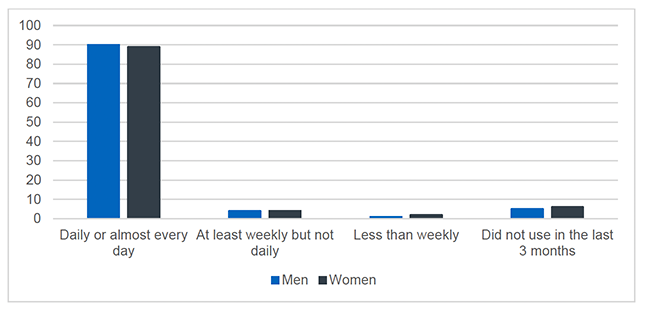
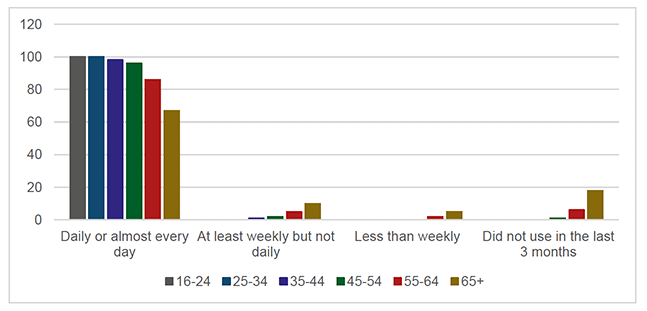
4.3.6 Figures 4.5 and 4.6 show the frequency of internet use by age group and sex. Key points from these graphs are as follows:
- Younger people generally use the internet more frequently than older age categories with all those age 34 and below stating that they use the internet daily or almost every day compared to just 67% of those age 65
- Women and men generally use the internet at a similar level of frequency
- Those who are equality act disabled generally use the internet less frequently than those who are not equality act disabled
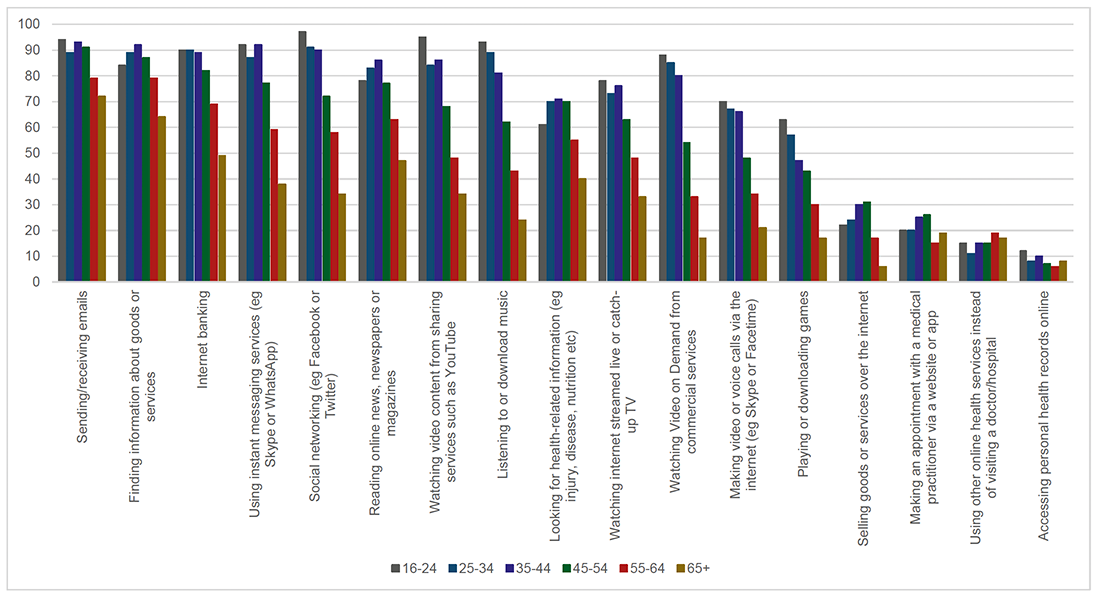
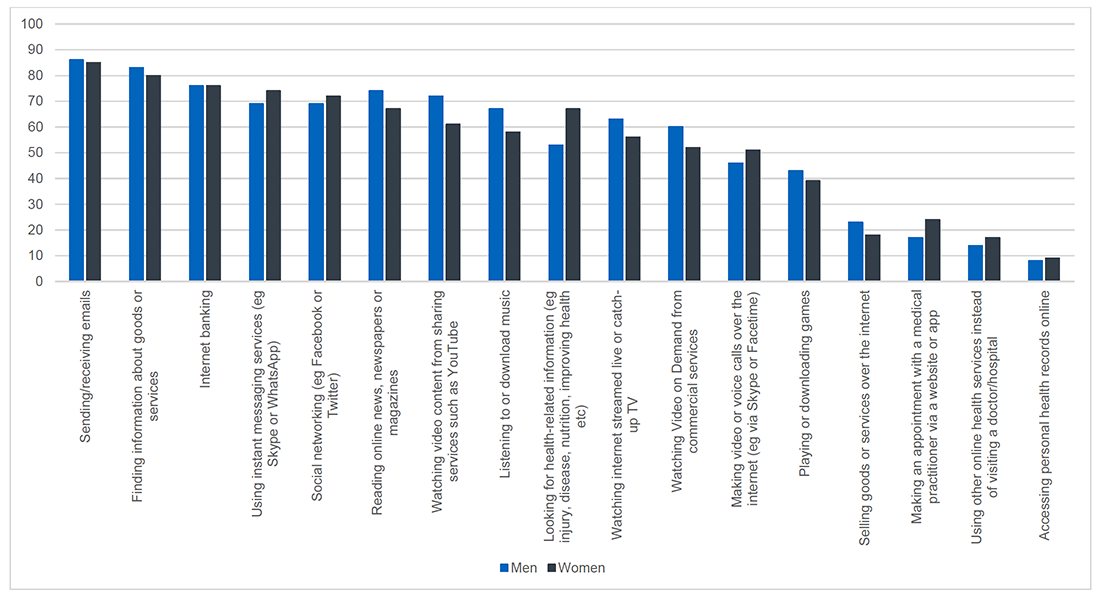
4.3.7 Figure 4‑7and Figure 4‑8 show the proportion of people undertaking various activities online split by age group and sex as recorded via the Opinions and Lifestyle Survey. Key points from these graphs are as follows:
- Younger people more commonly use the internet for activities which typically require faster connections including watching video on demand and playing games or downloading games – in total while 63% of those surveyed aged 16-24 had played or downloaded games in the last three months, just 17% of those over the age of 65 had done so.
- In comparison to other activities, there are relatively low proportions using online health services. As may be expected, older people use these services more frequently than young people with those in the age group 55-64 using them most frequently, followed by those aged 65 and over.
- In general, women use the internet more for instant messaging, social media, making video or voice calls whereas men more frequently use the internet for watching or streaming live or cable TV, watching video on demand, and playing or downloading games.
4.3.8 Overall, the data suggests that the benefits provided by R100 will differ amongst different groups in society owing to their frequency of use of the internet and the different activities undertaken (and therefore different requirements with respect to broadband speed).
Contact
Email: sean.murchie@gov.scot