
R100 Interim Evaluation
This report details findings of the R100 Programme Interim Evaluation, informed by the best practice set out in the Digital Appraisal Manual for Scotland (DAMS): https://www.gov.scot/publications/digital-appraisal-manual-for-scotland-guidance/
2 Background
2.1 Overview
2.1.1 This section provides a background on broadband and how it is provided in Scotland before providing an overview of the R100 programme and its relationship with other similar programmes in the UK.
2.2 How is broadband provided and what speeds are available?
2.2.1 In the UK, Fixed broadband is delivered via various technologies (as set out in the list below), with each incremental improvement in technology providing faster speeds and a more reliable connection than the former:
- Copper (ADSL[9]) – copper cables used to connect from the exchange to the premises. Maximum download speed is 24Mbit/s. Speed diminishes significantly with distance and copper cables are affected by poor weather and are susceptible to faults.
- Fibre to the cabinet (FTTC) – Fibre cables to the cabinet and copper cables to the premises. The maximum download speed is usually 80 Mbit/s. As with ADSL, speed diminishes with distance and affected by poor weather / susceptible to faults.
- Full fibre or ‘fibre to the premises’ (FTTP) – Fibre cables to the cabinet and the premises. Unaffected by distance and less susceptible to faults / weather.
- Hybrid fibre coaxial cable (HFC) – Fibre cables to the cabinet and coaxial cable from the street cabinet to the premises. Latest technology (DOCSIS 3.1) able to deliver speeds of up to 10Gbit/s and upload speeds of up to 1Gbit/s but in reality, speeds can be below this as shared with multiple users.
2.2.2 As well as fixed broadband, broadband can also be provided wirelessly. There are broadly three types of wireless broadband connection:
- Fixed Wireless Access - Broadband to fixed locations can also be delivered wirelessly via radio signals between two points. This is known as Fixed Wireless Access (FWA). FWA broadband networks generally cover areas which are within set distances and line of sight of radio masts. If a property is too far away from a mast or there is no line of sight between the mast and the property because of e.g. hills or trees, then it may be difficult for a supplier to get a signal strong enough to provide a superfast broadband connection.
- FWA using 4G or 5G - FWA can also be provided on licensed 4G and 5G networks. In this case a wi-fi router is installed with a mobile sim card and is connected by cable to an external aerial in a suitable outdoor location. 4G FWA is often used where wired connections or FWA is not available. However, like FWA, 4G FWA broadband networks cover areas which are within set distances and line of sight of mobile network radio masts and where a property is too far away from the mobile mast or there is no line of sight, it would be difficult for a supplier to get a signal strong enough to provide a superfast broadband connection. In addition, it’s possible that if lots of people are connected to the same mast (mobile and FWA users) at the same time, broadband speeds can drop. As a result, there may be areas of high mobile demand where a reliable FWA cannot be provided.
- Satellite broadband - broadband can also be provided via satellite using a dish or antenna on the property. There are two types: Geostationary Orbit (GSO) Satellite and Low Earth Orbit (LEO) Satellites. While there are a range of providers offering GSO, LEO is relatively new and is currently only offered by Starlink[10]. Satellite connections do not require a wired connection or 4G and have proved popular in some rural areas where these options are limited or speeds / reliability is poor.
2.3 What broadband speeds are available?
2.3.1 The topic of broadband speeds is complex, and the speed experienced by a user on a given day will vary. Four categories of broadband speed (as delivered to the home, rather than experienced in the home) can broadly be identified in the literature. These are set out in the table below along with the approximate download speed / times, and broadband technologies typically used to provide the services.
|
Broadband category |
Speed |
Approximate time taken to download one TV show (406MB via on demand) |
Typical broadband technologies which provide this service |
|---|---|---|---|
|
Decent / Standard |
10 Mbit/s |
10 mins 50 seconds to 3 mins 23 seconds |
Copper ADSL |
|
Superfast |
30 Mbit/s |
1 min 25 seconds to 43 seconds |
FTTC or HFC |
|
Ultrafast |
100 Mbit/s or more |
22 seconds to 6 seconds |
FTTP or HFC |
|
Gigabit |
1 Gbit/s and above |
3 seconds |
FTTP |
2.3.2 The speed of broadband determines the activities which can be undertaken using the connection. Fast speeds allow for quicker downloads and uninterrupted streaming and improve the quality of video content meaning it is possible to stream compatible content in full HD, or 4K. In addition, where there are more people using the internet at the same time, (e.g. in larger households) faster upload and download speeds are required as they help to reduce the impact of different family members using connected devices at the same time. While there are various breakdowns setting out what activities can be undertaken at different broadband speeds, the situation is complex and there is no universally accepted categorisation.
2.4 How extensive is broadband coverage across Scotland?
2.4.1 Ofcom reports on the percentage of UK premises (residential and commercial properties) with access to fixed broadband, specifically superfast broadband, gigabit-capable, and full fibre[12]. The table below provides a summary of this data for residential and commercial properties in urban and rural areas of Scotland.
|
Residential Overall |
Residential Urban |
Residential Rural |
Commercial Overall |
Commercial Urban |
Commercial Rural |
|
|---|---|---|---|---|---|---|
|
Not able to receive decent broadband |
2% |
0% |
11% |
7% |
3% |
22% |
|
Able to receive decent broadband |
98% |
100% |
89% |
93% |
97% |
78% |
|
Superfast broadband |
95% |
99% |
79% |
85% |
91% |
63% |
|
Gigabit-capable |
72% |
80% |
34% |
45% |
54% |
16% |
|
Full fibre |
53% |
58% |
32% |
30% |
35% |
15% |
2.4.1 The roll-out of broadband services in the UK is led by private suppliers who determine when and where to deliver services based on commercial considerations, with the result that there is a clear division between connectivity levels in urban areas compared to more rural locations where lower population densities lead to a reduced commercial case for investment. In addition, the data suggests that a higher proportion of residential properties have access to broadband compared to commercial premises and there is generally a more pronounced divide between urban and rural coverage with respect to commercial properties as compared to residential properties.
2.4.2 Overall, Ofcom estimates that around 18,000 (0.6%) premises (homes and businesses combined) in Scotland do not have access to a decent broadband service via either a fixed or FWA network and around 6,600 premises cannot access either a decent fixed broadband service or get good 4G coverage indoors. Aside from a handful of exceptions, all of these premises are in rural Scotland[14].
2.5 R100 Programme
2.5.1 As demonstrated above there is a clear division between connectivity levels in urban areas compared to more rural locations due to the reduced commercial case for investment in the latter locations. R100 aims to overcome this inequality by delivering broadband services in locations where they would not otherwise be provided by the market.
2.5.2 The genesis of the R100 programme was the Programme for Government 2016/17 which included a commitment “to extend superfast broadband access to 100% of premises across Scotland”. R100 was subsequently developed to achieve this goal and is now a central action within the Scottish Government’s Digital Strategy published in 2021[15].
2.5.1 The Investment Objectives for the R100 Programme are as follows:
- Improve business performance in Scotland by facilitating increased productivity, innovation, and access to new markets.
- Improve wellbeing of people across Scotland.
- Reduce the negative impact of the digital divide, through a) addressing regional disparities in provision and b) increased availability amongst groups disproportionately represented in these areas.
- Strengthen communities, including in rural areas, by offering enhanced opportunities to work, trade, and deliver public services, helping to address depopulation.
- Aid the transition to net zero by reducing travel requirements that result from ability to work or engage with others remotely.
- Increase Scotland's capacity to maintain business productivity, activities important for wellbeing, and access to essential services in the face of communication disruption, especially for those rural and island communities.
2.5.2 There are three strands of the R100 programme:
- the over £600 million R100 contracts
- the R100 Scottish Broadband Voucher Scheme (SBVS)
- continued commercial coverage provided by commercial suppliers.
2.5.3 The first two of these are discussed further below.
R100 Contracts
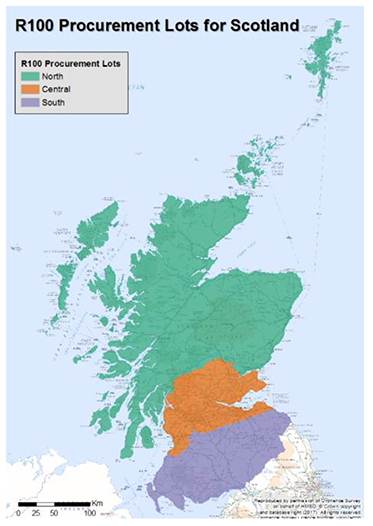
2.5.4 The R100 procurement process was split into three regional lots, namely North, Central, and South as shown in Figure 2‑1. All three contracts were awarded to BT, who then appointed Openreach as its delivery partner. The Central and South contract was awarded in December 2019 with builds starting in 2020, and the North contract was completed in December 2020, with build commencing in 2021.
2.5.5 While initially conceived as a scheme to provide Superfast broadband services, a large proportion of the properties receiving connectivity improvements via R100 have been provided with Gigabit broadband connectivity.
R100 Scottish Broadband Voucher Scheme
2.5.6 The R100 SBVS was launched in September 2020 and provides funding of up to £5,000 to help homes and businesses not in scope of either the main R100 contracts or planned commercial investment to obtain superfast broadband. To access the voucher scheme eligible property owners must contact registered suppliers who then apply for the voucher on their behalf. In contrast to the R100 Contracts, attaining broadband via SBVS therefore requires the householder to take the initial action and progress with an application. While an important element of the programme, SBVS makes up a small proportion of the overall programme.
2.5.7 The SBVS scheme is technology neutral, with the solutions offered by registered suppliers determined by an individual property’s location. Available technologies include:
- FTTP
- FWA
- FWA using 4G or 5G
- Satellite - GSO only
2.5.8 As noted above, there are two types of satellite broadband available: GSO and LEO. Currently, no LEO satellite operators have signed up to the R100 programme. As such Starlink is not currently available via R100.
Geographic Scope
2.5.1 The Scottish Government maintains a database of properties which have benefited from the R100 programme, are due to benefit over the upcoming period, and those for whom connections have been delivered commercially. This database is continually updated on a rolling basis as the programme progresses to ensure that Scottish Government funding is only invested where no commercial development is planned. Data from a September 2024 version of this database which focused only on those properties benefitting from R100 or due to benefit from R100 (i.e. those benefitting via commercial deployment were excluded) suggests that 80% of the properties affected by R100 are in accessible, remote or very remote rural areas, with just 17% in urban locations and the remaining 3% in small towns. The areas covered by the programme also include island communities with the delivery of connectivity to these areas bringing additional challenges due to the need for subsea cables.
2.6 Other similar programmes and market interventions
2.6.1 There are a range of other digital infrastructure programmes which have been implemented or are currently being delivered in Scotland, including:
- The UK Superfast Broadband Programme and the Scottish element of this (Digital Scotland Superfast Broadband (DSSB) Programme)
- Local Full Fibre Network
- Project Gigabit
2.6.2 By way of context, each of these are discussed further below.
UK Superfast Broadband Programme and the Digital Scotland Superfast Broadband Programme
2.6.3 The UK Superfast Broadband programme was established in 2010 in response to concerns that the commercial deployment of superfast broadband would fail to reach many parts of the UK. The programme was delivered in three phases:
- Phase 1: aimed to extend superfast coverage to 90% of UK premises by December 2016
- Phase 2: aimed to extend coverage to 95% of premises by December 2017
- Phase 3: aims to provide superfast broadband coverage (or faster networks) in areas where availability remained below the 95% coverage target and extend superfast coverage beyond 95% where possible.
2.6.4 Scotland under the programme titled DSSB was part of the Phase 1 and Phase 2 programme
2.6.5 DSSB involved over £410 million of investment from the Scottish Government, UK Government, Highlands and Islands Enterprise, local authorities, ERDF and the private sector, and was delivered through two regional projects – Highlands and Islands, and the Rest of Scotland. Both contracts went through separate procurement processes, and were ultimately awarded to BT.
2.6.6 The programme aimed to provide users with superfast broadband; over 24Mbps.[17]. Most connections delivered through DSSB were FTTC or FTTP. The programme successfully delivered fibre-based access to 95% of home and businesses across Scotland.[18]
2.6.1 The UK Superfast Broadband Programme has now been superseded by Project Gigabit (see below). However, there remain legacy contracts under the Superfast Broadband Programme that are still delivering to homes and businesses. In late 2020, the government approved a further £490 million of new contracts signed to provide mainly gigabit-capable coverage to a further 172,000 premises.[19]
As highlighted above, the R100 project builds on the DSSB programme, with R100 ensuring all homes and businesses can access superfast broadband. Local Full Fibre Network
2.6.2 The Local Full Fibre Network (LFFN) programme launched in 2017 by Building Digital UK (BDUK) an executive agency, sponsored by the UK Department for Science, Innovation and Technology. The programme aimed to accelerate and de-risk deployment of digital infrastructure in order to drive productivity and growth in the UK and had an initial funding envelope of £200million. Local bodies were able to apply for funding from BDUK, and could then choose to deliver locally through one of the following three delivery models within the programme:[20]
- Public-Sector Anchor Tenancy - bringing together local public sector customers, to create enough broadband demand to reduce financial risk of new full-fibre networks
- Public-Sector Building Upgrades - directly connecting public sector buildings, such as schools and hospitals
- Public-Sector Asset Re-use - opening up public sector assets, such as ducts, to allow fibre to be laid more cheaply.
2.6.3 It is understood that the programme largely focused on England. However, in 2022, Highland Council completed a four-year project across Inverness, Fort William, Thurso, and Wick that benefited from funding through the LFFN programme.[21] The programme delivered a gigabit speed fibre optic broadband network which connects 152 public sector sites (schools, hospitals etc).
Project Gigabit
2.6.4 Project Gigabit is the UK government’s £5 billion programme that targets hard-to-reach areas where it is more difficult and more expensive to build digital infrastructure. There are three aspects to the programme:
- Project Gigabit Procurements - the majority of premises that will be connected by Project Gigabit will be served by the Project Gigabit Procurements element of the Programme. These involve local, regional, and cross-regional contracts with broadband suppliers to deliver gigabit-capable infrastructure to an agreed set of premises.
- Gigabit Voucher Scheme - eligible residential and business not currently within Project Gigabit projects can apply for a UK Gigabit Voucher worth up to £4,500 to help cover the costs of installing gigabit broadband. While to date these have focused on locations in England[22], there are a number of active GVS projects in Scotland.
- GigaHubs – focuses on connecting public sector buildings, including schools, GP surgeries, libraries and other public buildings, with gigabit-capable broadband in order to improve public services. These premises will act as “hubs” to bring gigabit-capable speeds into the heart of communities. It is anticipated that the investment will also incentivise other broadband suppliers to build off the newly installed network making the surrounding areas increasingly viable for commercial intervention. Data from BDUK Rural Gigabit Connectivity Hubs Evaluation published in December 2023 suggests that between July 2019 and April 2022, there were 1,088 Hub connections, with most being in primary schools. Of these, 173 were in Scotland (16%).[23]
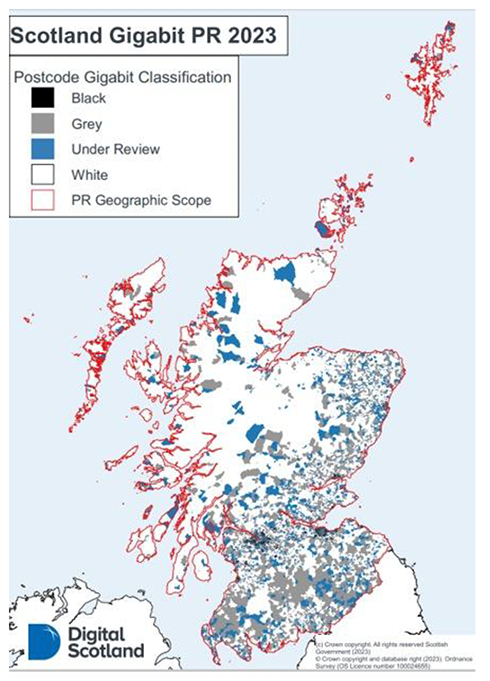
2.6.5 The Scottish Government carried out an Open Market Review of all current and planned infrastructure within the scope area between 21st February 2022 and 21st March 2022 and, following a public review, defined the eligible Intervention Area for potential future procurements under the Gigabit Infrastructure Subsidy Scheme (see Figure 2‑2). Premises are defined as either White, Grey, Under Review or Black as per the definitions below. Subsidy is only available for premises defined as white.
- White - indicates premises with no gigabit network infrastructure and none is likely to be developed within 3 years
- Black - indicates premises with two or more qualifying gigabit infrastructures from different suppliers being available, or will be deployed within the coming 3 years
- Grey - indicates premises with a single qualifying gigabit infrastructure from a single supplier is available, or is to be deployed within the coming 3 years
- Under Review - indicates premises where suppliers have reported current or planned commercial broadband coverage, but where claimed current gigabit coverage has not been verified, or, in respect of planned build, where evaluators are confident that gigabit infrastructure will be delivered, but some risks to delivery remain, or there are some gaps in evidence.
2.6.6 The Scottish Government has delegated authority from UK Government and performs the role of contracting authority. According to the November 2024 Project Gigabit update[24], in Summer 2024, the Scottish Government launched:
- a local procurement in the Scottish Borders and parts of Mid- and East Lothian, incorporating over 11,000 eligible premises
- a regional procurement in the Dundee, Aberdeenshire and Moray Coast area, incorporating over 68,000 eligible premises.
2.6.7 Further procurements are expected to cover Orkney and Shetland, Fife, and Perth and Kinross.
2.6.8 BDUK also signed a framework agreement with Openreach in 2024 to provide access to gigabit-capable broadband to hard-to-reach premises across the UK. This framework enables the delivery of multiple call-off contracts covering premises in different clusters of geographic regions of the UK. Seven call-off contracts have been awarded under the framework thus far, including a £157 million contract for the delivery of gigabit-capable broadband to 65,000 premises in Scotland.
Contact
Email: sean.murchie@gov.scot