
R100 Interim Evaluation
This report details findings of the R100 Programme Interim Evaluation, informed by the best practice set out in the Digital Appraisal Manual for Scotland (DAMS): https://www.gov.scot/publications/digital-appraisal-manual-for-scotland-guidance/
6 Resident Survey
6.1 Overview
6.1.1 This chapter provides a summary of the responses received to the online residential survey. As set out in Chapter 5, the survey included separate sub sections covering each of the following groups:
- Group 1: households who have been provided with broadband via R100 and have taken up the connection
- Group 2: households who have been provided with broadband via R100 but have not taken up the connection
- Group 3: households who are scheduled to receive broadband via R100 but have not yet been connected
6.1.2 The residential survey included questions which were specific to the individual group as well as questions which were asked to all groups. This chapter initially focuses on the former, working through each group in turn, before a comparative section which reports the results of each group alongside one another to enable comparison between the responses.
6.1.3 As noted in Section 4.2, this research is being carried out during the R100 rollout and many of those benefitting from R100 have only experienced the improved connectivity for a relatively short period of time. As such, it will not capture all the benefits of the programme, with some benefits potentially taking longer to materialise.
6.2 Group 1 Survey Responses
Voucher and main contracts breakdown
6.2.1 Respondents to the survey were initially asked whether their household had applied to the IVS or SBVS. It was assumed that those who indicated that they had not applied to either were beneficiaries of the R100 main contracts. The figure below shows the breakdown of responses between the IVS, IBVS, and the main contracts.
6.2.2 The majority of households in the sample (42%, n=141) had benefited from the SBVS, with 29% (n=98) benefiting from the main contracts, and 28% (n=94) benefitting from the IVS.
6.2.3 Of those who indicated that they had applied for the IVS, 79% (n=74) said that their broadband still used the same means of connection as was funded via the IVS, with 2% (n=2) stating that they subsequently applied for the SBVS and 19% (n=18) stating that their broadband was now provided by a different means of connection.
6.2.4 Of those who indicated they had applied for the SBVS, 88% (n=127) said that their broadband still used the same means of connection as was funded via the SBVS and 12% (n=17) stated that their broadband was now provided by a different means of connection.
Key Point: In contrast to the programme as a whole, over 70% of Group 1 households in the sample were voucher beneficiaries compared to just 29% who had benefitted via the main contracts. This is unsurprising given that voucher recipients have already actively engaged with the R100 programme and therefore are likely to be more receptive to the research.
Ease of voucher application process
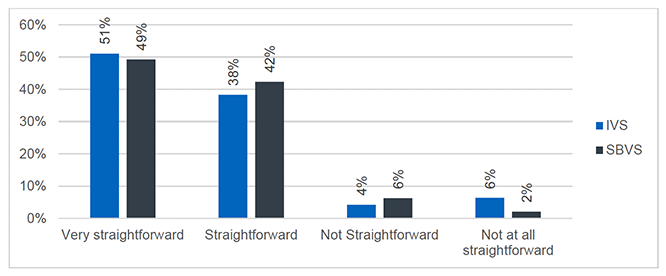
6.2.5 Households who had applied to the IVS or SBVS were asked how they found the process of obtaining broadband via the voucher. The responses are shown in the figure below.
6.2.6 The majority of households in the sample (over 80% in each case) indicated that the application process was very straightforward or straightforward. However, 10% (n=10) of those applying to the IVS and 8% (n=12) of those applying to the SBVS stated it was not straightforward or not at all straightforward. Those indicating it was not straightforward or not at all straightforward were asked to provide further detail on their experience in an open text response. In the open text responses, issues with the provider and delays to the installation process were highlighted:
- “I chose a company who would provide a satellite broadband solution on recommendation from a neighbour who had used them. However, there was a lot of back and forth with the operator who was wanting to charge me more than the value of the available voucher. Eventually, I did get a solution, covered by the voucher, but it was a long and complicated process.” (IVS recipient, Aberdeenshire)
- “A provider was found and an initial survey carried out. The company then became very difficult to contact and eventually did not progress the scheme.” (IVS applicant, Highlands)
- “…rather complicated and bureaucratic, installer missed five appointments [and the] technical possibilities were limited” (IVS recipient, Perthshire)
6.2.7 Several respondents also highlighted a lack of information on the voucher scheme:
- “It was very difficult to find out how to apply for the voucher. I asked BT, but they told me they did not deal with voucher applications. I eventually found a small company who sorted it out for me. Openreach engineers came to my property several times - different parts of the company did not seem to communicate with each other. The whole process took over a year.” (SBVS recipient, Highlands)
- “I only found out about the scheme after contacting my local Councillor for help as we have very poor broadband connection where I live. Took me many goes to find someone who could help us. The information is not readily available or easily accessible.” (SBVS recipient, Stirling)
6.2.8 A number of households also made comments about being provided with incorrect and sometimes contrasting information about their situation and what they were eligible for:
- “[I] applied and was knocked back. I was told I could get [a connection via] BT as they pass close by. BT wanted over £10,000 to connect me. I therefore had to reapply for voucher scheme. The total time taken to get connected was over 18 months” (IVS recipient, Argyll and Bute)
- “I applied for the voucher scheme in May 2024 but was told broadband is planned in my area for 2026 (2 years away). I contacted the provider, and they said I was too far from the main road, so it wouldn’t be coming to my property. I informed the R100 people of this, but they still wouldn't give me the voucher." (IVS applicant, Aberdeenshire)
- “It was very confusing as I was in the correct area but wasn’t approved as being in the correct area. The supplier then made some calls and got approval for me. It was never fully explained to me, but I was very grateful to finally have access to broadband. (SBVS applicant, Argyll)
6.2.9 Comments were also made about it taking a long time to secure a supplier:
- “Had to wait years to find a supplier” (SBVS recipient, Highlands)
- “Was difficult to find suppliers as some never got back to us and we had to have satellite and not 4G, so it was harder to find a supplier” (SBVS recipient, Aberdeenshire)
Key Point: While the majority of households in the sample felt that the voucher application process was straightforward, nearly 20% highlighted difficulties including issues with providers, a lack of information on the voucher scheme, being provided with incorrect and contrasting information, and it taking a long time to secure a supplier.
About your current connection
6.2.10 Those who fell into one of the following two categories were then asked to provide details of their broadband connection and comment on their levels of satisfaction with and use of the connection:
- Group 1 households who were provided their connection via the main contracts
- Group 1 households who had applied to IVS or SBVS and stated that their current broadband used the same means of connection as was funded via the voucher (i.e. they had made no subsequent upgrade since applying to the voucher scheme)
6.2.11 The responses are reported alongside those from Group 2a and Group 3 in Section 6.5 below.
Life choices
6.2.12 Group 1 households were also asked a series of questions about how their broadband connection has affected their life choices. Respondents were first asked whether they lived at their property when Superfast Broadband (or quicker) was first installed (and therefore whether they experienced the improvement in their broadband speeds). In total, 90% (n=265) stated that they lived at the property and 10% (n=31) stated that they had recently moved.
Respondents who had recently moved to the property
6.2.13 Those households who had recently moved to the property were asked whether they would have moved if superfast broadband (or quicker) had not been available. In total, 42% (n=13) said they would not have moved, 35% (n=11) said they would have moved and 23% (n=7) stated that they did not know. It is noted that the sample size for this question is small and therefore it is difficult to draw firm conclusions.
Key Point: There is some evidence that R100 has removed a potential barrier for some when considering where to live.
Lived at property when broadband was improved
6.2.14 Those who stated that they lived at the property when broadband was installed were asked a series of questions about the impact of the improvement including the impact on:
- the nature of their work
- access to formal education opportunities,
- household travel
- the local community, including the level of community activities and the number of shops available locally
6.2.15 Respondents in this category were also asked about the positive / negative impacts of the enhancement. Each of these aspects are discussed in turn below.
Nature of work
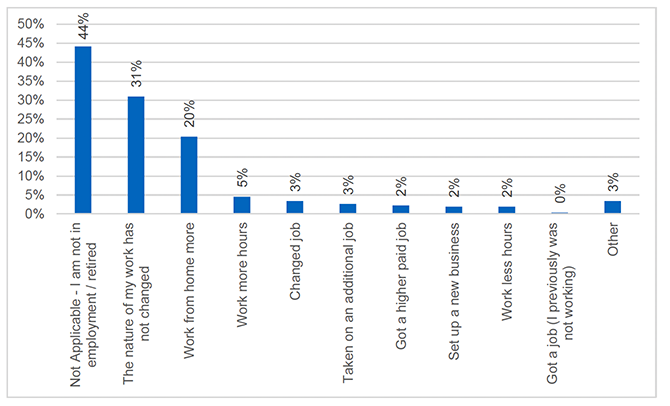
6.2.16 Figure 6‑3 shows the impact of the improvement in connectivity on the nature of respondents’ work. The graph shows the percentage of respondents selecting each option – it is noted that respondents could select more than one response and therefore the proportions do not sum to 100%.
6.2.17 In total, 44% (n=117) were not in employment, 31% (n=82) stated that the nature of their work had not changed and 25% (n=66) selected one of the other options indicating that the nature of their work had changed in some way. In total, 20% (n=54) stated that they now work from home more. Smaller numbers also selected work more hours (5%, n=12), changed job (3%, n=9) and taken on an additional job (3%, n=7).
6.2.18 In the open text responses, respondents emphasised the benefits in terms of work and employment, noting that the improved connection has enabled working from home; more efficient work practices, including Teams meetings and accessing secure systems; and enabled multiple users to use the connection at the same time. Freelancers and small business owners (e.g., videographers, coaches) also highlighted increased efficiency and fewer disruptions:
- “Using TEAMS for work video calls with improved speeds has allowed me to engage fully in discussion. Previously the lag between when I spoke and when others actually heard me meant it was difficult to do.” (Voucher / main contracts recipient, Aberdeenshire)
- “It has greatly helped my everyday work experience. Previously we received broadband through 4G, which was much slower and unreliable. Now, my connection is always fast enough and is very reliable, taking away a lot of inconvenience and frustration during my workday.” (Voucher / main contracts recipient, Stirling)
- “It's really helped me with my work. I'm a freelance videographer and photographer. The higher speeds have really helped with the speed of downloading stock footage and uploading my YouTube videos. It also means that both my wife, who runs a coaching business and spends a lot of time on Zoom, and I can use the internet at the same time without fear of interrupting one another’s activity.” (SBVS recipient, Highlands)
- “My partner is a GP and previous instability of connection meant she would regularly be kicked out of health systems losing up to 2 hours of her workday which meant longer hours for her, inefficient work for her practice and patient frustration.” (SBVS recipient, Aberdeenshire)
Key Point: R100 has allowed some people to make positive changes to how and where they work, removing a barrier to labour market efficiency.
Access to formal education opportunities
6.2.19 Respondents who lived at the property when broadband was installed were also asked whether the improvement in broadband had enabled anyone in the household to access formal learning opportunities which they previously could not access. Overall, 9% (n=25) said yes and 91% (n=240) said no. Those who indicated yes were asked to provide further details via an open text question. A range of courses were identified in the open text responses, including:
- Formal Education: Several individuals completed degrees, diplomas, or postgraduate studies (including master level qualifications and a PhD). Children completed National 5s, Highers, and university degrees, and accessed online tutoring.
- Professional and Work-Related Training: Respondents also completed various work-based courses and qualifications (e.g., Driver CPC, career long professional learning (CLPL), food hygiene, Alcohol Personal License (APLH), nursing, marketing, social media, and job-based training from employers). Online access enabled participation in previously inaccessible webinars and Zoom tutorials.
- Other Training: Respondents also mentioned community council meetings, mindfulness teacher training, holistic and wellbeing training, and Youth Advocacy and Support Services (YASS).
Key Point: R100 has allowed people to access a wide range of formal education and training opportunities which they would otherwise have been unable to access.
Household travel
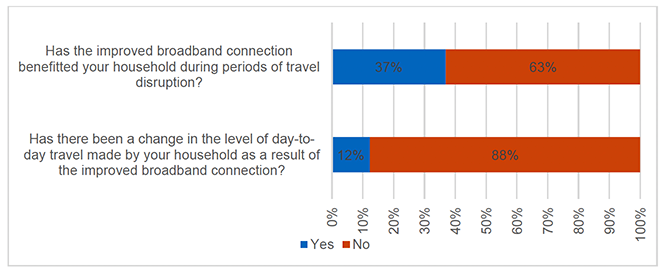
6.2.20 Respondents who lived at the property when broadband was installed were also asked several questions on the impact of the improvements on their household’s travel. The results are shown in Figure 6‑4.
6.2.21 In total, 37% (n=96) of households said the improvement in broadband had benefitted their household in periods of travel disruption and 12% (n=32) said that the improved connection had resulted in a change in the level of day-to-day travel made by their household.
6.2.22 Households who indicated that there had been a benefit during disruption or a change in their level of day-to-day travel were asked to provide further details via an open text question should they wish. Respondents emphasised being able to access up to date travel information and public transport timetables, particularly during poor weather. A small number also noted being able to access local resident groups for information on local disruptions such as landslides.
6.2.23 Almost all of those who said there had been a change in their household’s day-to-day travel said that their travel had reduced, with the majority emphasising this was a result of being able to work from home and smaller numbers noting that they now do their grocery shops / access services online. Several respondents also emphasised the benefit of being able to check public transport options before leaving the house, thereby reducing unnecessary trips. Just one respondent noted that their travel had increased slightly as a result of greater involvement in local activities.
Key Point: R100 has led to benefits for households during periods of travel disruption due to the availability of up-to-date travel information. The data also suggests that for some households the improvement has led to a reduction in day-to-day travel due to the ability to work from home, shop and access services online, and greater access to travel information.
Community impacts
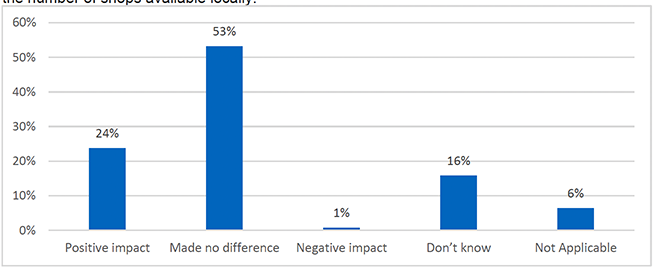
Respondents who lived at the property when broadband was installed were also asked to provide an indication of the impact of the improvement on the level of community activities and the number of shops available locally.
6.2.24 Figure 6‑5 and Figure 6‑4 show the results of these questions.
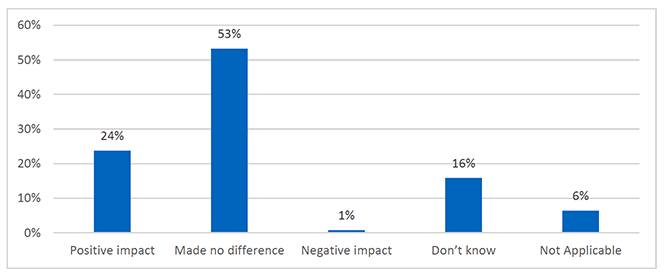
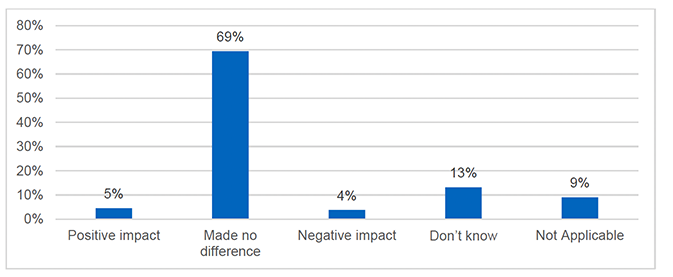
6.2.25 While, in each case, the majority of respondents said that the improvement had made no difference, a proportion highlighted either a positive or negative impact, with:
- 24% (n=63) stating that there had been a positive impact on the level of community activities compared to just 1% (n=2) who said there had been a negative impact
- 5% (n=12) stating there had been a positive impact on the number of shops available locally compared to 4% (n=10) who said it had had a negative impact
6.2.26 Respondents were also asked to provide any further details of the positive or negative aspects of the impact on the community in an open text response should they wish. Several comments were made about the positive impact on community activities:
- “Our whole area had such slow speeds, so now the community has the option to have fast internet it means we can all access the things we need, advertising of local events, news, road closures, traffic, shop closures, shop opening times, means less time spent going to places that cannot or do not have what you need, plus being able to see road conditions or road closures, accidents that have happened - as in areas to avoid.” (SBVS recipient, Aberdeenshire)
- “There are a lot more activities / events published / organised at the Village Hall, and which are now also very well attended, because of the wider availability of communication. Road closure information, bin service information, and access to local transport network / road closure information is now also much easier to access.” (SBVS recipient, Moray)
6.2.27 The two respondents who noted that there had been a negative impact on the level of community activities referenced problems with their connection being unreliable rather than a direct impact on the community.
6.2.28 In the open text responses, a number of respondents highlighted the potentially negative impact on the number of shops available locally:
- “Much more online shopping / less visits to the shops in town” (voucher / main contracts recipient, Dumfries and Galloway)
- “Availability of broadband leads to temptation to shop online not locally. We are in a use it or lose it situation in the village.” (SBVS recipient, Highlands)
- “It’s too ieasy to order online but then [there are] so few shops in South Ayrshire so doest matter” (main contracts recipient, South Ayrshire)
Key Point: The data suggests that R100 has had a positive impact on the level of community activities in some areas. The impact on the number of shops available locally is less clear, with roughly equal proportions stating it has had a positive / negative impact on this aspect.
Positive / negative impacts
6.2.29 Respondents who lived at the property when broadband was installed were also asked whether the improvement in broadband had had a positive or negative impact on the range of aspects as shown in the table below.
| Positive impact | Made no difference | Negative impact | Don't know | Not Applicable | |
|---|---|---|---|---|---|
| Keeping in touch with family and friends | 63% | 34% | 1% | 0% | 3% |
| Feeling of connectedness to wider world | 62% | 33% | 2% | 1% | 3% |
| My wellbeing | 49% | 45% | 2% | 1% | 3% |
| Finding out about what is going on in the local area | 47% | 49% | 1% | 0% | 3% |
| My ability to manage my finances | 41% | 54% | 2% | 1% | 3% |
| Feeling of connectedness to the local community | 35% | 58% | 1% | 2% | 4% |
| My own digital skills | 33% | 63% | 2% | 1% | 2% |
| Taking part in activities locally | 28% | 65% | 1% | 1% | 5% |
| My confidence using the internet | 28% | 66% | 2% | 0% | 3% |
| Amount of free time / leisure time | 22% | 68% | 3% | 2% | 5% |
| My physical activity levels | 18% | 74% | 3% | 1% | 5% |
| My physical health | 17% | 76% | 2% | 1% | 3% |
6.2.30 Across all aspects, a higher proportion identified a positive impact than a negative impact.
6.2.31 The largest proportion of respondents selected a positive impact with respect to:
- Keeping in touch with family and friends – 63% (n=165) identified a positive impact compared to 34% who selected no difference and 1% who selected negative impact
- Feeling of connectedness to wider world – 62% (n=164) identified a positive impact compared to 33% who selected no difference and 2% who selected negative impact
- Wellbeing – 49% (n=130) identified a positive impact compared to 45% who selected no difference and 2% who selected negative impact
6.2.32 In the open text responses, respondents emphasised the social, mental and physical health and wellbeing benefits, noting that they are now better connected with family and friends as well as local community groups and classes:
- “Without the improvements to the broadband speed, I would have felt very isolated during the pandemic. It was impossible to stream/make video calls/download software and updates prior to the improvements.” (SBVS recipient, Highlands)
- “As well as typical personal and social use, I have been able to connect with several community support and advocacy groups and become actively involved with charitable organisations helping disabled people.” (Voucher / main contracts recipient, Aberdeenshire)
- “We can have family trivia with other households, FaceTime to family in other parts of the world, we can read online, tutorials, guides, sports activities, local activities!” (SBVS recipient, Aberdeenshire)
- “Overwhelming benefit is mental health improvement associated with wider connectivity to the outside world in terms of access to services, to information, to financial management etc. - I would stress again, that as a rural dweller, this cannot be under-estimated!” (IVS recipient, Stirling)
- “Able to do more online exercise classes, work from home more often, find out more about what is going on locally, watch live church services, keep in touch by video call to family in USA” (SBVS recipient, Western Isles)
- “As a result of having superfast broadband speeds, we have been able to access more information on local events, and therefore participate in things that we had previously not known about” (SBVS recipient, Moray)
- “Faster speed allows me to access information more quickly or deal with household related issues in a timely manner. I can then spend the time saved on more pleasurable leisure activities like getting outside to walk, run or ride my bike.” (voucher, main contracts recipient, Midlothian)
6.2.33 As well as keeping in touch with family and friends and feeling more connected to the wider world, respondents also emphasised that the improvement had led to reduced frustration due multiple users being able to use the connection at the same time and being able to do things more efficiently:
- “I think the main positive impact is that it has reduced the negative impact! The frustration of slow internet and constant buffering is mind numbing.” (IVS recipient, Western Isles)
- “We now have access to streamed TV and films. More people can use the internet connection simultaneously in an efficient manner.” (voucher / main contracts recipient, Aberdeenshire)
- “All members of the household are now able to be online all at the same time. Before (due to poor mobile signal), when someone needed to make a call over Wi-Fi - another person had to stop listening to music/streaming tv etc.” (SBVS recipient, Edinburgh)
- “Less family strife. Everyone can do everything they want to on the internet at the same time. Even when children are home from university” (SBVS recipient, Highlands)
6.2.34 Respondents also emphasised the benefits of being able to make video calls, use online streaming services and undertake online banking and bill payments:
- “It makes a huge difference that we can jump onto video calls without worrying that we have the bandwidth to do it. It also means we can both do multiple activities concurrently without worry, such as video calls and streaming TV. We are also moving to streaming TV services as we can now run them effectively.” (Voucher / main Contracts recipient, Scottish Borders)
- “Online banking and bill paying is so much easier than before” (IVS recipient, Highlands)
- “Can now participate with confidence in online video calls and share much larger (>1Gb) files.” (SBVS recipient, Highlands)
6.2.35 While a wide range of positive impacts were identified, a small number of respondents recorded negative impacts. An exploration of the open text responses from these respondents reveals that rather than a negative impact against the specific aspects covered in the question, the negative impacts were more general in nature, relating to the reliability / performance of the connection, the cost of the connection, or being locked into contracts despite being unhappy with the services. Examples of the open text responses provided under each of these headings are set out below:
General issues with the reliability / performance of the connection:
- “Spent hours on the phone to [supplier name redacted] and had two engineer visits to no effect. It has been a total waste of money and time. I took on an extra job on the strength of faster and more reliable service and have not been able to work effectively using the service often having to resort to 4G to complete tasks / hold zoom meetings.” (SVS recipient, Argyll and Bute)
- “Despite improved speed I think the reliability is as poor, or at times worse, than the previous system.” (Main contracts recipient, Shetland)
- “New option has reduced quality of calls over Wi-Fi making working from home challenging” (SBVS recipient, Highland)
- “The solution was no better than my own setup, but I was promised faster speeds and better reliability” (SBVS recipient, Stirling)
- “It is impossible to watch an HD program as it will buffer leaving me and my family very angry and frustrated.” (Main contracts recipient, Highlands)
High cost of the connection, particularly compared to more urban areas:
- “Price is becoming unaffordable now… £35 for most basic service which excludes maintenance. If it goes up much more, I’ll be forced to disconnect the service” (SBVS recipient, Stirling)
- “The cost of having connections is very high each month and in current times can lead to month-to-month worries.” (SBVS recipient, Aberdeenshire)
- “The cost [is a negative impact]! It is far too much for me to afford and I have no options but to stay with the current suppliers/providers.” (IVS recipient, South Lanarkshire)
- “The negative impact is that my bill has surged.” (Main contracts / voucher recipient, Argyll)
- “The only negative impact is the extra cost that has to be met for broadband compared to a more populated area” (Main contracts, Aberdeenshire)
Being locked into contracts, even though services didn’t meet expectations:
- “Very disappointed we have gone from 4G Wi-Fi to satellite under the R100 voucher scheme and nothing has improved but we are tied into a contract” (SBVS recipient, South Ayrshire)
- “I’m not sure how we stand contractually about changing supplier now we are on a line of sight (LOS) signal.” (SBVS recipient, Aberdeenshire)
Key Point: A large proportion of respondents identified positive impacts with respect to keeping in touch with family / friends; feeling connected to the wider world and overall levels of wellbeing. A small number of respondents identified negative impacts due to ongoing issues with the speed and reliability of their connection.
Impact on those age 16 or under
6.2.36 All households were also asked via an open text question whether the improvement in broadband had had a positive or negative impact on anyone age 16 or under within the household, with those for whom the question was not applicable directed to leave the question blank. In total, 27 respondents (25% of the households with children in the sample) said that there been an impact.
6.2.37 In the responses a wide range of positive benefits were emphasised, including improved social connectivity with friends and family; increased entertainment options via streaming services; the ability to undertake online gaming; and being able to use multiple devices at the same time leading to reduced family stress. Several respondents noted that the connection had provided access to online learning, tutoring, schoolwork and educational resources with some noting that there were particular benefits for children with disabilities / autism as it enabled more independence and access to tailored resources.
- “[My son] is able to access online tutoring for his upcoming national 5 exams, have online music lessons (bagpipes and guitar) and play his PS5 games with friends online as well as keeping in touch with grandparents overseas.” (SBVS recipient, Western Isles)
- “It would be nearly impossible for our 15-year-old to complete her S4 schoolwork without the internet access we currently have.” (SBVS recipient, Dumfries and Galloway)
- “Positive as daughter has autism and having better broadband means she can access more.” (SBVS recipient, Aberdeenshire)
- “Yes, my son is disabled, and the faster more secure broadband has helped immensely.” (SBVS recipient, Highlands)
6.2.38 However, while the majority referenced positive benefits, some respondents noted that it had both positive and negative impacts, with broadband supporting learning opportunities but also leading to increased time spent on social media or gaming:
- “Yes and no. More social media, game play too, but access to learning and tutorials, online help and items of interest/music/sports/booking online has all been positive!” (SBVS recipient, Aberdeenshire)
- “Mixed effect. Better opportunities for education and ability to find out information and do research more quickly; but also, an increase in the use of gaming and social media which can have considerable negative effects.” (SBVS recipient, Edinburgh)
6.2.39 It should also be borne in mind that while improved connectivity can provide benefits for children’s education, affordability of devices and contracts remains a key issue and acts to restrict take-up. There is therefore a risk of creating intra-community inequalities where children in better-off households are fully connected while their peers remain excluded.
Key Point: On the whole respondents emphasised the benefits of the improved connection for young people, including the positive benefits in terms of children’s education. However, some respondents also highlighted the negative impacts associated with use of social media and gaming. In addition, it should be borne in mind that while improved connectivity can provide benefits, affordability of devices and contracts acts as a barrier to up-take for some groups resulting in intra-community inequalities.
6.3 Group 2 Survey Responses
Aware of the R100 / unaware of R100
6.3.1 Overall, 80% of Group 2 households were unaware of R100 prior to receiving the survey, with fewer households aware amongst those eligible for the voucher scheme (more than 85% unaware) compared to those eligible via the main contracts (50/50 split between those who were aware and those who were unaware of R100) (see
6.3.2 Figure 6‑7).
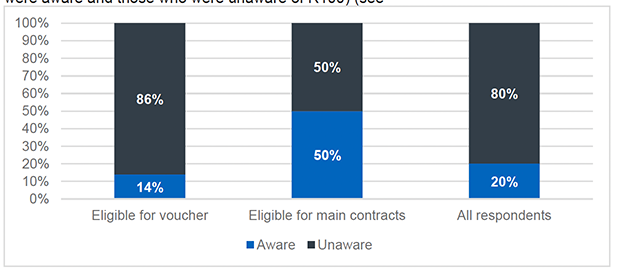
Key Point: More than 85% of Group 2 households eligible for the voucher scheme and 50% of those eligible via the main contracts who responded to the survey were unaware of R100.
Current Connection
In total, 82% (n=155) of Group 2 households had a current home broadband connection compared to 18% (n=34) who did not (see figure below).
Key Point: The majority of Group 2 households responding to the survey (over 80%) had an existing broadband connection.
Respondents without a current broadband connection
How household accesses the internet
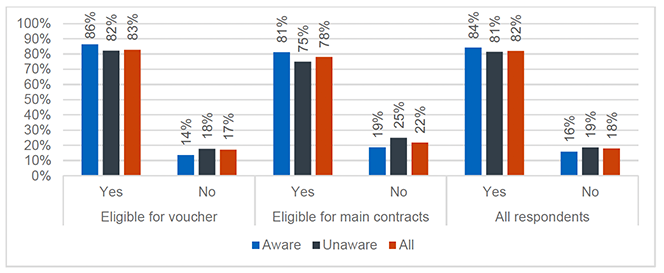
6.3.3 Those households who did not have a broadband connection were asked how their household typically accesses the internet. Overall, 91% (n=31) indicated that they used 3G, 4G, 5G connectivity on a smartphone, with 3% (n=1) using public access resources, and 6% (n=2) not using the internet (see Figure 6‑9)
6.3.4 Respondents were then asked via open text responses what tasks their household typically uses the internet for and whether there are things their household is missing out on by not being able to access the internet more often. A wide range of uses of the internet were identified, including shopping, streaming, social media, gaming, healthcare, accessing news and information, video calls, accounting activities, and work and education. Respondents emphasised the difficulties of undertaking these tasks. Comments emphasised the difficulties associated with working from home, making video calls or streaming content:
- “Everything we do on the Internet is difficult, and there are times we are not able to use it at all. I have had to go elsewhere to submit VAT returns when 4G has been down” (Group 2a respondents, Shetland)
- “Video calling is very temperamental so becomes very difficult to speak to loved ones. For work, I am unable to use conference room chats, I require moving to my parents’ miles away for a meeting online.” (Group 2a respondent, Highlands)
- “Streaming can be patchy. I had been looking at a homeworking opportunity but that proved to not be possible. I am also a musician / songwriter and collaboration online is currently not possible.” (Group 2a respondent, Aberdeenshire)
- “Unable to watch movies or TV shows via any streaming services, also problems accessing videos as part of my master’s course as well as work related topics” (Group 2a respondent, Shetland)
Key Point: The majority of households in the sample who did not have a current broadband connection accessed the internet using 3G, 4G or 5G connectivity on a smartphone. Amongst this group, there was a desire to use the internet for a wide range of activities, but the lack of a fast and reliable connection was a significant barrier.
Likelihood of applying for a voucher / signing up to home broadband
6.3.5 Households who i) were unaware of R100 and ii) did not have a current broadband connection were firstly asked if they intend to apply for a voucher / upgrade their contract or sign up to a new contract now that they knew about the scheme. The responses are shown in the figure below.
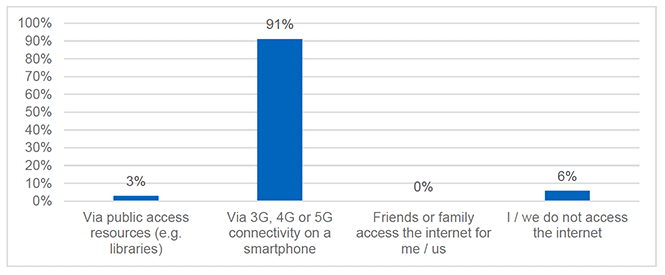
6.3.6 In total, 89% (n=25) said they would apply for the scheme and 11% (n=3) said they would not.
6.3.7 Those that said they would not apply were then asked to what extent a range of factors explained their decision. Respondents without a home broadband connection who had indicated that they were aware of R100 were also asked this question. While sample sizes were small (n=5-9[82]), key issues raised included:
- the monthly cost of the broadband service being too high (n=9): two people identified as a major factor and three people identified as a minor factor
- prefer to use 3G, 4G or 5G mobile connection to access the internet (n=9): one person identified as a minor factor and one person identified as a major factor
- someone in the household has a disability and I / we are unable to afford the assistive technology needed to enable internet use (n=9): one person identified as a minor factor
- applying for the Scottish Broadband Voucher is too complicated (n=5): one person identified as a minor factor
Respondents with a current broadband connection
Likelihood of applying for a voucher / signing up to home broadband
6.3.8 Households who i) were unaware of R100 and ii) had a current broadband connection were firstly asked if they intend to apply for a voucher / upgrade their contract or sign up to a new contract now that they knew about the scheme. The results are shown in the figure below.
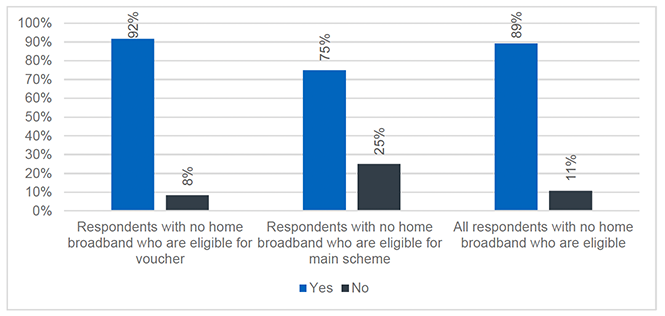
6.3.9 In total, 74% (n=91) said they would apply for the scheme and 26% (n=32) said they would not.
6.3.10 Those that said they would not apply were then asked to what extent a range of factors explained their decision not to apply for a voucher or upgrade / sign up to a new contract. Respondents who had indicated they had a home broadband connection and were aware of R100 were also asked this question. The table below shows the responses received from both groups. Note, while some options were asked of those eligible for the voucher and the main contracts, some (‘applying for a voucher is too complicated’ and ‘concerned that the SBVS is a scam’) were only asked to those eligible for the voucher and therefore the sample size for these responses is smaller.
| Major factor | Minor factor | Not a factor | I don't know | Not applicable | |
|---|---|---|---|---|---|
| It’s too expensive to upgrade (n=64) | 39% | 11% | 27% | 17% | 6% |
| Applying for a voucher is too complicated (n=46) | 28% | 17% | 37% | 11% | 7% |
| Changing the contract is too complicated / stressful (n=64) | 25% | 16% | 42% | 8% | 9% |
| Happy with the current speeds (n=64) | 22% | 25% | 30% | 6% | 17% |
| Currently locked into a contract (n=64) | 22% | 19% | 36% | 6% | 17% |
| Do not want someone coming to the house to set up the connection because of concerns around security / scams (n=64) | 5% | 8% | 63% | 5% | 20% |
| Concerned that the Scottish Broadband Voucher Scheme is a scam (n=46) | 4% | 11% | 61% | 4% | 20% |
6.3.11 The key issues highlighted were:
- it’s too expensive to upgrade – 39% identified as a major factor and 11% identified as a minor factor
- applying for a voucher is too complicated – 28% identified as a major factor and 17% as a minor factor
- changing the contract is too complicated / stressful – 25% identified as a major factor and 16% as a minor factor
Key Point: The data suggests that a lack of awareness of R100 is a key barrier to take-up, with 89% of households with a current connection who were previously unaware of R100 and 74% of those without a current connection who were previously unaware, stating that they intend to apply now that they know about the scheme. From an equality perspective, awareness gaps are particularly important for groups already less digitally engaged, including older adults, disabled people and low-income households. To help ensure R100 provides benefits for all groups in society a greater focus on awareness-raising activities which are both tailored and inclusive would be beneficial. Amongst those for whom awareness was not a barrier, key barriers included the cost of upgrading and the complications involved in applying for the voucher / upgrading the contract. These barriers align closely with known equality risks: low-income households, older people with low digital confidence, and disabled people who may require assistive technology.
About your current connection
6.3.12 Group 2 respondents who indicated that they had a current broadband connection were asked to provide details of their broadband connection and comment on their levels of satisfaction with, and use of, the connection. The responses are reported alongside those from Group 1 and Group 3 in Section 6.5 below.
6.4 Group 3 Survey Responses
Voucher and main contracts breakdown
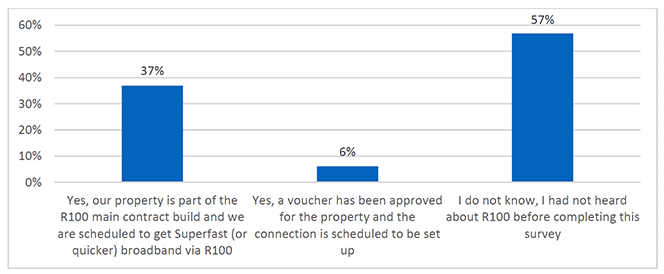
6.4.1 Group 3 respondents to the survey were initially asked whether they were scheduled to receive broadband via SBVS or the main contracts. The figure below shows the breakdown of responses received.
6.4.2 In total, over half of respondents (57%, n=194) were unaware of R100, while 37% (n=126) confirmed that they were scheduled to get superfast broadband via the main contract and 6% (n=21) said that a voucher had been approved but not yet set up. A high proportion of respondents being unaware of the scheme echoes the findings from the Survey 2 group.
Key Point: As with Group 2 respondents, the majority of Group 3 respondents in the sample were unaware of R100.
Current Connection
6.4.3 Respondents were then asked if they had a home broadband connection at the property. In total, 86% (n=294) said yes and 14% (n=47) said no.
Key Point: As with Group 2 respondents, the majority of Group 3 respondents in the sample had an existing broadband connection.
Respondents without a current broadband connection
6.4.4 Those who indicated that they did not have a broadband connection were then asked how their household typically accessed the internet. All those who responded (n=46) stated that they access the internet via 3G, 4G, or 5G connectivity on a smartphone.
6.4.5 Respondents were then asked what tasks their household typically uses the internet for and whether there were things their household was missing out on by not being able to access the internet more often. As with Group 2, a wide range of uses of the internet were identified, including shopping, streaming, social media, gaming, healthcare, accessing news and information, video calls, accounting activities, and work and education, with respondents emphasising the significant challenges of undertaking such activities without a reliable internet connection.
6.4.6 One respondent additionally identified the difficulties associates with independent living for an older relative:
- “[We are] hugely affected ... The radio signal here is lousy, so my 96-year-old uncle cannot listen to many stations. Equipment that we could use to enable him to continue living safely and independently often relies on having efficient broadband. He only has very limited television channels. The mobile signal here is also poor, so internet is not even good on mobile networks. We basically live as if back in the 1980s.” (Group 3 respondent, Aberdeenshire)
6.4.7 While another emphasised the challenges in setting up a business without a reliable and fast connection:
- “Having moved in during November 2024 we have tried two separate providers neither of whose equipment worked properly, we now have to use our mobile phones as hot spots for doing basic things like fill in this form, very inconvenient. As we are trying to set up a business and for the house even contacting the local council to register for things is proving a challenge.” (Group 3 respondent, Perth and Kinross)
Key Point: All those households without a current broadband connection accessed the internet using 3G, 4G or 5G connectivity on a smartphone. Amongst this group, there was a desire to use the internet for a wide range of activities, but the lack of a fast and reliable connection was a significant barrier.
Respondents with a current broadband connection
6.4.8 Group 3 respondents who indicated that they had a current broadband connection were asked to provide details of their broadband connection and comment on their levels of satisfaction with, and use of, the connection. The responses are reported alongside those from Group 1 and Group 2 in Section 6.5 below.
6.5 Comparative Analysis
6.5.1 As set out in the introduction, this section focuses on the questions which were asked of all three groups or more than one group within the survey and reports the results of each group alongside one another to enable comparison between the responses. It includes sections covering:
- broadband connection – including type of connection, speed and current provider
- satisfaction with broadband connectivity
- household internet devices
- household use of broadband connection
- degree of working from home
- wellbeing
- views on neighbourhood and community
6.5.2 It is noted that while all Group 1 respondents were asked questions about their current connection, only those respondents in Groups 2 and 3 who indicated that they had a current broadband connection were asked these questions. The direct comparison therefore overestimates the broadband connectivity of those in Group 2 and 3 as it does not include those who do not have an existing connection.
Broadband connection
Type of connection
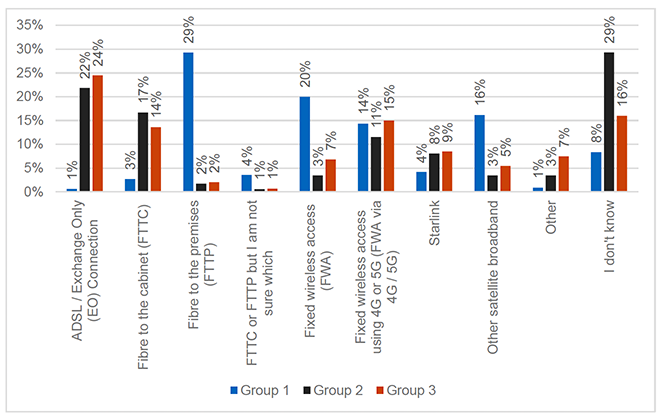
6.5.3 Respondents in Group 1 and those in Group 2 and 3 who indicated that they had a current home broadband connection were asked to indicate how their current connection is provided. The results are shown in the figure below.
Key Point: As may be expected, amongst Group 1 respondents, the most common response was FTTP, followed by FWA whilst amongst Group 2 and Group 3 respondents, the most common responses were ADSL, FTTC, FWA and Starlink.
Speed of current connection
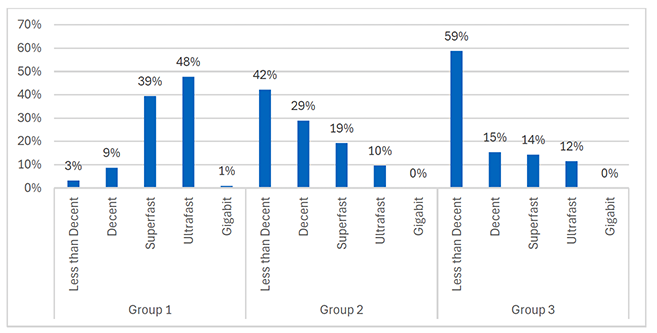
6.5.4 Group 1, 2 and 3 respondents were also asked to provide the speed of their current connection. The responses are shown in the figure below. It is noted that not all respondents provided a response.
6.5.5 While 88% of those in Group 1 who responded stated that they had superfast broadband speeds or quicker, just 29% of those in Group 2 and 26% of those in Group 3 achieved this speed of broadband connection.
Key Point: Group 1 respondents generally benefit from higher speeds than those in Group 2 and Group 3.
Current provider
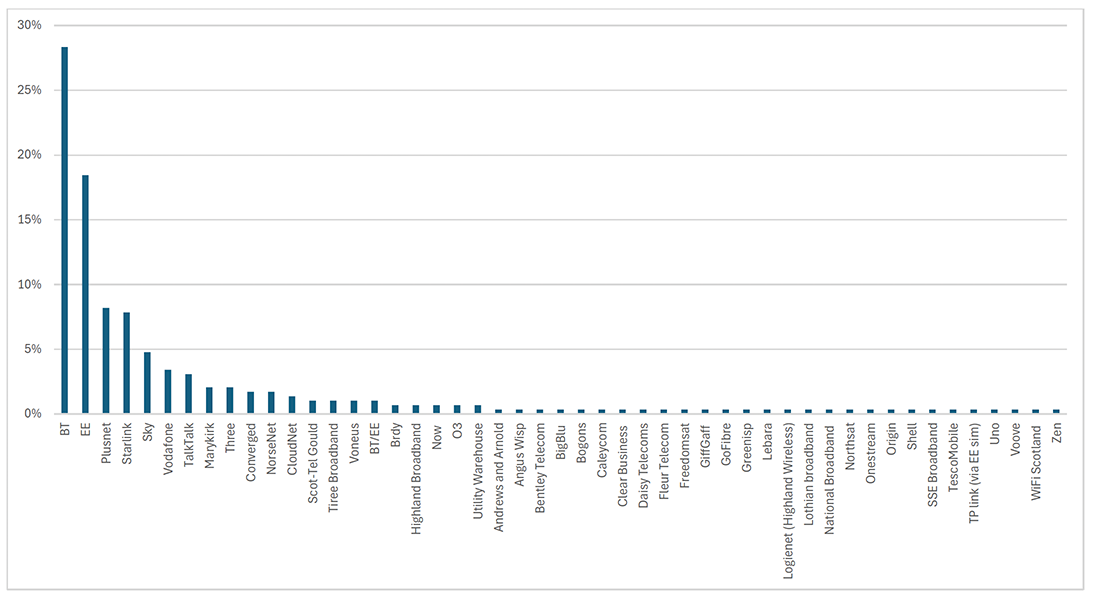
6.5.6 Respondents were also asked to provide the name of their current broadband provider. The results for Group 1, Group 2 and Group 3 are shown in Figure 6‑15, Figure 6‑16, and Figure 6‑17 respectively. It is noted that not all respondents provided a response.
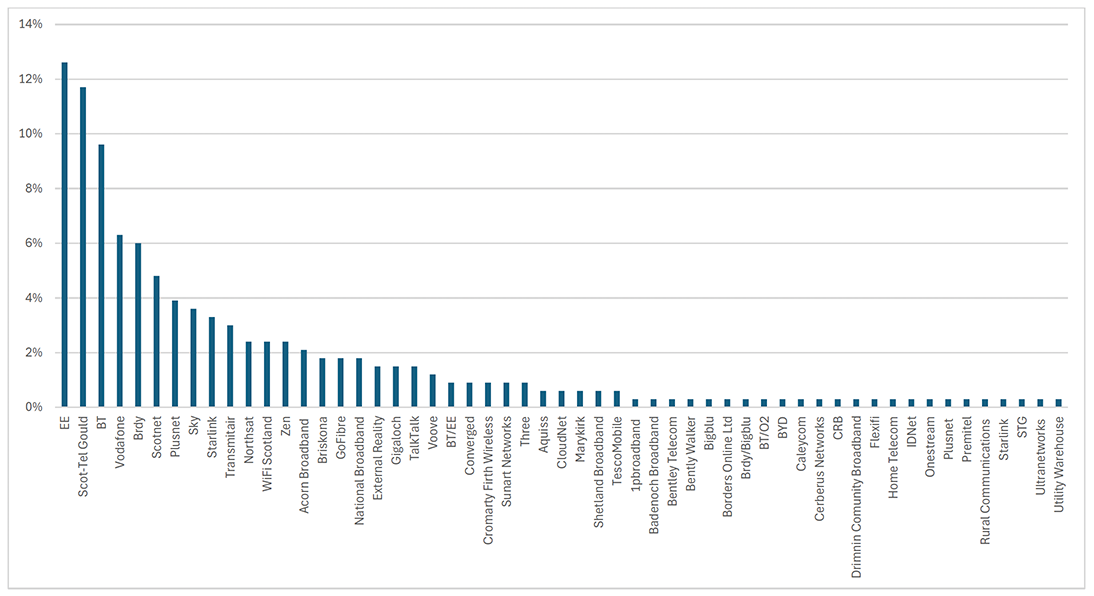
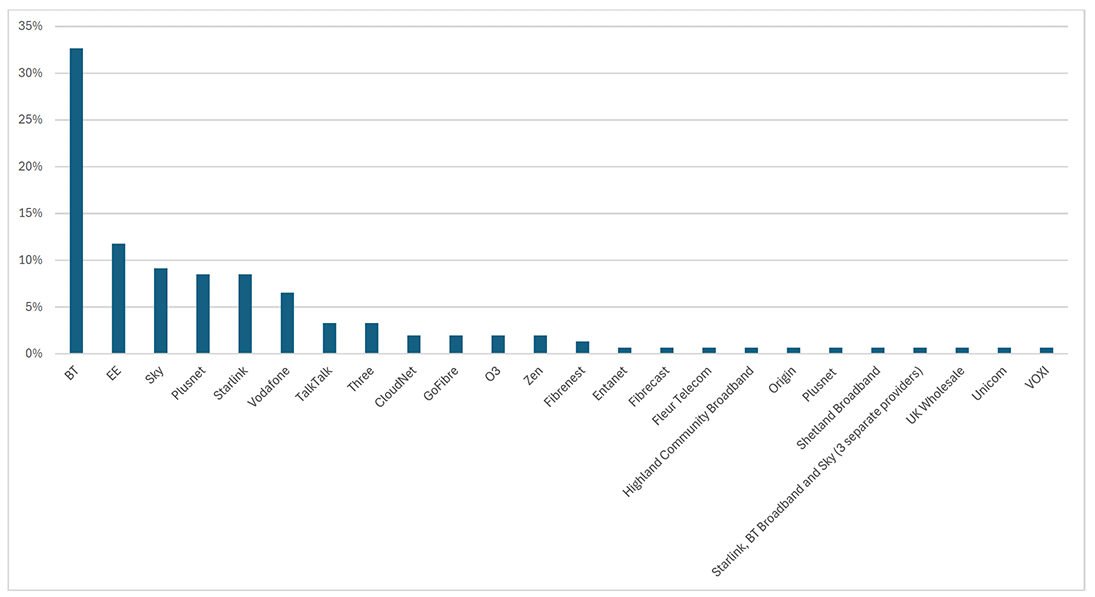
6.5.7 Across all three groups, a similar set of providers dominate, including BT, EE, PlusNet, Starlink, Sky, and Vodafone. Group 1 respondents benefit from a wider range of providers. It is also notable that Starlink features in all three groups (albeit in smaller numbers in Group 1) with a proportion of businesses / organisations opting to pay for a satellite solution due to the importance of a reliable connection.
Key Point: A similar set of providers dominate all three groups with Group 1 properties benefitting from a wider range of providers than Group 2 and Group 3 properties.
Satisfaction with broadband connectivity
6.5.8 The figures below show levels of satisfaction with the speed, reliability, and value for money of broadband connectivity amongst Group 1, Group 2, and Group 3 respondents.
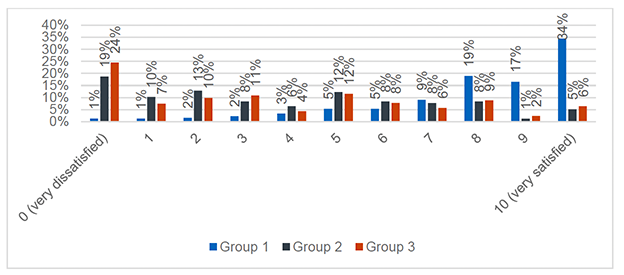
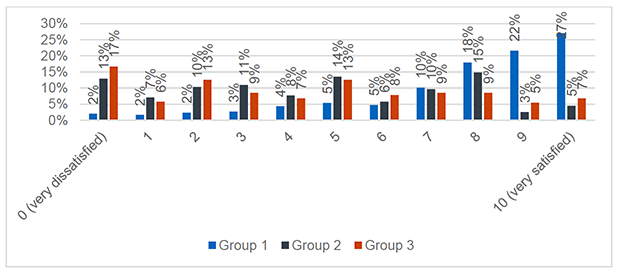
6.5.9 While sample sizes are small and therefore a note of caution is needed when interpreting the results, the data suggests that across all three measures, Group 1 respondents have higher levels of satisfaction:
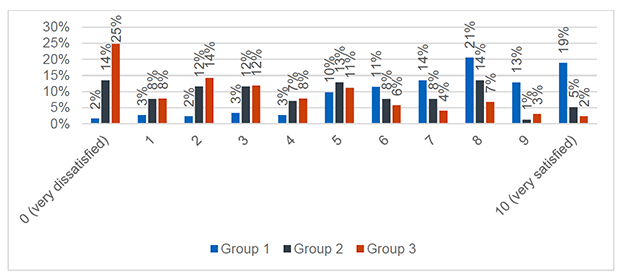
- 70% (n=207) of Group 1 respondents rated their satisfaction with the speed of their connection as 8 or above, compared to 15% (n=23) of Group 2 respondents and 18% (n=52) of Group 3 respondents
- 67% (n=197) of Group 1 respondents rated their satisfaction with the reliability of their connection as 8 or above, compared to 22% (n=34) of Group 2 respondents and 21% (n=61) of Group 3 respondents
- 52% (n=155) of Group 1 respondents rated their satisfaction with the value for money of their connection as 8 or above, compared to 20% (n=31) of Group 2 respondents and 12% (n=36) of Group 3 respondents
6.5.10 Amongst Group 1 respondents, those provided with connectivity via the main contracts had higher levels of satisfaction with both the speed and reliability of their connection than those provided with connectivity via IVS or SBVS whereas satisfaction with cost was more similar across the groups.
6.5.11 Amongst Group 3 respondents, satisfaction with value for money is very low, with over a quarter of respondents stating that they are very dissatisfied with this aspect.
6.5.12 While satisfaction amongst Group 1 was higher, a number of comments were made in the open text response regarding both the unreliability of some satellite and mobile based solutions and the higher cost compared to other locations and being locked into one provider:
- “The cost of £46 per month for this speed of broadband is not value for money. Locally in 300MB fibre optic broadband is available for less than half this price, and at no cost to the household to install. Yet 4 miles away, I have no access to fibre broadband so no access to the broadband market, I am stuck with just one provider.” (Group 1 respondent, Aberdeenshire)
Key Point: Group 1 households have higher levels of satisfaction with speed, reliability and value for money than those in both Group 2 and Group 3. Amongst Group 1 respondents, those provided with connectivity via the main contracts had higher levels of satisfaction with both the speed and reliability of their connection than those provided with connectivity via IVS or SBVS
Household internet devices
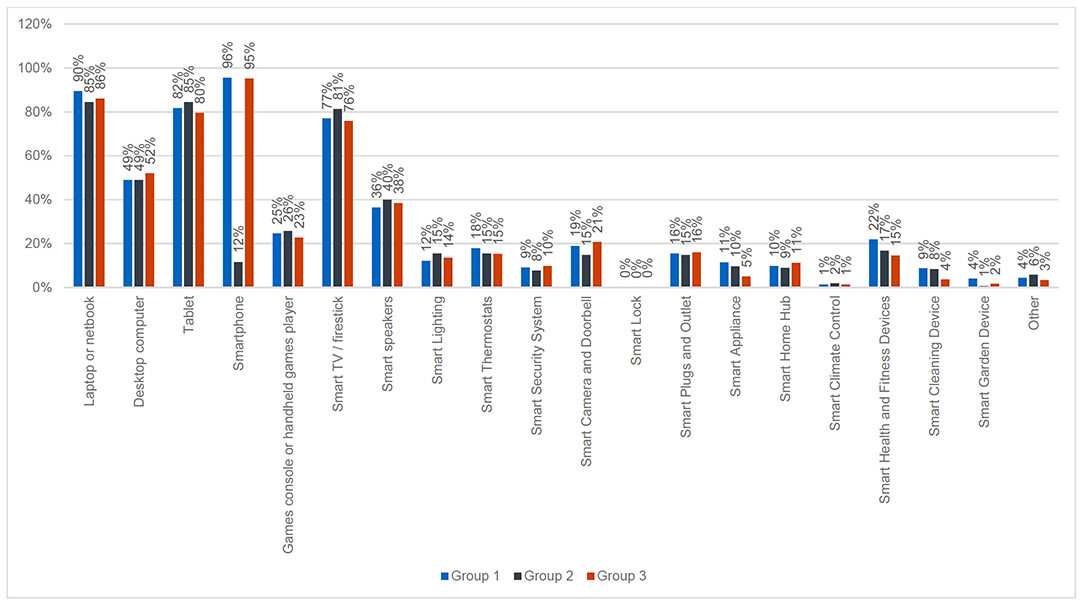
6.5.13 Respondents were asked to indicate which smart devices their household uses. The figure below shows the percentage of households in the sample with each smart device.
6.5.14 Overall, the most popular devices were laptops, tablets, smartphones, and smart TVs / firesticks. Ownership of smart devices was slightly higher amongst Group 1 respondents although the differences are marginal. In general, households with children tended to have more smart devices than households without children.
Key Point: Households owned a wide range of household smart devices with the most popular devices being laptops, tablets, smartphones, and smart TVs / firesticks.
Household use of broadband connection
Overall
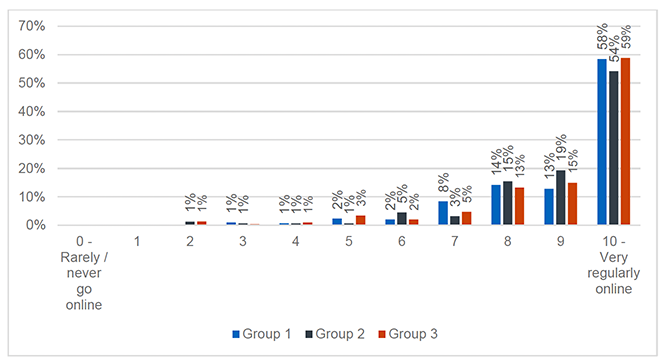
6.5.15 Figure 6‑22 shows the frequency with which households in each group use their current broadband connection. Across all three groups, frequency of use is high, with marginal differences between the groups.
Key Point: Households across all three groups use their current broadband connection at a high frequency, emphasising the importance of connectivity for a range of household activities.
Use by activity
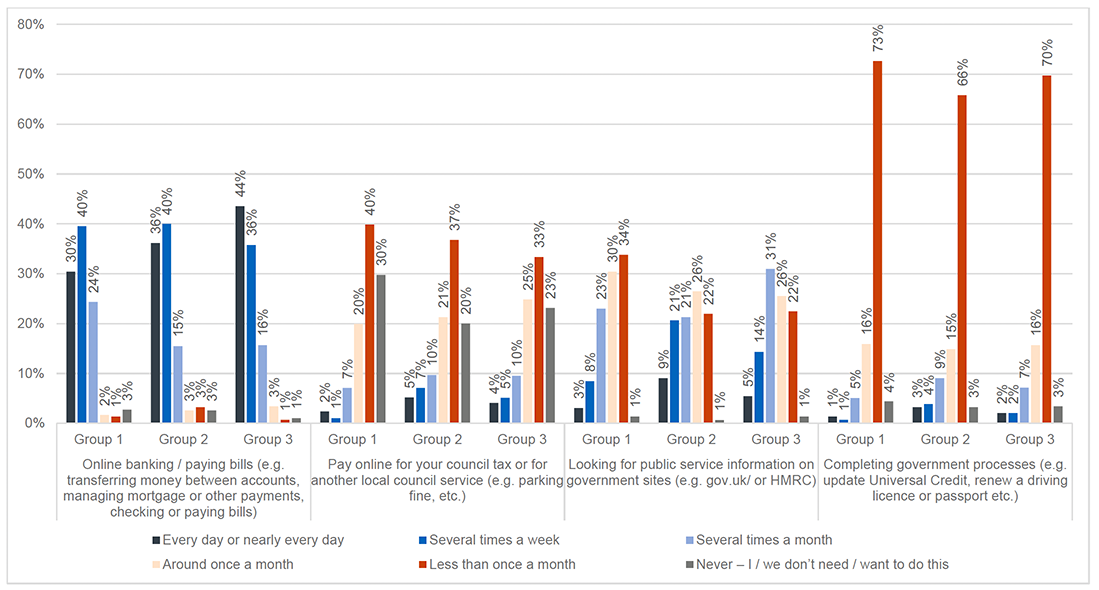
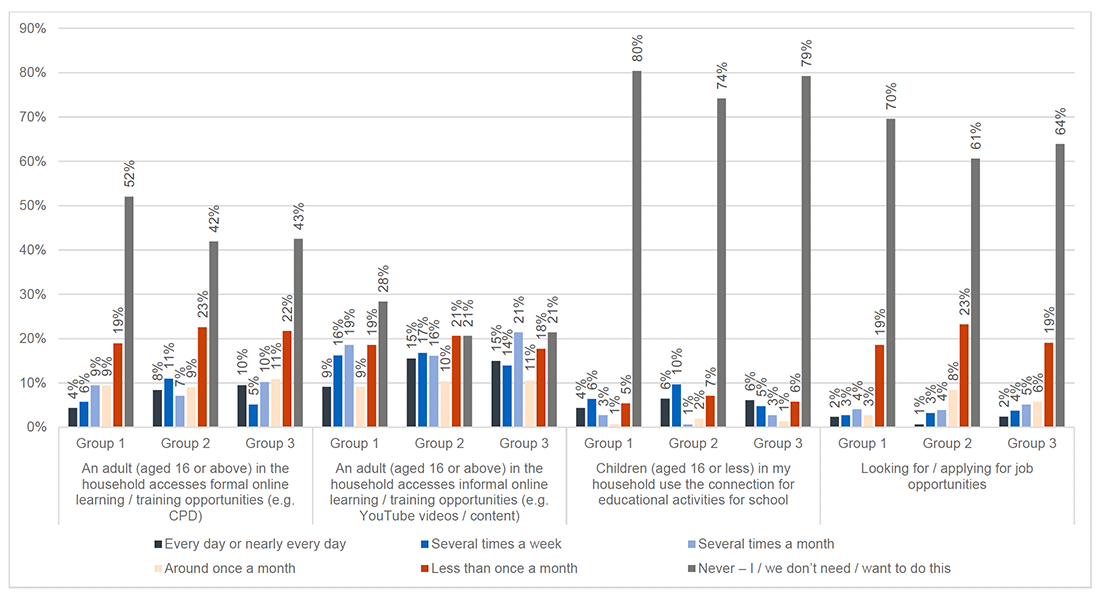
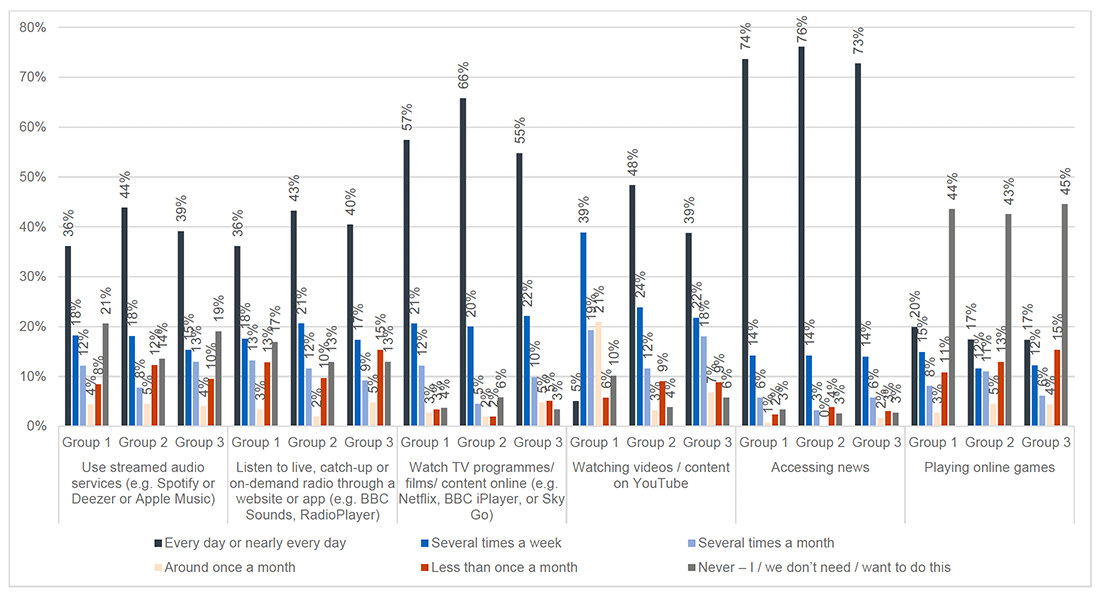
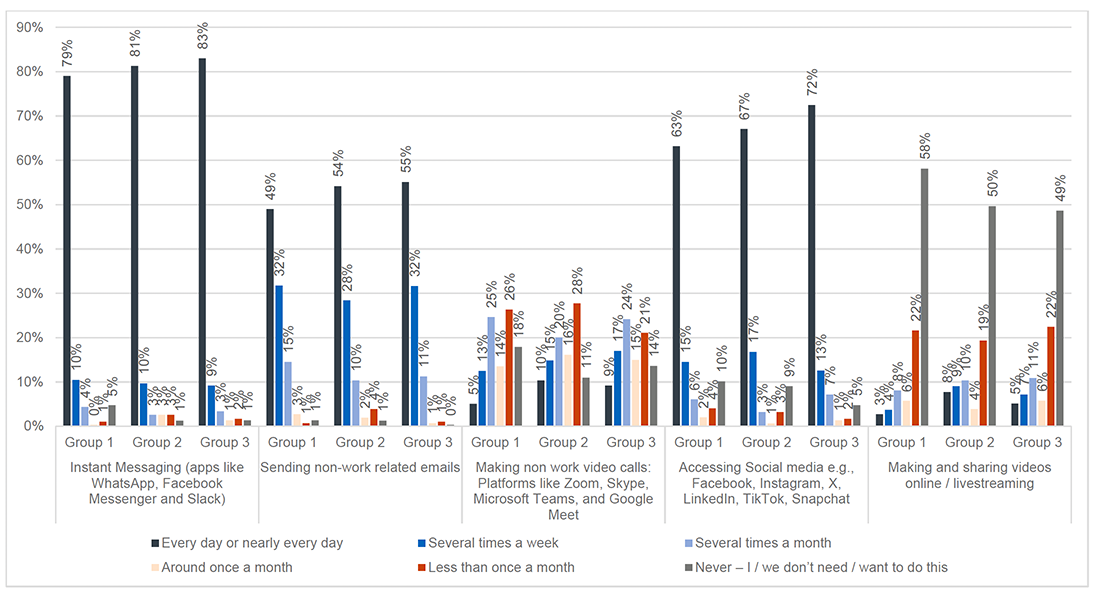
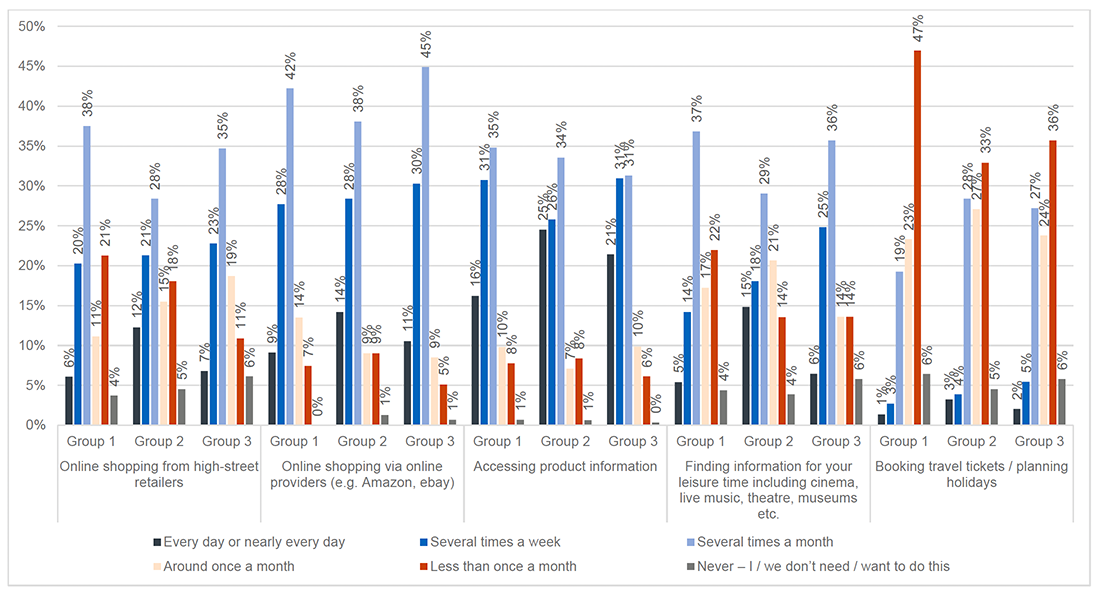
6.5.16 As well as providing an indication of their overall use, respondents were also asked to provide an indication of the frequency with which their household use their current connection for a range of activities, including household admin, activities relating to employment and education, entertainment activities, social media and messaging, shopping, and health related activities. The results are shown in Figure 6‑23 to Figure 6‑28, with a summary of the findings for each activity provided in the bullet points below the graphs.
Household admin
- Over 70% of households in each group undertake online banking / bill paying on at least a weekly basis, with around 30% doing so daily
- While paying online bills, looking for public service information and completing government processes are undertaken less regularly, almost all respondents across all three groups do these activities online
Activities relating to employment and education
- More than 10% of households in each group access adult formal online learning / training opportunities and over 30% access informal adult training courses at least weekly
- Use of the connection by children for educational activities was high – with over 10% of Group 1, 16% of Group 2 and 11% of Group 3 using the connection for this purpose on at least a weekly basis – the higher proportions amongst Group 2 likely reflects the higher proportion of households with children in the Group 2 sample.
Entertainment activities
- Across all groups use of the connection for entertainment purposes was high
- In total, over 70% of households in each group stated that they accessed news on a daily basis
- Watching TV programmes / online content was also frequently undertaken with 57% of those in Group 1, 66% in Group 2 and 55% in Group 3 doing so on a daily basis
- Using streamed audio services, listening to live, catch up or on demand radio was undertaken slightly less frequently with over a third in each group doing so on a daily basis
- In total, 20% of those in Group 1 and 17% in Group 2 and Group 3 respectively played online games on a daily basis with rates higher amongst those households with children
Social media and messaging
- In total, around 80% of households in each Group used the connection for instant messaging (such as WhatsApp, Facebook Messenger and Slack) on a daily basis and over 60% in each group used social media e.g. Facebook, Instagram etc daily
- 18% of those in Group 1, 25% in Group 2 and 26% in Group 3 used the connection to make non work video calls on at least a weekly basis, highlighting the importance for out of work connections to family and friends
- While using the connection to make and share videos online / livestream was less frequent, around 20% in each Group did this at least several times a month
Shopping
- Across all groups, use of the connection for shopping was high underlining the general growth in online shopping, even in areas where connectivity is more limited
- Rates of online shopping via online providers (e.g. Amazon, eBay) were higher than rates of online shopping from high street retailers, emphasising the growth and dominance of the former
Health related activities
- While the connection was used fairly frequently for tracking fitness and health metrics and looking up and looking up health symptoms and healthy eating / exercise programmes, smaller numbers used e-consult and or virtual GP / hospital appointments. This may reflect the more limited availability of such services in areas where connectivity has traditionally been poorer.
Key Point: Across all activities, frequency of use is fairly similar across all groups, highlighting the importance of internet connectivity for a range of day-to-day activities regardless of the level of connectivity.
Extent to which current connection provides for the needs of the household
6.5.17 Respondents were also asked whether the speed and reliability of their current connection allowed their household to do everything it wants to do online. The results are shown in the figure below.
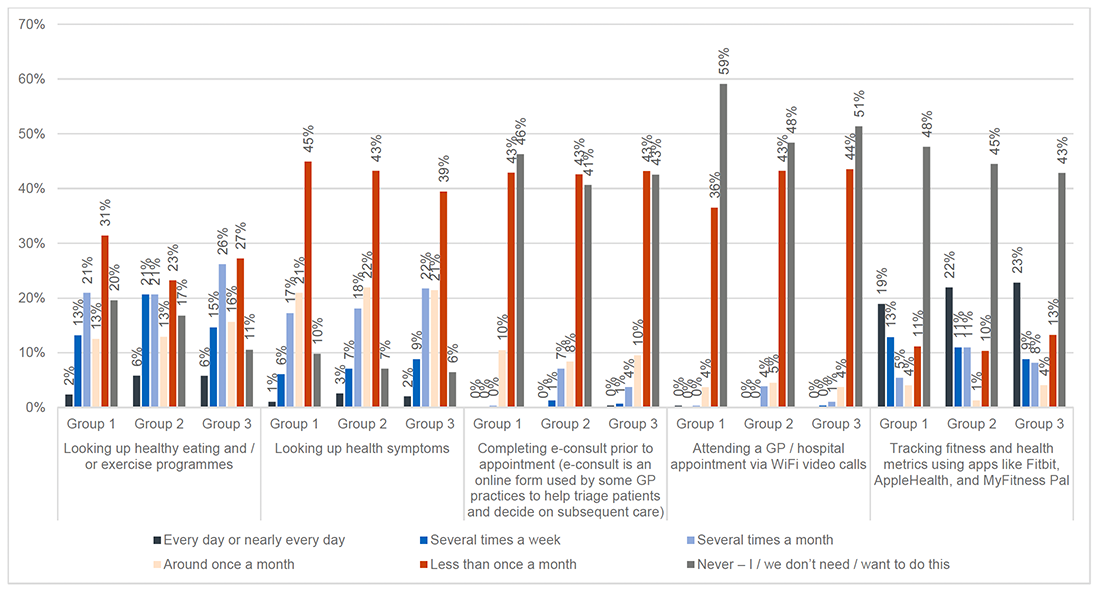
6.5.18 Over 80% (81%, n=241) of Group 1 households were able to do everything they wanted to do online using their connection. In contrast just 40% of Group 2 and 35% of Group 3 households were in this category.
6.5.19 Amongst Group 2 and Group 3, there was a desire to be able to use the internet for all activities and for there to be parity with urban areas, with many feeling ‘stuck’ as a result of there being no viable providers or technologies:
- “We’d like to do what every town / city dweller can do…we are the forgotten areas and its hopeless” (Group 3 respondent, Highlands)
- “We’d like to use it like anyone else in the country who has superfast broadband” (Group 3 respondent, Aberdeenshire)
6.5.20 Respondents noted that slow speeds and poor reliability make everyday tasks using the internet challenging and frustrating. A wide range of activities were identified which respondents currently cannot do and would like to be able to do including using multiple devices at the same time; streaming TV/movies; working from home; video calling; online banking; shopping and using online government services, and support for smart devices such as security systems and health monitoring.
6.5.21 Several respondents noted that they were unable to do advance their careers in the way that they wish as a result of their poor connection:
- “There are two of us in the household and we have to take turns streaming shows or audio. If one of us has a Zoom call, the other has to not use the internet ... One of us has the opportunity to teach online but has not been able to pursue [that] both because of the disruption to the household but also because of the unreliability of the connection.” (Group 3 respondent, Highlands)
- “I would like to be able to livestream to platforms like Twitch and create videos for YouTube as an extra source of income…I would like to do contract work from home or run a small business from home, but the Internet speed and reliability precludes this too.” (Group 3 respondent, Glasgow)
6.5.22 Entrepreneurs, freelancers and creative professionals also noted challenges due to upload and sync delays and being unable to use cloud services effectively.
- “I am a photographer. Uploading my photos to Facebook, means that everything that is connected to the internet has to be shut down. Sometimes it can take me 5 hrs or more to upload 40 small photos!” (Group 3 respondent, Aberdeenshire)
6.5.23 Respondents also noted issues with education and learning with students unable to upload projects and difficulties joining conferences online:
- “We have to hot spot from our phones in order to upload college projects to a portal as the upload speed is max 0.5m/bs and cannot handle media uploads.” (Group 3 respondent, Aberdeenshire)
- “.. it has proven impossible to present research live at international conferences because audio and video at the same time is a nightmare. Pre-recording presentations, compressing them into zip files to email them to the conference secretary prior to the day (with upload still taking ages) is ineffective and costs time… It is also suboptimal having to ask other participants at conferences and/or presentations to switch off their own cameras and present their slides with audio only.” (Group 3 respondent, Orkney)
6.5.24 Several respondents also noted safety issues, particularly around emergency call buttons being unreliable.
- “I need a good signal for my emergency call button to work. Age related issues.” (Group 3 respondent, Highlands)
- “As I do not get a mobile phone signal in or around my property, I rely on Wi-Fi calling in the event that my landline fails (currently on day 18 of no landline following the storm on 24th January 2025) (Group 3 respondent, Highlands)
6.5.25 One respondent with autism also referenced that the lack of support services locally means they have a strong reliability on internet-based provision, and this can cause significant distress when the connection goes down:
- “Our internet regularly goes down, … and if there's no internet, we can't do anything -- and being on an island in the middle of the North Sea, the internet is a lifeline service! Additionally, I am autistic and due to the lack of support services available locally, all of the support and tools that enable me to function require an internet connection to use, so when the connection is down, I sit here for days on end crying in distress with nobody to help me.” (Group 3 respondent, Orkney)
6.5.26 While satisfaction amongst Group 1 respondents was higher, several Group 1 respondents stated that their household could not do everything online. A number of respondents highlighted difficulties with reliability, noting frequent dropouts, particularly during poor weather, and inconsistent performance across the day. Some users noted that despite the upgrade, they had not seen any improvement in performance while others were critical of the timings in terms of R100 rollout and the lack of information on delivery dates:
- “4G service works well outwith peak holiday times but during school holidays the speed slows dramatically.” (Group 1 respondent, Highlands)
- “Speed and bandwidth are degraded in poor weather and can drop off massively when the cell network is busy with frequent dropouts. It is normally far slower at night when people are at home than during the day when people are at work.” (Group 1 respondent, Aberdeenshire)
- “Use of laptop can be very slow in the school holidays, and we can’t watch online TV on Saturdays and Sundays” (Group 1 respondent, Aberdeenshire)
- “We upgraded to Brdy and the Scottish Government broadband in order to get better connection and download speeds, but it doesn't seem any better than the previous copper wire connection using the telephone internet from TalkTalk” (Group 1 respondent, Aberdeenshire)
- “Fixed wireless is inherently unreliable due to weather/interference etc… we really need the stability and performance of an FTTP connection. Of particular concern are the constantly slipping dates for providing us with an FTTP connection under R100, and for the most part, a total lack of information and transparency with regard to timescales for this.” (Group 1 respondent, Stirling)
Key Point: Group 1 households were considerably more satisfied with their broadband connection and its ability to meet household needs than those in Group 2 and Group 3. However, while more satisfied, a number of Group 1 respondents still experience challenges with connectivity.
Degree of working from home
6.5.27 Group 1 respondents and Group 2 and Group 3 respondents with an existing broadband connection were also asked to indicate the extent to which they and the other adults over the age of 18 who they live with work from home. The figure below shows the results of this question for each group, with the percentage representing the proportion of all adults in the sample.
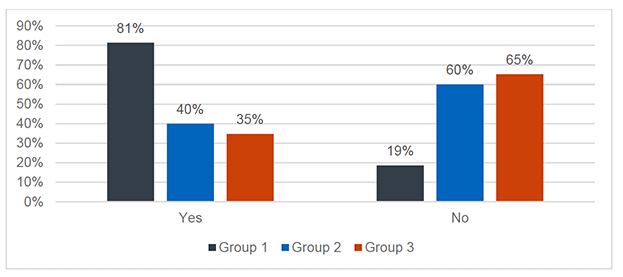
6.5.28 Across all three groups a high proportion of respondents worked from home for at least some of their contracted hours. In contrast to what may be expected, a higher proportion of those in Group 2 and Group 3 stated that they worked from home than those in Group 1. This contrasts with many of the open text responses which focused on the benefit of now being able to work from home (Group 1) and the challenges of working from home (Group 2 and 3). It is noted that smaller sample sizes and a higher proportion of those in Group 1 not being in employment may account for some of the differences.
Key Point: Across all three groups a high proportion of respondents worked from home for at least some of their contracted hours. In contrast to what may be expected and the comments in the open text responses, a higher proportion of those in Group 2 and Group 3 stated that they worked from home than those in Group 1.
Wellbeing
6.5.29 As discussed in Section 3.6, there is much discussion in the literature on the ability of improved digital connectivity to improve levels of both individual and community wellbeing. However, capturing wellbeing benefits is particularly challenging, in part because wellbeing cannot be directly quantified or monetised as is the case with economic benefits and there are a diverse range of factors which influence wellbeing, making it difficult to isolate the impact of R100.
6.5.30 To help identify wellbeing impacts, the survey replicated the questions on personal well-being included within the UK’s Annual Population Survey (APS)[83]. Respondents were asked one question covering each of the four measures of personal wellbeing[84], as follows:
- Life satisfaction - Overall, how satisfied are you with your life nowadays?
- Feeling the things done in life are worthwhile - Overall, to what extent do you feel that the things you do in your life are worthwhile?
- Happiness - Overall, how happy did you feel yesterday?
- Anxiety - Overall, how anxious did you feel yesterday?
6.5.31 As with the APS, respondents were asked to rate their wellbeing on a scale between “0 - not at all’ to “10 - completely”.
6.5.32 Personal wellbeing is reported in the APS as both average means and thresholds, with the latter defined as set out in Table 6‑3.
Table 6‑3: Office for National Statistics personal wellbeing thresholds[85]
| Life satisfaction, worthwhile, happiness | Ratings | Anxiety | Ratings |
|---|---|---|---|
| Low | 0 to 4 | Very Low | 0 to 1 |
| Medium | 5 to 6 | Low | 2 to 3 |
| High | 7 to 8 | Medium | 4 to 5 |
| Very High | 9 to 10 | High | 6 to 10 |
6.5.33 Figure 6‑31 summarises the overall results to the four wellbeing questions as defined above by group and Table 6‑4 compares the average mean wellbeing scores between the Group 1 and Group 2 / 3 surveys. In the table, in addition to the mean score in each case, the corresponding APS threshold as defined above is also shown in brackets.
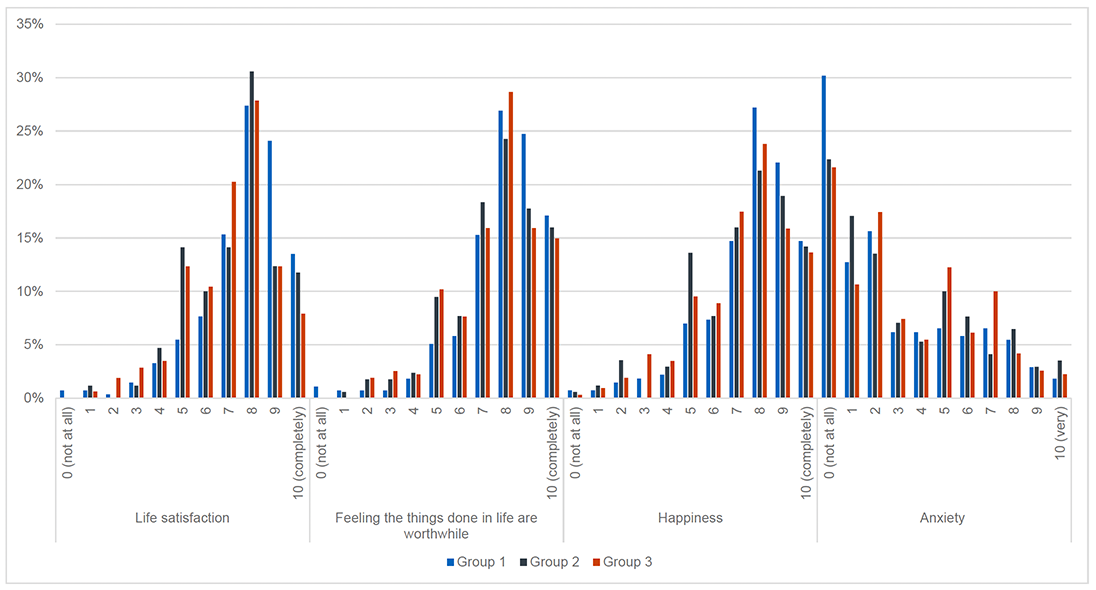
Table 6‑4: Average mean wellbeing score and corresponding Annual Population Survey threshold for the Group 1, Group 2 and Group 3 surveys
| Wellbeing | Group 1 | Group 2 | Group 3 | Group 1 / Group 2 difference | Group 1 / Group 3 difference |
|---|---|---|---|---|---|
| Overall, how satisfied are you with your life nowadays? | 7.7 (High) | 7.3 (High) | 7.1 (High) | 0.4 | 0.6 |
| Overall, to what extent do you feel that the things you do in your life are worthwhile? | 7.9 (High) | 7.5 (High) | 7.5 (High) | 0.4 | 0.4 |
| Overall, how happy did you feel yesterday? | 7.6 (High) | 7.3 (High) | 7.2 (High) | 0.3 | 0.4 |
| On a scale where 0 is “not at all anxious” and 10 is “completely anxious”, overall, how anxious did you feel yesterday? | 2.9 (Low) | 3.2 (Low) | 3.4 (Low) | 0.3 | 0.5 |
6.5.34 Overall, wellbeing is relatively high across all three groups, with the highest levels amongst those in Group 1. This corroborates earlier findings, with nearly 50% of Group 1 respondents having noted that the improved connection had a positive impact on their wellbeing. There are a wide range of factors which influence wellbeing however, it is difficult to directly attribute the differences between the groups above to the R100 Programme.
Key Point: Those in Group 1 had higher wellbeing scores than those in Group 2 and 3, although given the wide range of factors affecting wellbeing, it is difficult to directly attribute the differences to R100.
Views on neighbourhood and community
6.5.35 Respondents were also asked several questions about their neighbourhood and community. The results are shown in the figure below.
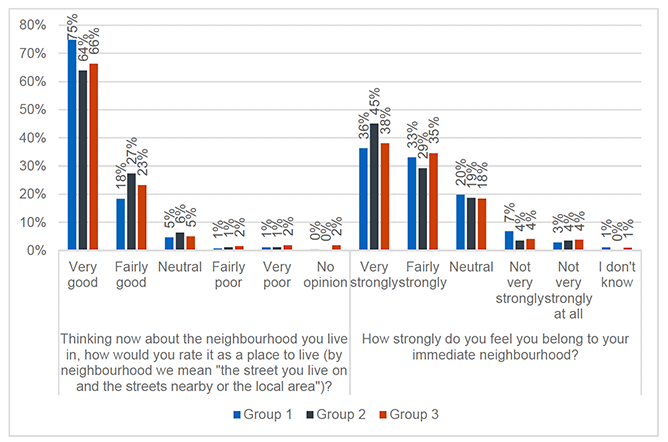
6.5.36 Across all three groups, the majority of respondents in the sample rated their community as either ‘very good’ or ‘fairly good’ as a place to live. Most respondents also felt a sense of belonging to their local community with around 70% of respondents in each group stating that they feel they belong to their community either ‘very strongly’ or ‘fairly strongly’. While there are slight differences amongst the groups, the differences are marginal and therefore it is difficult to attribute any improvement associated with the delivery of R100.
Key Point: Respondents generally felt positively about their community and had a strong sense of belonging to it, however differences between the groups were marginal and therefore it is difficult to attribute any improvement to R100.
Contact
Email: sean.murchie@gov.scot