
Cardiovascular risk reduction - quality prescribing guidance 2026-2029: consultation
Cardiovascular disease (CVD) is largely preventable, and many modifiable risk factors increase the likelihood of developing CVD. This guide highlights how to support people in modifying risk factors such as diet, healthy weight, alcohol, physical activity, stress and tobacco smoking.
Open
32 days to respond
Respond online
6. Cardiovascular disease (CVD) in Scotland
In Scotland, 16% of adults reported living with any form of CVD in 2024, a figure that is unchanged since 2003.1 CVD is the second largest cause of overall disease burden and second most common cause of death in Scotland, after cancer.
Despite substantial improvements in the prevention of atherosclerotic diseases in the UK, the overall burden of CVDs remains high. For CVDs to decrease further, future prevention strategies might need to consider a broader spectrum of conditions and examine the specific needs of younger age groups and socioeconomically deprived populations.[10]
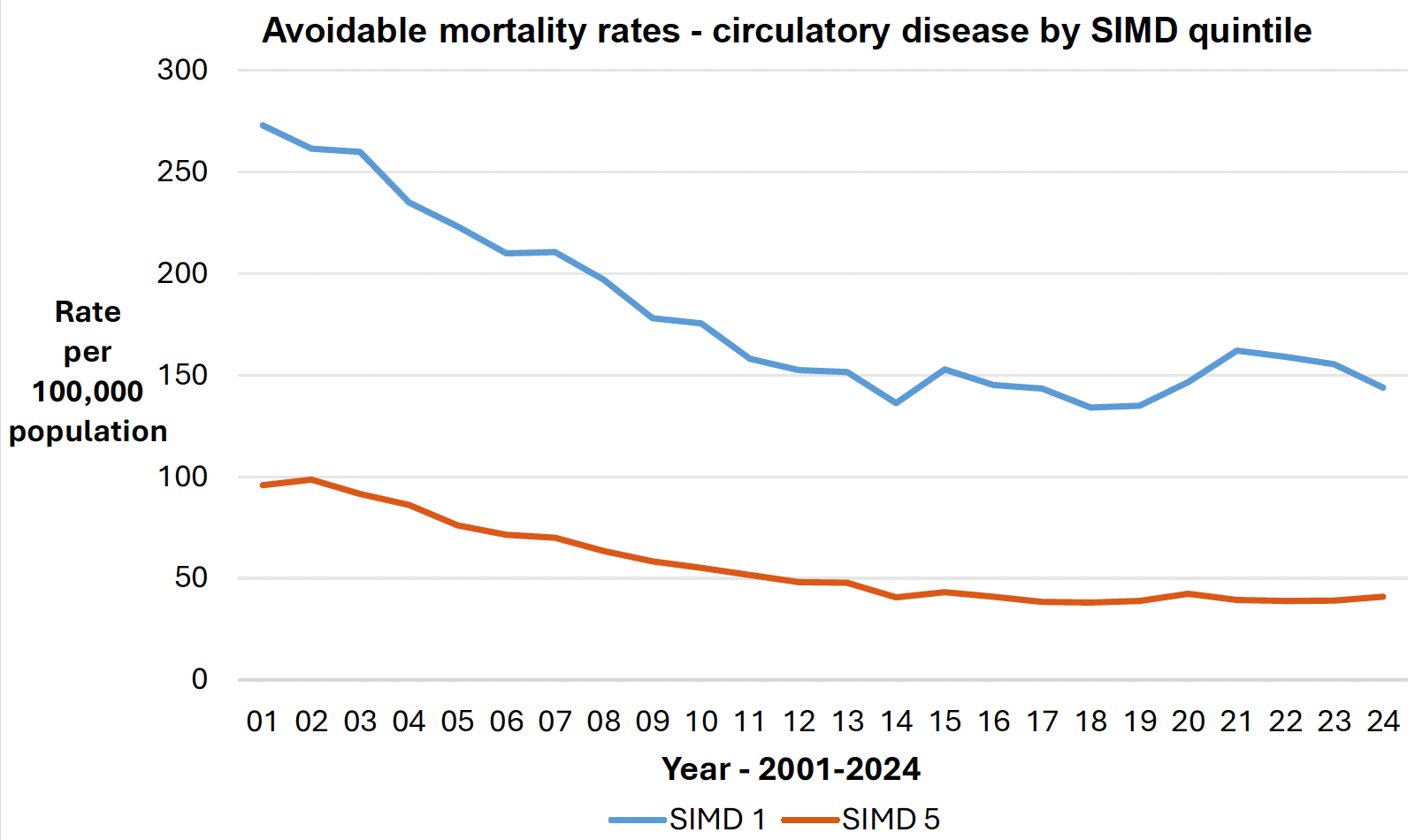
In 2001, the avoidable mortality rate for diseases of the circulatory system in the most deprived quintile was 2.8 times the rate in the least deprived quintile (273.0/100,000 v 95.9/100,000). In 2024, it was 3.5 times as high (143.9/100,000 v 41.0/100,000).[11]
Cardiovascular disease is largely preventable and many modifiable risk factors increase the likelihood of developing CVD:2
- more than half of heart attacks and strokes in Scotland are associated with high blood pressure
- adults with diabetes are two to three times more likely to develop CVD and are nearly twice as likely to die from heart disease or stroke
- around 1 in 5 deaths from heart and circulatory diseases in Scotland are associated with high LDL (low-density lipoprotein) cholesterol
- Around 1 in 10 deaths from CVD in Scotland are attributable to smoking
each year
- around 1 in 7 CVD deaths in Scotland are associated with a high body-mass index (BMI)
Many people do not know they are living with CVD risk factors. Of the 1.5 million people in Scotland estimated to have high blood pressure, only 860,000 have been diagnosed. Of those diagnosed, only 24% (206,000) are adequately controlled.2 A primary objective of the Scottish Government’s Cardiovascular Risk Factors Programme is to find those living with key modifiable risk factors and to optimise early intervention and care to reduce an individual’s risk of developing CVD.3
This quality prescribing guide supports the implementation of this risk factor programme by helping HCPs identify and treat five key modifiable risk factors in individuals who do not currently have a diagnosis of CVD. These risk factors are:
- hypertension
- hyperlipidaemia
- obesity
- diabetes
- smoking
These risk factors align to the European Society of Cardiology guidelines on cardiovascular disease prevention. These state that blood apolipoprotein-B-containing lipoproteins (of which low-density lipoprotein (LDL) is most abundant), high blood pressure, cigarette smoking, and diabetes are the main causal and modifiable Atherosclerotic Cardiovascular Disease (ASCVD) risk factors. Adiposity, which increases CVD risk via both major conventional risk factors and other mechanisms, is another important risk factor. [12] It is increasingly recognised that chronic health conditions are, to differing extents, caused or exacerbated by excess adiposity and the need for a proactive approach to obesity prevention and effective weight management.[13]
The Scottish CVD Risk Factors Programme principles to guide action within healthcare are: [14]
- Risks: Find>Optimise>Reduce
- Identification and management of any one risk factor > should lead to the consideration of all CVD related risk factors
- Every Contact Counts – always consider CVD risk factors, possibilities for opportunistic checks, conversations about risk factors
- The use of ASSIGN (v2.0) in the recommended cohorts
- Reaching the missing – people with the highest risks are most likely to be those who are unable to use our services as they are routinely structured – and we must apply proportionate universalism to do more to reach them, to work in different ways e.g. beyond the practice doors taking a trauma-based approach
Contact
Email: EPandT@gov.scot