
Cardiovascular risk reduction - quality prescribing guidance 2026-2029: consultation
Cardiovascular disease (CVD) is largely preventable, and many modifiable risk factors increase the likelihood of developing CVD. This guide highlights how to support people in modifying risk factors such as diet, healthy weight, alcohol, physical activity, stress and tobacco smoking.
Open
32 days to respond
Respond online
11. Obesity
Obesity is an overarching term describing the condition characterised by excess adiposity (body fat), with or without abnormal distribution or function of adipose tissue, with multifactorial poorly understood causes.
Clinical obesity is a chronic, systemic illness arising in alterations in tissue function from excess adiposity which can lead to life-altering and potential life-threatening complications.
The WHO International Classification of Disease now labels obesity as a “chronic complex disease”, although this classification has not been universally accepted by governments or in clinical practice. [69]
Body mass index (BMI) is widely used to identify if a person is a healthy weight for their height. For most adults, having a BMI of 18.5 to 24.9kg/m2 is considered to be a healthy weight. A person with a BMI of 25 to 29.9kg/m2 is considered to be overweight, and someone with a BMI 30kg/m2 or over is considered to be obese.[70]
The Scottish Health Survey, published in 2024 showed the mean BMI for adults to be 28.2kg/m2 with a small difference between males and females. The prevalence of those living with obesity was 27% in men and 35% in women.1
There are clear links between obesity and social deprivation; 24% of adults living in the least deprived areas have obesity rising to 36% in the most deprived areas.1
The causes of obesity are multifactorial and increasingly well understood with the environment playing the biggest role in changing obesity levels. Indeed, obesity is not about willpower in most people. A combination of changing physical environment with a reduction in physical activity, susceptible genetics and changing food environment with increased accessibility of processed foods relative to increased cost of healthier foods are among the factors that influence an individual’s risk for the development of obesity. The obesity system map gives an overview of the overall complexity.[71] It considers the interplay of food production, food consumption, societal influences, individual psychology, individual activity, activity environment and biology.
11.1 Medical complications of obesity [72]
Obesity can lead to complications in all body systems. These can have a significant impact on a person’s daily function and long-term health including:
- endocrine (all adult-onset diabetes)
- cardiovascular (hypertension, angina, myocardial infarction, heart failure, arrhythmia, cerebral infarction, deep vein thrombosis, pulmonary embolism)
- digestive (pancreatitis, liver disease)
- infectious (bacterial infections)
- musculoskeletal (gout, osteoarthritis, back pain)
- respiratory (asthma)
- malignant (kidney cancer)
- skin (skin infections and eczema)
- blood (anaemia)
- genitourinary (renal failure)
- nervous system (sleep disorders—mostly sleep apnoea) diseases[73]
11.2 Why is obesity important in CVD risk reduction?
A large body of evidence supports the association between obesity and development of major CV events, including myocardial infarction (MI), heart failure (HF) and sudden cardiac death.[74]
CV risk factors associated with obesity include:
- Type 2 diabetes – there is a strong link with a higher BMI in both epidemiological and genetic studies. There is robust trial evidence that intentional weight loss can lead to remission of T2D
- Hypertension – there is a well-recognised link between hypertension and increasing adiposity and there is improvement in hypertension with intentional weight loss
- Dyslipidaemia – the lipid pattern associated with obesity is characterised by elevated triglycerides and lower HDL cholesterol levels. Intentional weight loss can reverse these changes
- Haemostatic changes/abnormalities – obesity is linked to thrombotic events across both the arterial and venous systems. There is evidence that obesity surgery may reverse these changes
- Renal changes – increased adiposity is associated with the development of chronic kidney disease and decline in eGFR
- Reduced physical activity – lower physical activity levels are often considered to be a cause of obesity. Studies also support the development of obesity as a causal risk factor leading to lower activity levels
11.3 How should we measure obesity?
You should ask for permission each time before discussing overweight, obesity or central adiposity and before taking measurements.[75]
Traditionally BMI has been used to define obesity. WHO defines overweight in adults as BMI greater than or equal to 25kg/m2 and obesity as a BMI greater than or equal to 30kg/m2. Although useful as a screening tool, the limitations of BMI on an individual basis are well recognised as it cannot distinguish between lean and fat mass.
Waist: height ratio should, therefore, be used in addition to BMI to diagnosis obesity in those with a BMI <35kg/m2. If the ratio is 0.6 or above, individuals are at the highest risk, and if it’s between 0.5 and 0.59 they are at increased risk. In both cases individuals will likely need to lose weight to reduce their risk of heart and circulatory diseases. If the ratio is 0.4 to 0.49 then individuals are in the healthy range.[76]
In higher BMIs (e.g. 35 or above) it is reasonable to assume excess adiposity without other measurements.63,66
The national cardiovascular disease toolkit provides a diagnostic pathway to assess individual’s risks and treatment goals.
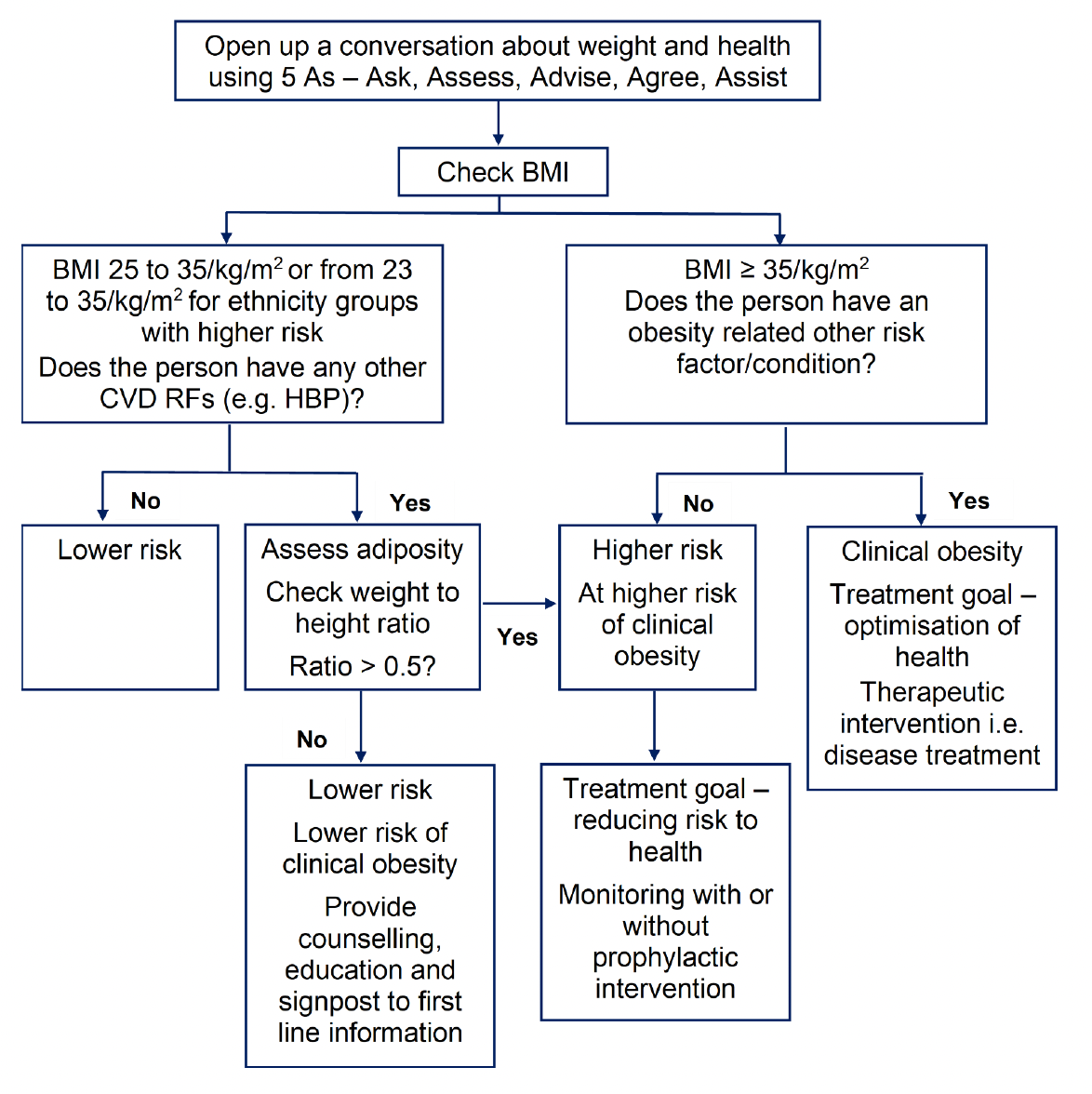
To have a person-centred conversation about weight and health it can be useful to consider the 5 As:[77]
Ask discuss weight with the patient
Assess assess health status, comorbidities and cause of weight gain
Advise advise on treatment plan
Agree agree on weight loss expectations and treatment plan
Assist assist the patient in the continuous process of weight loss management
Weight bias and stigma are major obstacles preventing the treatment of obesity and remain common place amongst HCP and policy makers. Professionals working with individuals with obesity should be aware of these issues and the impact of weight stigma on delivery of safe, effective and compassionate care.
NICE have a visual summary on principles of care.
Public Health Scotland (PHS) have an online course Challenging weight stigma to support professionals working in this area.
11.4 Lifestyle interventions
Some of these services can be accessed directly through self-referral and others will require a referral from a GP or other HCP.
11.4.1 Online resources
Advice, support and resources to help individuals lose weight are available via NHS inform. The website highlights that reaching and staying a healthy weight isn’t always easy but small, realistic changes can make a big difference to an individual’s health and wellbeing.
The site gives trusted information on websites, apps, and local services across Scotland. It also provides practical tips to help understand weight and how to lose weight safely and keep it off.
11.4.2 Local weight management groups
Local groups can help individuals achieve weight management goals. Having like-minded people all aiming for the same outcome of improved health and diet can be a great motivator. Each board in NHS Scotland has a free weight management programme that can support with weight loss. These services may be available over the phone or online as well as in person. Information on these resources is available via NHS inform.
11.4.3 Support from dietitians
Dietitians can assess, diagnose and treat dietary and nutritional problems. They can provide advice on what foods to eat to optimise and improve health. Individuals meeting local criteria can be referred to dietitians by a HCP.
11.4.4 Type 2 diabetes (T2D)
Early in the course of T2D, it is possible for some people to achieve remission through weight loss. Remission is defined as HbA1c remaining below 48mmol/mol (6.5%) for at least three months, without diabetes medication. Achieving remission reduces complications from T2D and allows people to experience a greater quality of life. Remission of T2D is directly related to the amount of weight lost, with clinical trial data showing that the vast majority (85%) of trial participants who lost more than 15kg achieved remission.
Health boards in Scotland offer a T2D remission programme based on an 800kcal total diet replacement programme, followed by a period of structured food reintroduction and weight maintenance, supported by specialist dietitians. People can be referred to these programmes via their HCP.
More information is available in:
- SIGN Guideline 172 Prevention and remission of type 2 diabetes
- Type 2 Diabetes Mellitus - quality prescribing strategy: improvement guide 2024 to 2027
11.5 Principles of prescribing - pharmacotherapies for obesity
11.5.1 Incretin-based therapies
Incretin-based therapies demonstrate the potential to treat obesity and T2D and reduce cardiovascular disease risk.[78],[79],[80] These medicines are licensed in the treatment of people living with obesity for use as an adjunct to a reduced-calorie diet and increased physical activity. Clinical trials have demonstrated that when used alongside non-pharmacological therapies, incretin-based therapies were more effective for weight loss than non-pharmacological therapies alone.[81],[82]
Glucagon-like peptide-1 receptor agonists (GLP-1 RA) are a class of medications that were initially developed for the management of T2D. Clinical trials have shown their efficacy in the treatment of obesity.
GLP-1 RAs mimic the GLP-1 hormone naturally produced in the body. They act by increasing insulin secretion, suppressing glucagon secretion, delaying gastric emptying so increasing satiety and acting via the central nervous system to reduce hunger and appetite.
More recently medications acting on both GLP-1 RA and glucose-dependent insulinotropic polypeptide (GIP) receptor agonists (GIP-RA) have been developed.
Tirzepatide is a long-acting GIP (glucose-dependent insulinotropic polypeptide) receptor and GLP-1 (glucagon-like peptide-1) receptor agonist that increases insulin sensitivity and secretion, suppresses glucagon secretion, and slows gastric emptying.[83]
As well as reducing weight, clinical trials such as SELECT have shown a reduction in adverse cardiovascular outcomes with the use of semaglutide (Wegovy®).[84] SUMMIT showed a reduction in heart failure events with tirzepatide (Mounjaro®).[85] It is thought that some of their efficacy is from weight loss and some from the direct effect of the medication itself.
This guide will focus on semaglutide and tirzepatide, but the general principles apply broadly to products from these classes of incretin-based therapies.
As this is an emerging area of treatment there is limited evidence or guidance in relation to stopping medication. Over time most people will either reach a healthy weight, or a new setpoint where they are no longer losing weight. It is known that a significant proportion of people will regain some of the weight they have lost if they stop treatment altogether. At present when individuals reach a stable weight, it is recommended that they should be maintained on the lowest effective dose.
11.5.2 Prescribing in Scotland
The two medications which are currently available and approved by SMC for the treatment of obesity are Wegovy® (semaglutide), a long acting GLP-1 RA and Mounjaro® (tirzepatide) a combination therapy with agonist activity at both GLP-1 and GIP receptors.[86],[87] Clinical pathways are in development at present; prescribers should refer to local board treatment pathways and associated guidance.
Note - semaglutide (Wegovy®) was accepted for use within NHS Scotland in June 2026 as an adjunct to a reduced-calorie diet and increased physical activity to reduce the risk of major adverse cardiovascular events (cardiovascular death, non-fatal myocardial infarction, or non-fatal stroke) in adults with established cardiovascular disease and either obesity or overweight (BMI ≥27kg/m2). This is outwith the scope of this guide and local guidelines and pathways should be followed.
11.5.3 SMC recommendations – semaglutide (Wegovy®) September 2023 and tirzepatide (Mounjaro®) May 2024
Indication: Adults with BMI of > 30kg/m2 in the presence of at least one weight-related comorbidity
*A lower BMI cut-off may be more appropriate for members of minority ethnic groups known to be at equivalent risk of the consequences of obesity at a lower BMI than the white population
Setting: Specialist weight management service (semaglutide only) and any setting i.e. primary and secondary care (tirzepatide)
Route and frequency: Weekly subcutaneous injection
When to stop: If unable to lose at least 5% of initial bodyweight after 6 months of treatment
Pregnancy and contraception: Should not be used in pregnancy
GLP-1 medicines should not be taken during pregnancy or just before trying to get pregnant. This is because there is not enough safety data to know whether taking a GLP-1 medicine can cause harm to the baby. In some animal studies, GLP-1 medicines were found to be harmful to the unborn foetus, although more information is needed to see whether or not this same effect would be seen in humans.[88]
The Faculty of Sexual and Reproductive Healthcare have produced a patient information leaflet on GLP-1 agonists and contraception.
- Mounjaro®: A non-oral contraceptive method should be used for four weeks after starting and after each dose increment
- Wegovy®: Contraception should be used while taking Wegovy
Breastfeeding:
- Mounjaro®: could be considered for use during breast-feeding[89]
- Wegovy®: should not be used during breast-feeding[90]
NHS Scotland Consensus Statement
Following SMC approval of both Wegovy® and Mounjaro®, a SLWG was convened to support NHS Scotland with various issues that had arisen in relation to the prescribing of these medications. These included the variable provision of specialist weight management services across Scotland, supply issues with these medications, and the challenge of financial planning for the use of these products within the SMC restrictions.
The SLWG supported the SMC advice but acknowledged the delivery challenge and recommended a phased approach to prevent variation between health boards.
Recommendations are as follows:[91]
- First phase of implementation should be those with a BMI of >38kg/m2 in the presence of at least one obesity-related clinical conditions (detailed below)
- Individuals can be treated in any healthcare setting where evidence-based and appropriate lifestyle advice can be delivered. This could be:
- A tier 2 or tier 3 weight management service depending on the complexity of the individual’s needs
- Primary and community care, consistent with long term condition management of associated condition e.g. hypertension
- Secondary care as part of specialist treatment for associated conditions e.g. diabetes, chronic kidney disease (CKD)
Obesity-related clinical conditions
- Chronic kidney disease (stages 3 or 4)
- Pre-existing cardiovascular disease
- Type 2 diabetes
- Hypertension
- Idiopathic intracranial hypertension
- Metabolic dysfunction-associated steatotic liver disease (MASLD/NAFLD)
- Obstructive sleep apnoea
- Polycystic ovary syndrome (PCOS)
- Prediabetes
- Dyslipidaemia
- Significant psychological distress related to obesity
11.6 Safety
The MHRA provided a reminder to healthcare professionals on the potential side effects and potential for misuse of these medications.
Prescribers should advise individuals that:
- GLP-1 RAs are prescription-only medicines to be used under medical supervision and should only be prescribed by a registered healthcare professional
- the benefits and risks of using a GLP-1 RAs for weight loss outside of the licensed indications have not been studied
- common gastrointestinal side-effects of GLP-1 RA treatment (including nausea, vomiting, diarrhoea and constipation) can persist for several days and may affect more than 1 in 10 patients. This may result in dehydration, which if severe may lead to other serious health complications such as kidney damage resulting in hospitalisation
- throughout treatment stay well hydrated by drinking plenty of fluids (such as water) to avoid dehydration, which can sometimes occur after experiencing gastrointestinal side-effects including vomiting and diarrhoea
- other serious but less common side-effects of GLP-1 RAs include acute gallstone disease, pancreatitis and serious allergic reactions
- if obtaining a private prescription (from a non-NHS prescriber), ensure that this is dispensed from authorised sources, such as registered pharmacies, to avoid the risk of receiving falsified pens
- carefully read the instructions for use in the patient information leaflet, and use the prescribed dose
- if you are concerned about any side-effects, speak to a HCP
The MHRA has strengthened their warnings for GLP-1 receptor agonists and dual GLP-1/GIP receptor agonists on acute pancreatitis, including necrotising and fatal cases. Clinical trials have not as yet shown a higher risk of acute or chronic pancreatitis with these medications compared to placebo.[92] Nevertheless, healthcare professionals are advised to: [93]
- remain vigilant to the risk, and signs and symptoms of acute pancreatitis
- use these drugs with caution in patients with a history of pancreatitis
- enquire about privately prescribed GLP-1 or dual GLP-1/GIP receptor agonists if a patient presents with suspected symptoms, as such use may not appear in their medical history
- discontinue treatment immediately if pancreatitis is suspected, and not to restart treatment if confirmed
- counsel patients or their carers to seek urgent medical attention if they develop persistent severe abdominal pain that may radiate to the back, and may be accompanied by nausea and vomiting
Semaglutide therapy has been associated with very rare reports of non-arteritic anterior ischaemic optic neuropathy (NAION),87 a condition that can cause sudden, painless vision loss, typically in one eye, often described as a blurring or cloudiness of vision.
Healthcare professionals are advised to:
- enquire about privately prescribed semaglutide if a patient presents with suspected symptoms, as such use may not appear in their medical history
- urgently refer patients with suspected symptoms for an ophthalmological examination
- discontinue treatment immediately if NAION is confirmed
- counsel patients or their carers to seek urgent medical attention if signs and symptoms of NAION, including rapidly worsening eyesight in one or both eyes, occur
The MHRA has produced a patient information leaflet giving guidance on the safe and effective use of GLP-1 medicines for weight loss and diabetes.
Falsified GLP-1RAs preparations, some containing insulin, have been found in the UK. HCP are advised to remind individuals to always obtain prescription medicines from qualified healthcare providers, and not to use preparations they suspect are counterfeit as this may lead to serious harm. HCP should remain vigilant for symptoms associated with hypoglycaemia in individuals who may have obtained a counterfeit preparation containing insulin; they should be advised to seek immediate medical attention if such symptoms occur. Suspected counterfeit preparations should be quarantined and reported to the Yellow Card scheme.
11.6.1 Interaction with other medicinal products
Incretin-based therapies delay gastric emptying and may therefore reduce the absorption of any oral medications. No dose adjustments are expected to be required for most concomitantly administered oral medicinal products. However, it is recommended to monitor patients on oral medicinal products with a narrow therapeutic index (e.g., warfarin, digoxin), especially at initiation of tirzepatide treatment and following dose increase. The risk of delayed effect should also be considered for oral medicinal products for which a rapid onset of effect is of importance.[94]
Further information is available from the Specialist Pharmacy Service considerations and interactions with- glp-1 receptor agonists.
11.6.2 Women using hormone replacement therapy (HRT)
The British Menopause Society (BMS) has produced guidance for HCP on incretin-based therapies and HRT. Incretin-based therapies delay gastric emptying and may therefore reduce the absorption of any oral component of HRT. Non-hysterectomised women require progestogen supplementation to minimise the risk of endometrial hyperplasia and endometrial cancer associated with unopposed oestrogen exposure.[95] There is a potential risk of reduced endometrial protection with reduced absorption of oral progestogens in women taking incretin-based therapies.
The BMS guidance recommends review of current HRT with consideration of dose adjusting progestogens if necessary.
11.6.3 Other medications
People who are using these medications either privately or through the NHS are likely to experience significant weight loss. This means that medications for conditions such as T2D and hypertension may need reviewed and de-escalated over the course of their treatment.
| No. | Recommendation | Strength |
|---|---|---|
| 1 | Ask for permission each time before discussing overweight, obesity or central adiposity and before taking measurements. | Evidence-based recommendation (NICE 246) |
| 2 | In adults with BMI below 35kg/m2, measure and use their waist-to-height ratio, as well as their BMI, as a practical estimate of central adiposity and use these measurements to help to assess and predict health risks (for example, type 2 diabetes, hypertension or cardiovascular disease). | Evidence-based recommendation (NICE 246) |
| 3 | Incretin-based therapies should be considered for those who meet SMC/consensus statement criteria. | Evidence-based recommendation (SMC) |
Contact
Email: EPandT@gov.scot