
Cardiovascular risk reduction - quality prescribing guidance 2026-2029: consultation
Cardiovascular disease (CVD) is largely preventable, and many modifiable risk factors increase the likelihood of developing CVD. This guide highlights how to support people in modifying risk factors such as diet, healthy weight, alcohol, physical activity, stress and tobacco smoking.
Open
32 days to respond
Respond online
5. Introduction
5.1 Scope of this guidance
This guidance provides a practical, evidence‑based framework to support healthcare professionals in Scotland to identify, assess and manage cardiovascular disease (CVD) risk in adults without established CVD. Lifestyle changes, including stopping smoking, are important and these are explored and further resources highlighted. Medication can play a role in reducing lifetime risk of developing cardiovascular disease in those with identified risk factors. This guidance provides evidence-based recommendations for initiation of treatment by non-specialists. Specialist treatment is outwith the scope of this guidance, where appropriate links to further resources are provided.
5.2 Why is preventing cardiovascular disease important?
In Scotland, 16% of adults reported living with any form of cardiovascular disease (CVD) in 2024, a figure that is unchanged since 2003.1 CVD is the second largest cause of overall disease burden and second most common cause of death in Scotland, after cancer. Cardiovascular disease (CVD) is an umbrella term which describes a range of conditions affecting the heart, blood vessels, or both. It is caused by thrombosis or atherosclerosis. These include diseases which are inherited or that a person is born with, as well as those that develop later, such as coronary heart disease, atrial fibrillation, heart failure, stroke and vascular dementia.
NHS Scotland is estimated to spend £950 million per year on CVD. The overall cost to the Scottish economy of CVD (including premature death, long-term care, disability and informal costs) is estimated to be £2.5 billion per year. It is forecast that the health burden of CVD will increase between 2019 and 2043 by 34% - the highest increase of all disease groups.2
5.3 Methodology
This guide was developed by the collaborative efforts of a multidisciplinary team of clinicians, academics, patient groups and policy makers from across Scotland, from Scottish Government and NHS Scotland.
This document is intended to support good clinical practice, and it is complementary to SIGN and NICE guidance.
Where appropriate, recommendations are made for class of medications, in these cases healthcare professionals should consider national/local formularies or guidelines for choice of drug.
5.4 Strength of recommendation
In order to determine the strength of the recommendation for action for the clinical team, the evidence base for the recommendation in this guideline draws upon recommendations from other high-quality clinical guidelines. A multidisciplinary group considered each recommendation, and, if applicable, adopted the advice. If the original guideline states the strength of recommendation, this is noted.
Good practice point – recommended best practice based on the clinical experience of this guideline development group where the recommendation has not previously been considered by a published guideline. Previous clinical guidance may have also suggested that the actions are good practice points.
5.5 7-Steps Medication Review Process
If medication is indicated after assessing for primary prevention risk, the 7-Steps person-centred medication review process should be undertaken before initiating treatment. This process starts by matching therapeutic objectives to current life priorities with the individual. This is illustrated in Figure 1. This initial discussion guides decision-making in subsequent steps that consider medication need, effectiveness, and safety before a therapeutic plan and follow-up strategy are agreed upon.
Applying the 7-Steps as part of a holistic medication review has the potential to address all six dimensions of quality in health care: efficacy, safety, efficiency, timeliness, equity, and acceptability. [4] Although the 7-Steps approach was primarily designed to be applied at the point of medication review to correct inappropriate prescribing, its principles may equally be applied when initiating new medicines, to prevent inappropriate prescribing, or when an individual moves across transitions of care. This may result in reducing the dose or stopping a medication completely, although this should not be the primary objective of a medication review. Addressing unmet needs may include starting new medications for individuals identified as having risk factors for cardiovascular disease.
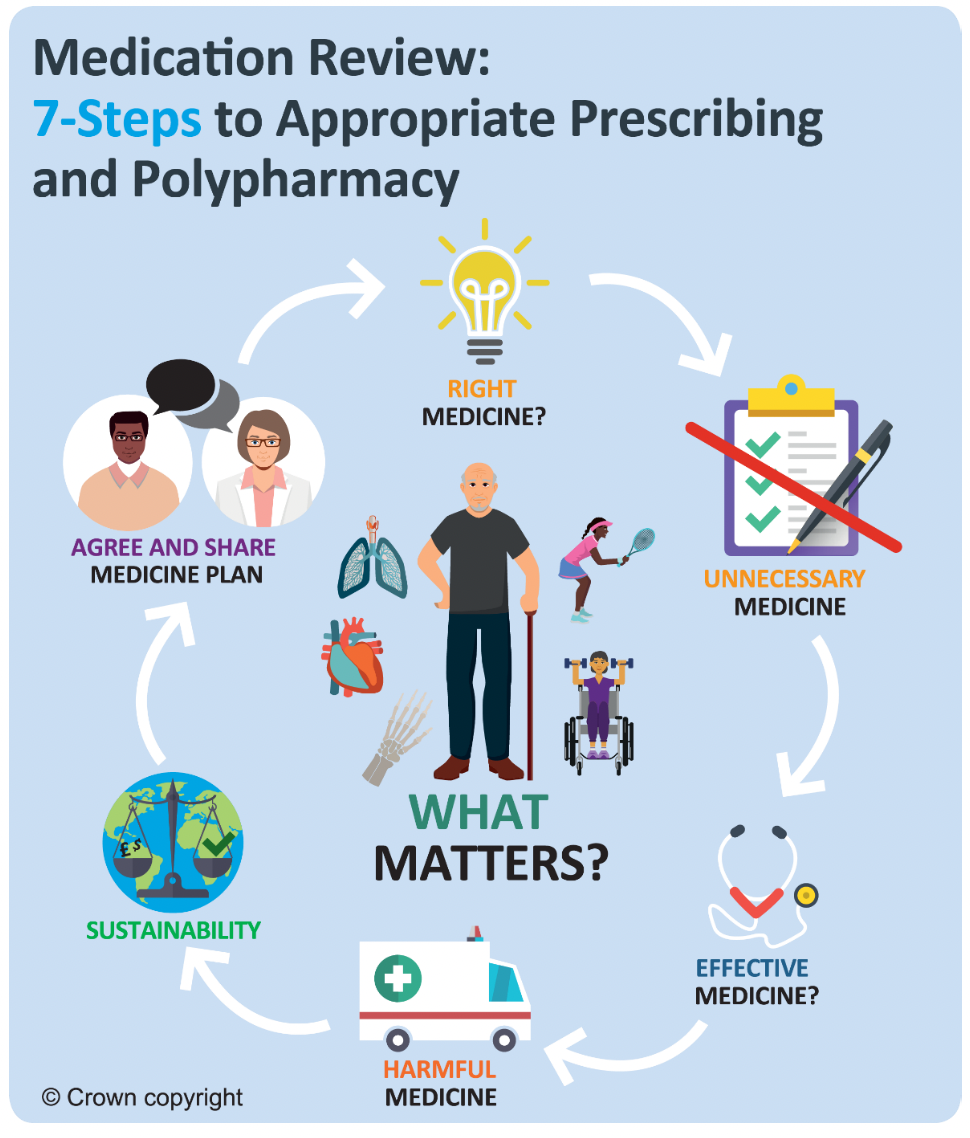
The actions undertaken in each step are summarised, and begin with asking “what matters to the person?”
Step 1: sets the context within which all further decisions are made, namely establishing what matters to the patient
Step 2: identify essential treatment
Step 3: determine if the patient is taking unnecessary treatment
Step 4: identify whether therapeutic objectives that matter to the patient are achieved and that there is evidence of the effectiveness of the medicines (NNT)
Step 5: assess if any medicines are too risky or cause unacceptable adverse effects
Step 6: consider which medicines are cost-effective and environmentally sustainable
Step 7: determine whether the patient is willing and able to manage their medicines in a way that avoids harm and maximises benefit.
5.6 Sustainability
NHS Scotland has set a target of becoming a net zero health service by 2040 and the plans for this are outlined in the NHS Scotland climate emergency and sustainability strategy: 2022-2026. This commitment was made in response to the recognition that climate change is currently the greatest global health threat of this century.
Early intervention to prevent disease can reduce cumulative environmental impact. Long term medical conditions require ongoing treatment, consultations with health care professionals, prescribing of medicines and potentially surgical treatment and in-patient care, as well as associated travel, which all impact on the environment. The Sustainable Healthcare Coalition has developed the diagram below to show schematically what the balance of environmental burden might be with, and without, early intervention in healthcare.[5]
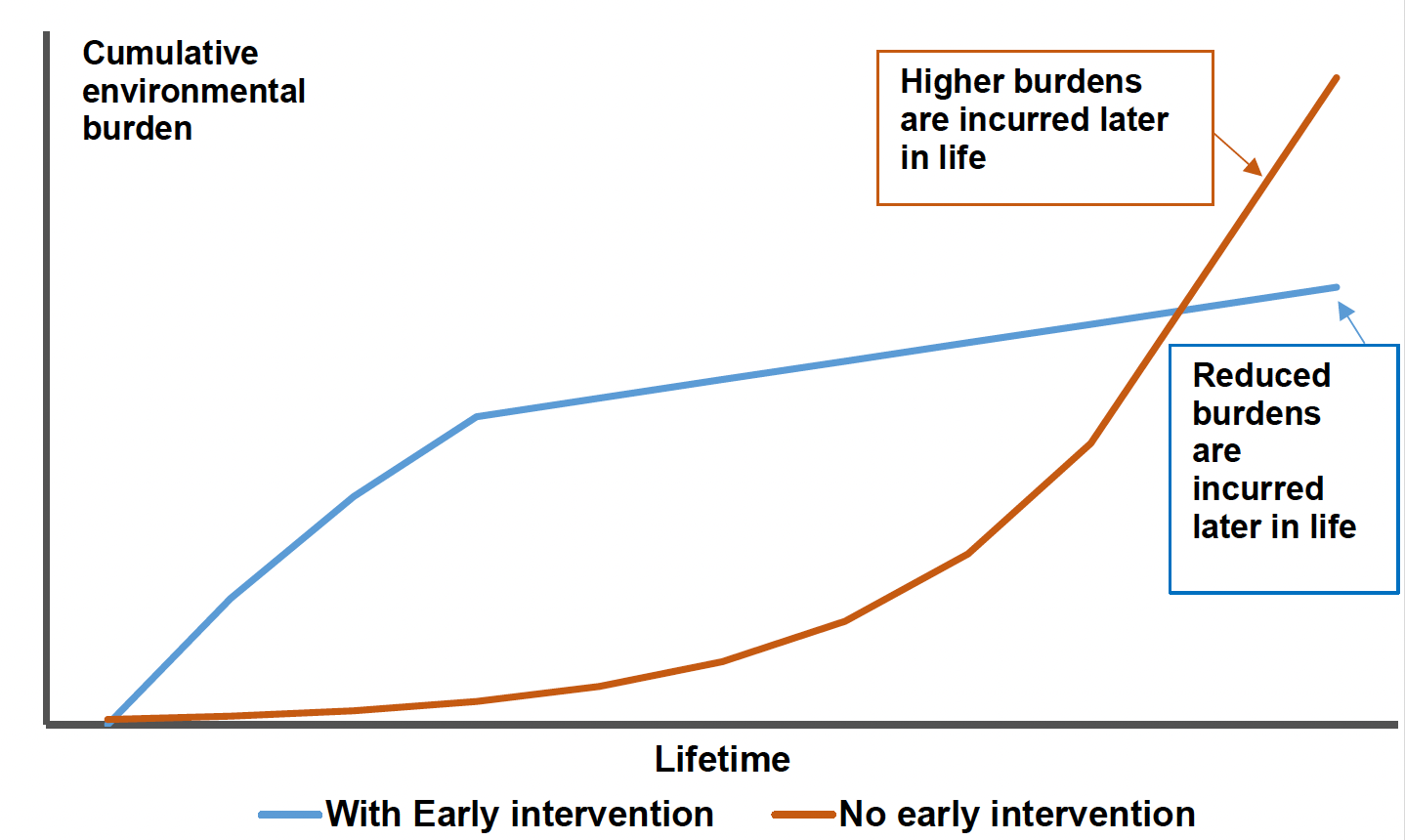
Reproduced with kind permission from Sustainable Healthcare Coalition; Healthcare, Circular Economy Principles and Sustainable Wellbeing, 2020
Treatment of established cardiovascular disease can have significant environmental impact and preventing the development of cardiovascular disease can reduce the need for hospital admissions, complex interventions and surgery.
In Scotland in 2024/25:[6]
- more than 13,000 patients were discharged from hospital following a heart attack or angina, with the average length of stay varying from 2.3 days to 9.6 days
- acute hospital services are resource intensive and are the largest contributor overall to NHS greenhouse gas emissions[7]
- more than 9,000 adult Percutaneous Coronary Intervention procedures were undertaken to open narrowed or blocked coronary arteries
- these procedures are considered to have a high carbon footprint due to high levels of material consumption and product waste [8]
- more than 2,000 adult cardiac surgeries were performed
- surgery is known to contribute significantly to greenhouse gas emissions through the use of inhaled anaesthetics, electricity, surgical supplies and personal protective equipment8
Identifying individuals at increased risk of cardiovascular disease and shifting treatment to prevention is important to achieve environmental and financial sustainability; NHS Scotland’s annual expenditure on CVD is estimated at £950 million.2 Scotland’s Population Health Framework, published in 2025, highlights that prevention is one of the most cost-effective interventions the NHS and wider system can make in relation to improving population health and reducing inequalities.[9]
A focus on prevention is also key in the Health and Social Care Service Renewal Framework. This policy sets a framework for a health and social care system which supports and promotes prevention. These are critical components of a sustainable health and social care system – one that not only promotes good health but also responds quickly when risks or early signs of illness or crisis emerge.
This quality prescribing guide focuses on using early detection and intervention to reduce the long-term impact of cardiovascular disease on individuals, society, the NHS and the environment.
Contact
Email: EPandT@gov.scot