
Cardiovascular risk reduction - quality prescribing guidance 2026-2029: consultation
Cardiovascular disease (CVD) is largely preventable, and many modifiable risk factors increase the likelihood of developing CVD. This guide highlights how to support people in modifying risk factors such as diet, healthy weight, alcohol, physical activity, stress and tobacco smoking.
Open
32 days to respond
Respond online
14. Individualised treatment decisions (Numbers needed to treat)
Numbers needed to treat (NNT) can be a useful tool when making person-centred decisions to initiate or deprescribe medications. They can support evidence-based conversations when considering what matters to the individual. A fuller explanation is available in Appendix C and in Polypharmacy Guidance: appropriate prescribing, making medicines safe, effective and sustainable 2026 - 2029.
However, the generalised nature of NNT can make them less useful for consideration in primary prevention of CVD for several reasons:
1. An individual’s estimated 10-year percentage risk of developing of CVD can be calculated by ASSIGN (v2.0) – this gives the ability to have a more individualised conversation about risk of CVD events and the potential for reduction of this risk with modification of risk factors. ASSIGN (v2.0) considers comorbidities such as hypertension and dyslipidaemia when making the calculation.
2. Lifestyle changes – individuals may choose to institute lifestyle changes first – stopping smoking, increasing physical activity, losing weight – which can have a significant impact on their CV risk score reducing the requirement for using medication at present. Risk should be re-assessed after three to six months.
3. Lifetime cardiovascular risk should be considered. Younger individuals will have more time to develop heart disease but conversely more time for any treatment to reduce their risks. It may be appropriate to consider pharmacological interventions in some young individuals with 10-year risk of <10% following individualised discussion of lifetime risk.
4. Life expectancy – primary cardiovascular prevention is linked to 10-year survival – if an individual has a shortened life expectancy, then careful consideration is required to ensure that they will be likely to gain benefit from any treatment.
When practising Realistic Medicine, the BRAN approach is often considered and can be utilised here:
B – benefits – the individual’s lifetime risk of CVD using ASSIGN (v2.0), age and any life limiting comorbidities should be used to discuss the benefits of modifying risk factors, including pharmacotherapy.
R – risks – what are the risks of therapy and does the individual feel these outweigh the benefits. This may be a consideration in women who are trying to conceive where medications such as statins are contraindicated.
A – alternatives – lifestyle changes can have a large impact on cardiovascular risk. Stopping smoking is one of the most effective interventions in reducing cardiovascular risk. Losing weight may also reduce blood pressure and reverse T2D.
N - do nothing - the individual’s lifetime risk of CVD using ASSIGN (v2.0), age and any life limiting comorbidities should be used to discuss the potential risks of doing nothing.
14.1 Individualised Decision Making
NICE have produced a useful patient decision aid which gives graphical representation of risks and benefits of statins for individuals with different 10 year CVD risk. Note following the recalibration of ASSIGN (v2.0) in 2024 the threshold defining high-risk is now 10%, consistent with the 10% risk threshold applied to the QRISK cardiovascular disease risk score by NICE.
N.B In some ethnic minorities, risk tools under- and overestimate CVD risk, because they have not been validated in these populations. For example, in people originating from the south Asian subcontinent it is safest to assume that the CVD risk is modestly higher than predicted from most scoring tools. More information on risk could be obtained in such individuals using alternative scores such as QRISK3.
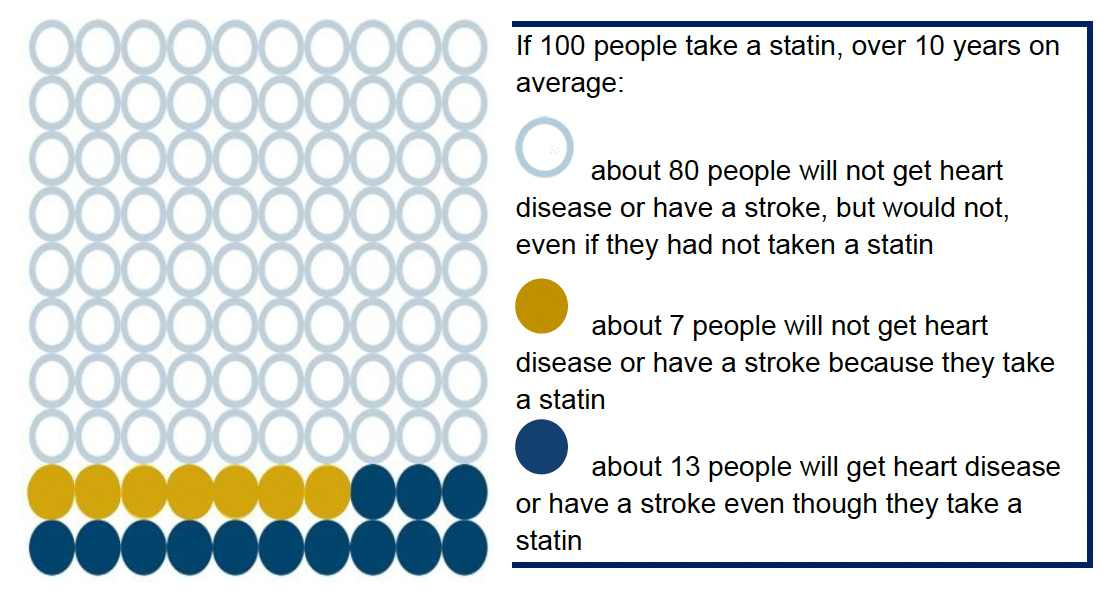
On average, for every 100 people with this risk score who do not take a statin, over 10 years 20 people will get heart disease or have a stroke and 80 will not.
We cannot say for certain what will happen to any specific person.
| QRISK score | Number of people who will not get heart disease or have a stroke, but would not even if they had not taken a statin | Number of people who will not get heart disease or have a stroke because they take a statin | Number of people who will get heart disease or have a stroke even though they take a statin |
|---|---|---|---|
| 8% | 92 | 3 | 8 |
| 10% | 90 | 4 | 6 |
| 15% | 85 | 5 | 10 |
| 20% | 80 | 7 | 13 |
| 25% | 75 | 9 | 16 |
| 30% | 70 | 11 | 19 |
| 35% | 65 | 13 | 22 |
| 40% | 60 | 15 | 25 |
14.2 Numbers Needed to Treat
The NNT is defined as the expected number of people who need to receive the intervention rather than the control for one additional person to either incur or avoid an event in each time frame. A NNT of 10 can be interpreted as one additional (or less) person that will incur an event for every 10 participants receiving the experimental intervention rather than control over a given time frame. This is referred to as the NNT to benefit.
NNTs are only estimates of average benefit, and it is rarely possible to know precisely what the likely benefit will be in a particular individual. Prescribers and individuals should be aware of a degree of uncertainty because it is usually not possible to calculate valid confidence intervals around NNTs. Furthermore, treatment of hypertension, diabetes or obesity will impact on outcomes other than CVD, for example all three are risk factors for development of chronic kidney disease. Individuals should be made aware of all potential benefits of treating these conditions.
A comprehensive NNT table was developed for Polypharmacy Guidance 2026. Further information on NNT is also available in Appendix C.
Contact
Email: EPandT@gov.scot