
National Mission on Drugs: annual monitoring report 2024-2025
This third annual monitoring report provides an analysis of the progress made between April 2024 and March 2025 on the National Mission to reduce drug deaths and improve lives.
8. Outcome 5: Quality of life is improved by addressing multiple disadvantages
8.1 Summary
Headline metrics
Mental wellbeing score for adults who have used drugs: No new data for this metric for 2024/25.
Ratio of drug death rate in the most deprived areas to rate in the least deprived areas: People in the most deprived areas were 11.5 times more likely to die of a drug death compared to people in the least deprived areas in 2024. Lower than in 2023 and lower than before the National Mission.
Commentary: Inequalities in drug related deaths and harms have reduced slightly but are still high. There is positive activity at the ADP level in addressing wider health and social care needs through informed, compassionate services. Direct insight from people with lived experience would strengthen understanding of progress.
8.2 Background
People with problem substance use often experience multiple disadvantages, complex needs and/or other comorbidities, requiring tailored support. Factors such as deprivation, homelessness, trauma, and co-occurring mental health problems can compound drug-related harms and impact quality of life.[39] National and local initiatives aimed at addressing these disparities include improving support for people with co-occurring substance use and mental health diagnoses, trauma-informed workforce and services, and the implementation of the MAT standards. A range of initiatives have been introduced as part of the National Mission to address the wider needs of people who use drugs. Although this report cannot link any improvements directly to specific initiatives, it explores measures such as wellbeing, harm related to disadvantage, and local activities that are relevant to this outcome to assess progress.
8.3 Headline metrics
8.3.1 Headline metric: Mental wellbeing score for adults who have used drugs
Mental wellbeing provides an indication of an individual’s ability to cope with the stresses of life, realise their own potential, work productively and make contributions to their community. There is no new data for this indicator for this 2024/25 monitoring report. The most recent data is from 2023, when adults who had used any drug in the last 12 months reported lower mental wellbeing than those who had not used drugs (mean WEMWBS scores of 46.3 and 49.4 respectively; The Warwick Edinburgh Mental Wellbeing Scale (WEMWBS) scale ranges from 14 to 70; higher scores indicate greater mental wellbeing). Self-reported survey data from the Scottish Health Survey related to drug use may be affected by under-reporting due to stigma or mistrust.[40]
8.3.2 Headline metric: Ratio of drug death rate in the most deprived areas to rate in the least deprived areas
The ratio of drug deaths between the most deprived and least deprived areas serves as an indicator of inequality in drug related mortality as measured by deprivation. The age-standardised drug death rate for people living in the most deprived areas of Scotland (as measured by the Scottish Index of Multiple Deprivation, SIMD) was 11.5 times higher than in the least deprived areas in 2024 (47.3 and 4.1 per 100,000 respectively) (Figure 10). This is a decrease compared to 2023 (when the ratio was 14.4) and lower than before the National Mission (2020: 18.0, 2021: 14.3 per 100,000). The drug death deprivation ratio has generally been falling over recent years but remains much greater than for other causes of death where people in the most deprived areas are around twice as likely to die as those in the least deprived areas.[41]
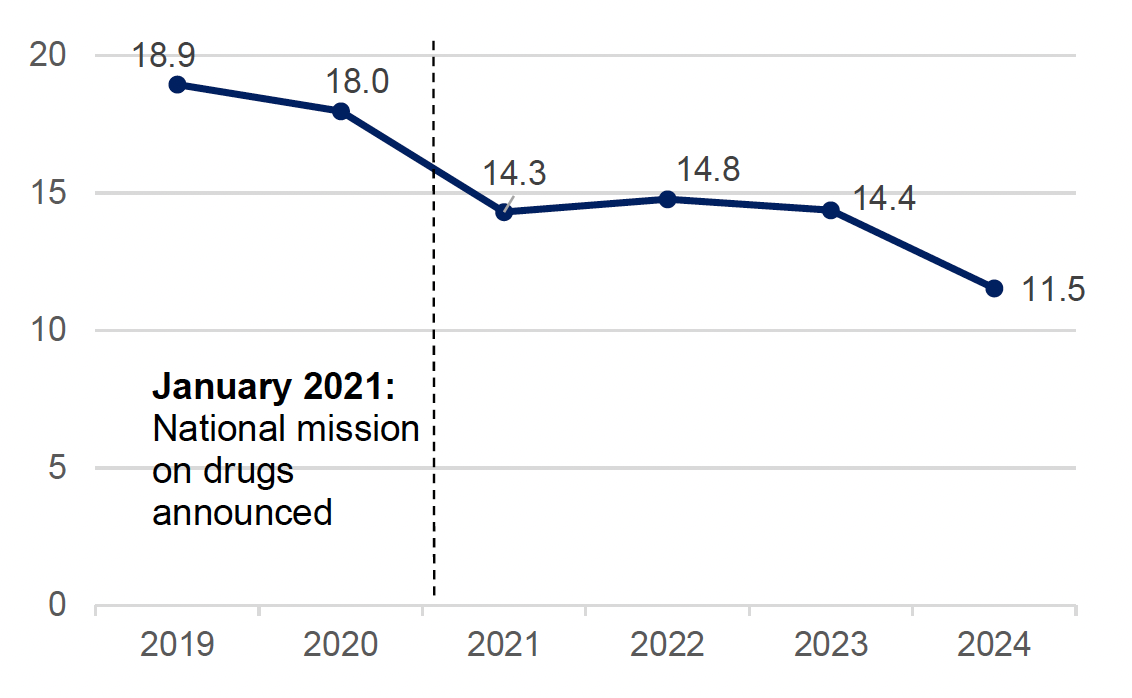
Source: Drug-related deaths in Scotland 2024, National Records of Scotland, September 2025
8.4 Supporting metrics
8.4.1 Supporting metric: Ratio of drug-related hospital stay rate in the most deprived areas to rate in the least deprived areas
Data on drug-related hospital admissions, broken down by the deprivation level of an individual’s area of residence, offer insight into inequalities in the harms linked to drug use. In 2024/25, the drug-related hospital stay rate for people who live in the most deprived areas was 11.9 times higher than for those in the least deprived areas (484.1 and 40.6 per 100,000 respectively) (Figure 11). This is similar to the previous two years but lower than before the National Mission. Just under half (49%) of the patients with a drug-related hospital stay live in the 20% most deprived areas in Scotland.[42]
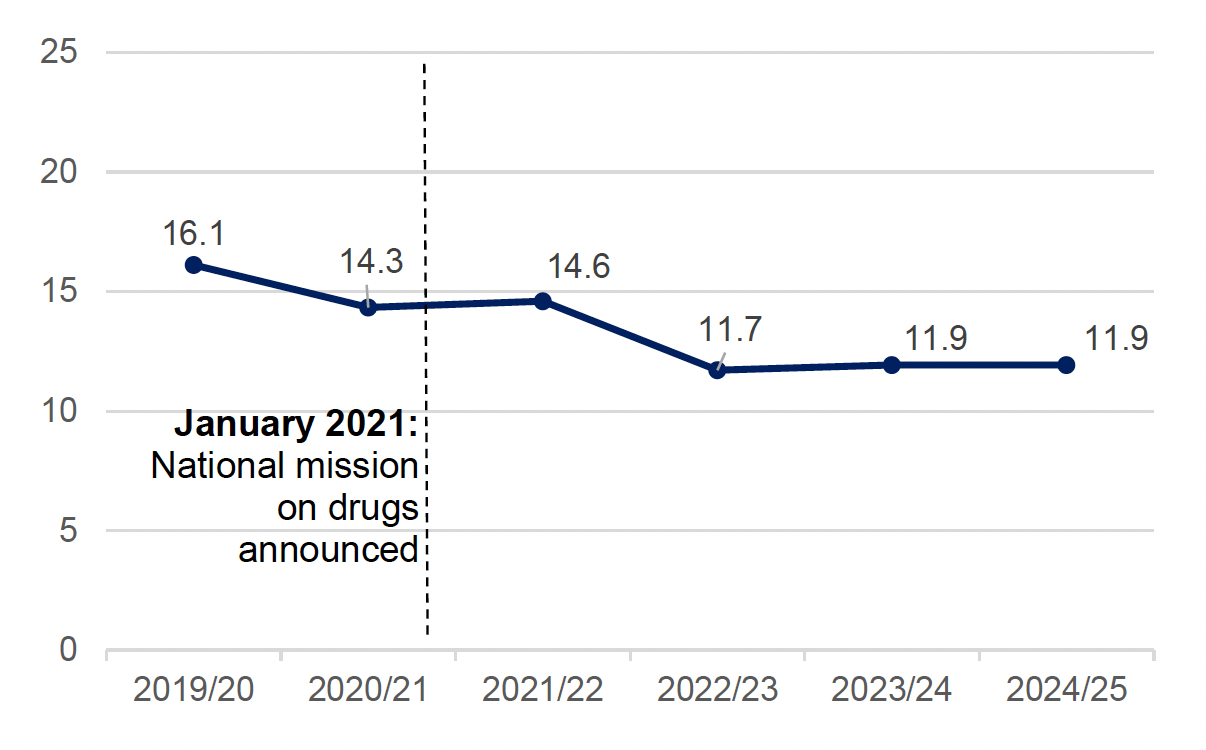
Source: Drug-related hospital statistics - Scotland 2023 to 2024, Public Health Scotland, February 2026
8.4.2 Supporting metric: Number of drug deaths amongst people experiencing homelessness
The estimated number of drug deaths among people experiencing homelessness serves as an indicator of drug related mortality within a key population at heightened risk. There were an estimated 79 people experiencing homelessness who died a drug death in Scotland in 2024, a decrease of 21 (21%) since 2023 when there were 100 such deaths. In 2024, 34% of all homeless deaths were due to drugs, a lower proportion than in previous years (2019-2023 average: 48%).[43]
Deaths of people experiencing homelessness are difficult to count – these National Records of Scotland (NRS) statistics provide an estimate based on death registration records and statistical modelling. This metric uses homelessness status as a proxy for multiple disadvantage and only includes people who were experiencing homelessness at the time of death. Prevalence of drug use amongst the population of people experiencing homelessness is unknown.
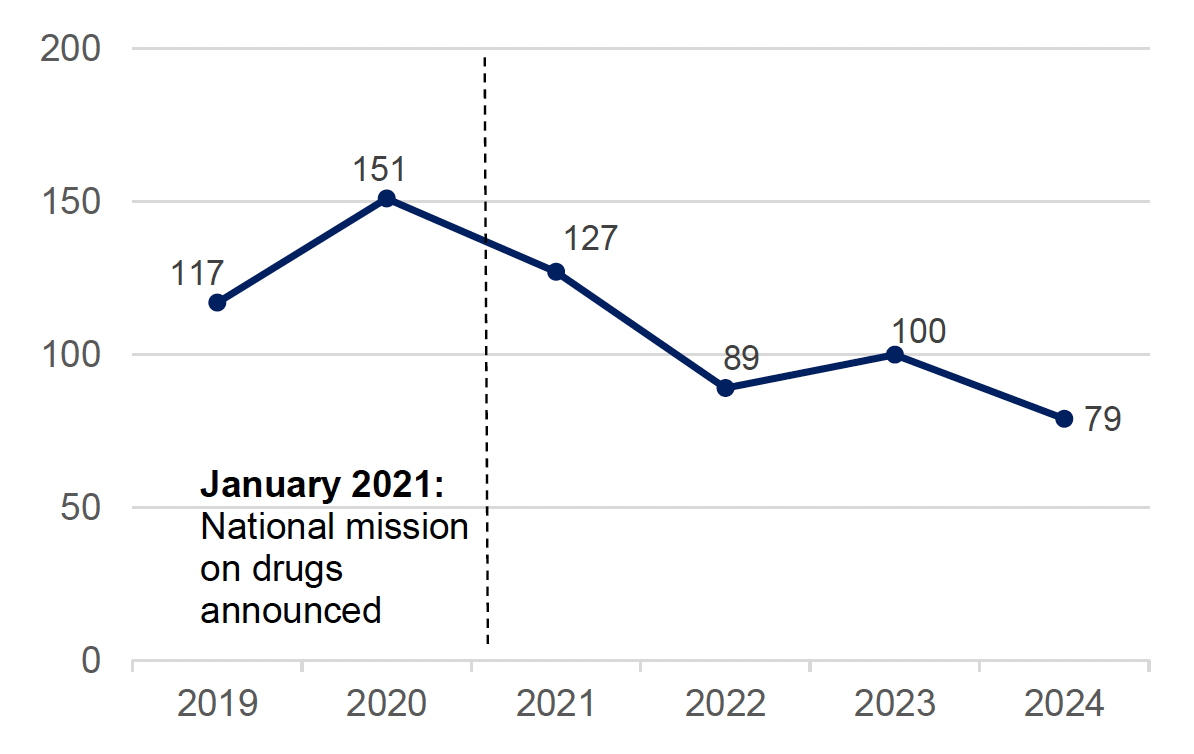
Source: Homeless Deaths 2024, National Records of Scotland, March 2026
8.4.3 Supporting metric: Number of homeless households with a drug or alcohol dependency support need
Homelessness statistics provide insight and indication of the extent of drug and alcohol dependency in a key high-risk population. In 2024/25, there were 3,306 households assessed as homeless or threatened with homelessness where drug or alcohol dependency support needs were identified. This is a decrease of 183 households (5%) compared to 2023/24 when there were 3,489 such households. The number of households with a drug or alcohol dependency support is similar to the level before the start of the National Mission. This should be interpreted in the context of both the overall number of homeless households and the number of those households with any support needs - homeless households with a drug or alcohol dependency support need has been stable at 10-12% of all households assessed as homeless over the time period of analysis presented here. Note that support needs are self-declared and may therefore be an under or overestimate.[44]
8.4.4 Supporting metric: Percentage of ADP areas with formal joint working protocols with mental health services
This metric aims to reflect one dimension of work towards ensuring that wider health and social care needs are addressed through informed, compassionate services. Eight in ten ADPs (83%) reported that they had formal joint working protocols in place to support people with co-occurring substance use and mental health diagnoses to receive mental health care. This is a slight reduction from 2023/24 (87%) but higher than in 2022/23 (59%), the earliest year for which data is available. Several ADPs who reported that they did not have a formal protocol in place in 2024/25 highlighted that this is currently in development.[45]
These data are self-reported by ADP lead officers and do not provide insight into service uptake. Geographic distribution, and the number or range of settings within an ADP area providing the service are also not captured.
8.4.5 Supporting metric: Percentage of ADP areas undertaking activities to implement a trauma-informed approach
This metric aims to reflect a further dimension of work towards ensuring that wider health and social care needs are addressed through informed, compassionate services. All ADPs reported a range of activities which have been undertaken in ADP-funded or supported services to implement a trauma-informed approach with most activities increasing on the level reported by ADPs in 2023/24.
In terms of the activities undertaken, all ADPs reported that services were engaging with people with lived/living experience (up from 93% in 2023/24) and training the existing workforce (also up slightly from 93% in 2023/24). Nine in ten reported that services were engaging with third sector/community partners (90% of ADP areas, similar to 2023/24). Recruiting staff was the least commonly reported activity (50% of ADP areas) and there has been a reduction in ADPs reporting this activity each year since 2022/23 (83% in 2022/23, 63% in 2023/24 and 50% in 2024/25). Provision of trauma-informed spaces/accommodation increased most notably to 77% of ADP areas (up from 63% in 2023/24. Other responses included ongoing work to develop trauma-informed spaces, work to implement a Culture of Kindness, trauma walkthrough activities and use of a wellbeing survey.[46]
These data are self-reported by ADP lead officers and do not provide insight into service uptake. Geographic distribution, and the number or range of settings within an ADP area providing the service are also not captured.