
National Mission on Drugs: annual monitoring report 2024-2025
This third annual monitoring report provides an analysis of the progress made between April 2024 and March 2025 on the National Mission to reduce drug deaths and improve lives.
4. Outcome 1: Fewer people develop problem drug use
4.1 Summary
Headline metrics
Prevalence of problem drug use: 1.13% estimated prevalence of opioid dependence in 2023/24. Slight reduction since the start of the National Mission.
Percentage of people who have a current problem with their drug use: 1% of people reported having a current problem with their drug use in 2023. No new data for 2024/25. Trend analysis not available.
Commentary: While there is some evidence of a slight decline in opioid dependence, gaps remain in our understanding of the extent of problematic use of other drugs.
4.2 Background
Preventing the development of problem drug use is central to reducing drug-related harms and deaths. This includes working with young people, providing early access to support, and improving understanding of the supply of harmful drugs. In parallel, work is ongoing across government on the wider determinants of health and tackle inequalities. To understand prevention and the effectiveness of prevention-focused initiatives over time, it is useful to explore population-level prevalence of problem drug use, both at a local level and across key demographic groups including children and young people.
4.3 Headline metrics
4.3.1 Headline metric: Prevalence of problem drug use
Estimates of the prevalence of problem drug use provide insight into the scale of, and trends in, problem drug use as well as the likely demand for treatment services. As a vulnerable, criminalised, partially hidden and comparatively small group, the population of people who use drugs problematically is difficult to measure accurately. Estimates of the prevalence of problem drug use are limited to opioid dependence and do not provide insight into the prevalence of problematic use of other substances. Estimates are presented with 95% credible intervals (CrI) to represent the extent of uncertainty around each finding, and all population size estimates have been rounded to the nearest hundred.
In 2023/24 (the most recent data available), the estimated number of people with opioid dependence in Scotland was 43,600 (95% CrI: 42,000 to 45,400). This represents an estimated prevalence of 1.13% (95% CrI: 1.09% to 1.18%) of 15- to 69-year-olds. Estimated prevalence among males was over twice that among females (males 1.59% (95% CrI: 1.53% to 1.66%), females 0.68% (95% CrI: 0.66% to 0.71%)).[6]
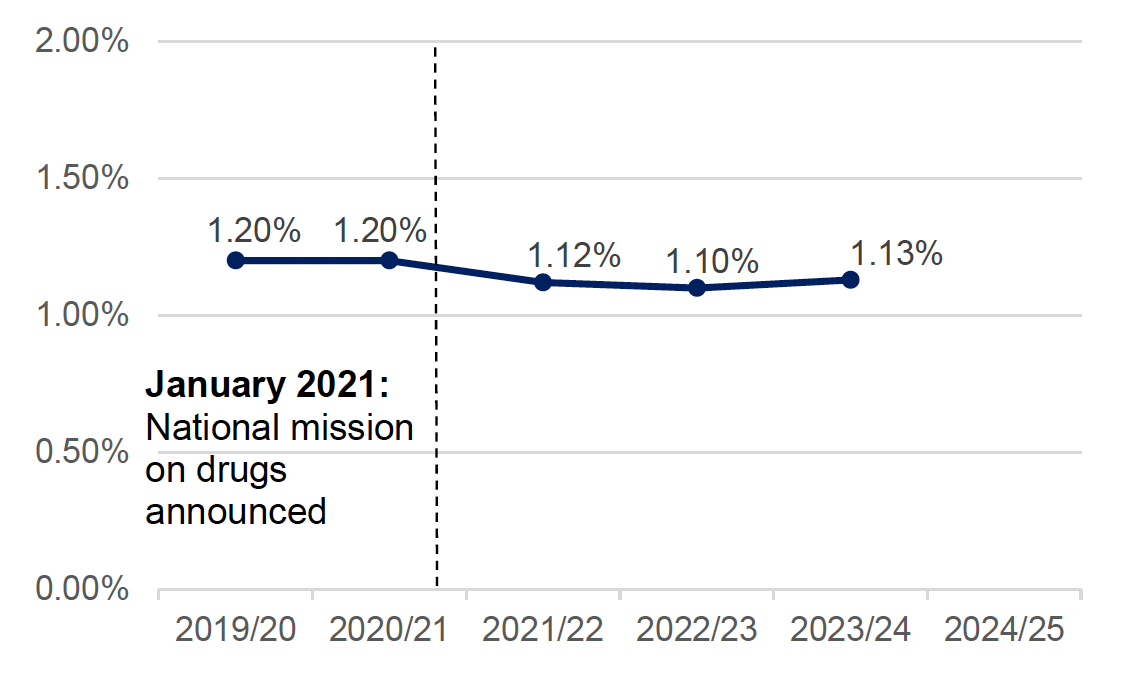
Source: Estimated Prevalence of Opioid Dependence in Scotland 2014/15 to 2023/24, Public Health Scotland, March 2026
There is some evidence of a small reduction in the estimated number of people with opioid dependence over recent years. It is likely that these changes were driven primarily through an ageing cohort of people who are opioid dependent in combination with comparatively little growth in the number of new initiates/incident cases. These estimates suggest that prevalence of opioid dependence is high in Scotland compared to many other countries.
4.3.2 Headline metric: Percentage of people who have a current problem with their drug use
The Scottish Health Survey asks about drug use every two years, offering insight into levels of problem drug use based on self-reported perceptions. No new data is available to provide insight into progress for this metric for this 2024/25 monitoring report. The most recent data, from 2023, shows that 1% of people reported having a current problem with their drug use. Males were more likely to report currently having a problem with drug use compared to females. In 2021, fewer than 0.5% of people reported a current problem. However, due to the small number of adults reporting current drug use it is not possible to monitor significant change over time. The Scottish Health Survey may not capture a representative sample of people who have a current problem with drug use and is therefore likely to underestimate prevalence. Self-reported survey data may also be affected by under-reporting due to stigma or mistrust.[7]
4.4 Supporting metrics
4.4.1 Supporting metric: Prevalence of problem drug use among young people
Estimates of the prevalence among young people provide insight into the scale of problem drug use among this specific demographic group. Estimates are presented with 95% Credible Intervals (CrI) to represent the extent of uncertainty around each finding.
In 2023/24 (the most recent year for which data is available), the prevalence of opioid dependence was estimated at 0.67% (95% CrI: 0.62% to 0.74%) among people aged 15 to 34 years. There has been a reduction in the estimated prevalence of opioid dependence among people aged 15 to 34 years since the start of the National Mission (2020/21: 0.82% (95% CrI: 0.77% to 0.88%)). This reduction was observed among both males and females. However, these estimates relate only to opioid dependence and offer no insight into the prevalence of problematic use of other substances.[8]
4.4.2 Supporting metric: Percentage of young people who have a current problem with their drug use
The Scottish Health Survey offers insight into levels of problem drug use among young people based on self-reported perceptions. No new data is available to provide insight into progress for this metric for this 2024/25 monitoring report. The most recent data, from 2023, shows that fewer than 0.5% of young people (aged 16 to 24 years) reported having a current problem with their drug use. In 2021, 1% of young people (aged 16 to 24 years) reported having a current problem with their drug use. However, due to the small number of people reporting current drug use it is not possible to monitor significant change over time. The Scottish Health Survey may not capture a representative sample of people who have a current problem with drug use and is therefore likely to underestimate prevalence. Self-reported survey data may also be affected by under-reporting due to stigma or mistrust [9]
4.4.3 Supporting metric: Percentage of S4 pupils who have ever taken illegal drugs
This metric offers insight into the extent to which high school aged children in Scotland have ever used illegal drugs and serves as an alternative indicative measure of drug use prevalence among young people. No new data is available from the Health and Wellbeing Census to assess progress against this metric for this 2024/25 monitoring report.
4.4.4 Supporting metric: Number of school exclusions involving substance misuse
School exclusions involving substance use highlight the negative impact drug use can have on education and may indicate an increased risk of problem drug use among young people. In the 2024/25 academic year there were 254 cases of exclusion from local authority schools involving substance misuse, 2.4% of all known exclusions. This is an increase from the 2020/21 academic year (150 such exclusions, 1.8%, may partly reflect reduced time spent in school by pupils during the pandemic), but is a reduction on the 2022/23 level (375 such exclusions, 3.2%). This data only captures cases where substance use leads to school exclusion, not its broader impact on educational attainment or performance.[10]
4.4.5 Supporting metric: Number of drug supply crimes
Recorded drug supply crimes offer a measure of the wider social impact of drug use by capturing the extent of criminal activity linked to the supply of harmful substances recorded by the police. In 2024/25, 4,802 crimes related to drug supply were recorded in Scotland. This is an increase of 579 crimes (14%) compared to 2023/24 when there were 4,223 such crimes (Figure 4). Recorded drug supply crimes are slightly lower than they were at the start of the National Mission. However, the COVID-19 pandemic and associated measures to limit physical contact affected both the type and volume of crime recorded since March 2020 which may have impacted trends. These data also underestimate the scale of drug supply crimes because not all crimes are reported to the police. The number of recorded crimes may also be affected by police activity and operational decisions.[11]
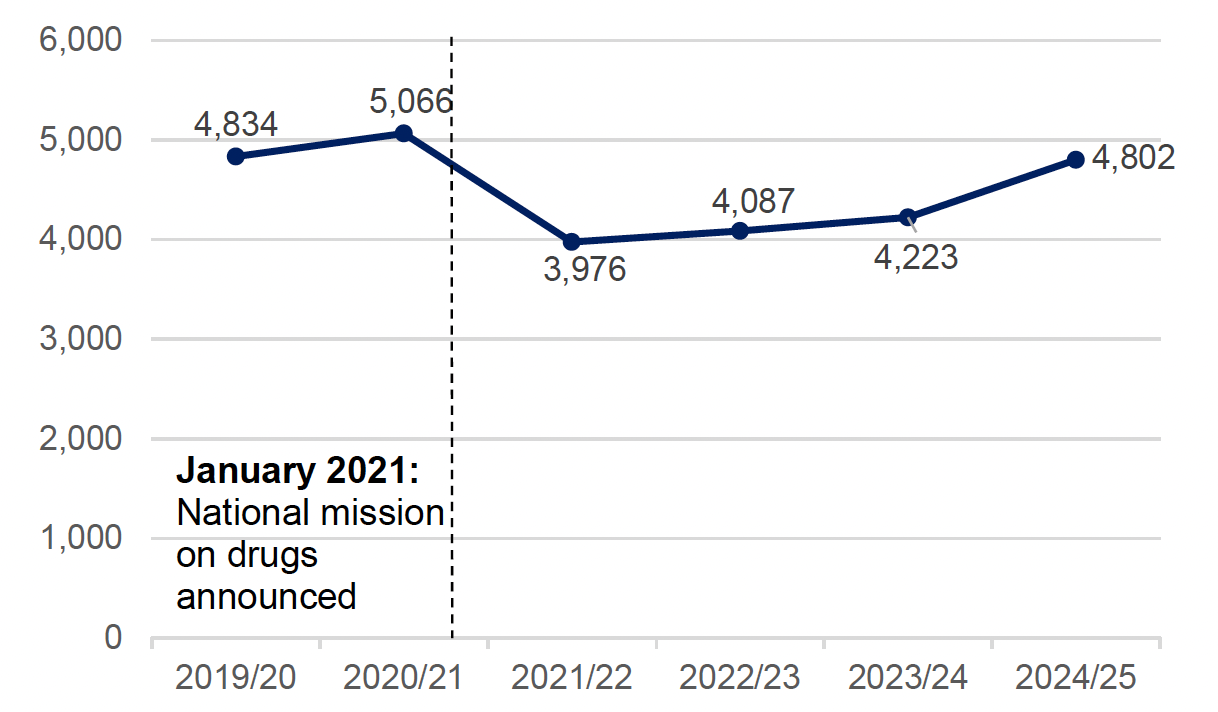
Source: Recorded Crime in Scotland 2024-25, Scottish Government, June 2025
4.4.6 Supporting metric: Amount of (a) heroin, (b) benzodiazepines, and (c) cocaine seized
Drug seizure data indicates the quantity of illegal drugs that are removed from the supply chain each year. In 2024/25 it is estimated that 60 kg of heroin, 1.81 million benzodiazepine tablets and 210 kg of cocaine (total powder and crack cocaine) were seized by Police Scotland. This data is not comparable with previous years because the methodology used to collect information on drug supply seizures has changed.[12]
While drug seizure data provide insights on illegal drugs removed from markets each year, the quantity of drugs seized can fluctuate considerably between years. Moreover, the totals are not necessarily correlated with the number of seizures made. While most drug seizures consist of relatively small quantities (usually possession-related crimes), annual quantities of drugs seized can be greatly influenced by a small number of large seizures (usually from supply-related crimes).