
National Mission on Drugs: annual monitoring report 2024-2025
This third annual monitoring report provides an analysis of the progress made between April 2024 and March 2025 on the National Mission to reduce drug deaths and improve lives.
5. Outcome 2: Risk is reduced for people who use harmful drugs
5.1 Summary
Headline metrics
Number of ambulance service naloxone administrations: 3,710 ambulance service naloxone administrations in 2024/25. Decrease of 18% since 2023/24 and lower than before the start of the National Mission.
Rate of drug-related hospital stays: 192 drug-related hospital stays per 100,000 in 2024/25. Decrease of 10% since 2023/24 and lower than before the National Mission.
Commentary: The metrics suggest some reduction in drug‑related harms since the start of the National Mission. However, interpretation of these metrics remains challenging, underlining the need for further intelligence, particularly in the context of changing patterns of drug use and an evolving drug supply.
5.2 Background
Targeted harm reduction plays a crucial role in a person’s recovery journey and helps prevent drug deaths. Naloxone, which is used to reverse opioid overdoses, is now carried by all Scottish Ambulance Service staff and front-line Police Scotland officers. Data on naloxone administration, drug-related hospital stays, and Rapid Action Drug Alerts and Response (RADAR) surveillance data from Public Health Scotland (PHS) provide insight into harm indicators. In addition, a range of community-based initiatives support safer drug use and help reduce risks such as blood borne viruses, injection site injuries and infections, and overdoses. This includes the Thistle facility in Glasgow, the UK’s first official safer drug consumption facility. Access to harm reduction services is also a core component of the Medication Assisted Treatment Standards.
5.3 Headline metrics
5.3.1 Headline metric: Number of ambulance service naloxone administrations
Data on incidents where naloxone was administered by Scottish Ambulance Service (SAS) clinicians provide an indication of the number of suspected opioid overdoses. In 2024/25, naloxone was administered in 3,710 incidents. This was 18% (798) fewer than in 2023/24 when 4,508 incidents were recorded and 30% (1,562) fewer than in 2020/21 (immediately before the National Mission started) when 5,272 incidents were recorded.[13]
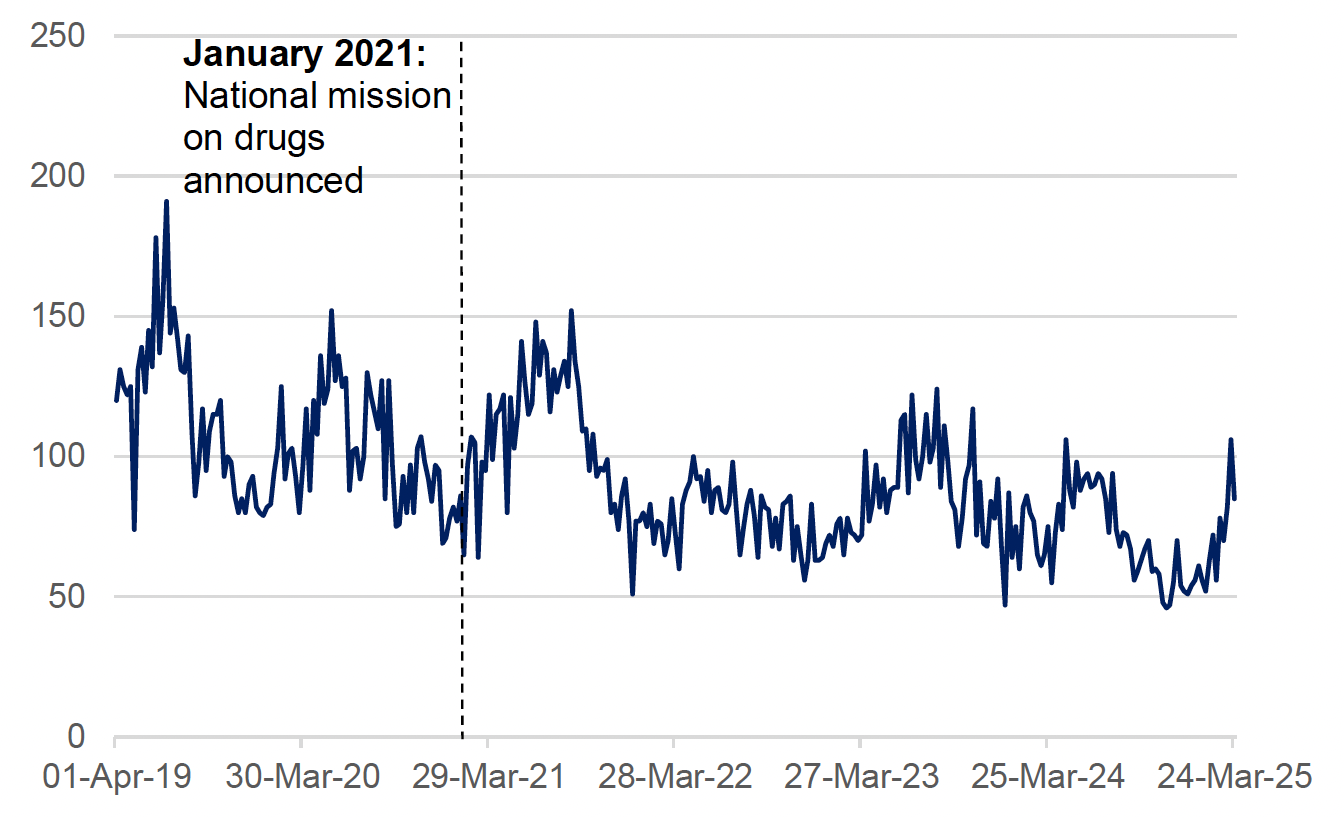
Source: Rapid Action Drug Alerts and Response (RADAR) dashboard, Public Health Scotland, October 2025 (data extracted January 2026)
Data on naloxone administration should be interpreted alongside the substantial activity undertaken in recent years to expand distribution and carriage of naloxone in Scotland. Distribution of kits to people at risk has remained the primary focus, while additional work targeting peers of people using drugs, family members and emergency services has also been undertaken with partners. This increased availability of naloxone and wider range of people who may be carrying and administering naloxone is likely to have had an impact on the number of naloxone administrations recorded by SAS.
5.3.2 Headline metric: Rate of drug-related hospital stays
Statistics on hospital stays in which drug use is recorded as a diagnosis provide insight into patterns and trends in drug-related harms over time. During 2024/25, the rate of drug-related hospital stays was 192 per 100,000 population (Figure 6). This is a decrease of 10% compared to 2023/24 (212 stays per 100,000 population) and 30% compared to 2020/21 (276 per 100,000) immediately prior to the National Mission.[14]
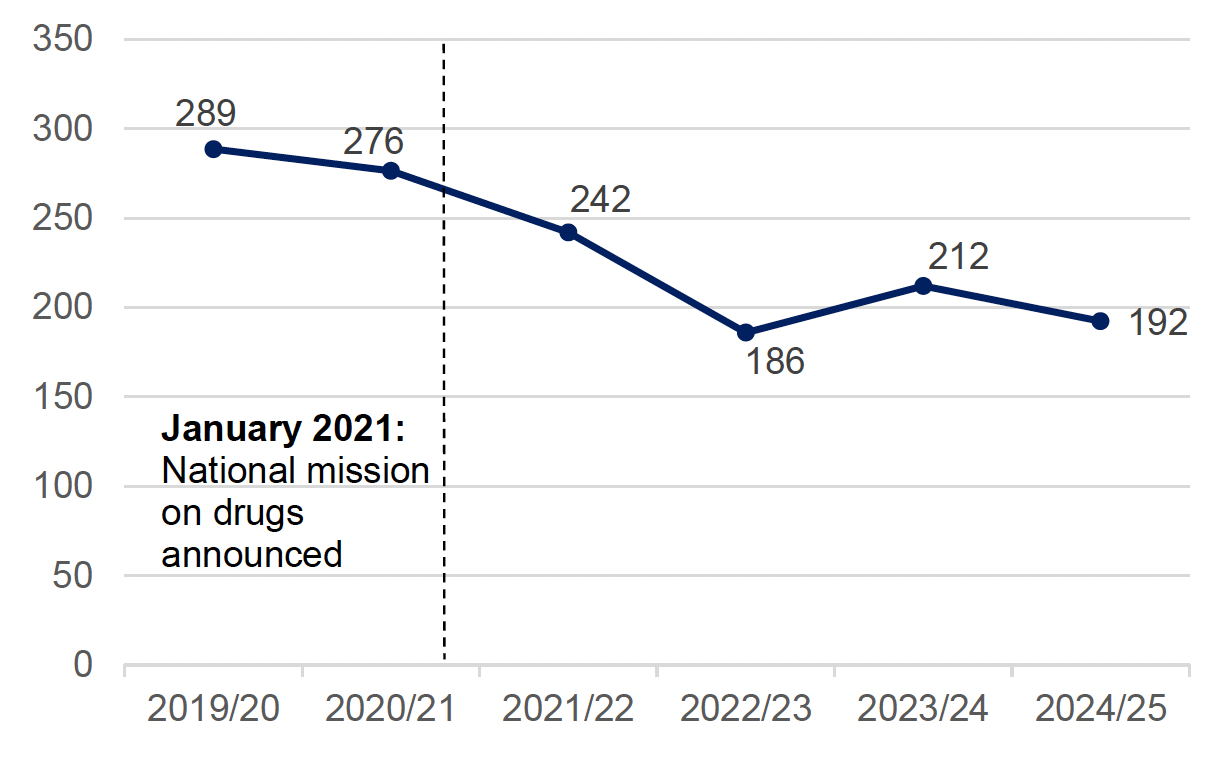
Source: Drug-related hospital statistics Scotland 2024 to 2025, Public Health Scotland, February 2026
Most drug-related hospital stays are in general acute hospitals, where the stay rate has decreased from a pre-National Mission level of 241 per 100,000 population in 2020/21 to 158 stays per 100,000 population in 2024/25. Drug-related psychiatric hospital stays have remained relatively stable over the same period.
In 2024/25, around seven in ten patients who had a drug-related hospital stay were male, a pattern that has remained broadly consistent in recent years. Patient rates were highest among those aged 35-44, however, rates for this age group have declined over time and longer-term trends indicate an aging patient profile. Around half of patients with a drug-related hospital stay live in the 20% most deprived areas of Scotland. Opioids continue to account for the highest substance-specific hospital stay rates, although these have reduced over time nearing a 20-year low of 75 per 100,000 population in 2024/25.
Drug-related hospital stay statistics are an underestimate of drug related harms because they exclude overdoses treated by the ambulance service or at emergency departments that do not lead to hospital admission. A patient may have more than one hospital stay during a financial year; therefore, the number of stays may be higher than the number of patients.
5.4 Supporting metrics
5.4.1 Supporting metric: Number of new hepatitis C diagnoses
The number of new infections of hepatitis C provides a proxy indicator of the risk of contracting this blood borne virus for the vulnerable population of people who inject drugs. There were 1,351 new diagnoses of hepatitis C antibody-positivity in Scotland in 2024. This was similar to the overall number in 2023 and follows a sharp rise observed between 2022 and 2023.[15]
These data are limited to new hepatitis C diagnoses, and do not capture chronic infections among people who inject drugs. In addition, these statistics reflect hepatitis C only - injecting behaviours also present risks in relation to contracting other blood borne viruses.
5.4.2 Supporting metric: Number of needles/syringes distributed per injecting equipment provision outlet attendance
Provision of injecting equipment is effective in reducing injecting risk behaviours in people who use drugs, and the number of needles and syringes distributed per attendance is a measure of engagement with these services. In 2024/25, an average of 16.5 needles/syringes were distributed per attendance at injecting equipment outlets. This level is broadly consistent with both the previous year (2023/24: 16.3) and the level at the beginning of the National Mission (2020/21: 16.9).[16]
This metric is limited to attendances when needles and syringes are provided and excludes distribution of other harm reduction equipment such as foil, wipes/swabs, citric acid and spoons. As no individual-level data are available it is not possible to determine the number of people using these services, injecting frequency or how drug use trends influence the number of attendances.
5.4.3 Supporting metric: Naloxone programme reach
‘Reach’ describes the proportion of people at risk of opioid overdose who have been supplied with take home naloxone, enabling them or others to intervene to reduce the risk of a fatal overdose. In 2024/25, the reach of the National Naloxone Programme was 82.2%. This is an increase of six percentage points compared to 2023/24 (76.2%), and an increase of 32 percentage points compared to 2019/20 (50.2%).[17]
Supply of take-home naloxone does not provide an indication of the number of administrations or overdoses prevented (see section 5.3.1). Additionally, newly available estimates of the number of people at risk of opioid overdose would affect this metric.
5.4.4 Supporting metric: Percentage of ADP areas where MAT standard 4 has been fully implemented
The aim of MAT (Medication Assisted Treatment) standard 4 is to ensure that all people are offered evidence-based harm reduction at the point of MAT delivery. In 2024/25 the standard was assessed as fully implemented (green) or sustained (blue), in 93% of ADP areas and partially implemented (provisional green) in 7% of ADP areas. The PHS benchmarking exercise did not record how many people were offered or took up harm reduction as part of the Standard. Noting this caveat, and supported by numerical indicator data, PHS concluded that the process measures were universally in place.[18]
5.4.5 Supporting metric: Percentage of ADP areas offering specific harm reduction services in drug services
This metric provides an indication of availability of core harm reduction services across National Health Service (NHS), third sector or council drug services across Scotland. In 2024/25, in drug service settings (NHS, third sector and council):
- All ADP areas (100%) reported providing supply of naloxone (in line with 2023/24).
- 93% of ADP areas reported providing hepatitis C testing (down from 97% in 2023/24).
- 97% of ADP areas reported offering injecting equipment provision (down from 100% in 2023/24).
- 97% of ADP areas reported offering wound care (in line with 2023/24).[19]
These data are self-reported by ADP lead officers and do not provide insight into service uptake (i.e. the number of people accessing services). Geographic distribution, and the number or range of settings within an ADP area providing the service are also not captured.