
National Mission on Drugs: annual monitoring report 2024-2025
This third annual monitoring report provides an analysis of the progress made between April 2024 and March 2025 on the National Mission to reduce drug deaths and improve lives.
7. Outcome 4: People receive high quality treatment and recovery services
7.1 Summary
Headline metrics
Number of people who have an initial assessment recorded: 8,053 people starting specialist treatment who had an initial assessment recorded in 2024/25. In line with 2023/24 but lower than before the National Mission.
Number of people prescribed opioid substitution therapy (OST): 28,015 people prescribed opioid substitution therapy in 2024/25. Lower than level at start of the National Mission.
Number of approved statutory funded residential rehabilitation placements: 913 approved statutory funded residential rehabilitation placements in 2024/25. Slightly lower than 2023/24 but notably higher than at the start of the National Mission.
Commentary: While access to publicly funded residential rehabilitation has improved, the number of people receiving other forms of treatment is below pre-National Mission levels. The evolving drug market highlights the need for adaptation of services alongside better understanding of unmet need and the quality of services as experienced by those who access them.
7.2 Background
High quality, evidence-based treatment that promotes a recovery-orientated system of care is essential to get more people into the treatment they need. A wide range of community based, and residential services operate to support people with problem substance use in Scotland including access to Medication Assisted Treatment (MAT), often in the form of opioid substitution therapy (OST), as well as access to residential services such as rehabilitation. Targets are in place to increase residential rehabilitation capacity by 50% to 650 beds and for 1,000 individuals to be publicly funded to go through residential rehabilitation per year by 2026.[27]
7.3 Headline metrics
7.3.1 Headline metric: Number of people who have an initial assessment recorded
The data recorded at the initial assessment stage of the treatment journey provide a measure of the number of people engaging in specialist treatment. In 2024/25, 8,053 people starting specialist drug or drug and alcohol treatment had a complete initial assessment recorded on DAISy. This is in line with 2023/24 (8,034 people) but 10% (907) fewer than in 2021/22, the first year for which these data are available (Figure 8).[28]
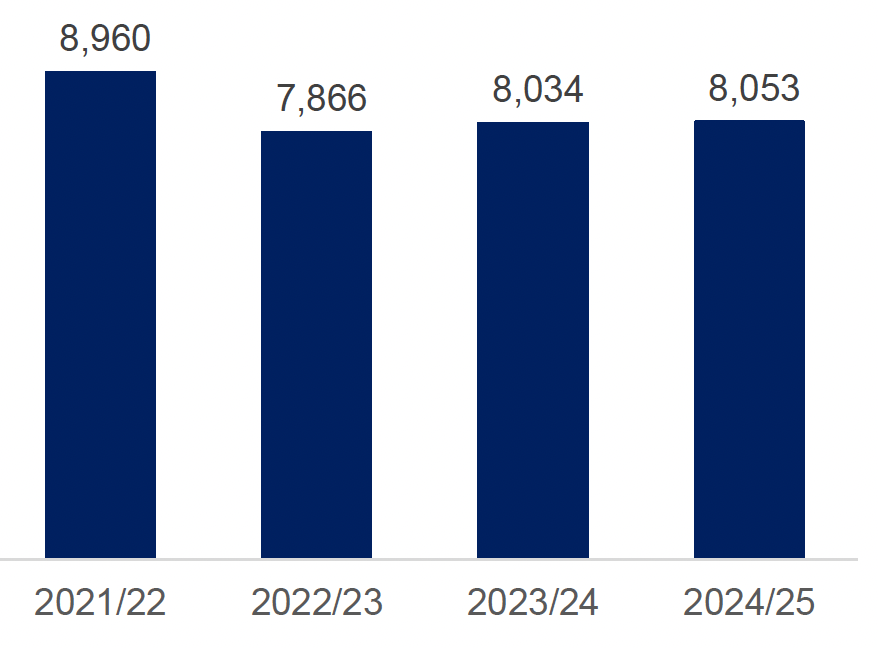
Source: Drug and alcohol information system (DAISy) overview of initial assessments for specialist drug and alcohol treatment 2024/25, Public Health Scotland, January 2026
DAISy is a unique source of data on treatment access but there are data completeness issues. In 2024/25, across all substance types, only 67% of eligible episodes of care had an initial assessment completed and entered into DAISy – this is broadly in line with previous years and work is progressing to improve data completeness levels.
7.3.2 Headline metric: Number of people prescribed Opioid Substitution Therapy
The evidence base for Opioid Substitution Therapy (OST) is well established, and the number of people prescribed OST provides a measure of the level of provision of this form of treatment.[29] OST was prescribed to an estimated minimum of 28,015 people in Scotland in 2024/25. This is 6% (1,802 people) fewer than in 2023/24 (29,817 people) and 7% fewer than in 2020/21 before the National Mission began (30,058 people).[30] There has been some change in the mix of types of OST prescribed, with an increased proportion of people prescribed long-acting injectable buprenorphine (Buvidal) in recent years.[31]
7.3.3 Headline metric: Number of approved statutory funded residential rehabilitation placements
Residential rehabilitation treatment is associated with improvements across a variety of outcomes.[32] The Scottish Government has committed to build capacity and expand residential rehabilitation pathways as part of the National Mission, including a target that by 2026 at least 1,000 people every year would be publicly funded for their residential rehabilitation placement.
There were 913 approved statutory funded placements for residential rehabilitation in 2024/25. This is a decrease of 27 placements (3%) compared with 2023/24 (940 approved placements) but an increase of 329 placements (56%) compared with the first year of the National Mission (2021/22). Consistent with previous years, most statutory funded placements approved in 2024/25 were approved by ADPs (2024/25: 75%), with the remainder made up of National Mission approved places (e.g. Prison to Rehab placements) and Ward 5 Woodland View placements.[33]
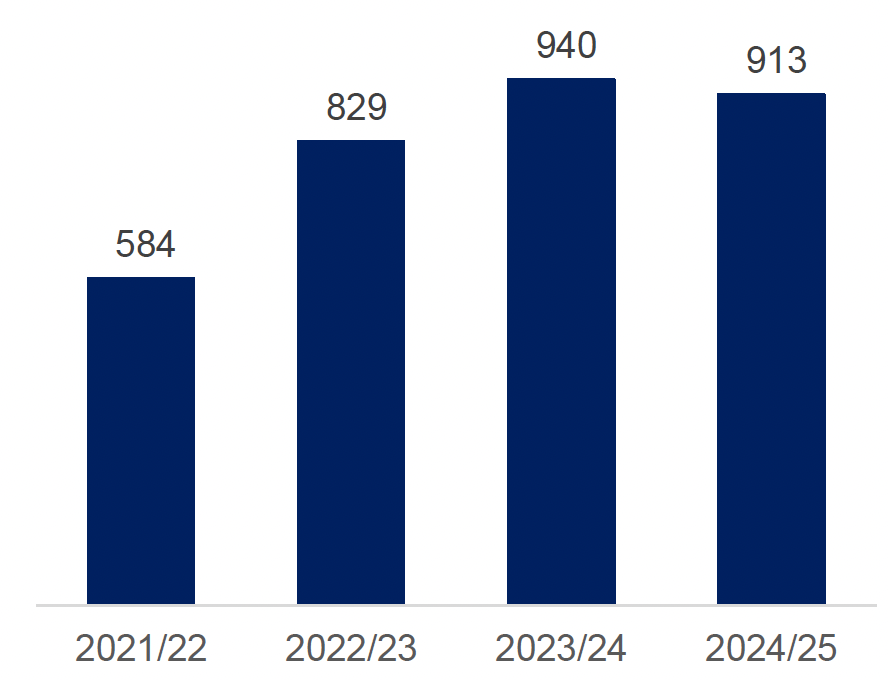
Source: Interim monitoring report on statutory funded residential rehabilitation placements, Public Health Scotland, July 2025
This monitoring metric was developed in 2023 when the PHS approved statutory funded placements data was the only published information available in this area. However, this data has limitations - it only captures placements approved and does not capture instances when a person does not start their placement, nor whether a person’s residential treatment programme is completed as planned.
New data sources now provide further insight into progress. In 2024/25, 993 Scottish residents started a publicly funded residential rehabilitation placement in Scotland. Access to publicly funded residential rehabilitation in Scotland has substantially improved. There has also been a shift towards more Scottish residents and fewer non-Scottish residents accessing residential rehab in Scotland. The number of Scottish residents accessing rehab (publicly or privately funded) is estimated to have increased by around 50% between 2019/20 (immediately before the start of the National Mission) and 2024/25.[34]
The Scottish Government also has a target to increase residential rehabilitation capacity to 650 beds by 2026. As at October 2025, there was a maximum capacity of 574 residential rehabilitation beds in Scotland across 28 facilities. This is an increase of 149 beds (35%) compared to 2021 (425 beds).[35]
7.4 Supporting metrics
7.4.1 Supporting metric: Percentage of ADP areas where (a) MAT standard 1, (b) MAT Standard 2, and (c) MAT Standard 5, have been fully implemented
The MAT standards, published in May 2021, are evidence-based standards designed to enable the consistent delivery of safe, accessible, high-quality MAT treatment. The Scottish Government is working with ADPs to fully implement the MAT standards across all localities.[36]
MAT standard 1 aims to ensure that all accessing services have the option to start MAT from the same day of presentation. In 2024/25 the standard was assessed as fully implemented (green) or sustained (blue), in 86% of ADP areas and partially implemented (provisional green) in 14% of ADP areas.
MAT standard 2 aims to ensure that all people are supported to make an informed choice on what medication to use for MAT, and the appropriate dose. In 2024/25 the standard was assessed as fully implemented (green) or sustained (blue), in 93% of ADP areas and partially implemented (provisional green) in 7% of ADP areas.
MAT standard 5 aims to ensure that all people receive support to remain in treatment for as long as requested. In 2024/25 the standard was assessed as fully implemented (green) or sustained (blue), in 93% of ADP areas and partially implemented (provisional green) in 7% of ADP areas.[37]
These metrics are based on data collected for quality, measuring progress towards national standards rather than outcomes; data are gathered locally using separate systems, with no single national data collection system.
7.4.2 Supporting metric: Percentage of ADP areas where MAT standards 6-10 have been fully implemented
MAT standards 6 to 10 are concerned with the processes of embedding whole-system improvements in the provision of substance use specialist services by ensuring that they are underpinned by psychological and trauma-informed principles. MAT 6 to 10 also cover indicators for the organisation of shared care, for provision of appropriate advocacy and for recognition of dual diagnosis for those with psychological morbidities. These metrics are based on data collected for quality, measuring progress towards national standards rather than outcomes; data are gathered locally using separate systems, with no single national data collection system. In 2024/25, measuring these five MAT standards across the 29 ADP areas, 75% (109 out of 145) were assessed as RAGB fully implemented (green).[38]