
Fair Start Scotland Evaluation Report - Year 6: Phone Survey with Service Participants - March 2026
Research report detailing findings from the fifth Wave of a phone survey undertaken to capture the experiences of Fair Start Scotland (FSS) participants. The report is one element of an evaluation programme of FSS, and focuses on evaluating Year 6 (April 2023-March 2024) of FSS delivery
Chapter Eight: 2021-22 cohort: Outcomes over time
Overall summary
This chapter presents key longitudinal findings from participants who joined FSS between July 2021 and June 2022 and were surveyed at both Wave 4 and Wave 5. It explores how their employment status and motivation to return to work have changed over time. This chapter also provides insight into the sustainability of outcomes achieved through FSS support and highlights the challenges faced by participants, particularly those with health conditions or longer periods of unemployment. On some occasions subgroup base sizes were too low to conduct significance testing – the relevant subgroups are specified throughout the chapter.
We first contacted the 2021-22 cohort (750 individuals) in December 2022 and January 2023 (Wave 4), up to 16 months after they joined the service. We then surveyed a selected sample of 200 individuals from the 2021-22 cohort again between June and July 2025 (Wave 5), around 30 months after they took part in the Wave 4 survey.
On average, a little over three years (40.2 months) had passed between these participants joining the FSS service and taking part in the Wave 5 survey[40]. The length of time between joining the service and completing the Wave 5 survey ranged from 36 months to 45 months, meaning it had been at least 3 years for all participants.
Key findings:
- the long-term outcomes for participants who joined the service in 2021-22 indicate that the majority of those who secured employment by Wave 4 were able to maintain their employment by Wave 5
- the overall proportion in work remained consistent (over two in five) with a similar proportion of participants moving into and out of work between waves
- participants in the 2021-22 cohort were less likely to be working for an employer in a paid role and more likely to report being out of work at the Wave 5 survey compared to the Wave 4 survey, but they were more likely to report being self-employed
- a new question added to the Wave 5 survey showed that most participants (around seven in ten) had been unemployed or inactive at some stage since receiving support from FSS. More than a quarter had a fixed-term or temporary job that ended and just under a quarter left work due to a change in life circumstances. A similar proportion had left work due to health issues
- motivation to return to work among those who were not working at the time of the Wave 5 survey was lower than reported motivation among those not working at Wave 4. However, many still reported in Wave 5 that their motivation had increased from when they first started receiving support from FSS, suggesting some longer-term influence of support
Employment status[41] of the 2021-22 cohort
It is important to note that for participants in the 2021-22 cohort who were in-work at the time of the survey, the survey did not ask how participants obtained these jobs. It is therefore not possible to ascertain based on the findings from the survey, whether those who were in-work at the time the survey took place were placed in those jobs through FSS providers, or obtained the jobs by themselves (including after having left the service). The survey findings allow us to see where former FSS participants were in their employment journey at the time of reporting.
This section will look at the working status of the 2021-22 cohort at the point of the Wave 5 survey, and compare this to their previous answers from the Wave 4 survey. For both Waves these provide a snapshot of participants’ activities when the surveys were conducted and do not represent FSS employment outcomes.
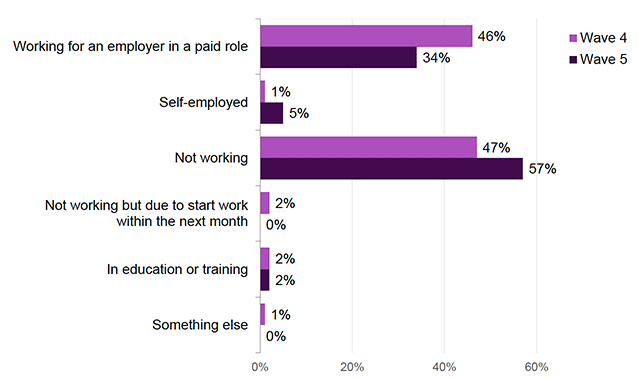
The 2021-22 cohort saw changes in their working status between Waves 4 and 5, as shown in Figure 34 below. Participants were less likely to be working for an employer in a paid role (46 per cent in Wave 4 compared with 34 per cent in Wave 5), and more likely to be out of work at Wave 5 compared to Wave 4 (57 per cent in Wave 5 compared with 47 per cent in Wave 4). This cohort were more likely to report being self-employed at Wave 5 compared to Wave 4 (5 per cent compared to 1 per cent). The proportions of the cohort in education or training remained stable between waves. It should be noted that the working status in Figure 34 is based on what activity participants considered to ‘best describe’ what they were doing at the time of the survey.
Source: IFF Research telephone survey of FSS customers. A1. Which of the following best describes what you are doing at the moment? Base: 2021-22 cohort Wave 4 (200) Wave 5 (200). ‘Not working’ combines: ‘Not working and claiming an out-of-work benefit’ and ‘Not working and not claiming an out-of-work benefit’ at Wave 3, and the following at Wave 4: ‘Unemployed and looking for work’, ‘Not in employment because of sickness or disability’, ‘Looking after the home or family full-time’, ‘Caring for an adult relative or friend with a disability or long-term illness’, ‘Working in a voluntary or other unpaid role’, ‘Retired and/or claiming a pension’
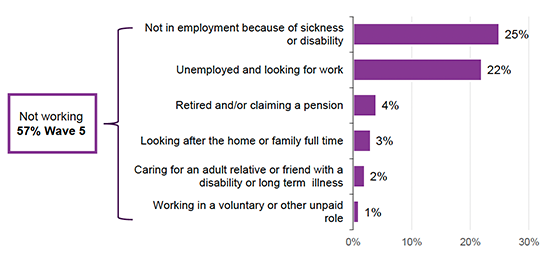
As shown in Figure 35 below, participants who were not working tended to be either not in employment because of sickness or disability (25 per cent) or unemployed and looking for work (22 per cent).
Source: IFF Research telephone survey of FSS customers. A1. Which of the following best describes what you are doing at the moment? Base: 2021-22 cohort Wave 5 (200)
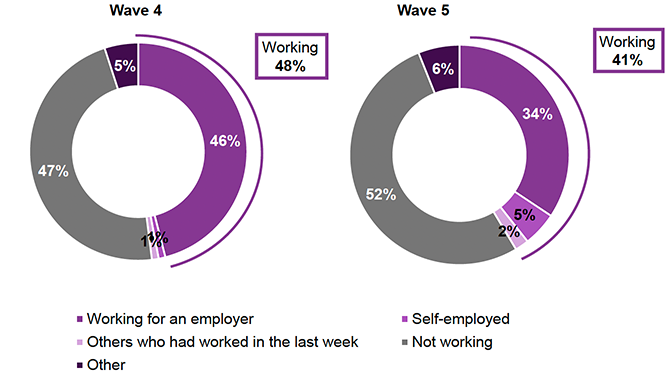
Participants who selected an option other than working for an employer or self-employed, were asked if they had done any paid work in the last week, to capture those who might work part-time or ad-hoc hours. As shown in Figure 36 below, by combining this with those working for an employer and in self-employment, a total of 41 per cent of participants had worked in the week prior to the survey at Wave 5, similar to Wave 4 (48 per cent).
Source: IFF Research telephone survey of FSS customers. A1. Which of the following best describes what you are doing at the moment? Base: 2021-22 cohort Wave 4 (200) Wave 5 (200). A1a. Did you do any paid work in the seven days prior to the interview? Base: 2021-22 cohort Wave 4 (110) Wave 5 (120)
Of those participants who were in work, 66% were working less than 16 hours per week and 34% were working 16 or more hours per week.
At Wave 5, the following groups were more likely to be in work:
- participants aged under 35 (39 per cent) compared to those aged 50 and over (23 per cent)
- participants without health conditions (53 per cent) compared to those whose health conditions limited their daily activity a little or a lot (24 per cent)
- participants with degree level education or above (52 per cent) and those with Highers, Advanced Highers or equivalent qualification (44 per cent) compared to those with a National SCQF 1-5 or equivalent qualification (19 per cent)
- parents (53 per cent) compared to those who were not parents (30 per cent)
There were no significant differences between male and female participants, between participants belonging to a priority family and those who don’t, between early leavers and non-early leavers, re-joiners and non re-joiners, and those living in a deprived or non-deprived area.
Subgroup sizes were not large enough to make comparisons between white and ethnic minority participants or between those living in a rural or urban area.
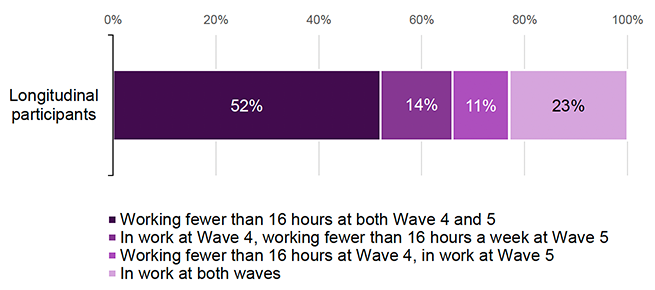
The 2021-22 cohort were asked about their employment situation at Wave 4 and Wave 5, meaning we can look at the overall movement of working status for these participants between waves, as shown in Figure 37 below. Almost a quarter (23 per cent) of participants were classed as ‘in work’ at both waves (working 16 or more hours in both waves), whilst one in ten (11 per cent) moved from working fewer than 16 hours at Wave 4 (including those not working at all) to ‘in work’ at Wave 5. Just over one in ten (14 per cent) were ‘in work’ at Wave 4, but had transitioned to working fewer than 16 hours a week (or not working at all) by Wave 5. Over half (52 per cent) of participants worked fewer than 16 hours per week (which includes those not working at all) at both waves.
Source: IFF Research telephone survey of FSS customers. Combination of A1_W3/W4. Which of the following best describes what you are doing at the moment? And A3_W3/W4. How many hours per week do you usually work, or spend in education? Base: 2021-22 cohort (200)
There were some differences in change in working status for some subgroups of participants, as follows:
- those aged 50 and above were less likely than those aged under 35 to have been in work at both waves (13 per cent compared to 29 per cent)
- those with a National SCQF 1-5 or equivalent qualification were more likely than those with a Highers/Advanced Highers or equivalent qualification (39 per cent) and those with a Degree or above (36 per cent) to have been out of work at both waves (63 per cent)
- participants whose health conditions affected their day-to-day activities were significantly more likely to have been out of work at both waves than those without a health condition (62 per cent compared to 39 per cent), and those without a health condition were more likely to have been in employment at both waves than those with a limiting health condition (33 per cent compared to 18 per cent)
- parents were less likely to have been out of work at both waves (35 per cent compared to 56 per cent among those without children)
- re-joiners were more likely than non re-joiners to have been out of work at both waves (75 per cent compared to 47 per cent)
Comparisons could not be made for ethnicity and those living in a rural or urban area due to low sample sizes.
In Wave 5, the 2021-22 cohort who were in work were asked whether they had had any breaks in employment since they completed the previous survey in Wave 4. The majority (61 per cent) reported that they had not had any breaks in employment since then, with just under two in five (39 per cent) reporting they had. Sample sizes were too low to explore differences between subgroups.
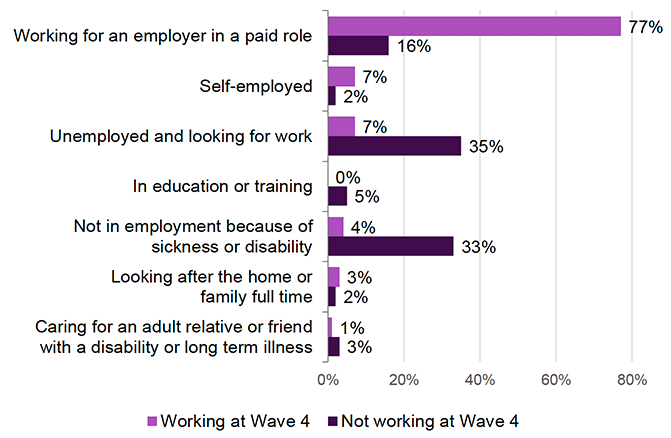
The 2021-22 cohort were asked what they had mostly been doing since they were surveyed previously, as shown in Figure 38 below. Of those who were working at Wave 4, the vast majority (84 per cent) remained so at Wave 5, with 77 per cent working for an employer, and 7 per cent self-employed. Fourteen per cent were not in work, with 7 per cent unemployed and looking for work, and 4 per cent not in work due to sickness or disability.
Of participants who were not working at Wave 4, around three-quarters (78 per cent) remained out of work, with 35 per cent unemployed and looking for work, 5 per cent in education or training, 33 per cent not in employment because of sickness or disability, 2 per cent looking after the home or family full-time, and 3 per cent caring for an adult friend or relative. However, almost one in five (18 per cent) had moved into work, with 16 per cent now working for an employer, and 2 per cent in self-employment.
Source: IFF Research telephone survey of FSS customers. B1aX_W4 Which of the following best describes what you have been doing since the last survey? Base: Pre-employment at Wave 4 (127), In employment at Wave 4 (73). Note: answer options under 3 per cent for both groups not shown
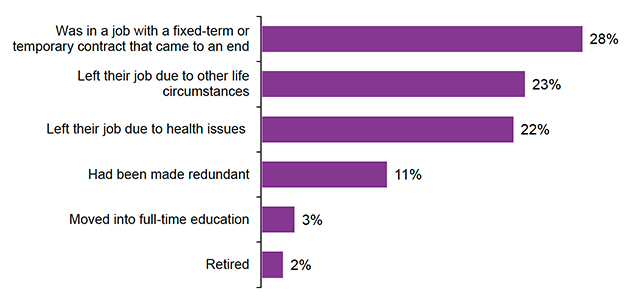
In Wave 5, participants in the 2021-22 cohort were asked if they had had any breaks in employment since receiving support. Combined with their current employment status, this enabled the identification of participants who had been unemployed or inactive at some point since starting FSS[42]. These made up 72 per cent of the 2021-22 cohort at Wave 5. Those who had been unemployed or inactive at some point were asked whether they had experienced specific developments in their work since receiving support.
As shown in Figure 39 below, almost three in ten (28 per cent) reported that they were in a job with a fixed-term or temporary contract which came to an end. Just over one in five (23 per cent) said that they had left their job due to a change in life circumstances, while a similar proportion (22 per cent) said they had left their job due to health issues. Around one in ten (11 per cent) had been made redundant. A small proportion had moved into full-time education (3 per cent), or had retired since starting FSS (2 per cent).
Source: IFF Research telephone survey of FSS customers. F1f_W5 Thinking about any developments in your work situation since receiving support from Fair Start Scotland, do any of the following apply? Base: All who had been unemployed or inactive at some stage since receiving support from FSS (147) (redundant, fixed-term job, left job due to health conditions (144)) (moved into full-time education (142)) (retired (139))
Male participants aged 25-49 were more likely to report that they had left their job due to a change in life circumstances than male participants aged 50 and over (28 per cent compared to 8 per cent).
There were no differences between the following subgroups: gender, age, health conditions and level of deprivation. Sample sizes were too low to explore differences between subgroups.
Outcomes and motivation to return to work
This section explores 2021-22 cohort participants’ motivation to return to work and any impact that FSS has had on their motivation. Findings in this section focus on outcomes for the 2021-22 cohort and how they have changed between Wave 4 and Wave 5.
Views on returning to work
Participants who were not in work for more than 16 hours per week (65 per cent of the 2021-22 cohort) were asked about their motivation to return to work. The questions were phrased as either ‘returning to work’ or ‘returning to full-time work’ depending on whether they were not working at all or working less than 16 hours[43]. The proportion of participants stating they wanted to return to work or full-time work ‘to a great extent’ decreased between Wave 4 and Wave 5, from 67 per cent to 47 per cent. More participants stated they did not want to return to work ‘at all’ at Wave 5 (19 per cent) compared to Wave 4 (1 per cent).
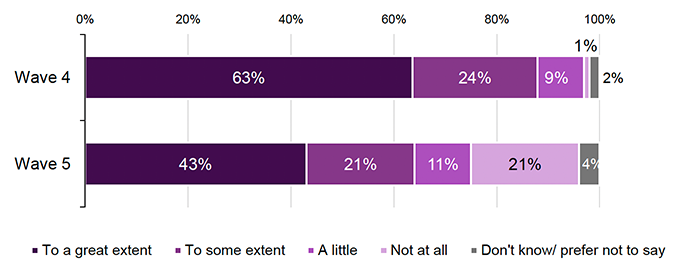
Looking specifically at participants who were not in employment at both waves, the proportion who felt motivated to return to work ‘to a great extent’ decreased in Wave 5 from 63 per cent to 43 per cent, as shown in Figure 40 below. The proportion of participants who answered ‘not at all’ increased from 1 per cent to 21 per cent (this was also the case for the 2020 cohort when comparing between waves, suggesting this could be due to the length of time between receiving FSS and the longitudinal survey). Three in five of those not in employment at both waves (60 per cent) reported that their health limited their day-to-day activities.
Source: IFF Research telephone survey of FSS customers, E2_W4/W5. To what extent would you like to return to (full-time) work in the future? Base: All who work fewer than 16 hours per week at both waves (96)
In terms of differences by subgroup, participants aged 50 and above were less likely to want to return to work ‘to a great extent’ (25 per cent compared to 61 per cent for those aged 35 to 49).
Impact of Fair Start Scotland on motivation
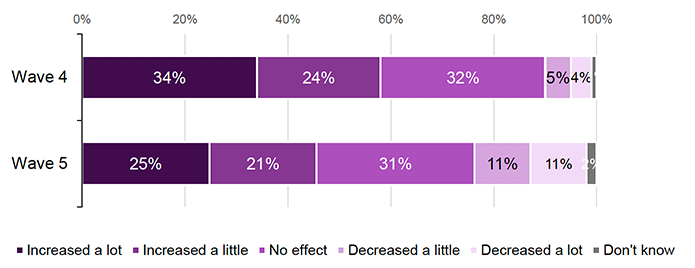
As shown in Figure 41 below, at Wave 5 just under half of the 2021–22 cohort (46 per cent) reported that their motivation had increased since they first started receiving support from FSS. This is lower than in Wave 4, where 58 per cent said their motivation had increased. Around one in ten (11 per cent) said in Wave 5 that their motivation had decreased a lot since they first started receiving support, higher than in Wave 4 (4%).
Source: IFF Research telephone survey of FSS customers, E8_W4/W5. To what extent would you say your motivation to find (full-time) work has increased or decreased from when you began receiving support from the Fair Start Scotland service? Base: All who work fewer than 16 hours per week. Wave 4 (114) Wave 5 (130)
Sample sizes were too low to make comparisons within subgroups for level of education, ethnicity, priority family, early leavers, parents, re-joiners, and urban or rural.