
Fair Start Scotland Evaluation Report - Year 6: Phone Survey with Service Participants - March 2026
Research report detailing findings from the fifth Wave of a phone survey undertaken to capture the experiences of Fair Start Scotland (FSS) participants. The report is one element of an evaluation programme of FSS, and focuses on evaluating Year 6 (April 2023-March 2024) of FSS delivery
Chapter Four: Health of Participants
Overall summary
This chapter explores the health status of Fair Start Scotland (FSS) participants in the 2023-24 cohort, and examines how physical and mental health conditions influenced their experiences and outcomes. It provides a detailed breakdown of the types of health conditions reported, their impact on daily activities, and how these factors relate to employment status and long-term unemployment.
Key findings:
- almost half of participants reported having a long-term health condition(s)
- nearly three-quarters of those who reported a health condition reported that it limited their ability to carry out day-to-day activities
- mental health was the most commonly reported health condition. White participants, particularly white females were more likely to report mental health conditions than any other demographic group
- participants who were not in work were more likely to report health conditions, long-term illness, and physical disabilities than those in employment
- younger participants (16-24) were more likely to report developmental disorders or neurodivergence than older particiapants. Older participants (aged 50 or above) were more likely to report hearing-related conditions, physical disabilties and long-term illnesses compared to younger participants
- whilst the proportion of participants reporting significant limitations in daily activities due to health conditions was similar to the 2021-22 cohort, overall reporting of health conditions was lower in this Wave, partly because a higher number of participants preferred not to share this information
Health conditions
Almost half of participants (48 per cent) reported at least one long-term health condition. As shown in Figure 7 below, over one-fifth (22 per cent) reported one health condition and 27% per cent reported multiple conditions.
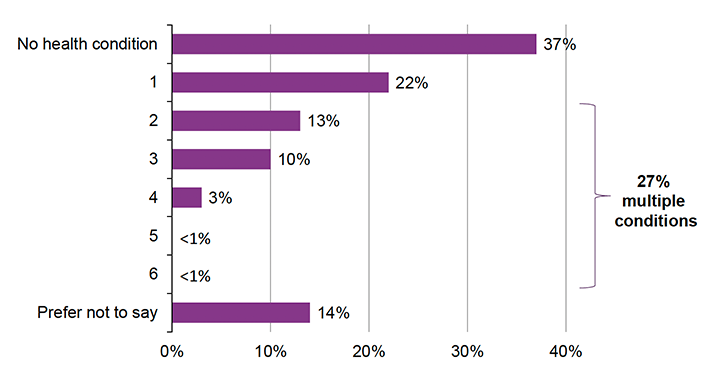
Source: IFF Research telephone survey of FSS customers, Sample information. H4l: Do you have any of the following conditions which have lasted, or are expected to last, at least 12 months? Base: 2023-24 cohort (469)
As shown in Figure 8 below, the most common condition reported among the 2023-24 cohort was a mental health condition, reported by 28 per cent of participants. Long-term illnesses were the second most common with just under one-fifth of participants reporting this (18 per cent), followed by a physical disability (16 per cent) or a learning difficulty (12 per cent).
Participants who reported multiple conditions were also asked which was their main health condition. As shown in Figure 8, mental health conditions (17 per cent) and physical disabilties (8 per cent) were the most commonly reported main condition. This was followed by long-term illness, disease or condition (7 per cent), learning difficulties (5 per cent) and developmental disorders (5 per cent).
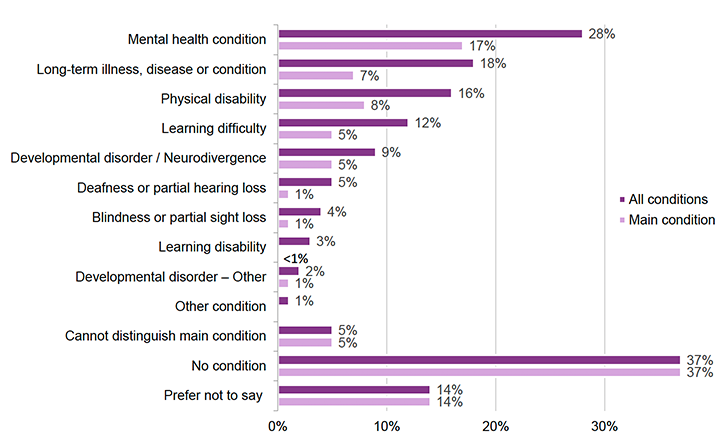
Source: IFF Research telephone survey of FSS customers, Sample information combined with H4l: Do you have any of the following conditions which have lasted, or are expected to last, at least 12 months? H4m: And which of those would you consider to be your main health condition or disability? Base: 2023-24 cohort (469)
There were some differences by demographic groups, as follows:
- male participants were six times more likely than female participants to report deafness or partial hearing loss (6 per cent compared to 1 per cent)
- younger participants aged 16 to 24 were more likely to report developmental disorders or neurodivergence than those 25 or over (21 per cent compared to 6 per cent). Older participants aged 50 or above were more likely than those under 35 and those aged 25 to 49 to report conditions related to hearing (11 per cent compared to 4 per cent and 3 per cent), or physical disabilities (28 per cent compared to 8 per cent and 16 per cent), or long-term illness (30 per cent compared to 13 per cent and 16 per cent)
- participants with a white ethnic background were more likely than those from an ethnic minority background to report mental health conditions (38 per cent compared to 17 per cent), physical disabilities (21 per cent compared to 14 per cent) and learning difficulties (18 per cent compared to 1 per cent)
- white female participants were more likely to report a mental health condition (47 per cent), compared to 34 per cent of white male participants, 14 per cent of male participants from an ethnic minority and 22 per cent of female participants from an ethnic minority
- participants who were not working at the time of the survey were more likely than those who were working to report a number of conditions including mental health conditions (34 per cent compared to 22 per cent), long-term illness (26 per cent compared to 14 per cent) and physical disabilities (21 per cent compared to 12 per cent)
- parents were more likely than those who were not parents to report having no health conditions (57 per cent compared to 38 per cent)
There were no other notable differences between demographic groups regarding the health conditions or disabilities reported by participants.
Impact of health conditions
To gauge the impact that health conditions had on FSS participants, all who had a health condition or disability were asked about the extent to which it limited their ability to carry out day‑to‑day activities, either whether they were not limited at all by it, limited a little, or limited a lot. Figure 9 below shows the distribution of responses for the 2023–24 cohort. Nearly two-fifths of all participants (36 per cent) said they were impacted by a health condition either a little or a lot.
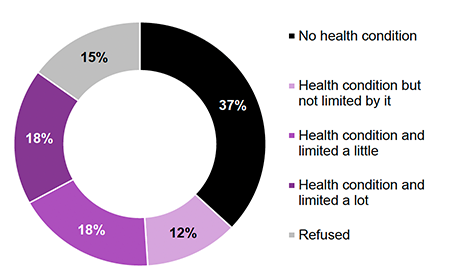
Source: IFF Research telephone survey of FSS customers, H4n_ALL Does your health or disability limit your ability to carry out day-to-day activities? Base: 2023-24 cohort (469)
Participants who were more likely to report a health condition which limited their activites were:
- participants from a white ethnic background (49 per cent compared to 21 per cent of those from an ethnic minority background)
- those who were not working (48 per cent compared to 25 per cent of those working)
- early leavers (45 per cent compared to 34 per cent of those who had not left FSS early)
Focusing on only those who reported a health condition or disability, Figure 10 below shows that nearly three-quarters (73 per cent) of participants were limited in their ability to carry out day-to-day activities. Almost two-fifths (37 per cent) of those who reported a health condition were limited ‘a little’ and a similar proportion (36 per cent) said ‘a lot’. Less than a quarter (24 per cent) reported a health condition that did not limit their activities.
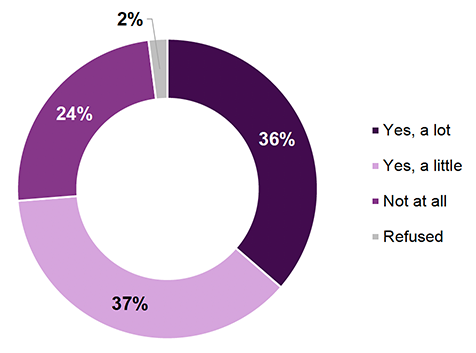
Source: IFF Research telephone survey of FSS customers, H4n_W5. Does your health or disability limit your ability to carry out day-to-day activities? Base: 2023-24 cohort with health condition who agree to give data (221)
Differences in health of participants in 2023-24 cohort, comparisons between cohorts
Overall the proportion of participants in the 2023-24 cohort reporting long-term health conditions was lower than previous cohorts (48 per cent, in comparison to 62 per cent for the 2021-22 cohort and 57 per cent for the 2020 cohort). However, it should be noted that more participants refused to share whether they had any health conditions (14 per cent compared to 4 per cent for the 2021-22 cohort), which affects the comparability of these figures. The 2023-24 cohort was equally as likely to report multiple health conditions as the 2020 cohort (27 per cent), which was lower than the 2021-22 cohort (34 per cent).
Overall, the 2023-24 cohort was less likely to report that they had a health condition that impacted their daily lives than previous cohorts (36 per cent, compared to 48 per cent for the 2021-22 cohort). Again, more participants among the 2023-24 cohort refused to answer this question (15 per cent compared to 5 per cent). However, those with health conditions were equally likely as those in the previous cohort to report that their condition limited their ability to carry out day-to-day activities a lot (36 per cent for the 2023-24 cohort and 35 per cent in the 2021-22 cohort). This was higher than the rate for previous cohorts (25 per cent in the 2020 cohort, 27 per cent in the 2019 cohort and 29 per cent in the 2018 cohort).