
Fair Start Scotland Evaluation Report - Year 6: Phone Survey with Service Participants - March 2026
Research report detailing findings from the fifth Wave of a phone survey undertaken to capture the experiences of Fair Start Scotland (FSS) participants. The report is one element of an evaluation programme of FSS, and focuses on evaluating Year 6 (April 2023-March 2024) of FSS delivery
Summary
This report presents detailed findings from the fifth Wave of a phone survey conducted to capture the experiences of Fair Start Scotland (FSS) participants. The phone survey is one element of an evaluation programme of FSS, and focuses on evaluating Year 6 (April 2023 – March 2024) of FSS delivery.
Background
Fair Start Scotland is a devolved voluntary employability service responsible for providing personalised employment support for disabled people and those at risk of long-term unemployment throughout Scotland. The service launched in April 2018, initially for three years, and then with an extension for a further three years to accept referrals until 31st of March 2024.
As of April 2024 FSS no longer accepts new referrals, however the service has continued to deliver support to those who had already started. Evaluation of the service has been conducted throughout its lifetime[1], in order to understand the impact that FSS has had on participants in terms of their experiences and outcomes, and to contribute to continuous improvement of the service. The following report forms part of the evaluation of the service extension phase, in which findings will contribute to the continuous improvement of employability services in Scotland, currently delivered under the No One Left Behind approach.
Methodology
Between 2018 and 2025 there have been five survey “waves” with FSS participants. FSS participants who took part in this phone survey research are referred to according to the calendar year (cohort) they joined FSS, as follows:
- 2018 cohort (participants first interviewed in June 2019 as part of Wave 1 survey)
- 2019 cohort (participants first interviewed in May 2020 as part of Wave 2 survey)
- 2020 cohort (participants first interviewed in May 2021 as part of Wave 3 survey)
- 2021-22 cohort (participants first interviewed in December 2022-January 2023 as part of Wave 4 survey)
- 2023-24 cohort (participants first interviewed in June-July 2025) as part of Wave 5 survey)
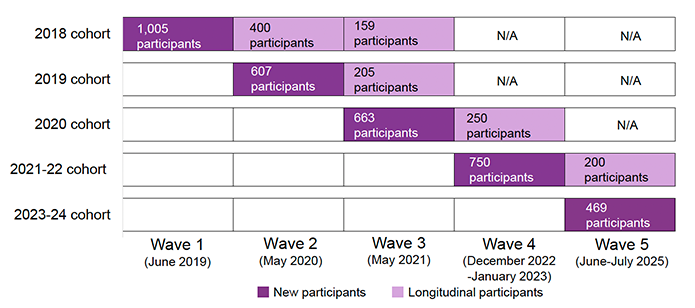
Figure 1 below further details the number of participants surveyed over the five survey waves, and when the survey was undertaken at each Wave.
From the Wave 2 survey onwards the survey had a longitudinal element, meaning that a proportion of the earlier cohort participants were recontacted in the subsequent wave(s) (“longitudinal participants” in Figure 1).
This final iteration of the survey (Wave 5) was carried out between June and July 2025 and was completed by a sample of 669 FSS participants, 200 of whom had been interviewed previously (at Wave 4). Out of the 669 participants surveyed, 469 had joined FSS between October 2023 and March 2024, and 200 had joined FSS between July 2021 and June 2022.
To analyse results from the phone survey, differences (where comparable) between cohorts/waves and participant subgroups were tested for statistical significance. Only significant differences are reported.
In the report, comparisons are made between the current 2023-24 cohort and past cohorts (i.e. the 2018, 2019, 2020 and 2021-22 cohorts) where relevant and methodologically reliable.
Outcomes over time are explored and compared between the longitudinal participants of the Wave 4 survey (2021-22 cohort) and the Wave 5 participants (2023-24 cohort).
Participant subgroups include the following:
- gender
- age
- age by gender
- ethnicity
- participants who had a health condition
- gender by presence of a health condition
- education level
- whether participants are in a priority family group (families with a higher-than-average risk of child poverty)
- whether participants are parents
- the stage of support participants were at (pre-employment or in-work support)
- participants who were early leavers from the service
- participants who were re-joiners to the service
- those living in a deprived area
- those living in an urban or rural area, and
- participants’ employment status/activity before participating in FSS, and at the time of the interview
Some of the participants interviewed had participated in the FSS service more than once (referred to as “re-joiners”). The experiences of re-joiners were compared against those of non re-joiners to identify any differences[2].
Early leavers[3] are included as a key subgroup in this analysis. According to the Fair Start Scotland Statistical Summary, the early leaver rate for those joining the service from April 2018 to September 2024 is 49 per cent, meaning this group is underrepresented in the current research sample. This underrepresentation may be linked to difficulties in engaging early leavers for follow-up surveys. However, the number of early leavers surveyed (105 participants) is sufficient to allow meaningful comparisons against other FSS participants.
With the aim of assessing longitudinal outcomes, 200 of the 2021-22 cohort interviewed at Wave 4 were interviewed for a second time at Wave 5. In order to address the risk of non-response bias, weighting was applied to longitudinal data on geographical Lot, gender and age based on the population proportions of 2021-22 FSS starters, and on employment status based on the employment status of the 2021-22 cohort at Wave 4[4].
Demographic data was collected as part of the phone survey to ensure the sample is broadly representative of all FSS participants. A table detailing key demographics of the survey sample can be found in the Technical Appendix.
Detailed statistics, including demographics data, for FSS were published by the Scottish Government quarterly[5].
Overview of results
Overall, findings show that in Year 6 of its delivery, the FSS service had continued to broadly deliver positive results for participants (the 2023-24 cohort). The key findings are summarised below.
Profile of participants in the evaluation
The profile of participants across several characteristics of interest is detailed below[6]:
- around two-thirds of the 2023-24 cohort surveyed were male and around a third were female
- just over half of participants were aged 35 or older, with just under half being younger
- a notable portion of participants held degree-level qualifications, while a minority (less than one in ten) had no formal qualifications. Younger participants were more likely to be qualified to the Scottish Credit and Qualification Framework (SCQF) Level 1 to 5, whilst older participants were more likely to hold no qualifications
- the majority of participants identified as white, with some representation from minority ethnic backgrounds
- just under two-fifths of participants had a health condition which limits their day-to-day activities, a similar proportion had no health condition, and just over one in ten had a health condition but no limitations
- around one in five participants were parents, and most of these belonged to priority family groups, most commonly lone parents or parents with a disability or health condition
- a third of participants had previously engaged with the service, and over half of these had accessed support multiple times. Some groups were more likely to be re-joiners such as participants aged 25 and over
Service experience and changes over time
Key findings relating to the experiences of FSS participants (2023-24 cohort) and changes over time are:
- overall satisfaction with the service was high, with nine in ten participants reporting they felt treated with dignity and respect
- both pre-employment support and in-work support were considered highly useful by those who took it up, with at least three in five participants finding the support useful
- types of pre-employment and in-work support which were considered particularly useful were help with job search activities and applications, support with an In-work Support Action Plan, financial guidance and specialist support for a physical health condition
- pre-employment support remained broadly consistent among the 2023-24 cohort compared to previous cohorts
- participants most often reported being offered one-to-one appointments, a dedicated key worker or employability advisor, help with job search activities and applications and an Employment Action Plan. These were also the types of support which participants reported receiving the most
- in-work support remained similar to the 2021-22 cohort, participants were most likely to be offered and take up support from a dedicated key worker, followed by one-to-one appointments with regular support and contact
- around two-fifths of participants reported meeting with their key worker about once a week, and a quarter reported meeting them once a fortnight according to their needs
- over three in five participants who were employed, self-employed, or had worked in the last week at the time of the survey felt FSS had helped them to get their job
- awareness that the service was voluntary was widespread, though some participants were unclear or believed it was mandatory
- perceptions of the service were less positive among
- those who had not worked in the last 5 years (compared to those who had worked in the last 5 years) for example, they were less likely to agree that the service offered support to improve their general quality of life and wellbeing
- those who lived in areas classified among the 15 per cent most deprived (compared to those in areas classified among the 85 per cent least deprived) for example, they were less likely to agree that the support took account of their indivdiual needs and circumstances
- participants with limiting health conditions (compared to those with no health conditions) were also less likely to agree that the support took account of their indivdiual needs and circumstances
- early leavers were less likely to say they left the service because they found work compared to those who completed the service, and more likely to say they left due to domestic or personal reasons, or because the service was not relevant to their needs
The research found some differences in reported experiences between cohorts, as follows:
- take up of in-work support was lower within the 2023-24 cohort compared to the 2021-22 cohort, and was closer to levels seen among the 2020 cohort
- some perceptions were less positive when compared to the 2021-22 cohort for example, the extent to which participants felt the service offered support to improve their general quality of life and wellbeing, and that the support took account of their individual needs and circumstances
- while the majority of participants found having a dedicated key worker useful in both 2023-24 and 2021-22, this had reduced slightly in 2023-24
Working status and quality of work
It should be noted that for those who were in work at the time of the survey, the survey did not ask how participants obtained these jobs. It is therefore not possible to say based on the findings from the survey, whether those who were in work found their job as a direct result of FSS support or obtained their job independently (including after having left the service).
Key findings relating to the working status and quality of work of FSS participants are:
- almost two-thirds of participants were unemployed and looking for work before receiving support, and a quarter had been out of work for five or more years prior to FSS
- two-fifths of participants were in paid employment at the time of the survey (not including those who were self-employed)
- male participants were more likely than female participants to be unemployed and looking for work
- participants who had achieved a degree or higher were more likely than those with no qualification to be in paid employment
- those who had left FSS early were less likely to be in paid employment than those who had not left early
- over three-fifths of participants who were in work or in education were working or studying 30 or more hours per week
- participants who were actively searching for work before they started receiving support were more likely than those who were economically inactive to be working or studying 30 or more hours per week
- those without a health condition were more likely than those with a health condition that limits their day-to-day activities to report working or studying 30 or more hours per week
- most commonly, participants in work were working in elementary occupations (low-skilled or manual jobs) followed by caring, leisure and other service occupations
- the large majority of working participants reported earnings that suggested they earned at least the National Living Wage, with a substantial proportion (just over two in five of those aged 21 and over) who reported earnings that suggested they earned the Real Living Wage[7]
- among the small number of participants who reported earnings that suggested they earned under the National Living Wage, some were self-employed, in education or training, or on temporary or zero-hours contracts
- only a small proportion of participants in work reported being under the age of 21. Of these, over nine in ten reported earnings that suggested they earned at least the National Minimum Wage
- most employed participants had permanent contracts, a small proportion were on temporary or zero-hours contracts, or were self-employed
- minority ethnic participants were more likely than white participants, to be employed on a temporary contract
Outcomes and motivation to return to work
Key findings relating to participant outcomes and motivation to return to work are:
- most participants who were not working or working less than 16 hours per week expressed a strong desire to return to work/full-time work. Over half reported increased motivation to find work since receiving support from Fair Start Scotland
- participants with limiting health conditions were less likely to report increased motivation to return to work compared to those with non-limiting conditions
- early leavers were also less likely to report increased motivation to return to work compared to those who completed FSS support
- help with Curriculum Vitae’s (CVs) and application forms was the most commonly cited support that made a difference to participants
- the majority of participants felt their job search skills had improved, and that FSS had a positive impact on their wellbeing
- there were some early indications that the 2023-24 cohort were moving towards higher quality employment since taking part in FSS
- over half of those in work had accessed training or development opportunities, and many had received a pay increase since joining FSS[8]
- a notable share had taken on additional responsibilities or moved to a job that better suited them
- early leavers who were in work were less likely to report positive progression outcomes, including pay increases and access to training
- participants with limiting health conditions who were in work were less likely to report having received training opportunities
- participants in work reported being highly satisfied with their job, but were less likely to feel that their job reflected their career aspirations, or provided them with enough income
Long-term outcomes for the 2021-22 cohort
The 2021-22 cohort (750 individuals) were first contacted in December 2022 and January 2023 (Wave 4), up to 16 months after they joined the service. We then surveyed a selected sample of 200 individuals from the 2021-22 cohort again between June and July 2025 (Wave 5), around 30 months after they took part in the Wave 4 survey. There was a longer length of time between the Wave 4 and the Wave 5 survey than for previous waves of longitudinal research. This needs to be taken into consideration when comparing longitudinal outcomes to previous waves of research. A discussion of the limitations on analysis is set out in Chapter 2 Methodology.
Below is a summary of the key findings from the longitudinal data for the 200 individuals who took part in both Wave 4 and Wave 5 surveys:
- participants in the 2021-22 cohort were less likely to be working for an employer in a paid role[9], and more likely to report being out of work at the Wave 5 survey compared to the Wave 4 survey, but they were more likely to report being self-employed
- the long-term outcomes for participants who joined the service in 2021-22 indicate that the majority of those who were in work at Wave 4 were able to maintain their employment by Wave 5
- the overall proportion in work remained consistent (over two in five). This was due to a similar proportion of participants moving into and out of work between waves
- a new question added to the Wave 5 survey revealed that the majority of participants within the 2021-22 cohort (around seven in ten) had been unemployed, or inactive at some stage since receiving support from FSS. More than a quarter had a fixed-term or temporary job that ended, and just under a quarter left work due to a change in life circumstances. A similar proportion had left work due to health issues
- motivation to return to work among those who were not working at the time of the Wave 5 survey was lower than reported motivation among those not working at Wave 4. However, many still reported in Wave 5 that their motivation had increased from when they first started receiving support from FSS, suggesting some longer-term influence of support