
Environment, Natural Resources and Agriculture Research: Strategy 2027 to 2032
The Environment, Natural Resources and Agriculture (ENRA) Research Programme is our major science research funding programme. This strategy outlines our vision, priorities and mechanisms for the next cycle of multidisciplinary research covering the period 2027-2032.
5.0 Delivering Our Investment
To deliver the research priorities set out in this Strategy, the programme will use our main key funding mechanisms:
1. Strategic Research Programme (SRP)
- Longer-term (three to five years) research which provides evidence relevant to Scottish Government ARIs.
- We will continue to use the MRPs to deliver the strategic research programme and will allocate resources accordingly.
- Processes that ensure flexibility and the ability to rapidly commission new, emerging areas of research need in the delivery of the strategic research will be maintained and developed.
An example impact case study from work supported by the ENRA Strategic Research Programme is provided below.
Strategic Research Programme
Emerging Water Futures: Understanding the Vulnerabilities of Scotland’s Water Resources to Drought
This research, led by James Hutton Institute with support from BioSS underpinning national capacity funding, addresses Scottish Government’s research question on Water scarcity and drought: what are the risks and vulnerabilities within Scotland, and how do we build resilience?
The project built an ambitious work programme, bringing together multiple research and funding streams, including RESAS Strategic Research Program, Hydro Nation Chair Programme and CREW. In collaboration with SEPA and Biomathematics and Statistics Scotland, the project quantitatively evaluated the national Drought Risk Assessment Tool (DRAT) statistical criteria for determining the onset and recovery from severe hydrological drought.
This helped to build confidence in the SEPA decision-making approach, outlined in the Scotland National Water Scarcity Plan. The analysis of a new data set of daily reported water abstractions collated by SEPA and Scottish Water highlighted the dominance of drinking water abstractions within consumptive water use in Scotland. In collaboration with the University of Aberdeen, the analysis found doubling of hydrological drought frequency and increased drought duration by 2050, mainly driven by climate change, rather than changes in abstraction demand. These findings and ongoing work directly contribute to water resources decision-making.
2. Underpinning National Capacity Programme (UNC)
- The Underpinning National Capacity programme will continue to fund the maintenance of national collections of crops (such as potatoes, barley and soft fruit) along with pest and pathogen collections.
- New services will be expected to support the outcome-focused approach discussed above, including data and modelling capabilities and encouragement of utilisation of living labs.
An example impact case study of work supported through the ENRA UNC Programme is shown below.
Underpinning National Capacity – The Commonwealth Potato Collection
The James Hutton Institute is the custodian of the Commonwealth Potato Collection (CPC), an internationally significant potato germplasm resource comprising over 1,500 accessions derived from approximately 80 wild and cultivated Solanum species.
The Commonwealth Potato Collection (CPC) underpins modern potato improvement by providing genetic diversity for disease resistance, stress tolerance, and nutritional enhancement.
The CPC represents a critical reservoir of genetic variation that has been utilised for many decades to improve cultivated potato. Examples include the H1 gene from S. andigena clone CPC1673 that has delivered durable potato cyst nematode (PCN) resistance in more than half of UK cultivars, while RenSeq-enabled breeding has accelerated the development of resilient varieties such as Carousel with novel late blight resistance. Genomic tools like RenSeq have shortened breeding cycles from 10-12 to around 7 years, establishing a sustainable, innovation-driven pipeline.
Beyond resistance, CPC accessions are now contributing traits for heat tolerance, offering an additional source of climate-resilient traits for future potato improvement. enhanced protein and nutritional content, and improved cooking quality.
3. Responsive Research Fund
- This flexible programme will deliver Scottish Government priority-led responsive projects. Medium-term research responding to new, unforeseen policy needs and issues which emerge throughout the duration of the programme.
- The ability to deliver projects in collaboration with other UK/international funders or industry stakeholders to maximise the value and impact of our investment.
4. Centres of Expertise
- Centres of Expertise work at the interface between policy and research. They provide responsive work in areas of high policy importance: climate change, animal disease outbreaks, plant health, and water, drawing upon expertise from a range of different institutions and linking to policy teams.
- As part of the development of the 2027-2032 programme cycle, we will review the scope of subjects covered by the Centres of Expertise to ensure our investment delivers maximum impact.
- The Centres of Expertise will contribute to ENRA’s overall objectives by addressing the needs of the Missions, but likely will cut across Missions and may have broader engagement.
5. Impact Investment
- Funding used to deliver initiatives to maximise the impact of our research on government, business, industry and public. Investment will be linked to the updated impact approach and will deliver existing and effective knowledge exchange tools. For example; funding here would deliver support for living labs and for innovation pathways.
5.1 Governance & Reporting
Governance
The main components to the governance structure for the research programme are shown in Figure 4 below, with no changes being proposed from the current governance structure.
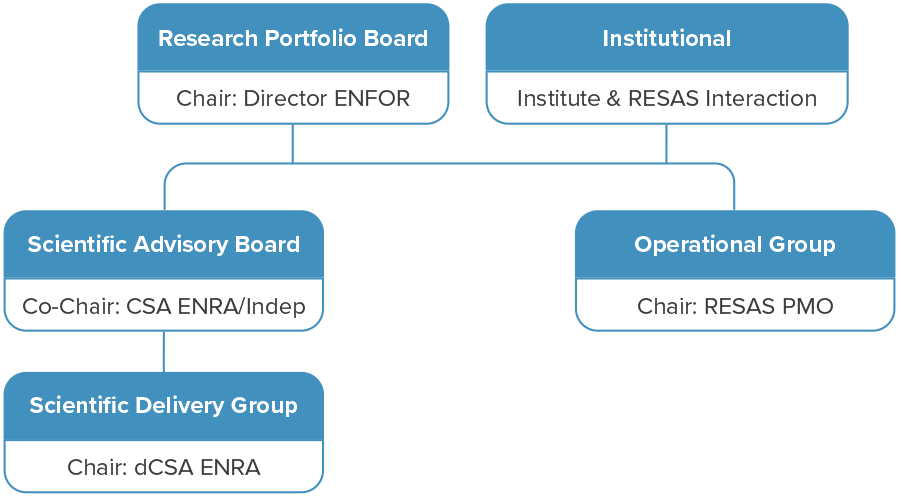
The Research Portfolio Board (RPB) oversees the whole programme on behalf of Scottish Ministers. It is responsible for ensuring the programme meets the priorities set out in this Strategy. The RPB is briefed by the Main Research Providers to understand their operational status.
The ENRA Scientific Advisory Board (SAB) reports to the RPB and provides independent scrutiny and evaluation of the quality of research within the programme.
The Operational Group focuses on operations, finance, metrics and reporting. Attending it are officials from both the MRPs and Scottish Government officials responsible for programme delivery, working through operational issues as they arise.
The Scientific Delivery Group (SDG) supports the SAB and promotes scientific alignment across the Missions within the programme. Attending it are researchers from MRPs and Scottish Government officials responsible for programme delivery, actioning key recommendations from the SAB.