
Environment, Natural Resources and Agriculture Research: Strategy 2027 to 2032
The Environment, Natural Resources and Agriculture (ENRA) Research Programme is our major science research funding programme. This strategy outlines our vision, priorities and mechanisms for the next cycle of multidisciplinary research covering the period 2027-2032.
3.0 An outcome-focused approach
The ENRA Research Strategy 2027-2032 will promote an outcome-focused approach to maximise the impact of our research, which the Programme will deliver through integrated projects, cross-disciplinary collaboration, and practical application of findings to deliver the Missions. The approach calls for improved design and targeting of policy interventions, wider uptake of good practice across key sectors, cross-cutting research to include behavioural science, and development of new technologies and processes.
A theory of change defines the impact pathway from project activities to the project outputs, leading to outcomes, and finally the impact delivered at Mission level (Figure 3). Impact requires co-production, co-development and collaboration, with stakeholders engaged at each stage. Stakeholder engagement is vital for research to deliver outcomes for wider society and enhance return on investment.
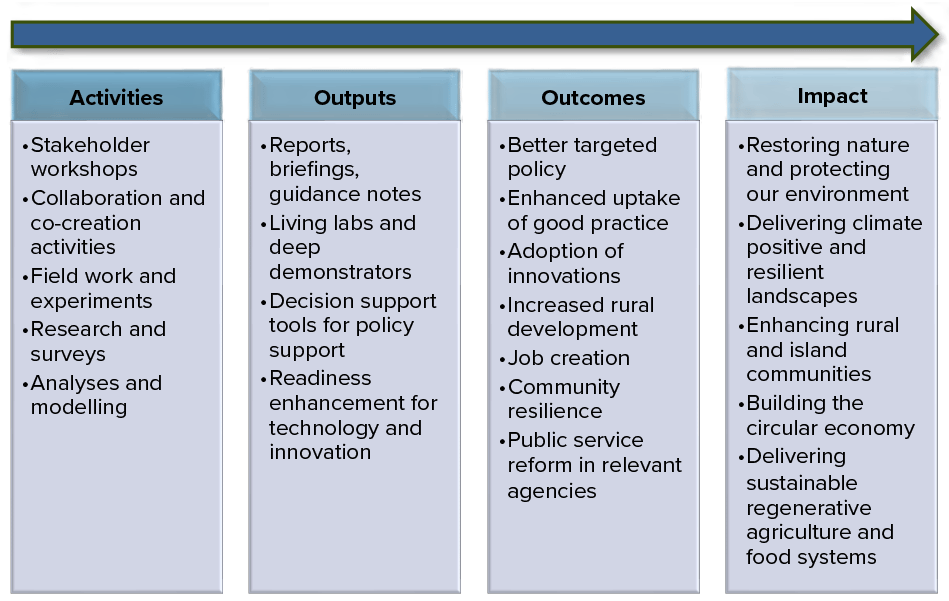
Activities
- Stakeholder workshops
- Collaboration and co-creation activities
- Field work and experiments
- Research and surveys
- Analyses and modelling Outputs
- Reports, briefings, guidance notes
- Living labs and deep demonstrators
- Decision support tools for policy support
- Readiness enhancement for technology and innovation
Outputs
- Stakeholder workshops
- Collaboration and co-creation activities
- Field work and experiments
- Research and surveys
- Analyses and modelling
Outcomes
- Better targeted policy
- Enhanced uptake of good practice
- Adoption of innovations
- Increased rural development
- Job creation
- Community resilience
- Public service reform in relevant agencies
Impact
- Restoring nature and protecting our environment
- Delivering climate positive and resilient landscapes
- Enhancing rural and island communities
- Building the circular economy
- Delivering sustainable regenerative agriculture and food systems
We envision achieving impact within our Missions by delivering the following outcomes, detailed in Sections 3.1 to 3.3 below:
3.1 Government: Decision Support for Policy Impact
The ENRA research programme plays a critical role in supporting evidence-based policy making across land use, agriculture, land reform and natural capital. A key priority for the next programme will be to ensure that data and modelling across the programme are well-integrated and responsive to evolving policy needs, providing robust decision support and knowledge exchange. This was a key recommendation of the ENRA Science Advisory Board (SAB) and the First Ministers’ Environmental Council (FMEC).
Currently, decision support tools are lacking in key areas. Modelling and data use is fragmented, preventing systems approaches to decision making. To address these challenges, a new data and modelling framework for the 2027-2032 Research Programme (Annex B: ENRA Strategy for Decision Support) is being developed for the programme which aims to:
- Develop options for more collaborative and interoperable decision-making capability across the programme, while encouraging flexibility and innovation to adapt to changing technology, policy priorities, evidence and societal needs.
- Support and promote greater standardisation of data management, quality assurance and data/model practices, to promote greater sharing, collaboration and reuse. Drawing on guidance such as the Scottish Local Government Finance Green Book, Magenta Book for guidance on evaluation, Aqua Book for guidance on robust, fit for purpose analysis, and Scottish Artificial Intelligence (AI) Playbook.
- Strengthen governance and communication arrangements to improve collaboration across the research-policy interface through improved knowledge exchange, ensuring governance is proportionate, adaptive, and focused on integration rather than control.
- Leverage outputs from the Scottish Land LiDAR programme and other earth observation initiatives to inform targeted policy interventions and optimise land use.
- Foster a culture of collaboration and co-design between researchers, policymakers, and stakeholders, supporting training and capacity-building to enable wider participation in modelling and data activities.
An example of the effective use of modelling and analytical methods to inform policy, in the current ENRA research programme is shown below.
Helping Scotland’s farming sector transition towards net zero
Scotland’s agriculture has a critical role to play in supporting rural economies and helping the country achieve net zero. To support this transition in a just way, appropriate evidence on measures to reduce greenhouse gas (GHG) emissions is needed from the national to the farm scale. Research funded by the ENRA research programme (2022-2027) and undertaken by Scotland’s Rural College (SRUC) has used national scale integrative modelling and analytical methods to identify practical farm level changes to reduce GHG emissions.
This has included detailed farm level modelling of suckler beef systems to identify options for improving efficiency and reducing emissions – e.g. faster finishing times, reduced calving intervals. This work has helped to identify farm measures which would simultaneously reduce farm cost and GHG emissions per animal. Results from this modelling have been used to inform Scotland’s Agricultural Reform Programme, in the development of the Committee on Climate Change’s 7th National Carbon Budget and in industry by informing the Institute of Grocery Distribution’s Net Zero Plan for the food sector.
3.2 Agency, Land Manager, and Community Interactions: Living Labs
The scientific research in the programme is targeted at filling knowledge gaps identified in areas related to the environment and nature. To deliver impact this research must be connected with relevant stakeholders, including land managers, farmers, public agencies, and communities. Many of these are already trialling sustainable practices and innovative land-use approaches. Engagement with researchers can help stakeholders and government to understand, evidence and scale out solutions to environmental problems. Interactions with stakeholders are key to determining how to implement understanding and generate change. Peer-to-peer transmission is critical in land manager uptake of new initiatives.
Living Labs can build the necessary connections to deliver impact. Living Labs are one of the strongest delivery mechanisms within the ENRA Strategy because they turn policy ambition into real world change. They bridge the gap between research, communities, land managers, agencies and industry, ensuring that national strategies are implemented in ways that are practical, just, and effective.
Living Labs are user-centered partnerships or interfaces that integrate research and innovation processes in practical, real world settings, such as communities, catchments, landscapes or farms. Living Labs focus on co-creating and testing realistic and just solutions to address key sustainability challenges at the right scale, with the right mix of disciplines and knowledge, and over the time needed to build trust and deliver impact and effective shared learning. By moving scientific knowledge into practical action Living Labs have been shown to help drive adoption of good practice, allowing researchers and stakeholders to co-create realistic land use and land management solutions[7].
Critically, Living Labs focus on co-developing solutions in real world contexts, where research has socio-economic benefits and includes active participation (direct user involvement), not just observation. The approach emphasises the need for genuine co-production, long-term engagement, and inclusion of a wide range of stakeholders, including farmers and other landowners, land managers, public bodies, community groups, industry and underrepresented groups. Living Labs will work with stakeholders to develop dedicated facilitation and resources to enable peer-to-peer learning. Living Labs will engage with networks of practice that support effective information sharing and encourage shared ownership of research outcomes. Living Labs will also take an interdisciplinary approach, integrating natural and social sciences, to promote synergies between Challenges and Missions, address real-world problems and facilitate engagement.
An example of how Living Labs are currently used in the ENRA Research Programme is provided in the case study box below.
Living Lab
The Lewis & Harris Animal Health and Welfare Project is a successful example of a Living Lab approach to tackle livestock diseases, particularly sheep scab and roundworms. Primarily funded through the ENRA research programme (with additional funding leveraged from industry) and co-developed with crofters, vets, scientists, industry representatives and regulators, it demonstrates how working in partnership and putting communities at the heart of decision-making can lead to practical improvements in animal health.
The project included workshops, in-depth semi-structured interviews, flock testing, and joint treatment campaigns, supporting >500 crofters and collectively treating >90,000 sheep for sheep scab. It also provided access to simple at-home roundworm faecal egg counting kits, providing crofters with the tools and resources to manage and control roundworms more effectively, reducing the development of resistance to treatments.
In conjunction with the provision of tools and resources to better understand and control important endemic diseases, the project improved animal productivity and welfare, reduced GHG-emissions, while increasing social capital and boosting crofter mental health. The work has informed Scottish Government policy, created business opportunities, and facilitated discussions to adopt practices on a nationwide level with pan-island network initiatives ongoing.
Through the 2027-2032 programme, to support agencies, land managers and communities, we will aim to:
- Support the formation of a network of Living Lab initiatives, which are codeveloped with researchers, users and communities to help deliver on the five Missions across Scotland.
- Drive innovation in sustainable practices by providing a testbed for new tools and technologies aimed at improving animal, plant and ecosystem health.
- Use Living Labs to inform government policy, public service reform and disseminate good practice guidance to land users and communities on sustainability.
3.3 Industry/Innovators: Adoption of new research, technologies and innovations
Innovation is critical to delivering the Missions of this programme and more broadly to deliver economic growth in a competitive environment. The innovation approach within this programme will support grassroots and community-led innovation, interdisciplinary collaboration, and social, organisational, and advisory innovation, as well as technological advances.
New vaccines, practices and diagnostics are needed to support animal and plant health as novel diseases are spread by climate change. New breeds of plants and animals are required to deliver food production resilience to changing climate. Innovative approaches can accelerate the embedding of circular economy practice and approaches, for instance the use of ‘Green Sheds’ to capture ruminant methane emissions and generate power. eDNA technology has the potential to improve our understanding of biodiversity and ecosystem health, and hence support action by NatureScot, Forestry and Land Scotland, and other land managers. This research would complement ongoing eDNA initiatives within the Marine Directorate, fostering alignment across terrestrial and marine environments. LiDAR has the potential to accelerate mapping and restoration of peatlands. Codes of practice such as the Peatland Carbon Code have supported investment in natural capital.
The research programme will aim to streamline funding processes, provide dedicated support for scaling successful innovations, and establish robust metrics and key performance indicators to track adoption and impact. Stronger links will be developed with enterprise agencies, industry, and existing innovation hubs to ensure that innovations move beyond pilot to widespread adoption.
The ENRA research programme will aim to catalyse Scotland to be a more dynamic and connected innovation ecosystem, one that accelerates promising ideas, removes barriers to uptake, to support successful adoption and scaling.
Through the 2027-2032 programme we will:
- Advance the readiness of research to emerging innovations, strengthening technological, user, market, societal and regulatory preparedness to ensure new solutions can move swiftly from concept to real-world application.
- Establish robust, future-focused innovation governance, drawing on the experience of the MRPs to embed clear strategies and share best practice in commercialisation, stewardship and responsible scaling.
- Deepen collaboration between researchers and industry, fostering strong partnerships, particularly in agri-tech and bio-tech, and leveraging Living Labs to co-develop and test innovations in real environments.
- Champion community-led innovation, recognising the value of local insight and enabling mentoring, peer learning and knowledge-exchange networks.
- Strengthen connections with enterprise and development agencies, across Scotland, the UK and internationally to stimulate development.
- Ensure innovation is inclusive, outward-looking and agile, responsive to emerging challenges and capable of delivering benefits across rural, island and urban communities alike.