
Environment, Natural Resources and Agriculture Research: Strategy 2027 to 2032
The Environment, Natural Resources and Agriculture (ENRA) Research Programme is our major science research funding programme. This strategy outlines our vision, priorities and mechanisms for the next cycle of multidisciplinary research covering the period 2027-2032.
2.0 Outcome-Focused Research: Missions
The ENRA Research Programme takes a Mission-oriented approach to ensure research is delivered in a systematic and outcome-focused manner directly linked to Scottish Government’s priorities. Missions target their related research projects towards unifying, specific goals, focused on systemic problems, and so avoids siloed research work. Missions clarify for researchers the outcomes that research investment must ultimately target for delivery, allowing for agility with a stable, long-term direction.
A Mission is a portfolio of projects that are targeted towards a key policy outcome. Missions can include projects that span sectors and scientific/analytical disciplines. Missions are designed to deliver outcomes that surpass what individual projects could accomplish independently.
The following Missions have been created to ensure alignment to Scottish Government priorities and key policy drivers:
- Delivering sustainable and regenerative agriculture and food systems
Working with nature to improve plant, animal and soil health, enhancing agricultural practices, and promoting resilient food systems. It also encompasses innovation in disease control, climate adaptation for crops and stock, strengthening food safety and sustainable farming to reduce environmental pollution and boost productivity.
- Delivering climate-positive and resilient landscapes
Focused on creating climate-resilient landscapes through optimised land use, and climate-positive landscapes through research to reduce emissions and enhance natural carbon sinks. Emphasises systems thinking and leveraging data, modelling, and decision-support tools to mitigate climate impacts, enhance land management, and manage pressures on water resources while promoting a just transition.
- Restoring nature and protecting our environment
Focused on safeguarding and enhancing Scotland’s natural resources, its air, soils, land, water, plants and wildlife, by addressing the drivers of nature loss and environmental degradation. Emphasises restoration of degraded ecosystems, sustainable use of wild species, minimising of pollution, improving the management of invasive non-native species. Targets sustainable use of resources to support thriving communities, nature, and the economy in a changing climate.
- Enhancing rural and island communities
Focused on strengthening Scotland’s rural and island communities, by improving understanding of service delivery, investment and land reform, alongside the characteristics of diverse rural and island areas. Aims to empower rural and island communities through innovative and place-based research methods, and provision of the right data and tools, to ensure that they can thrive.
- Building the circular economy
Focused on advancing circular economy practices through systems thinking, behavioural insights, and material analysis.
Missions are connected, and therefore our funded research needs to build appropriate links across Missions and alignment across projects. The Mission structure (Figure 1) will not only drive our approach but will be used as an overarching structure to steer, align and focus research across our entire research programme and all funding streams.
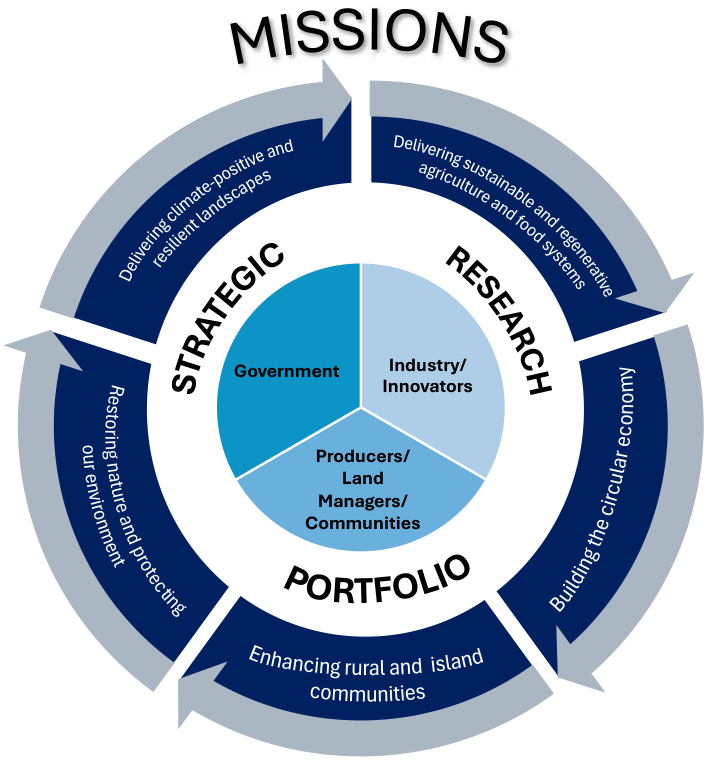
The five core Missions of the ENRA Research Programme will support Scottish Government policy objectives, to ensure alignment with existing policy frameworks. For example, the Land Reform (Scotland) Act 2025, Land Use Strategy, Agricultural Reform Route Map, Natural Environment (Scotland) Bill, Good Food Nation, Biodiversity Strategy, Environment Strategy, Livestock Health and Welfare Strategy, Scottish Plant Health Strategy and Population Health Framework. The Missions must also connect to broader international frameworks, to ensure Scotland’s contributions are globally recognised – as an example, linking with the United Nations (UN) Sustainable Development Goals (SGD). Many of these frameworks share the vision of the ENRA research strategy. Thus working in partnership, and aligning research needs, will be critical to the delivery of research benefits to Scotland.
Complex Systems Research
Within this research programme, there are complex challenges which cut across multiple Missions. Cross-cutting research is needed to address these interconnected systems challenges. Actions for halting biodiversity loss, reducing greenhouse gas emissions, building a circular economy and delivering sustainable agriculture must be understood and delivered as connected challenges for our national socio-ecological system. To resolve the multiple priorities for our land and its economy requires integrated, systems thinking, that recognises connections between nature and people, and spatial variability from highlands to lowlands. Effective systems thinking supports synergistic actions; effective policy, best practice and successful innovation delivered together, maximising impact and minimising unintended consequences.
Systems research — addressing nature-climate links, land-sea interactions, One Health, integrated land use, rural innovation — is therefore required across the five Missions. Rather than treating areas of research interest (ARIs) as standalone topics, research must actively consider inter-dependencies between land management, ecosystems, human health, and socio-economic systems.
To operationalise these cross-cutting projects, the strategy emphasises systems-thinking and co-production. Research will be commissioned to work across disciplines and sectors, supported by shared data infrastructure, AI-enabled modelling, and decision-support tools. Living Labs will play a key role in testing integrated solutions in real-world contexts, enabling adaptive management and peer-to-peer learning across ARIs. Living labs will support experimentation and evidence-based policymaking, driving systemic change and innovation. Importantly, ARIs linked to these themes will remain dynamic and outward-looking, allowing flexibility to respond to emerging risks and opportunities, while aligning with international frameworks such as the UN Sustainable Development Goals and One Health principles.
Challenges and Areas of Research Interest (ARIs)
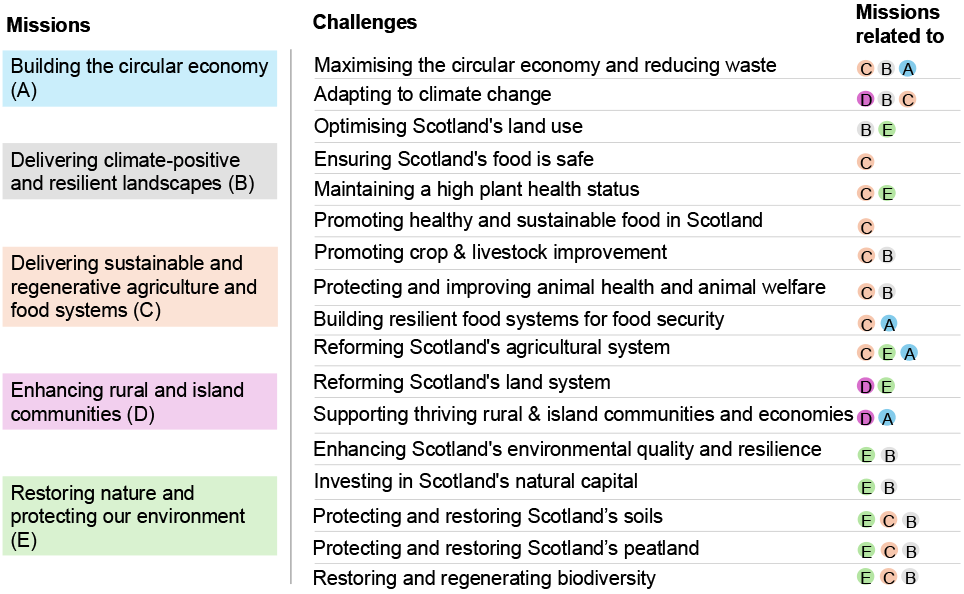
A set of supporting Challenges have been identified to underpin the Missions, providing detail on focus areas. For instance, the Mission to ‘Deliver regenerative and sustainable agriculture and food systems’ has Challenges focused on: maintaining high plant health status, promoting crop and livestock improvement, and building resilient food systems for food security. Some Challenges have relevance to two or more Missions, reflecting systemic issues. The Challenges are in turn underpinned by Areas of Research Interest (ARIs), indicating where project outcomes are expected to generate significant impact.
Research projects will address one or more ARIs and contribute to meeting one or more Challenges, and Missions. The list of priority ARIs detailed in Annex A shows the breadth and depth of interested projects across the research portfolio. The list of both funded and unfunded ARIs will be placed on the UK Government ARI database, to showcase our evidence needs. Further information on the approach to developing priority ARIs is provided in the box below, with a summary of the key definitions of the terms used in this strategy shown below.
Key Terms
Missions
A portfolio of linked interdisciplinary projects targeting government goals
Challenges
A more granular grouping of interdisciplinary projects that link across Missions
Areas of Research Interest
Specific priority questions of interest to government
Research Projects
A piece of research work that will answer the identified ARI
Areas of Research Interest (ARIs)
ARIs are specific research topics or questions that reflect the evidence needs of the Scottish Government. These ARIs identify key priorities where research can support policy development, enhance decision-making, and drive innovation. ARIs will be adaptive, being reviewed periodically and updated regularly to ensure responsiveness to emerging challenges and evidence needs. ARIs will also be developed across government (e.g. with the Marine Directorate) ensuring a holistic approach to avoiding duplication. The ARIs have been developed with awareness of the UK and international agendas, ensuring join-up where appropriate.
ARIs have been co-developed with input from external experts and policymakers, bringing into consideration local communities, industry, and civil society. Many of the ARIs focus on cross-cutting issues, such as nature-climate links, and may be linked to multiple challenges to encourage cross-disciplinary research. The following criteria were considered when identifying a priority ARI:
a)Uniqueness to Scotland: an ARI must be directly applicable to Scotland’s policy, landscape and/or communities.
b)Multiple Co-Benefits: the ARIs that are the highest priority will have co-benefits, including environmental, social and economic, and/or serve numerous stakeholders.
c)Links to Scottish Policy: an ARI should have a line of sight to a relevant policy, legislative or delivery challenge for the Scottish Government.
d)Business Opportunities: the programme should support opportunities for the biotech industry, agri-tech industry, environmental and food and drink sectors.
e)Supporting key research capacity: supporting essential expertise for the delivery of Scotland’s national priorities, fulfil statutory obligations or to meet international commitments.
The full list of ARIs underpinning the strategy is provided in Annex A: Areas of Research Interest. A summary of the cross-linkages between Missions and Challenges is provided in Figure 2.
The majority of the ARIs align to themes and priorities in the current research cycle. However, several new areas of interest are also captured. Some examples of these include:
- developing approaches to assess the risks of wildfire in Scotland
- understanding and resolving human-wildlife conflicts to enable nature restoration
- identifying the impact of climate-related food safety risks
- investigating barriers to achieving Scottish Dietary Goals
- strengthening Scotland’s food system resilience
- tackling mis/disinformation while promoting healthier, safe and sustainable food choices
- maximising use and value of LiDAR data to better understand our landscape, target policy interventions and optimise land use
- developing an approach within Scottish policy to prioritising chemicals that pose a risk to environmental quality and human health
- developing adaptive management approaches for grazers for nature positive and net zero land use outcomes
- advancing soil sustainability: developing national monitoring, studying long-term soil amendments, climate impacts, and new methods to detect emerging soil contaminants
- exploring private finance options for nature restoration