
Environment, Natural Resources and Agriculture Research: Strategy 2027 to 2032
The Environment, Natural Resources and Agriculture (ENRA) Research Programme is our major science research funding programme. This strategy outlines our vision, priorities and mechanisms for the next cycle of multidisciplinary research covering the period 2027-2032.
Annex C: ENRA Research Programme Impact Framework
1. Purpose
The ENRA Research programme must produce high-quality scientific outputs, which are useful, accessible and influential for government and other end users. Annex C sets out a proposed Impact Framework that describes the approach to defining, monitoring and evaluating research impact in the forthcoming ENRA 2027-2032 Research Programme.
2. Definition of Impact
In the context of the ENRA Research Programme 2027-2032, impact is defined as “the real-world difference research makes – changing lives, shaping policy, strengthening the economy, improving the environment, and enhancing health and wellbeing.” Impact refers to the positive changes or long-term benefits that extend beyond academia to individuals and communities. Impact includes improvements to the economy, society, culture, public policies, services, health, the environment, and overall quality of life. The framework will make explicit links to public health and ‘One Health’ outcomes, recognising the interconnectedness of environmental, plant, animal and human health and the importance of these outcomes for Scotland’s wellbeing.
3. Approach
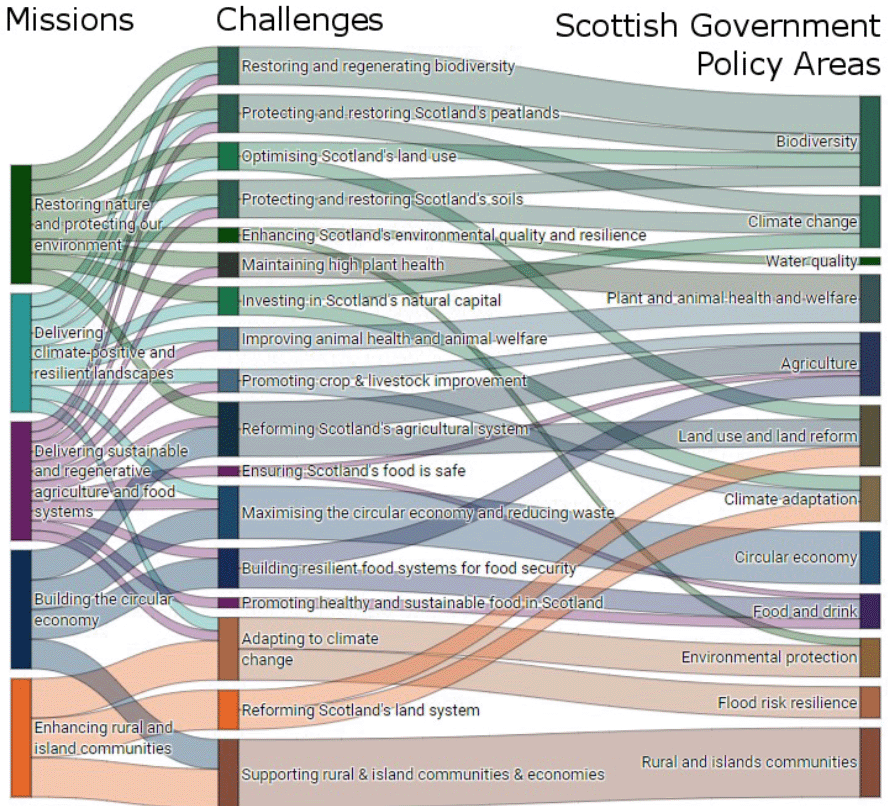
The proposed Impact Framework will be embedded within the strategic approach to the next ENRA Research Programme 2027-2032. The research set out in the ENRA Research Strategy will be centred around a series of ‘Missions for Scotland’, each underpinned by a set of supporting Challenges aligned with Scottish Government priorities and key policy drivers (Figure 5). The Missions are focused on:
- Delivering sustainable and regenerative agriculture and food systems
- Delivering climate-positive and resilient landscapes
- Restoring nature and protecting our environment
- Enhancing rural and island communities
- Building the circular economy
Impact
The five ‘Missions’ can also be defined as the ENRA Research Programme ‘impact areas’ (see Figure 6) i.e. they define the areas that benefit from the programme’s outputs and outcomes.
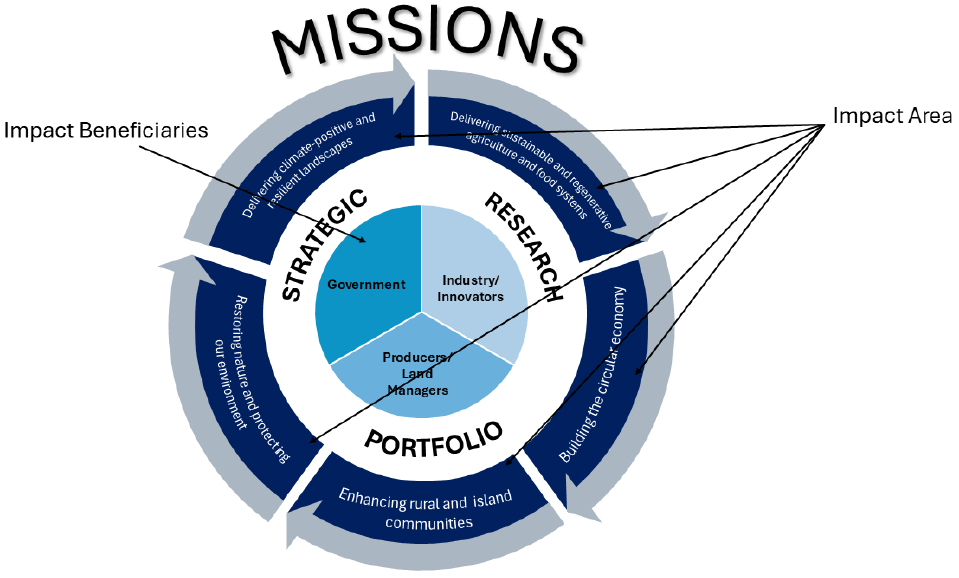
The outputs and outcomes of the ENRA Research Programme will deliver significant impacts from 2027 to 2032. Longer term benefits will also accumulate from this and previous research programmes, into the future. To ensure longer-term cumulative impacts develop the ENRA Research Programme 2027-2032 will lay the foundations for these to happen through a coordinated strategy around data and model management and archival.
The immediate impact beneficiaries or customers for the ENRA Research Programme 2027-2032 include government, industry and innovators, and producers or land managers. Ultimately the impact beneficiaries of the ENRA Research will be communities, civil society and the public. Impacts of the ENRA Research Programme could be realised for each in one or more of the Missions/impact areas (see Figure 6).
To assess the impact and value for money from our investment RESAS commissioned an external evaluation of the previous research programme in May 2023. This found that the research achieves substantial economic impact. The economic impact of the 2016-2022 ENRA Research Programme was estimated as £470 million to £680 million. This impact is from a variety of factors, including the economic return on public research, and is significantly greater than the government’s investment in the programme. The evaluation also found various examples of community and scientific benefits, as well as significant contribution to policy and Net Zero.
Outputs
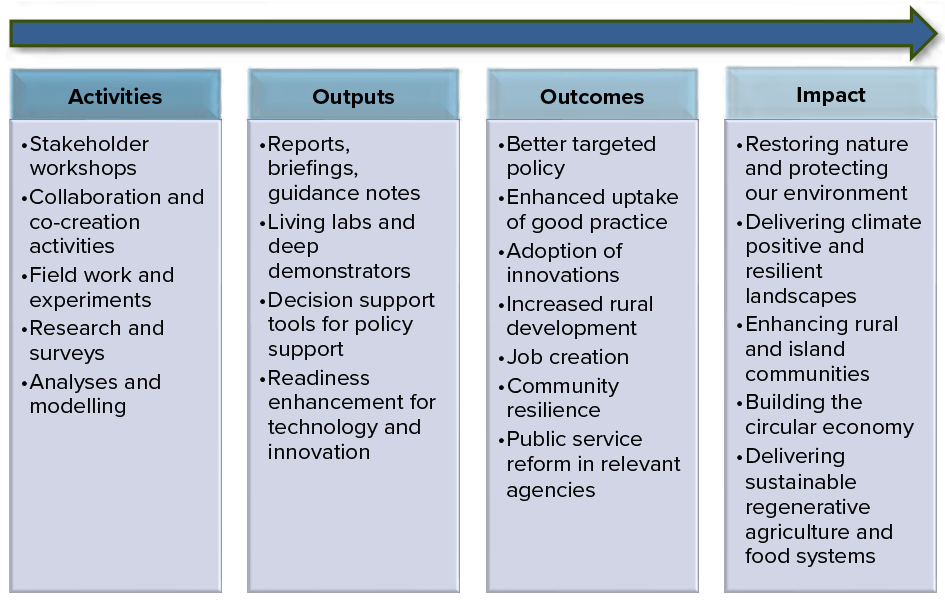
The outputs of the ENRA Research Programme are the tangible research products i.e. knowledge, resources or decision support tools[8] delivered or produced by projects within each Mission (see Figure 7). The project outputs such as a paper published in peer-reviewed scientific literature, a report, guidance or new model or system support tool should be considered a key step towards project outcomes.
Outcomes
Outcomes are the ways in which research outputs are used to inform and influence decisions and behaviours by impact beneficiaries. ENRA Research Programme will look to deliver impact on its Missions through six main types of outcomes:
i) better targeted and designed government/policy interventions,
ii) enhanced and wider uptake of better/best practice,
iii) creation and adoption of new technologies and processes to enhance economic and environmental outcomes, e.g. for business
iv) increased rural development,
v) job creation, community resilience
vi) public service reform in relevant agencies (see Figure 7).
These outcomes will help achieve impacts that will deliver wider environmental, economic and societal impacts for the ENRA Missions. The current programme plays an important role in supporting the wider agri-bio tech sector in Scotland. For example, it supports around 1,900 research jobs in Scotland directly and indirectly. It also provides a platform to allow Scottish institutes to secure additional funding from other UK and international funders. In 2023-2024, £39 million of external income was leveraged because of the programme. It has also supported the creation of spinout companies and wider commercialisation activity in new sectors such as indoor vertical farming. The economic impact of the next programme will be closely monitored to support wider industry and society.
Activities
- Stakeholder workshops
- Collaboration and co-creation activities
- Field work and experiments
- Research and surveys
- Analyses and modelling
Outputs
- Reports, briefings, guidance notes
- Living labs and deep demonstrators
- Decision support tools for policy support
- Readiness enhancement for technology and innovation
Outcomes
- Better targeted policy
- Enhanced uptake of good practice
- Adoption of innovations
- Increased rural development
- Job creation
- Community resilience
- Public service reform in relevant agencies
Impact
- Restoring nature and protecting our environment
- Delivering climate positive and resilient landscapes
- Enhancing rural and island communities
- Building the circular economy
- Delivering sustainable regenerative agriculture and food systems
4. Plan for Impact - Commissioning
Start with the impact we want to have.
By strategically thinking about the impact from the beginning of the research programme we can increase the likelihood of realising it.
Researchers will be asked to use an impact planning tool when drafting research proposals, i.e. a theory of change, to map out the anticipated impact pathway for a project (Figure 7), highlighting how the project outputs and outcomes will deliver impact on the Missions, linking to key SG priorities. Reporting on impact will be built into research plans as milestones and deliverables. The theory of change is a schematic presentation with a narrative or illustration such as a logic model that shows how a project can bring about the desired change or outcome (see Figure 8). This approach will provide information on the expected timescales between activities, outputs, outcomes and impacts, external enablers and barriers to achieving the intended impacts and underlying assumptions relevant to the pathway being achieved. In a theory of change, assumptions are the core beliefs or conditions that are considered true and necessary for the intervention to achieve its desired outcomes. They represent the underlying logic of the programme and explain why certain activities are expected to lead to specific changes. Essentially, they are the conditions that need to hold for the theory of change to work effectively.
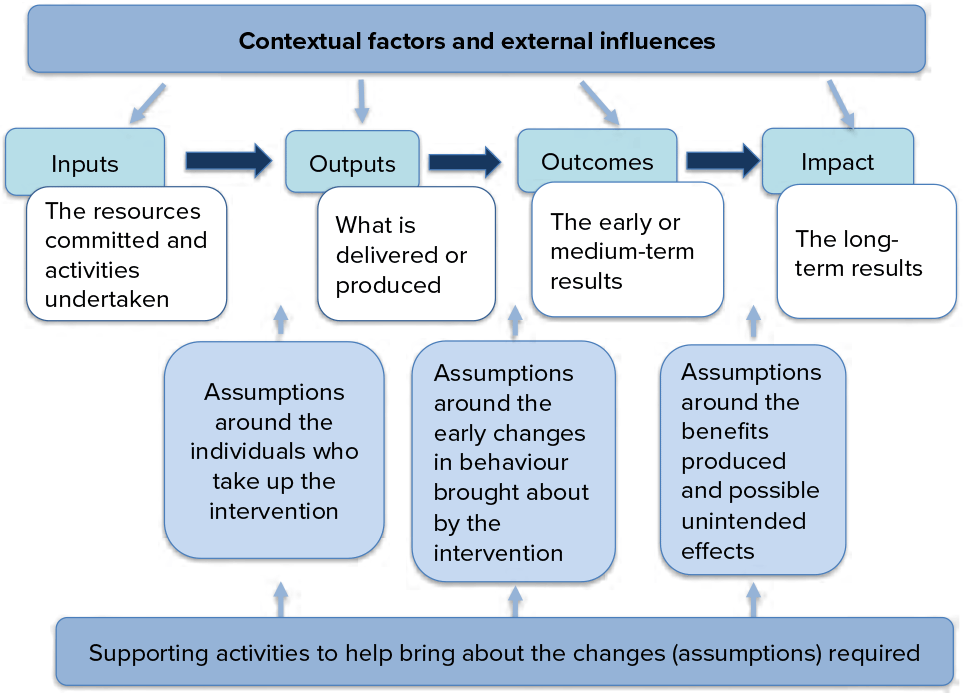
Developing a theory of change typically involves considering the proposed inputs (what investment/regulation/actions will take place) and the causal chain that leads from these inputs through to the expected outputs and outcomes, linked to what or who will change. A theory of change considers the causal mechanisms by which an intervention is expected to achieve its outcomes, basing this theory on the gathering and synthesis of evidence and its communication to stakeholders.
Researchers will be expected to develop project proposals in a co-creative and collaborative way with research users/stakeholders i.e. policy teams and key partners. Co-production will also be expected throughout the lifespan of the project. Researchers must identify and map their key stakeholders or policy customers as part of their project bid. Researchers should be invited to take a tailored approach and consider questions such as: Who needs to know what, and why? How can stakeholders use the research output? Where might outputs influence their policy/work/process? How can stakeholders contribute to the research?
To ensure coordination across Missions, researchers will be encouraged to connect individual project-level theories of change with higher-level programme objectives. This would allow activities from multiple projects to be strategically coordinated around specific challenges/Missions, with feedback mechanisms in place to ensure coherence. Mission Impact Officers will play a central role in this process.
5. Impact Monitoring
The annual reporting requirements for the 2022-2027 Research Programme, to enhance knowledge transfer between science and policy, requires project Principal Investigators (PIs) to submit onto Researchfish a Narrative Summary, including a 250-word Impact Narrative. Feedback following the Researchfish 2023-2024 Narrative Report, noted that while excellent examples of impact were demonstrated, there was a wide variance in the quality of the impact narratives and the evidence provided.
The Proposed Changes for the 2027-2032 ENRA SRP
Impact will be evaluated at all levels of the programme from individual projects to Missions.
The Impact Framework will use a mix of quantitative and qualitative indicators to measure success. Metrics and indicators of impact will include both policy, industry and economic outcomes, and broader impacts on the environment, public health, and communities.
Impact will be measured using key performance indicators (KPIs) to assess:
- Delivery of outcomes that support impact, including decision support tools, Living Labs, and innovations in technology.
- Practical adoption and measurable improvement in productivity, efficiency, sustainability, climate resilience and profitability at enterprise and regional level.
- Enhancement of public services including efficiency of regulation related to nature, environment and land management.
- Evidence of environmental benefits in terrestrial and freshwater systems (e.g. reduced emissions intensity, soil carbon gain, biodiversity improvement).
- Improved health and wellbeing, including dietary/nutritional improvement, increased rural development, job creation and community adaptation and resilience.
Stakeholder and community feedback will be key to evaluation and lived experience data will be valued alongside quantitative indicators.
To avoid placing unnecessary reporting burdens on researchers and to ensure that such reports remain meaningful, the impact framework will prioritise proportionate, outcome-focused reporting, ensuring that evaluation strengthens delivery rather than detracts from it.
The following section sets out how we intend to monitor and evaluate evidence of impact and record the pathway to help achieve impact of the ENRA Research Programme from 2027. Annual research project Impact Narratives and Mission level Impact Summaries will focus on both successes and lessons learned, including highlighting adjustments to the impact pathway such as recording unforeseen opportunities or potential unintended consequences.
At project level it is proposed that the additional annual Impact Narrative question continues to be part of the annual Narrative Summary with a small increase in word count from 250 to 500 words. The purpose of the project Impact Narrative is to give a more detailed summary of the project impacts over the year, highlighting successes or changes to the impact pathway, and providing a chance to detail new or previously unforeseen impact opportunities or unintended consequences. PIs will be encouraged to record project activities, which deliver impact such as workshops and outreach activities, policy briefings and interactions/engagements with policy customers, stakeholders and the public/communities. This will enable PIs to demonstrate the significance and breadth of impact. Testimonials from stakeholders including policy teams, businesses and communities/individuals who have used or benefited from the project could be used for example to help evidence/highlight impact.
It is proposed that an annual Mission Impact Summary (no more than four pages) is also produced by the Mission Impact Officer (see below) summarising impact across Challenge areas and the wider Mission. Mission summaries will draw upon the individual project Impact Narratives.
There will be continuity of some work from the 2022-2027 research programme, supported by clearly defined pathways to impact. New projects will propose pathways to impact at the outset; however, it is recognised that these routes may evolve over the life of the project as stakeholders change and new opportunities emerge. This approach is therefore designed to enable a flexible and agile approach to impact. PIs will be required to regularly review the project’s impact pathway and to work in a collaborative/co-production way with their policy customers/stakeholders and impacted communities to address issues and capitalise on new, unforeseen opportunities to maximise impact and address any unforeseen consequences during the course of the project.
Impact Case Studies
Case studies have the potential to bring to life the evidence around the societal. environmental, health and economic impacts of the ENRA research programme.
It is proposed that a series of Impact Case Studies (two to three per Mission), selected from the project impact narratives, are developed annually to support the Mission Impact Summary over the course of the programme and to demonstrate the positive examples of impact of the ENRA SRP. These will be published online following review by CSA ENRA and Scientific Advisory Board. Impact Case studies should describe and evidence how the SRP science and research has made a material contribution to a particular Mission and how the research funded through the SRP has strengthened the link between research and societal impact by promoting high-quality research that delivers measurable benefits to society, the economy and/or the environment.
The impact included in the case studies must have occurred within the 2027-2032 SRP programme but may reference research from previous programmes recognising the long-term nature of the research programme. An example of an impact case study from the current programme (2022-2027) research programme is included in the case study box below.
Underpinning National Capacity (with links to SRP: B. Sustainable Food System and Supply)
Langhill selection lines: data enabled genetic improvement for productive, climate-smart and welfarecentred dairying
The Langhill selection experiment is the world’s longest-running livestock genetics trial. Initiated in the early 1970s at SRUC’s Crichton Royal Farm in Dumfries, Langhill maintains two Holstein genetic lines, one selected for milk solids yield and another for fitness, under controlled dietary regimes.
Since 2022, the Langhill selection experiment has enabled measurable transformation across the UK dairy sector and beyond. SRUC’s research using the 50-year Langhill dataset underpins new breeding tools for feed efficiency, resilience, health and reduced methane emissions. These tools are now implemented in national genetic evaluations and industry guidance. Farmers are using indices that reduce purchased feed, improve lifetime survival and lower involuntary culling. Langhill supports innovations such as IVF accelerated breeding of methane efficient calves, open source digital twin models for dairy farming and involvement in the UK Dairy Carbon Network to demonstrate scalable net zero solutions. Impacts extend to farmers, companies, advisers and policy makers.
How will the Impact Narratives, Mission Impact Summaries and Case Studies be used?
The annual project Impact Narrative will be used to monitor and evaluate project funding. It will be uploaded onto Researchfish. The summary will inform Mission Impact Summaries and will be available online.
Mission Impact Summaries and Case studies will be used to monitor and evaluate the outcomes and impact of the SRP and will be available to Boards within the governance structure of the Research Programme 2027-2032. The process will mimic the Research Excellence Framework (REF) evaluation of UK Higher Education Institutes.
Clear guidance on how to complete impact reporting and what constitutes impact will be provided. Impact training will be made available to PIs for creating a theory of change impact pathway and impact reporting led by the Mission Impact Officers.
Roles and Responsibilities:
Mission Impact Officer
To support and champion a culture of impact across the programme it is proposed that up to two Impact Officers are appointed for each Mission from the SEFARI Institutes/CoEs. The role of the Impact Officer would be to lead and motivate a culture of impact across the ENRA SRP: they will drive impact by working across the boundaries of research, policy, industry and communities. Impact Officers will support researchers to deliver impact by building capacity and capability across the Institutes they will be key in: supporting and facilitating the generation of impact; increasing awareness and communication of impact; coordinating stakeholder identification and engagement; supporting and leading the monitoring, evaluating and recording impact; developing Mission Impact Summaries and Case Studies, and tracking progress.
Impact Officers would provide support and guidance to PIs on annual project impact reporting, would coordinate and produce annual Mission level Impact Summaries and coordinate the delivery of case studies across the Mission.
The Impact Officers would also have a role to look across the Missions to ensure the co-benefits of project outputs are realised and reported and to identify opportunities to increase impact, i.e. where outputs from one Mission may be relevant to the outcomes of another Mission for example. This work would support efforts to break down silos and promote cross-Mission working.
Their remit will include facilitating regular, inclusive impact assessment meetings, ensuring that impact narratives are gathered from across the Mission or portfolio, and that information flows between projects, Missions, and stakeholders.
It is suggested that Impact Officers lead an annual impact meeting/workshop highlighting and championing positive examples of impact and sharing examples of best practise.
Impact Officers will be empowered to challenge underperformance, share learning across projects, and ensure that impact reporting includes diverse perspectives, including those of communities and the public.
The Impact Officers would also be the first point of contact for Scottish Government on Impact.
Project Impact Champions
Each commissioned project within the SRP will have an identified Impact Champion who will support the activities of the Impact Officer to promote and report project impacts. The impact champion can change throughout the course of the project.
Challenge Leads
Scottish Government Challenge Leads (formally RESAS Topic Leads) will continue to review quarterly reporting of milestones, deliverables on Researchfish. They will also review the annual project Impact Narratives. This activity, however, will be supported by Mission Impact Officers.
6. Evaluation
The impact of the SRP will be evaluated at project level by Scottish Government Challenge Leads. Challenge Leads will review annual impact narratives for their projects and feedback will be provided to Impact Officers and PIs as appropriate.
The annual Mission Impact Summaries will be reviewed and assessed by CSA ENRA and the ENRA Scientific Advisory Board. Feedback will be provided to Mission Impact Officers.
CSA ENRA and the ENRA Scientific Advisory Board (SAB) members will also review a number of impact case studies for each Mission.
7. Communicating for Impact
The benefits and importance of capturing and communicating the impact of the ENRA research programme research outcomes, Underpinning National Capacity (UNC) and CoE, to government and other key stakeholders are clear. Clear and demonstratable impact will enable Scottish Government to show the value of embedding environmental and agricultural evidence in the policy decision-making process, the positive impact for business, innovation and wider society and will be able to use this evidence to support the case for continued investment.
The audience is defined as the impact beneficiaries or customers i.e. Government, Industry and Innovators and Producers/Land managers, communities, civil society and the public.
Scottish Government already supports several routes to raise awareness of the impact of the ENRA research programme; for example, there is a monthly newsletter, regular events including an online Seminar Series focusing on discrete elements of the programme and an annual ENRA Science, Evidence and Policy Conference, which covers the breadth of the research programme. It is suggested that further opportunities to build on this activity could include:
- Impact Case studies: these are already published on the SEFARI website[10] but these could be developed further and increased in volume. Case studies will be proactively shared with policy teams and stakeholders or post on social media.
- An impact prize (non-monetary) (including an Early Career impact prize/category) could be incorporated into the ENRA Conference. This could be judged by a panel including academic, policy, stakeholder/industry representation.
Stakeholder Engagement and Co-production
For research to have an impact it must be used by stakeholders. Evidence suggests that co-productive forms of research offer increased potential for academic, economic and social impact. Impact is more likely through deliberate design, facilitation and reflection, from the outset of the project through to post-delivery learning. Its potential benefits include:
- facilitating more holistic research, including the representation of different knowledge systems
- bringing greater accountability of publicly funded research
- building trust between researchers, policy makers, and other stakeholders
Co-development, co-production and collaboration including community engagement will be embedded throughout the research lifecycle, from project design to evaluation, ensuring that stakeholders and communities are engaged as equal partners at every stage.
Early and continuous engagement with end users and industry partners is essential if research outcomes are to be practical and widely adopted. Embedding co-design mechanisms in project development and governance will ensure that research remains relevant to land managers, producers, processors, and community organisations, supporting greater ownership and impact.
Researchers should also be encouraged to engage in activities that promote collaboration throughout the delivery of research programme on for example: co-development workshops, ongoing engagement meetings, impact events and visits to Research organisations and secondments/work shadowing opportunities (SEPAL initiative).
Building strong collaborations is essential for maximising impact. When the right partners are engaged, they can amplify outcomes through their organisations’ practical, policy, and communication activities. Similarly, involving potential beneficiaries in co-creation is an important first step toward impact, but maintaining their engagement throughout the project’s lifetime significantly increases the likelihood of achieving meaningful results.
Feedback on how research outputs are used by impact beneficiaries such as policy teams/stakeholders/community groups will be encouraged. Consideration will be given to potential mechanisms to support this activity including the Single-Product Evaluation for Immediate Delivery (SPEIDY[11]) Feedback Questionnaire on a Research output which provides a picture of the likelihood of research use.
8. Conclusion
A summary of the key points:
In the context of the ENRA Research Programme 2027-2032 impact is defined as “the real-world difference research makes — changing lives, shaping policy, strengthening the economy, improving the environment, and enhancing health and wellbeing.”
This refers to the positive changes or benefits that extend beyond academic circles. This includes improvements to the economy, society, culture, public policies, services, health, the environment, and overall quality of life, through enhanced knowledge transfer.
The ENRA Research Programme Impact Framework will provide a structured way to plan, monitor and evaluate research impact, ultimately to enhance knowledge transfer amongst a variety of stakeholders. The framework will support the enablement of evidence-based decision making within the wider ENRA research strategy via the proposed new requirements:
- Commissioning: impact will form part of the Invitation to Tender for Grant Funding (ITGF) process for the ENRA SRP 2027-2032. Researchers bidding for funding will be asked to use an impact planning tool when drafting research proposals, i.e. theory of change to map out the anticipated impact pathway for a project highlighting how the project outputs and outcomes will deliver impact on the Missions, linking to key SG priorities. This approach will provide information on the expected timescales between activities, outputs, outcomes and impacts, external enablers and barriers to achieving the intended impacts and underlying assumptions relevant to the pathway being achieved. Risk mitigation plans for mitigating against negative unintended consequences of and if impact fails should also be included. Researchers will be encouraged to go through a Theory of Change workshop ahead of project initiation with the Mission Impact Officer.
- Co-Development: researchers will be encouraged to co-develop project proposals in a co-creative and collaborative way with research users/stakeholders, i.e. policy teams and key partners. Ongoing co-production and collaboration will also be expected throughout the lifespan of the project. To emphasise this approach researchers are asked to identify/map their key stakeholders/policy customers as part of their project bid, and their processes of engagement. Policy customers/stakeholders will be encouraged to provide feedback on research outputs.
- Training and Guidance: clear guidance will be provided on how to complete impact reporting and what constitutes impact. Impact training will be made available to PIs for creating a theory of change impact pathway and impact reporting through the Impact Officers. Impact will be managed as a continuous, learning-based process with inbuilt feedback and follow-up.
- Monitoring: for the 2027-2032 SRP the following impact monitoring steps will be requested as part of the reporting and evaluation requirements: i) increased annual project Impact Narratives, ii) annual Mission Impact Summary, iii) annual Mission Case Studies.
- ENRA SRP 2027-2032 will have Mission Impact Officers: to support and champion a culture of impact across the research programme it is proposed that at least two Impact Officers are appointed for each Mission from SEFARI Institutes/CoEs. Each project will also have an identified Impact Champion to support the activities of the Mission Impact Officers.
- Evaluation: Scottish Government Challenge Leads will review quarterly impact updates and annual impact narratives for their projects. The annual Mission Impact Summaries and Case Studies will be reviewed and assessed by CSA ENRA and the ENRA Scientific Advisory Board annually.
- Communicating Impact: Scottish Government will promote Impact Case Studies to ensure that research programme achievements are recognised. Scottish Government will introduce an Impact prize.