
Cardiovascular Disease Directed Enhanced Service: views and experiences of General Practices
Presents the results of an online survey and qualitative interviews conducted with General Practices across Scotland. These explored the views and experiences of practices in implementing and providing the first year of the CVD DES programme, to contribute to its ongoing evaluation.
6. Take up and the profile of those engaging
This chapter looks first at appointment uptake and then goes on to consider who did, or did not, participate in the CVD DES.
Appointment uptake among targeted groups (survey findings)
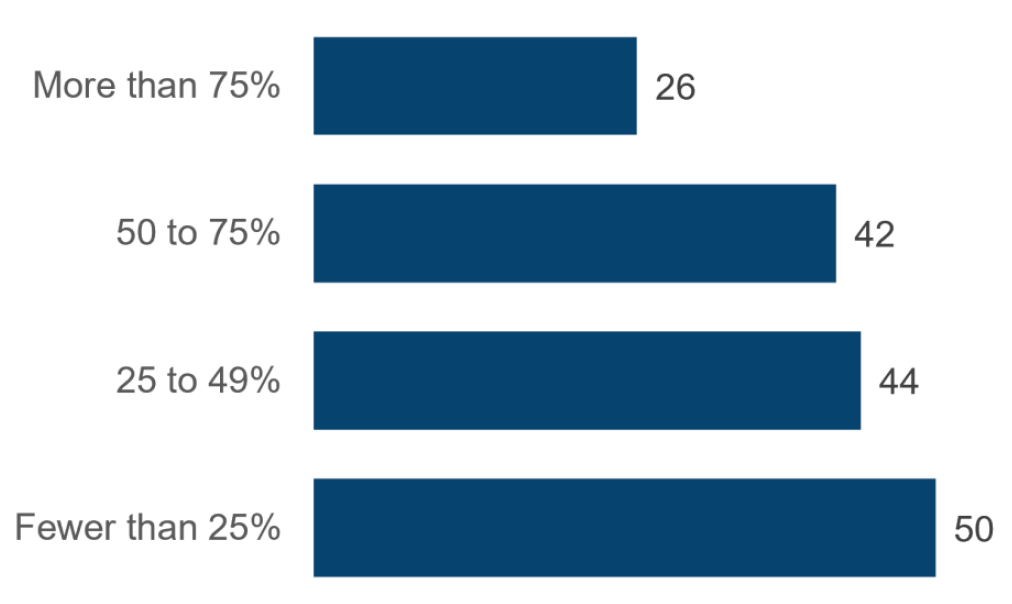
Survey question: Where you tried to target particular patient groups, what proportion of these individuals would you estimate have taken up the offer of an appointment?
Of 162 practices that responded to the survey, the most commonly reported estimate (31%; n=50) was that fewer than 25% of patients took up the offer of an appointment. However, responses were distributed across higher uptake categories, including 25-49% (27%; n=44) and 50-75% (26%; n=42), with fewer reporting uptake above 75% (16%; n=26). These findings suggest that, while lower levels of appointment uptake were most commonly reported, patient engagement varied across responding practices.
As illustrated in Table 4 below, estimated uptake of appointment offers varied between practices with higher and lower representation of patients from deprived areas. Among practices with a higher representation of patients from deprived areas, 36% of practices (23 of 64) estimated that 50% to 75% of targeted patients had taken up the offer of an appointment. This compared with 20% of practices (19 of 97) with a lower representation of patients from deprived areas. Conversely, 27% of practices (17 of 64) with a higher representation of patients from deprived areas estimated uptake to be fewer than 25%, compared with 33% of practices (32 of 97) with a lower representation of patients from deprived areas.
| Estimated uptake range | Practices with lower than average levels of patients living in deprived areas | Practices with higher than average levels of patients living in deprived areas | All sampled practices |
|---|---|---|---|
| fewer than 25% | 33% | 27% | 31% |
| 25 to 49% | 31% | 22% | 27% |
| 50 to 75% | 20% | 36% | 26% |
| More than 75% | 16% | 16% | 16% |
Who did, or did not, participate (interviews and survey)
Interviewees were asked whether, overall, levels of engagement and the profile of those engaging, aligned with their expectations at the start of the CVD DES.
Engagement among those living in more deprived areas or the ‘missing’ (interviews and survey findings)
Although there were exceptions, with some practices describing it as relatively easy to recruit patients, they were most likely to have found it harder than expected to get patients to engage with the programme, particularly in terms of those living in their more deprived areas.
In terms of the proportion of patients who had been invited to participate and then went on to take part, estimates varied from around one in eight up to almost all. The higher participation rates were very clearly linked to either the opportunistic approach or to very specific targeting of those to be contacted.
“I know that if we sent out letters then to the people of highest deprivation… they wouldn’t even look because they’re only focused on what the problem is at that time. Whereas if you’ve got somebody coming in… we sold it as ‘we’re trying to see whether or not you’re well otherwise’. So it’s more that we were capturing those that were already coming in.” Other Health Professional, medium sized practice in an urban area with a relatively high proportion of people living in deprived areas
“We also targeted people that we knew, because it was it was an easy group to engage with, to invite in, to explain to them when we were running clinics…” Practice Manager, medium-sized practice in a small town with a relatively low proportion of people living in deprived areas
At the other end of the spectrum the response rate tended to be lower for the text-based approaches and when there had been a clear and sustained focus on those living in area of higher deprivation and in particular on the ‘missing’ population.
“…it was really, really difficult to engage this crowd of people, the missing, as they called them in the paperwork… no matter what… and we really, really did try hard to, every which way we could.” Practice Manager, large practice in an urban area with a relatively low proportion of people living in deprived areas
Interviewees also referred to many invitations not being declined, just ignored but also to discovering that contact details, including phone numbers, were not up to date, with this particularly likely to be the case for the ‘missing’ population. It was noted, therefore, that it may not be only that ‘missing’ patients may be less inclined or be less able to participate, but also that they simply may not have received any invitation. Other potential barriers to participation highlighted, particularly for the missing population, included:
- physical disability or mobility issues may simply make it difficult to visit the practice; offering home visits was seen as a possible option, although it was noted that current funding rates would not cover such a service even if a practice could otherwise resource such an approach
- anxiety or concern that they would be lectured or preached at about lifestyle issues, including around weight, exercise and smoking
- an underlying anxiety around anything to do with their heart being serious or frightening
A number of practices reported that, having anticipated that these latter two issues might be a factor, they had been careful to highlight that the focus was not on judging people’s behaviours, but on wellness and offering suggestions about how patients could help avoid health issues in their future. Nevertheless, there was a suspicion that these types of concerns may have remained a significant barrier for some.
“If you’re overweight and you know you’re overweight and you know there’s a problem, you don’t want to hear that you’re overweight and there’s a problem.” Practice Manager, medium-sized practice in a small town with a relatively low proportion of people living in deprived areas
Even if the profile of patients going through the CVD DES may tend towards those living in areas of higher deprivation, many practices questioned whether the CVD DES, in its current form, is an effective mechanism for engaging with the ‘missing’ population of patients.
Survey respondents also referred to challenges in engaging the intended patient population. Practices reported difficulties encouraging participation among those most at risk, citing low uptake (‘Uptake poor. Non-attendance for appointments booked. Non-attendance for follow-up’), limited engagement (‘Very difficult to get patients to engage’), and the need for repeated contact attempts (‘we have found we have had to make several contacts with the patient to prompt them to attend for their blood work, experiencing that many who initially opt in fail to engage further’).
Some practices suggested that these challenges reflected broader difficulties in engaging certain groups rather than issues specific to the DES. In particular, practices noted that patients ultimately determine their level of engagement and that those at greatest risk may be among the least likely to respond to traditional invitation methods. Several practices therefore highlighted the potential value of more opportunistic or community-based approaches to reaching these groups. For example, one practice suggested that CVD checks ‘should be done in supermarkets and in community centres or social workspaces where these people will attend’.
These responses suggest that, for some practices, effective engagement of the target population remained a key challenge and may require approaches that extend beyond conventional practice-based invitation methods.
Other observations on the profile of those taking part (interview findings)
Returning to the interviews, and in terms of the profile of those who did take part, practises’ experiences were also varied. For example, while some found that those at the younger end of the age range were surprisingly likely to come forward, others found the opposite, and that the 50+ age group were most likely to be interested. There were reports of some younger patients who had been contacted being of the view that they were not at an age where they needed or would benefit from the types of checks being offered.
“…so the receptionist phoned these people. Yes they’d had their text message. ‘I'm 35. What am I even thinking about that for?’ They didn't recognise that this was a prime age for them to be screened and to come in and be seen, that the risk affected them. So bearing in mind, we’re talking deprived and we’re talking young folk…they were actually laughing at the receptionist on the phone…they didn’t see the importance of the screening for them.” Practice Manager, large practice in an urban area with a relatively high proportion of people living in deprived areas
There were also references to:
- women being more likely to engage than men
- patients with a South Asian or Eastern European background seeming more likely to take part
As to why this might be the case, it was suggested that women and people from Eastern European countries may be more used to a screening culture and, in terms of those of South Asian heritage, that it might reflect and awareness of certain health conditions having a high prevalence rate within that community.
Not disconnected was a view that some people may simply have been pleased or grateful that they had been offered a service, and that their practice had reached out to them.
“I don't know, the dynamic of actually being offered something by the health service, rather than…in the current climate, the perception being that you have to plead for it, actually getting offered it, I think was quite a nice breath of fresh air for people.” Practice Manager, large practice in an urban area with a relatively low proportion of people living in deprived areas
Plans for year 2 (interviews findings)
However, although sometimes noting that it may have been harder than expected to recruit patients to participate, the practices of interviewees were generally planning to continue with similar approaches to engaging with patients in year 2. Those that were planning changes tended to be doing so for practical reasons, rather than as a response to the profile of those who had been through the CVD DES in year 1. However, there were also references to potentially needing to change approach going forward - if for example the CVD DES was to go into a third year – including looking at ways of engaging more of those in the harder to reach groups, including younger people. Alternatively, there was a view that it might simply get easier as practices have moved through those living in SIMD 1 and 2 areas, and potentially to focusing on more of those living in less deprived areas.
Summary findings
From survey:
- where practices tried to target particular patient groups, the most commonly reported estimate was that fewer than 25% of patients took up the offer of an appointment
From interviews:
- interviewees reported a very wide range of uptake, with higher participation rates linked to either the opportunistic approach or to very specific targeting of those contacted
- although some found it relatively easy to recruit patients, practices were most likely to have had found it harder than they expected to get patients to engage with the programme, particularly in terms of those living in their more deprived areas
- even if the profile of patients going through the CVD DES may tend towards those living in areas of higher deprivation, many practices questioned whether the CVD DES, in its current form, is an effective mechanism for engaging with the ‘missing’ population of patients
Contact
Email: socialresearch@gov.scot