
Cardiovascular Disease Directed Enhanced Service: views and experiences of General Practices
Presents the results of an online survey and qualitative interviews conducted with General Practices across Scotland. These explored the views and experiences of practices in implementing and providing the first year of the CVD DES programme, to contribute to its ongoing evaluation.
3. Set up and training
This chapter draws on both the survey and interview findings in relation to the early stages of the 2025 to 2026 CVD DES and then goes on to present survey findings relating to awareness of the CVD DES and training.
Early stages – design and roll out (survey and interview findings)
Some survey respondents raised issues relating to programme design and implementation in their further comments (at a final question asking if they wished to raise any other issues with the Scottish Government). A number of practices highlighted challenges associated with the rollout and management of the DES.
“The implementation of the programme was fed in dribs and drabs, so it was difficult to get the information all together to then train other people.”
“Changing of the parameters of this project a few months into it did not help and I do not feel this project was adequately thought out.”
“It would have been better to have the patient list at the start of the project as we had to wait over a month before this was issued.”
“Practice Managers were not included in the original training invite.”
A range of similar issues were highlighted through the interviews. Although, overall, practices tended to suggest that the early communication and set up of the project had been reasonably straightforward and well handled, some issues were raised. These were often accompanied by suggestions relating to the processes supporting the set-up of any future programmes.
A general planning issue, which had also fed through into the early delivery stages of the 2025 to 2026 CVD DES, was that the Scottish Government may have rolled the programme out too quickly and, crucially, before all systems had been tested.
General Practices reported that they had limited time to prepare, with information about the CVD DES being shared at a relatively late stage and the decision to sign up needing to be made at short notice. It was also reported that there may have been some delays in practices being able to access the patient information they needed to assess eligibility; there was a perception that this may have been connected to certain health boards and to capacity issues within the company responsible for the set-up of the ESCRO tool.[4] [5]
There were also reports of a lack of clarity around how many patients each practice would be funded to see and the eligibility criteria more generally, and the arrangements for the release of the ‘per patient’ funding in particular; this not only caused some confusion and frustration but potentially led practices to carry out unfunded work.
Other ways in which the short notice, delays and lack of clarity may have affected how practices delivered the CVD DES in 2025 to 2026 included:
- needing to devise their own approach and processes ‘on the hoof’; this was sometimes connected to frustrations relating to wasted administration time particularly, but not solely, in the early stages
- increased challenges in delivering the number of interventions for which they were funded; this was connected with having missed a relatively quiet pre-summer holiday period and wanting to avoid too much activity over the winter period when services can be under the greatest pressure
- more generally, not being able to stage interventions evenly throughout the year; those raising this issue associated this not only with managing their own practice resources but also on not creating any spikes in pressure on phlebotomy services
In addition to comments relating to readiness, there were also comments about who the Scottish Government engaged with in the early stages of the CVD DES, and, in particular, a suggestion that practice managers should have been included in both the early conversations and any awareness-raising sessions connected to the CVD DES.
“… I don't know what the timescale was for Scottish Government on this before somebody said, ‘this is a good idea, let’s roll it out this financial year’, but actually getting a practice manager representative on the group, I think would be good.
… the initial workshop that was set up, an awareness event… practice managers were not invited to that… It should have been open and then you choose the best person within the practice who gets to go.” Practice Manager, large practice in an urban area with a relatively high proportion of people living in deprived areas
The importance of engaging Practice Managers was connected to them potentially being key to ensuring that the necessary arrangements and resources, including staffing, were in place and that practices were meeting the requirements to release funding.
Similar issues were raised by Other Health Professional interviewees, including that they, and particularly practice nurses, may be the ones leading on the day-to-day delivery of a programme like the CVD DES, and that the Scottish Government and health boards should consider how to work with, and crucially tap into the experience and expertise, of the wider group of health professionals working within practices when developing a programme of this kind.
Awareness of the CVD DES programme and training (survey findings)
Survey question: Have all relevant staff within your practice made aware of the CVDDES programme and its purpose?
Of 162 practices that responded to the survey, 98% (n=159) reported that they were aware of the CVD DES programme. Only three practices (2%) indicated that they were unaware or unsure – of these, two practices also reported not participating in the CVD DES. This suggests established awareness of the programme across responding practices at the time of the survey.
Survey question: Have you and/or others within your practice attended training to help you implement the CVDDES?
Of 162 practices that responded to the survey, 63% (n=102) reported receiving training to support implementation of the DES, while 37% (n=60) of practices reported that they had not received training. This suggests that access to training varied across practices and that a number of practices potentially implemented the programme without formal training.
As illustrated in Figure 5, there was some variation between NHS boards. Reported training attendance was highest among practices in NHS Ayrshire and Arran (83%), followed by NHS Greater Glasgow and Clyde (77%), NHS Borders (75%) and NHS Dumfries and Galloway (75%). Training attendance was lowest in NHS Western Isles (0%), although the number of responding practices was small.
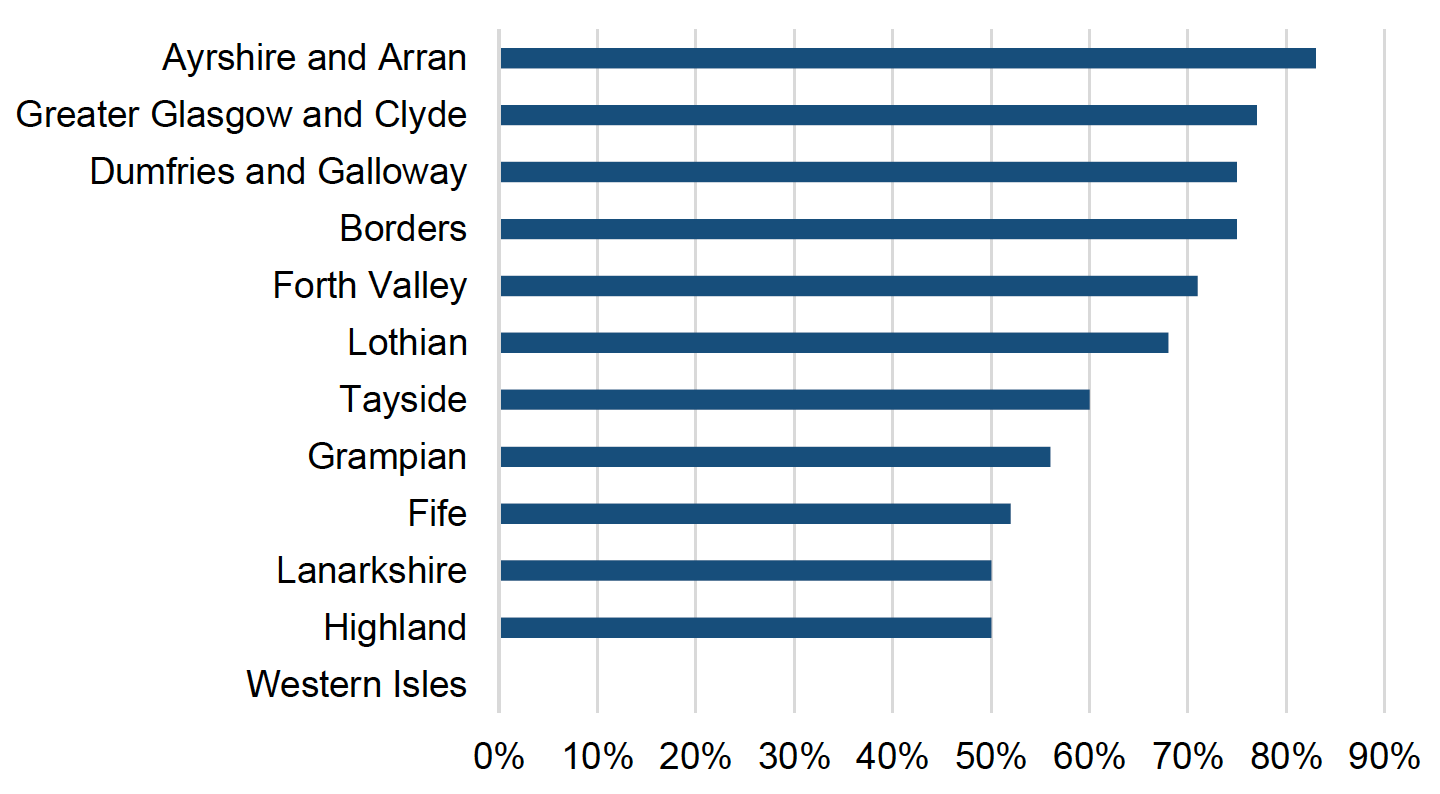
If Yes, please tick all that apply. Options: National online training; Your own practice training; Training offered by your health board; Other
Among the 102 practices that reported receiving training, national online training was the most commonly reported format (n=66), followed by practice-based training (n=39) and training provided by the practice’s health board (n=34).
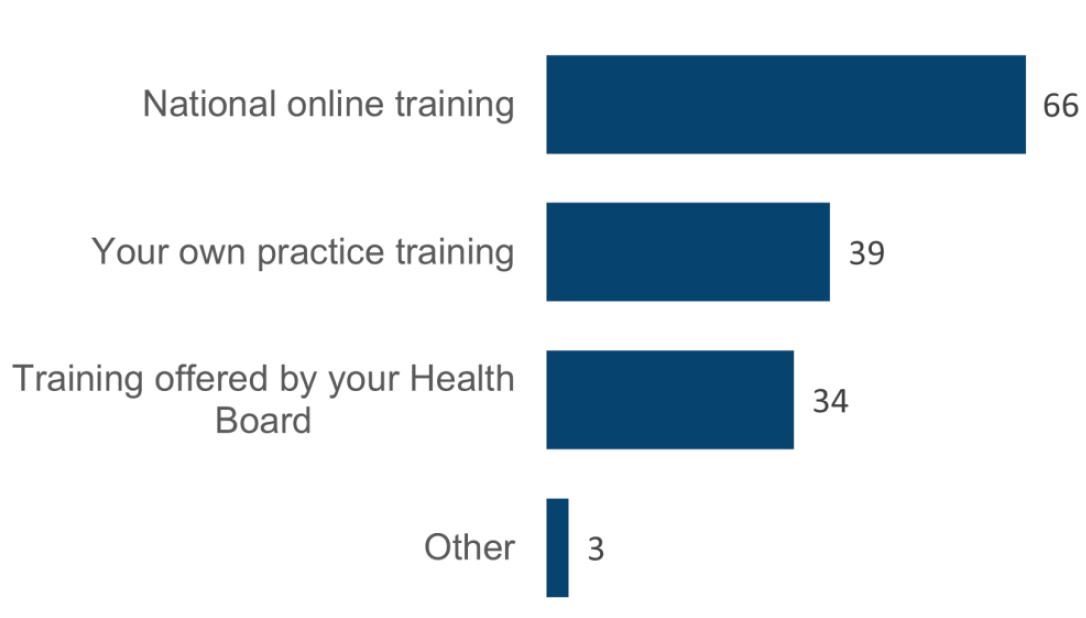
[note: Practices could select more than one response option; therefore, counts do not sum to the total number of responding practices that reported receiving training (n=102).]
Three practices selected ‘Other’ and provided free-text responses.
“Not sure who ran it.”
“I am struggling to recall - I think Lothian ran a webinar.”
“BSLM [British Society of Lifestyle Medicine] diploma.”
These findings indicate variation in how training was accessed across responding practices.
Summary findings
From survey:
- the vast majority of responding practices reported being aware of the CVD DES programme
- receipt of CVD DES implementation training exceeded non-receipt among responding practices, albeit with variation between individual health boards
- national online training was the most commonly reported type of CVD DES implementation training among practices that reported receiving training
From interviews and survey:
- the relatively rapid roll out of the CVD DES caused some frustrations; this was associated with limited time to prepare, delays in being able to access the information they needed and some initial confusion around eligibility criteria
- planning the project might have been improved by earlier engagement with Practice Managers and healthcare professionals in addition to GPs
Contact
Email: socialresearch@gov.scot