
Cardiovascular Disease Directed Enhanced Service: views and experiences of General Practices
Presents the results of an online survey and qualitative interviews conducted with General Practices across Scotland. These explored the views and experiences of practices in implementing and providing the first year of the CVD DES programme, to contribute to its ongoing evaluation.
1. Introduction
Background
Cardiovascular Disease (CVD) is the second largest cause of the overall disease burden in Scotland and the second most common cause of death after cancer. It causes 25% of all deaths in Scotland, with 4,337 avoidable CVD deaths in under 75s in 2024. In addition, mortality from coronary heart disease is five times higher in Scotland’s most deprived areas, compared to the least deprived.
Many people do not know they are living with CVD risk factors. The Scottish Health Survey suggests that 1.3 million people in Scotland are estimated to have high blood pressure, but only 24% of adults with high blood pressure are treated and controlled.
A key objective of the Scottish Government’s Cardiovascular Risk Factors Programme is to find those living with modifiable risk factors that they are currently unaware of, and to optimise early intervention and care to reduce patients’ risk of developing CVD.
The CVD Directed Enhanced Service (DES) formed part of the NHS operational improvement plan announced in April 2025 and contributes to the Scottish Government’s Cardiovascular Risk Factors Programme. This is the first national General Practice enhanced service in a number of years, with the Scottish Government allocating £10 million to General Practices in Scotland to find those patients aged 35 to 60 who have not had a full suite of CVD risk factor checks (i.e. blood pressure; lipid profile; weight/body mass index (BMI); glycaemic level; smoking status) in the last three years. General Practices are particularly encouraged to reach out to patients facing higher levels of deprivation and those who may traditionally under-utilise healthcare services.[1]
Further information on the implementation of the CVD DES can be found on the NHS Scotland’s Right Decisions website. The 2025 to 2026 circular[2] sent to Health Boards by the Scottish Government’s Primary Care Directorate provides further information on the operation of the CVD DES, including that General Practices were informed of a capped amount of funding and the number of patients expected to be identified and offered checks. This was based on the number of patients in each General Practice weighted by Standardised Mortality Ratio for Coronary Heart Disease Death and by Scottish Index of Multiple Deprivation (SIMD).
Scottish Government Uptake information for 2025 to 2026 highlights that:
- Between April and December 2025, General Practices reported that 82,405 patients had received the CVD risk factors bundle check, the first stage of the DES. Of these patients, 30,590 (37%) were living in the most deprived 20% of areas in Scotland.
- In addition to the risk factors bundle check, 54,397 (66%) of the 82,405 patients had received the complete CVD DES intervention, including a follow-up clinical review appointment.
- Of those patients who completed the full intervention, 23,820 (44%) were living in the most deprived 20% of areas and 8,291 (15%) were identified as being at increased risk of CVD and received advice on managing risk factors. Of the latter, 3,901 (47%) were living in the most deprived 20% of areas.
The implementation of the CVD DES and the wider CVD Risk Factors programme, and the outcomes they achieve, is being monitored and evaluated to enable learning about whether it is working as intended, is reaching the target group and is contributing to lower morbidity and mortality. The learning from this broader package of work will be incorporated into future development of the CVD DES programme. To enable this monitoring and evaluation, the Scottish Government has developed theories of change for the CVD DES and the wider programme and indicators and measures defined. Many of these indicators require quantitative analysis utilising primary care records, but other indicators need qualitative data on the views and experiences of key stakeholders.
Overview of survey and interview research strands
This report presents the findings of two separate research projects that explored General Practices’ experiences of, and views on, the CVD DES:
- an online survey conducted and analysed by the Scottish Government
- qualitative research that included 31 interviews conducted by an independent research company (Craigforth)
The qualitative research was part funded by the British Heart Foundation Intermediate Basic Science Research Fellowship (FS/IBSRF/23/25161) held by Dorien M. Kimenai.
The aim of both research strands was to explore the views and experiences of practices in implementing and providing the CVD DES, and in so doing to:
- contribute evidence to enable the Scottish Government to better understand how the programme has been implemented and why it is working or is not
- enable assumptions on how the programme may achieve its impact to be tested
- inform future developments of the CVD risk factor programme
Analysis of, and reporting on, the online survey returns was undertaken by the Scottish Government Health and Social Care Analysis Strategic Insights Unit.
Craigforth undertook, analysed and reported on the interviews and have worked with the Scottish Government to produce this combined research findings report.
Online survey – conducted by the Scottish Government
The online survey (attached at Annex A) comprised 29 questions covering NHS Board and General Practice details, programme delivery and implementation, and experiences of implementing the CVD DES. It included both closed- and open-ended questions exploring awareness of the programme and receipt of training; use of clinical toolkits and pathways; approaches to identifying and engaging eligible patients; and perceptions of the programme’s impact on workload and practice operations. Practices were also given the opportunity to opt into a follow-up interview to discuss their experiences in more detail and contribute to the qualitative research project.
The survey was distributed in mid-January 2026 through Primary Care Leads, who were asked by the Scottish Government Primary Care policy team to circulate the invitation to all General Practices within their respective health board networks. While this approach enabled rapid dissemination across General Practices in Scotland, it was not possible to determine the extent to which the invitation reached all practices. Consequently, a response rate could not be calculated.
Responses to closed-ended survey questions were summarised as counts descriptively. Counts and proportions were then used to summarise response patterns and generate bar charts. Supplementary subgroup analyses were undertaken to provide additional insights where considered useful. These included breakdowns by deprivation, urban/rural classification and NHS Board.
Responses to open-ended responses were analysed using a thematic analysis approach to explore the range and diversity of experiences of implementing the programme. The focus was on understanding the nature and meaning of General Practices’ experiences. Illustrative quotations are included in the report to provide examples of the themes identified.
Further information about the approach and analyses is set out in the Method Statement at Annex B.
Interviews – conducted by Craigforth
The Scottish Government commissioned an independent research company (Craigforth) to undertake qualitative research with General Practitioners. The research focused on:
- understanding the choices that practices have made when participating in and implementing the CVD DES
- whether they have felt sufficiently supported during their involvement with the CVD DES
- what they feel is working well and where there is room for improvement
- the extent to which practices feel that they are reaching the target population and making a difference through delivery of policy and practice focused outputs
The interview questions are attached at Annex A.
The qualitative element was designed to complement the quantitative data being gathered from practices by the Scottish Government.
The Scottish Government passed on summary information (General Practice name and contact details etc.) for the 40 practices that indicated that they would be willing to participate in follow up research when completing the online survey, or responded to a subsequent email request which Primary Care leads were asked to distribute to all General Practices in their board area.
Interviews took place between 9 June and 8 July 2026, were conducted on Microsoft Teams and were recorded. They took an average of 40 minutes with a range of 25 minutes to 70 minutes.
Framework analysis was used to ensure a systematic and structured approach. A draft analysis framework, structured around the research questions and final research tools (i.e. the interview schedule), was developed. The focus was on producing an account of the full range of experiences and views from practices, identifying any relevant examples or case studies, and highlighting cross-cutting themes. This included whether there may have been a relationship between experiences/views about the CVD DES and General Practice profile (for example whether in an urban or rural area etc.).
Based on discussions with the project’s Research Advisory Group (RAG), it was decided that the quantitative (online survey) and qualitative research findings would be presented together in a single research findings report.
A write up of the survey results was produced by the Scottish Government. This was shared with Craigforth who then produced the full draft report, including by adding in their analysis from the interviews.
The RAG was asked to comment on the full draft report, with revisions made by the Scottish Government and Craigforth teams as required.
Profile of survey respondents and interviewees
Online survey
A total of 164 responses to the online survey were received from GP practices in Scotland. With the exception of two practices that submitted two responses each, all practices submitted a single response. As the survey was intended to capture one response per practice, only the earliest response was retained where duplicate submissions were identified. The final sample therefore comprised 162 General Practices. There were 880 practices in Scotland at the time of this survey, of which about 95% were participating in the CVD DES.
Interviews
A total of 31 practices made a member of staff available for interview. To note that 24 of these practices had also completed the survey i.e. they were a subset of the 164 survey respondents.
Each practice put forward the person they considered most appropriate for interview. There were 13 Practice Managers, 13 GPs and five Other Health Professionals (an Advance Nurse Practitioner, two Nurses, a Pharmacist and a Physician Associate).
The profile information set out below has been produced by the qualitative research team using information supplied by the Scottish Government.
The health board-based profile of the General Practices taking part is set out in Table 1 below, where practices are also grouped according to the size of their patient list. Practices are categorised as small (<5,000 patients), medium (5,000-10,000 patients), and large (>10,000 patients).
| NHS Board | Small practice (< 5,000 patients) | Medium practice (5-10,000 patients) | Large practice (> 10,000 patients) | Total |
|---|---|---|---|---|
| Ayrshire and Arran | 0 | 0 | 1 | 1 |
| Borders | 0 | 0 | 1 | 1 |
| Dumfries and Galloway | 0 | 1 | 0 | 1 |
| Fife | 2 | 3 | 0 | 5 |
| Forth Valley | 0 | 0 | 1 | 1 |
| Grampian | 0 | 2 | 2 | 4 |
| Greater Glasgow and Clyde | 1 | 4 | 1 | 6 |
| Highland | 0 | 1 | 0 | 1 |
| Lanarkshire | 0 | 1 | 2 | 3 |
| Lothian | 0 | 3 | 2 | 5 |
| Tayside | 0 | 3 | 0 | 3 |
| All | 3 | 18 | 10 | 31 |
General Practices from 11 of Scotland’s 14 territorial health boards took part; there were no practices based in the Orkney, Shetland or Western Isles health board areas. Most of the practices interviewed (18 out of 31) were medium sized, while 10 were large. Only three small practices took part.
Table 2 (below) presents the maximum number of CVD DES checks for which the 31 practices were funded in 2025 to 2026 (i.e. the first year of the CVD DES). As noted above, this was based on the number of patients in each practice weighted by Standardised Mortality Ratio for Coronary Heart Disease Death and by Scottish Index of Multiple Deprivation (SIMD).
| Capped number of places allocated (banded) | Small practice (< 5,000 patients) | Medium practice (5-10,000 patients) | Large practice (> 10,000 patients) | Total |
|---|---|---|---|---|
| 0-49 | 1 | 0 | 0 | 1 |
| 50-99 | 1 | 7 | 0 | 8 |
| 100-149 | 0 | 7 | 1 | 8 |
| 150-199 | 1 | 3 | 2 | 6 |
| 200-249 | 0 | 1 | 4 | 5 |
| 250-299 | 0 | 0 | 3 | 3 |
| All | 3 | 18 | 10 | 31 |
The number of places per practice was most likely to fall into either the 50-99 or 100-149 range. Overall, and reflecting the relationship between number of places and the size of the patient list, smaller practices were likely to have fewer places, and larger practices were likely to have a larger number of places. However, the age and socio-economic profile of the patient list have the potential to shift that number up or down (relative to practices of the same size).
| Percentage of patients living in 20% most deprived areas (banded) | Small practice (< 5,000 patients) | Medium practice (5-10,000 patients) | Large practice (> 10,000 patients) | Total |
|---|---|---|---|---|
| 0-10 | 2 | 9 | 4 | 15 |
| 11-20 | 0 | 1 | 1 | 2 |
| 21-30 | 0 | 3 | 4 | 7 |
| 31-40 | 0 | 2 | 1 | 3 |
| 41-50 | 0 | 0 | 0 | 0 |
| 51-60 | 0 | 0 | 0 | 0 |
| 61-70 | 1 | 2 | 0 | 3 |
| 71-80 | 0 | 1 | 0 | 1 |
| All | 3 | 18 | 10 | 31 |
Of the 31 practices that took part in an interview, 15 had 10% or less of their patient list living in one of Scotland’s most deprived areas. To note, however, that at interview a number of interviewees commented that, whilst their practice was serving a relatively affluent area overall, they also covered small areas or pockets of deprivation. This might, for example, have been a particular estate within a town, or a particular village within a more rural area.
Sample representativeness of online survey and interviews
Both the survey and interview samples were broadly representative of the Scottish population in terms of deprivation and urban-rural classification. However, representation varied across NHS Boards. These factors should be considered when interpreting the findings. Further detail is presented in the sections below.
NHS Boards
At a national level, the General Practices in the online survey sample represented 21% of the total GP registered population. Coverage of the CVD DES sample varied across NHS Boards, ranging from 0% in NHS Orkney and NHS Shetland to 46% in NHS Forth Valley and NHS Fife (Figure 1).
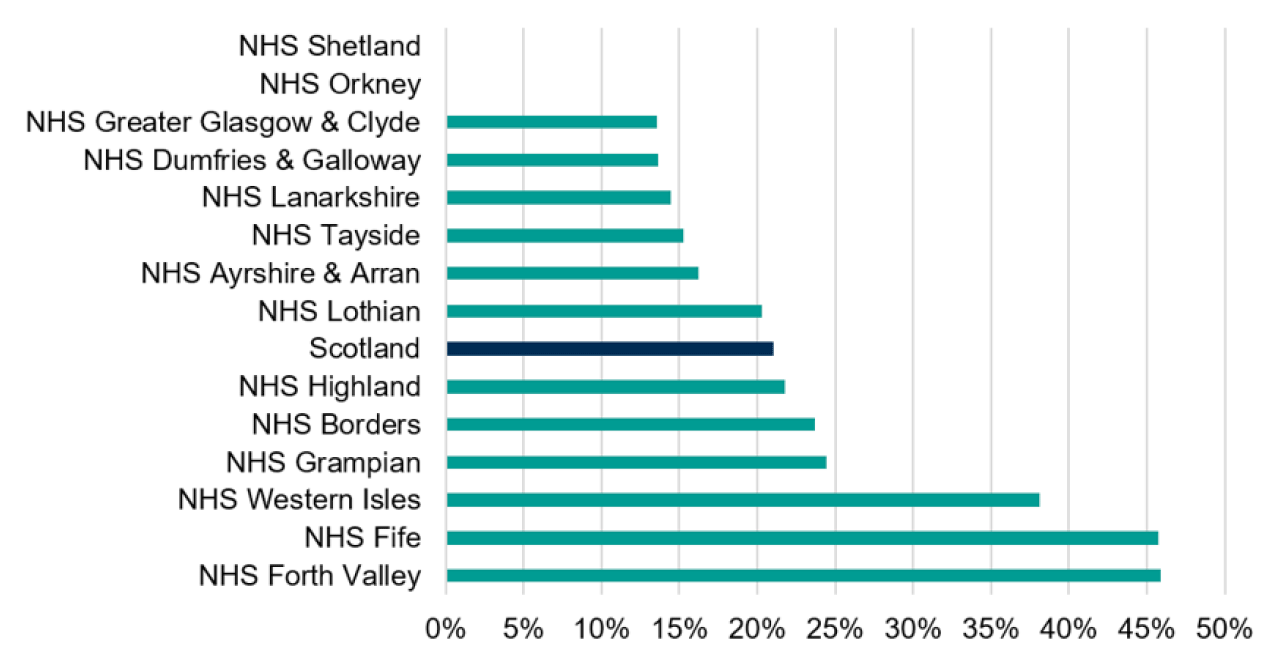
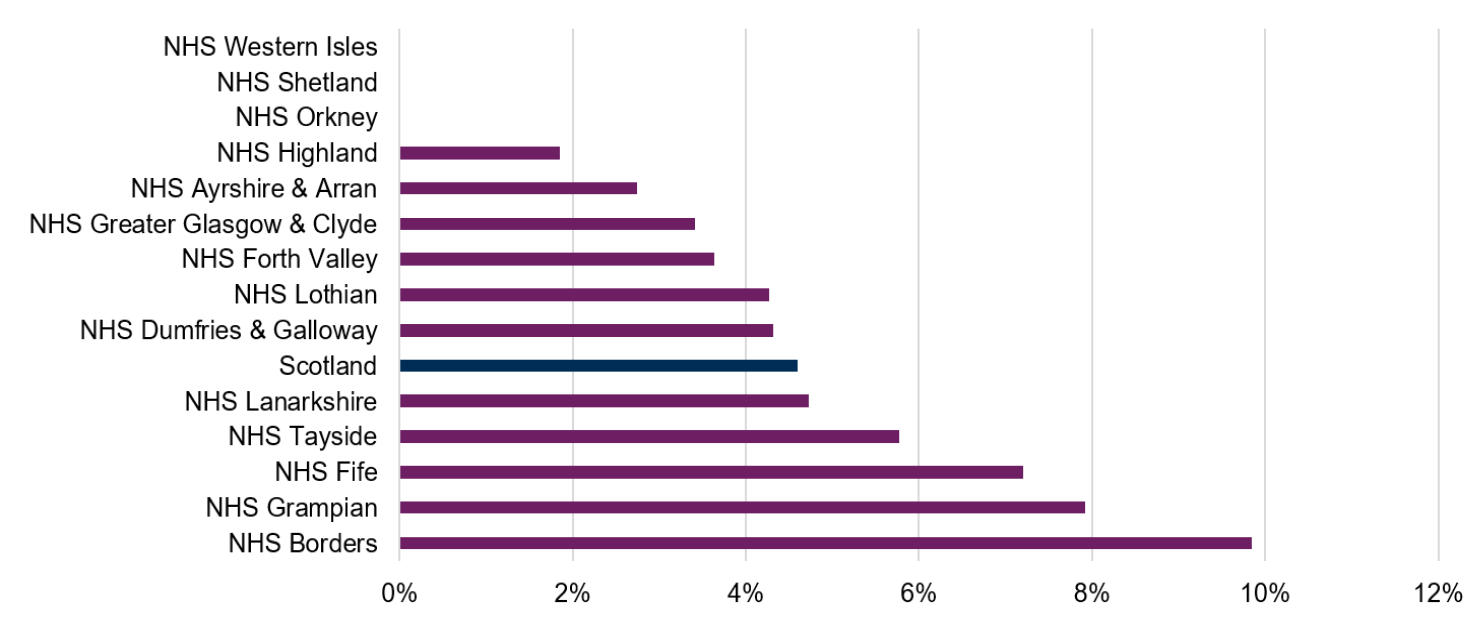
[note for Figures 1 and 2: One practice was removed from the analysis as their list size was not available in the latest available practice population data.]
The practices in the interview sample represented 5% of the total GP registered population. Again, coverage of the CVD DES sample varied across NHS Boards, ranging from 0% in NHS Orkney and NHS Shetland to 10% in NHS Borders (Figure 2).
Deprivation
The distribution of the online survey sample across SIMD quintiles closely reflected that of the overall GP registered population (Figure 3). Each quintile represented approximately 20-21% of the population nationally, and the survey sample showed a very similar pattern (19-22%).
The interview subsample was also broadly representative of the national deprivation profile, with representation across all quintiles ranging from 18% to 22% (Figure 3).
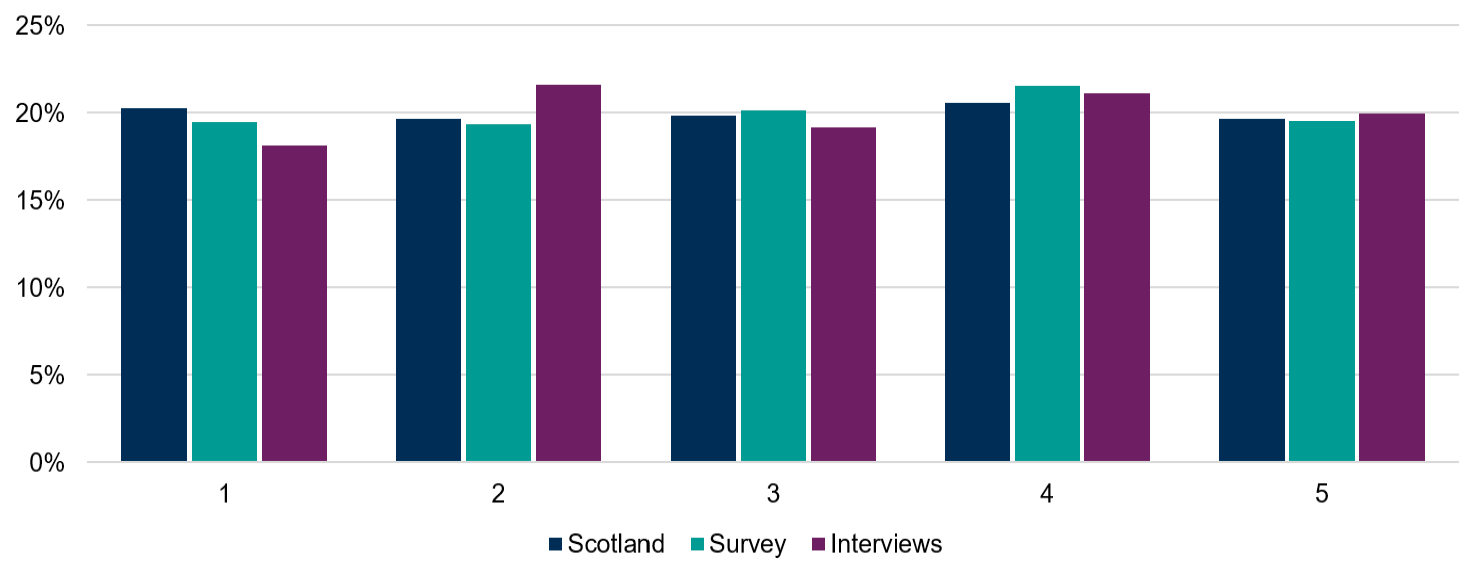
[note: SIMD categories are broken down by quintile. SIMD 1 represent patients living in the 20% most deprived areas, while SIMD 5 represent patients living in the 20% least deprived areas.]
Urban-rural
Nationally, 84% of patients registered with General Practices live in urban areas and 16% in rural areas. This distribution was similar to 83% of the online survey sample living in urban areas and 17% living in rural areas (Figure 4).
The interview subsample was also generally representative of the national population profile, with 84% of patients living in urban areas and 16% living in rural areas (Figure 4).
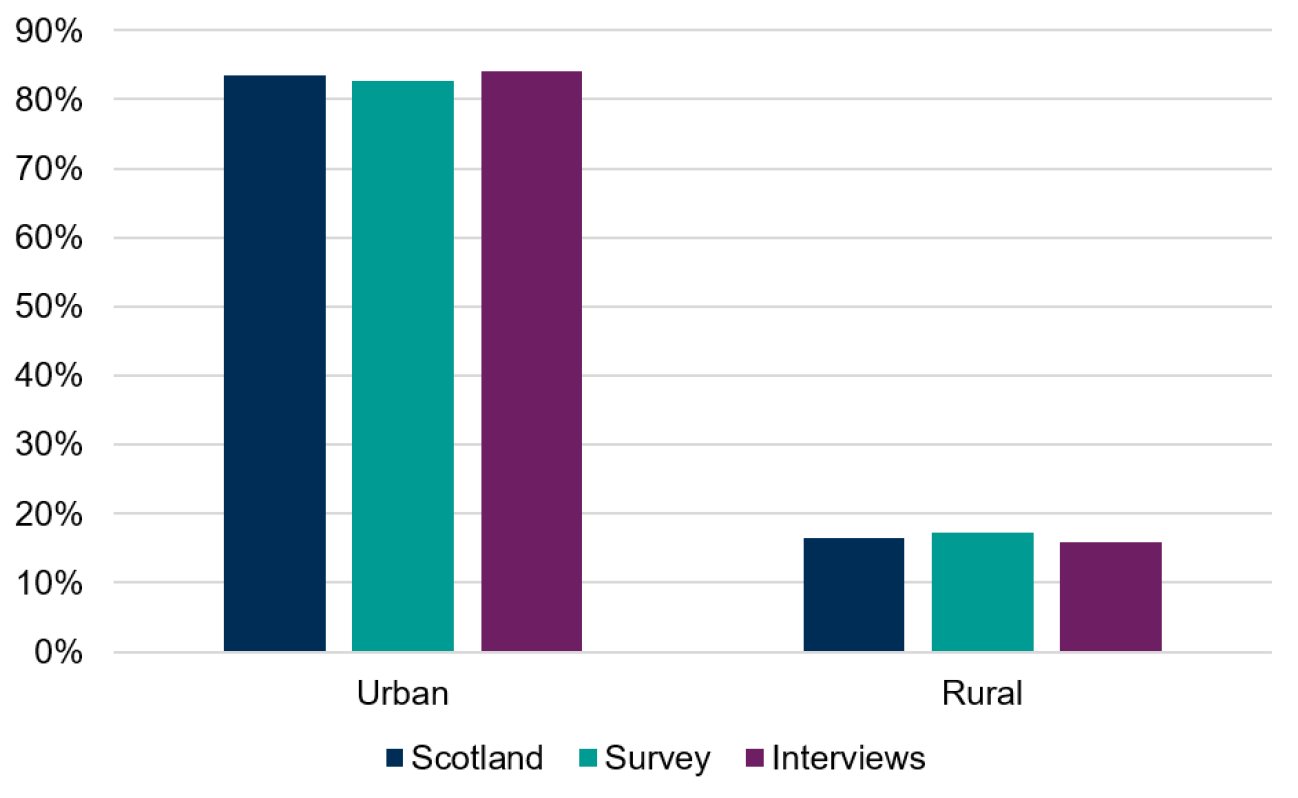
[note: Urban-rural categories are broken down by the patient’s 2020 Scottish Government Urban Rural Classification. The Urban category includes Large Urban Areas; Other Urban Areas; Accessible Small Towns; Remote Small Towns; Very Remote Small Towns. The Rural category includes Accessible Rural; Remote Rural; Very Remote Rural.]
This report
As noted above, this report presents the findings from both research strands, with the source of the findings (online survey, interviews or both online survey and interviews) set out at the start of each sub-section.
Other points to note are that:
- for the online survey findings, ‘n’ refers to the number of practices represented in the reported result
- to aid integration with the findings from the interview component, the results of the online survey may not be presented in the same order in which the questions were set out originally
- the analysis of the interviews reflects the qualitative nature of that strand, although occasional references may be made to frequently made points; to be frequently made requires the point to have been made by at least 1 in 5 interviewees (i.e. 6 interviewees or more)
- where notable or relevant, the interview findings may note the role of the interviewee within their practice i.e. whether a GP, Practice Manager or Other Health Professional
- the interview findings may also highlight any features of an interviewee’s practice that may be helpful in setting their views or experiences in context for example in terms of practice size, whether in an urban or rural area, relative levels of deprivation etc.
The report is structured as follows:
1. Introduction (this chapter)
2. Reasons for participating: looks at the interview findings about why General Practices decided to participate in the CVD DES.
3. Set up and training: draws on both the survey and interview findings in relation to the early stages of the 2025 to 2026 CVD DES and then goes on to present survey findings relating to awareness of the CVD DES and training.
4. Identifying and selecting patients: draws on both the survey findings and the views and experience shared through the interviews. It focuses on how General Practices decided to prioritise the patients they invited for a CVD DES health check and how they went about identifying those patients.
5. Approaches to patient engagement: draws on both the survey findings and the views and experiences shared through the interviews. It looks first at the common approaches that General Practices used to invite patients for CVD checks and then goes on to look at some of the approaches that differed from the standard, including through engagement with external organisations.
6. Take up and the profile of those engaging: draws on both the survey and interview findings to look first at appointment uptake and then goes on to consider who did, or did not, participate in the CVD DES.
7. Clinical assessment and outcomes: draws on both the survey and interview findings to consider the approach and tools General Practices were asked to use to assess patients’ cardiovascular risk and then goes on to look at practices’ observations about the types of health issues that were identified through the CVD DES. The chapter concludes with General Practices’ thoughts on the core elements of the DES, both in terms of the target groups and the focus on CVD.
8. Delivery, workload and resources: draws on both the survey and interview findings. It looks at some of the practical issues associated with delivery of the CVD DES, including software-related issues, the overall approach to delivering the CVD DES, and the experiences of General Practices in coding the outcomes of a consultation. It then goes on to consider workload and resourcing issues.
9. Emerging lessons on impact and next steps: draws on both the survey and interview findings. It looks first at General Practices’ decisions to continue into year 2 of the CVD DES and any views on potential involvement beyond the second year if the CVD DES continues. It then goes on to consider whether they are looking, or plan to look at different ways of engaging with patients as a result of participating in the CVD DES. The chapter concludes by summarising survey and interview participants’ overall reflections on the CVD DES and then presents some suggestions for possible changes going forward made by interviewees.
Contact
Email: socialresearch@gov.scot