
Cardiovascular Disease Directed Enhanced Service: views and experiences of General Practices
Presents the results of an online survey and qualitative interviews conducted with General Practices across Scotland. These explored the views and experiences of practices in implementing and providing the first year of the CVD DES programme, to contribute to its ongoing evaluation.
4. Identifying and selecting patients
This chapter draws on both the survey findings and the views and experience shared through the interviews. It focuses on how General Practices decided to prioritise the patients they invited for a CVD DES health check and how they went about identifying those patients.
Who practices targeted (survey and interview findings)
As noted in the introduction, each practice knew a capped amount of funding was available, with the number of patients expected to be identified and offered checks based on the number of patients in each practice weighted by Standardised Mortality Ratio for Coronary Heart Disease Death and by SIMD. This meant that there would always have been more patients who met the eligibility criteria on a practice’s list than the number of patients they were funded to see.
In addition to targeting patients in areas of higher deprivation, practices were also expected to consider “missingness”, i.e. patients with no recent contact with their practice.[6]
Survey question: Are you stratifying your patients list and/or targeting invitations (within your cap allowance) to reach the cohort in your practice catchment who could be classed as living with deprivation or who have repeatedly failed to engage with offers of healthcare?
Of 162 practices that responded to the survey, 83% (n=134) reported stratifying and targeting invitations for deprived or non-engaging patient groups, while 17% (n= 28) indicated that they did not. This suggests that targeted approaches were widely adopted as a core component of programme delivery, reflecting an intention to prioritise patients most at risk of poor outcomes or least likely to engage with care, within the limits of the programme’s cap allocation.
Supplementary subgroup analysis (see Annex B) showed that most practices reported stratifying their patient list and/or targeting invitations, regardless of deprivation profile. Among practices with a higher representation of patients living in deprived areas (n=64), 83% of practices (n=53) reported using targeted approaches. This was similar to the remaining practices (n=97), with a lower representation of patients from deprived areas, where 82% of practices (n=80) reported stratifying patient lists and/or targeting invitations.
Supplementary subgroup analysis (see Annex B) also showed that most practices reported stratifying their patient list and/or targeting invitations, regardless of the proportion of patients living in rural areas. Among practices with a higher representation of patients living in rural areas (n=60), 82% of practices (n=49) reported using targeted approaches. This was similar to the remaining practices (n=101), with a lower representation of rural patients, where 83% (n=84) reported stratifying patient lists and/or targeting invitations.
Interviewees were also asked about how they decided which patients were to be invited for a CVD DES appointment, including whether and how they factored in deprivation and ‘missingness’. In line with the survey findings, most interviewees reported that, based on their understanding of the aims of the CVD DES, they had looked first to patients living in the most socio-economically deprived areas covered by their practice.
General Practices’ experiences were inevitably very varied depending on the socio-economic profile of their patient population and the number of patients they were funded to see, but the starting point tended to be to look first at how to prioritise (or not) those living at SIMD 1 and 2 areas. In a small number of cases, an SIMD 3 area was the most deprived area covered by the practice.
Within the eligible group, a range of targeting approaches were then taken, with these often evolving over the course of the year and/or being used in combination. Interviewees referred to:
- inviting everyone who was eligible, the rationale being that take-up rate would not exceed capacity
- holding a webinar to which all eligible patients were invited, with the potential for follow up if requested
- random sampling of those eligible
- working through their list in alphabetical order
Age was sometimes a consideration, including:
- targeting younger patients first, the rationale being this might provide greatest relative benefit from adopting a preventative approach
- prioritising the older age groups within the permitted range, the rationale being they were more likely to be at risk of CVD and might also be more likely to attend
Practices had also used a range of approaches built around the selection/targeting of individual patients. These included:
- a medical professional, and sometimes a GP, working through their list to identify patients for whom a CVD check might be of greatest benefit; factors taken into account included ethnicity, family history and existing non-CVD related medical conditions, such as respiratory conditions
- looking through the list of eligible patients and targeting those most likely to be interested and then keep an appointment
- using a Links Worker[7] to identify patients who might be interested in participating
- extending the offer to a partner – for example if someone had been invited and had taken up the offer, asking if their partner would also like to participate
There was also targeting related to levels of contact, based around:
- fewest previous interactions with the practice, or who had not been seen recently; examples given included within 1 to 5 years, 3 years, several years, and up to 10+ years
- where there were no measurements and no recent test results on record
A contrasting approach was based around targeting patients with whom the practice already had recent or regular contact, but for whom there were information gaps or who had not had the requisite blood tests recently. The specifics varied, but included targeting patients:
- with known health conditions or lifestyle issues (e.g high BMI, high blood pressure or being a smoker) already on record, the rationale being they may be more likely to have other elevated CVD-related risk factors[8]
- already visiting the surgery for another reason, including either at the time of the visit or in advance of the existing appointment; there were references to existing appointments relating to mental health, contraception or substance misuse
This was sometimes articulated as an approach still looking to focus on those living in the more deprived areas, but sometimes also just as a general approach.
Although some practices had used a single or dominant approach throughout, others spoke of adopting a ‘mix and match’ approach, often by adding different elements over the course of the first year of the programme. This was generally driven by what was, or was not, working (discussed further below).
However, there were also occasional frustrations expressed by those who felt they had tried to deliver within what they saw as the spirit of the CVD DES – in terms of focusing on not only those in relative deprivation but also their ‘missing’ patients – about approaches they had understood others to be using.
“I'm aware of peers where… all they did was a bit of a mop up in terms of…we’ve got everything apart from this patient’s weight. So, if we get the weight, then that’s that… whereas that was not the spirit in terms of what we were trying to achieve… obviously the funding’s still there regardless, but I don’t think that was necessarily in the spirit of what the programme’s designed for.” GP, small practice in a rural area with relatively low levels of people living in deprived areas
Those who were taking an approach which party or wholly targeted those already in contact with the practice tended to see benefits in taking an opportunistic approach, including in making sure they were able to engage enough patients to deliver the number of interventions for which they had been funded.
“So we took a bit of a two-pronged approach to it… let’s look at the low hanging fruit and see where we can get some quick wins and then… let’s look at working our way through systematically.”
Practice Manager, medium sized practice in an urban area with a relatively high proportion of people living in deprived areas
This type of approach was also seen as offering a range of other practical benefits, for the patient – in terms of only needing to make one visit to the surgery – but also systemically. The expectation and experience were that it led to lower dropout rates, with fewer missed appointments. Another major benefit identified with taking this more opportunistic approach was the potential to add-on the CVD-related elements where a blood test was already required, thus potentially reducing any additional pressure on phlebotomy services stemming from the CVD DES.
However, it was also acknowledged that this type of opportunistic approach inevitably reduces any potential to deliver against one of the aims of the CVD DES, to engage with the ‘missing’ patients. The extent to which interviewees thought that any of the approaches are delivering against this aim is discussed further in Chapter 6).
Identifying eligible patients and target group – use of the ESCRO tool (survey and interview findings)
ESCRO is the sole integrated solution for the current requirements for Enhanced Services reporting within NHS Scotland. ESCRO modules include Alcohol Brief Intervention, Depression, Diabetes, Drug Misuse and Near Patient Testing.
The CVD DES circular 2025 to 2026 set out that practices should search their patient lists to identify eligible patients and should use local knowledge to target patients in higher deprivation. It went on to state that practices were required to download and use the ESCRO tool to identify an eligible population report at a patient level, using data held on practice servers. It noted that this list is grouped by SIMD using reference tables of postcode/SIMD that are embedded in the existing ESCRO data pump already deployed on every practice server to support the vaccination programme.
The ESCRO tool was also used as the primary reporting tool for the CVD DES. Practices’ wider experiences of using the tool, covered by both the survey and the interviews is covered further below at Chapter 8. The findings presented here relate only to using ESCRO to identify the eligible patient group and/or as an aid to targeting patients with particular characteristics within that wider eligible group.
Survey question: If you are stratifying your patient list and/or targeting invitations, how did you go about this?
Please tick all that apply. Options: Used ESCRO tool to stratify practice cohort list and ordered invites accordingly; Used own stratification tool to look at practice cohort list and ordered invites accordingly; Used practice staff knowledge of practice cohort to order invitation list; Other
The survey asked practices if they had made use of the ESCRO tool. Among the 134 practices that reported stratifying and targeting invitations, the ESCRO tool was the most commonly used method (84%; n=113) (Figure 7).
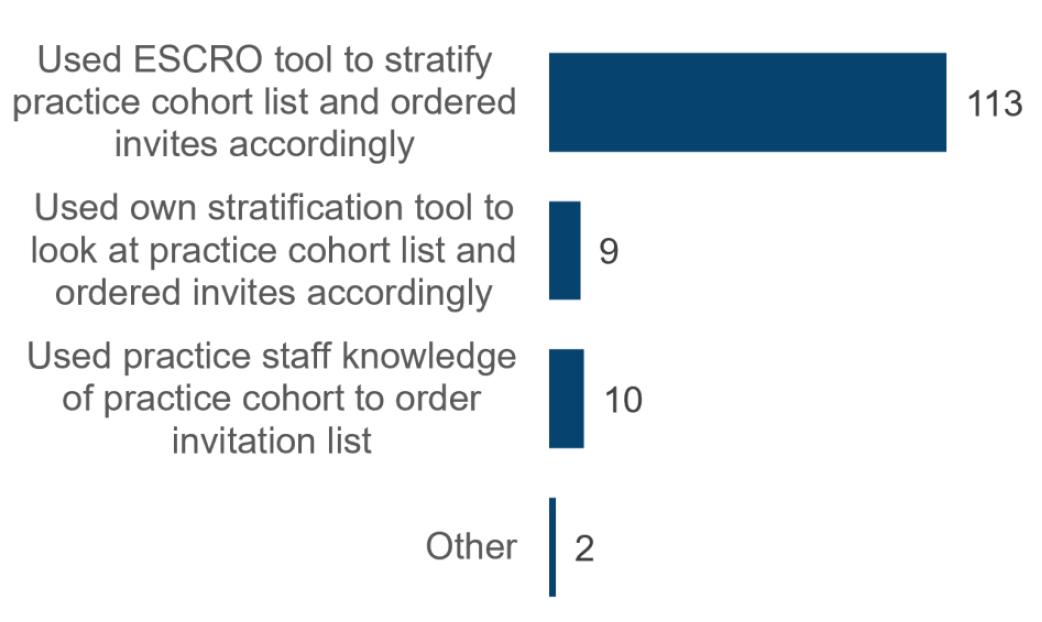
[note: General Practices could select more than one response option]
Other approaches were reported less frequently, including relying on practice knowledge (n=10) and using internally developed tools (n=9). Two practices provided free-text responses.
“Mixture of ESCRO and opportunistic approach helped target those in more socially deprived areas, text messages do not always work, nor do phone calls.”
“A combination of all three above.”
The findings indicate a high degree of reliance on the ESCRO tool to support stratification and targeting, with comparatively few practices reporting the use of alternative or supplementary approaches.
Survey question: If you are not stratifying your patients list and/or targeting invitations, what criteria did you use choose who to invite from your practice cohort of eligible patients?
Please tick all that apply. Options: Age of patient; Address of patient; Date of patient’s last contact with the practice; Patient’s health status; Opportunistic approach; Other
Among the 28 practices that reported not stratifying and targeting invitations, opportunistic approaches (46%; n=13) and age-based selection (39%; n=11) were the most commonly reported methods for identifying patients for CVD checks. Other approaches related to selection based on patient health status (21%; n=6), patient address (11%; n=3), and the date of the patient’s last contact with the practice (11%; n=3). Practices could select more than one option; therefore, percentages do not sum to 100%.
Free-text responses (32%; n=9) reflected a variety of approaches that related to pragmatic selection methods (‘fewest criteria to be met to achieve CVD DES goals’, ‘random selection’, ‘list order’), and the use of available data (‘using available info to estimate high risk individuals’, ‘ESCRO register’, ‘lowest deprived areas’).
Taken together, these survey findings suggest that, in the absence of structured stratification, patient identification appeared to rely on a mix of opportunistic, simplified, and context-dependent approaches, shaped both by practical constraints and locally determined processes.
Interviewees were also asked about the use of the ESCRO tool as a mechanism for identifying the wider group of patients eligible for the CVD DES and (potentially) to then identify patients with particular characteristics or circumstances to be prioritised.
Experiences were mixed; on the one hand, there were reports that ESCRO worked well in identifying both the eligible group, and then any adding characteristics the practice had chosen to prioritise. The process was described as quick and easy.
“I think the ESCRO tools are good, just a great resource… I think it works well and ….it pulls down the date, the broad data.” Other Health Professional, medium-sized practice in an urban area with a relatively high proportion of people living in deprived areas
However, others had found ESCRO difficult, challenging or time consuming to use. Issues highlighted by interviewees included that:
- some of their patients who should have been eligible were not appearing on the ESCRO list
- information was not made available early enough in the first year, with similar reports of not having access to the information for the second year at the point of interview
- the system is slow and difficult to navigate because there are no search parameters
- it is difficult to isolate the ‘missing’ patient group
- the format in which the data can be exported does not support follow up processes
On this latter point, it was reported that the export to Excel generates tick boxes that cannot be sorted or used for a mail merge (since this requires data in Microsoft Word 6.0). It was also noted that patient IDs are not included, limiting the data’s use for patient contact purposes.
“…the patient name and a date of birth, and that’s it… there’s no EMIS number, there’s no CHI, there’s nothing. So, we then have to use that date of birth to build a list to be able to…do the invites. But you know, you could have 10 John Smiths that you’re taking your time to pick out and match it up …there’s room for error…”[9] Practice Manager, large practice in a small town with a relatively high proportion of people living in deprived areas
Summary findings
From survey:
- most survey respondents reported stratifying and targeting invitations for deprived or non-engaging patients, with the ESCRO tool the most commonly used method for doing so
- among survey respondents that reported not stratifying and targeting invitations, opportunistic approaches and patient age were the most commonly reported criteria used to select patients for CVD checks
From interviews:
- most interviewees reported that they had looked to prioritise patients living in the most socio-economically deprived areas covered by their practice
- a range of approaches were used to choose which individuals to approach first, including random sampling, alphabetical, age-related, or based on a health professional’s knowledge of individual patients on the practice list
- while some practices looked to target patients with whom they had fewest interactions, others approached patients who had been in recent or regular contact, but had information gaps or who had not had the requisite blood tests recently
- interviewees generally expected their practice would continue with broadly the same approach adopted in year 1, although some were considering widening their selection criteria
- interviewees reported mixed experience of using the ESCRO tool: while some found it easy it was also described as challenging or time consuming to use
Contact
Email: socialresearch@gov.scot