
Cardiovascular Disease Directed Enhanced Service: views and experiences of General Practices
Presents the results of an online survey and qualitative interviews conducted with General Practices across Scotland. These explored the views and experiences of practices in implementing and providing the first year of the CVD DES programme, to contribute to its ongoing evaluation.
5. Approaches to patient engagement
This chapter draws on both the survey findings and the views and experiences shared through the interviews. It looks first at the common approaches practices used to invite patients for CVD checks and then goes on to look at some of the approaches that differed from the standard, including through engagement with external organisations.
Survey question: What method(s) did you use to invite patients for checks. Please tick all that apply
Of 162 practices that responded to the survey, a range of methods were reported for inviting patients for checks. Text messaging was the most commonly reported approach (70%; n=114), followed by phone calls (59%; n=97). Opportunistic approaches were also widely used, including inviting patients during consultations for other issues (44%; n=72) and when patients booked appointments for other purposes (20%; n=33). More traditional methods, such as letters, were used by 29% (n=48) of responding practices, while email was less commonly used (8%; n=13).
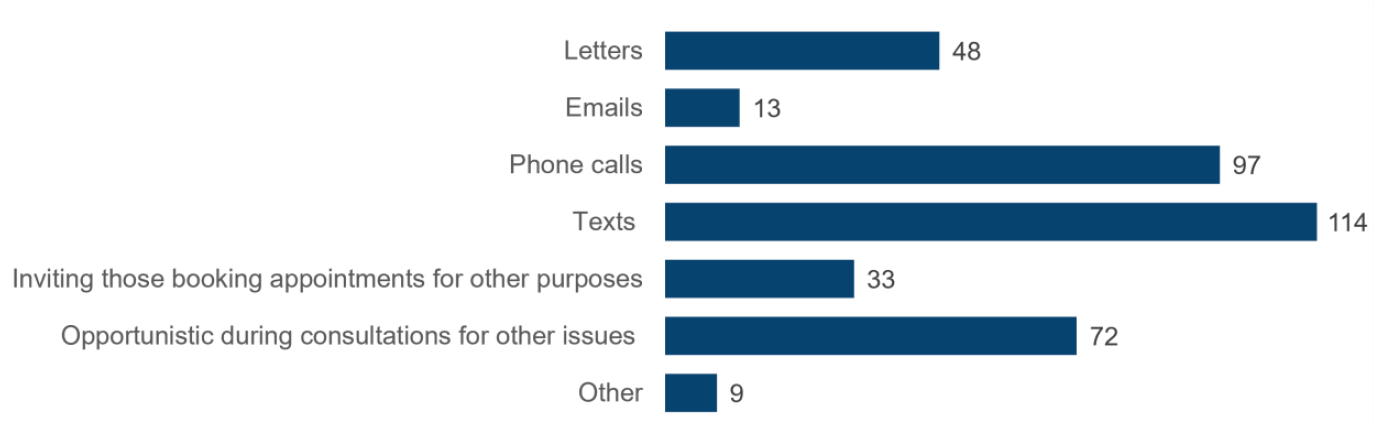
[note: Practices could select more than one response option; therefore, counts do not sum to the total number of responding practices (n=162)]
Of the nine practices that provided free-text responses, six provided descriptions of alternative engagement approaches, while three indicated that the practice had not participated in the DES. Alternative approaches included the use of digital tools (e.g. online booking platforms and practice websites), community outreach activities, patient participation groups and the use of data systems.
“Via PPG [Patient Participation Group].”
“Ran a CVD DES session at a community gala day.”
“Accurx[10] which allowed patient direct booking of appts [appointments] from text.”
“Medlink.”[11]
“Trying to utilise commenced list on ESCRO.”
“We had CVD forms linked on our webpage that were hidden, the pts [patients] were sent a text directing them to complete a form, this was helpful for making sure pts [patients] were given apps they were able to attend, we used the same method for feedback forms.”
These survey responses suggest that some practices supplemented more commonly reported approaches with locally developed digital and community-based methods.
The interviews highlighted a similarly diverse range of ways in which patients were informed about and asked if they wished to participate in the CVD DES, and also that a number of practices used a variety of approaches. This was sometimes because having tried one approach – which either did not work, or had limited success – they changed to another approach or added in additional contact methods. In line with the survey findings, interviewees were most likely to report using either text and/or phone calls to make patients aware of the CVD DES and invite them to participate.
There were no clear patterns in terms of which approaches had been successful or otherwise, although interviewees did identify a number of elements which they had found effective. These included text-based approaches that made it quick and easy to express interest and/or book an appointment, for example via:
- texts with an option to opt in – ‘if you want to hear more about this, reply yes’
- a direct booking link
- a dedicated phone number to call to book or a dedicated answer phone to register interest
- following up and initial ‘for information’ text with a phone call
Other practices had used a primarily phone call-based approach; this was sometimes because a text-based approach was not felt to be working, but was sometimes the preferred method of contact, albeit patients might have been sent some information in advance of calls being made.
In some cases, these calls were being made by admin teams/reception staff, with a script and suggested answers to possible questions sometimes provided. In other practices, the calls had been made by a healthcare professional; this was usually a GP or healthcare assistant.
Although the phone call-based approach was acknowledged as being resource-intensive, interviewees did also point to some advantages, including being able to start a dialogue, and answer any questions straightaway. This was sometimes connected to being able to allay any fears or confusion about why someone was being offered CVD-related checks; it was reported that some patients were concerned about why a practice might think they needed heart-related checks, but also that others (particularly among the younger patients being invited) did not themselves think they needed them. (This issue is picked up again in relation to take up at Chapter 6.)
Other benefits identified as arising from a phone call-based approach included making it easier to manage the number of patients going through the programme at any particular time, including making best use of available appointments, and being able to discuss the potential to ‘add on’ the CVD checks to an existing appointment (when the more opportunistic approach was being taken or partially taken).
In terms of other approaches practices had used to share information about or directly contact patients about the CVD DES, interviewees referred to:
- running a CVD DES session at a community gala day
- holding a webinar, at which patients could register interest
- putting information on the practice website, or putting up posters in the practice waiting spaces
- publicising the CVD DES via social media
- using a Patient Participation Group to spread information about the value of screening
It was sometimes noted, however, that these types of approaches are highly unlikely to generate any interest from the ‘missing’ group and, overall, they were seen as having had limited impact. Further discussion around some of the less frequently used approaches to engage patients is included in the next section.
Interviewees themselves often found it difficult to understand what had, or had not, worked well in their own area, and also sometimes noted that the approach taken had, in any case, to reflect the resources that were available. Nevertheless, in terms of possible learning going forward, interviewees pointed to:
- the benefits of clear messaging and the use of straightforward but non-alarming language; examples given included referring to a Wellness Check or General health check/MOT
- the potential benefits of a healthcare professional making the calls; although it was noted that this was a higher cost option, those going down this route tended to suggest that patients may have been more inclined to see the checks as important because a healthcare professional had made the call
- when a text-based approach was being used, the advantages of offering a dedicated booking route for CVD DES appointments, and when a call-based approach was being used, the benefit of booking the CVD DES appointment at the same time
Having a simple and straightforward way of booking an appointment was seen as important and as getting round a possible/likely barrier to participation for some.
“We set up an answer machine on one of the admin team’s phones and gave people that number. And when they answered, it said, ‘if you’re phoning about the CVD clinic…leave your details’ and then we phoned them back and booked them in. So, we were making it that there wasn’t a barrier of, ‘well, I’m not waiting for half an hour to get through to them’.” Practice Manager, large practice in an urban area with a relatively high proportion of people living in deprived areas
Other approaches, including engagement through other services or groups (survey and interview findings)
An information pack on Innovative ways to engage with people around their cardiovascular health was part of the suite of information made available to practices to support their delivery of the CVD DES.[12] Topics covered included community engagement approaches, with reference to engaging communities at different locations (such as community centres, services being run by third sector organisations, football clubs, religious buildings or the premises of large employers). The information pack also suggested linking with third sector initiatives and local groups, for example the local Men’s Shed or walking groups.
Survey question: Have you made any links with charities or other support organisations to help you implement and/or deliver the DES. If yes, please list the organisations.
Of 162 practices that responded to the survey, most (86%, n=140) reported not having established links with charities or support organisations to support CVD DES implementation and/or delivery, with a small number (14%, n=22) indicating that such links were in place. These findings suggest that charities and support organisations were not a prominent feature of CVD DES implementation and/or delivery for most responding practices, although some practices reported incorporating external support into their delivery approach.
As illustrated in Figure 9 below, reported links with charities or other support organisations were highest in NHS Tayside (50%) and NHS Borders (25%). No practices in NHS Dumfries and Galloway (0%) or NHS Western Isles (0%) reported having made such links, although the number of responding practices from these boards was small.
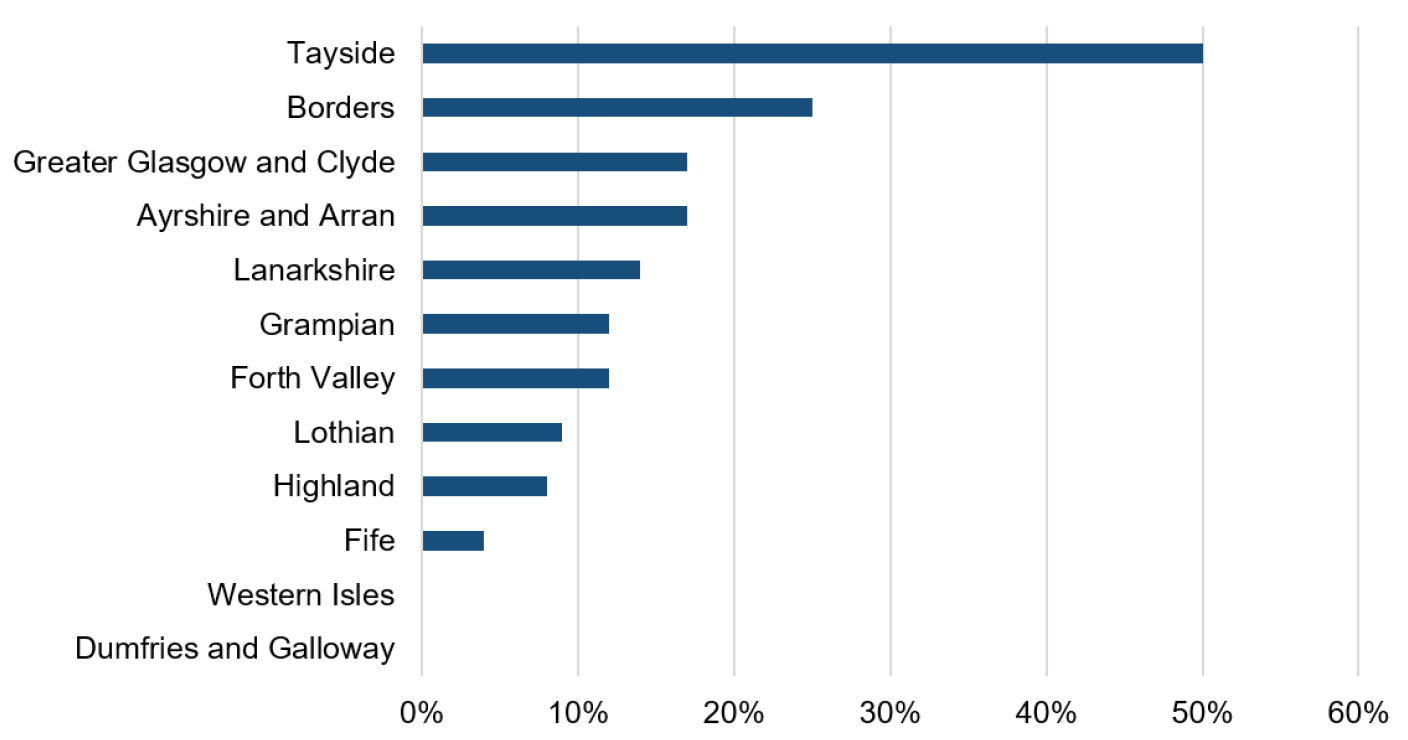
Supplementary subgroup analysis (see Annex B) showed that among practices with a higher representation of patients living in deprived areas (n=64), 14% of practices (n=9) reported having made such links. This is similar to the rate among practices with a lower representation of patients from deprived areas (n=97) where 13% (n=13) reported having made such links.
Supplementary subgroup analysis (see Annex B) also showed that among practices with a higher representation of rural patients (n=60), 20% of practices (n=12) reported having made links with charities or other support organisations. This was higher when compared with practices with a lower representation of rural patients (n=101) where 10% (n=10) reported having made such links.
Among the 22 practices that reported establishing links with charities or support organisations to support CVD DES implementation and/or delivery, a range of connections were mentioned. Reported links were most commonly with national charities (n=13), including the British Heart Foundation, Chest Heart and Stroke Scotland, Diabetes UK and Heart UK. Other commonly reported links were with local authority and community-based organisations (n=6), including Live Life Aberdeenshire and Angus Alive.
Some practices (n=4) highlighted the role of Community Links Workers and social prescribing contacts (e.g. ‘drug counsellor’) in supporting delivery, and others (n=4) mentioned links with clinical and lifestyle support services. Isolated references were made to digital support tools (n=1), links with Healthcare Improvement Scotland (n=1) as well as links with local social projects (n=1). One practice highlighted that, despite establishing a link with a local social project, workforce and capacity constraints prevented the relationship from being fully utilised.
Overall, these survey findings suggest that external support for CVD DES implementation and delivery, where established, was most commonly provided through links with national charities.
Interviewees were asked whether they had used any innovative engagement methods, such as group consultations, or outreach at community days and in particular about any non-standard approaches they had used to engage with those living in the most deprived areas covered by their practice.
Although almost all interviewees were aware of the Scottish Government information pack, most had not tried any of the community-based engagement approaches referenced. This was for a range of reasons, including that:
- it simply was not required, because other approaches used (primarily the text and call-based approaches referenced above) enabled practices to meet their targets, including with a focus on those living in more deprived areas
- timescales were too tight, and although there may have been some good suggestions, it would have taken too long to get them up and running
Interviewees also raised a number of potential challenges associated with engaging with people through public events or via drop-in sessions. These included:
- not having sufficient staff resources to take longer periods of time out of an already under strain appointment system
- not being able to easily manage the number of overall interventions for a project that had a per-place funding cap
- practical issues around taking blood samples, with the considerable resource implications in terms of collecting them, but also ensuring that the resources are available to have them analysed
- the cost of accessing point of care equipment (at potentially in excess of £10,000), being too high, even if there was potential to share costs with other practices
In addition to these practical challenges, there were also questions about how effective these types of community-based approaches were likely to be, particularly when it comes to engaging with the target population for the CVD DES, and the ‘missing’ population in particular.
The general view was that the ‘missing’ population was not likely to be accessing some of the types of events or services the information pack referred to and, more generally, that few people would be interested in discussing their cardiovascular health at a community event. There were also concerns that if people did engage, but a follow up was required, the drop-out rate was likely to be high.
One of the practices had tried attending a local gala day, with GPs, nurses from the practice, representatives from their health board’s health inclusion team and someone from Chest, Heart and Stroke Scotland all in attendance. They highlighted the significant level of resources that had gone into the day and that, although it had been a useful experience and an enjoyable day, it was not a viable approach going forward.
“…we only did checks on two of our patients. So that was three GPs that were there for probably four hours each…and also all the preparation, all the sorting everything out, getting all the equipment ready, all the back and forth… so that absolutely was not financially viable…” GP, medium-sized practice in an urban area with relatively high levels of people living in deprived areas
This event also highlighted a particular issue, which was also raised by some other interviewees, in terms of the link between community events and services, and any particular General Practice’s patient list. At this gala day event, some of those coming to speak with the practice team were patients at other practices. Other interviewees also noted the potential for community-based events to generate interest from patients at a different practice and potentially across a number of practices.
There were associated questions about whether this type of approach has the potential to raise expectations that cannot be met – for example if someone hears about the CVD DES, goes on to contact their own practice but they are either not participating in the CVD DES or are not in a position to offer the checks, for example because of numbers of places available. These sorts of potential challenges led to suggestions that these types of community-based interventions might be best taken forward at a health board level, rather than on a practice-by-practice basis. A similar point was made about the acquisition of the type of point of care testing equipment that could support a community-based approach.
An approach which practices were more likely to have considered was organising drop-in clinics, albeit they had generally concluded that the approach was likely to have limited success; one practice commented that they have held drop-in sessions before and that they typically had only two or three patients attend (other than when sessions related to flu vaccines). They suspected that in the case of a programme being targeted particularly at those living in deprived areas, a CVD drop-in session would generate little if any interest.
However, there were also reports of clinic-based approaches having been successful. For example, one practice ran a weekly evening clinic over the month of September. Information about the clinics was issued in advance, with a focus on those living in deprived areas, and over the course of the sessions, more than 2,500 patients were sent the information. Efforts to share information and generate interest were ongoing over the course of the month, including sharing a video of the first event on the practice’s Facebook page. Patients were invited to let the practice know they might be coming along, helping to minimise the paperwork that needed doing on the night and, over the course of the sessions, 360 patients attended.
“It was just drop in on the night…we had different stations, so somebody was doing heights and weights, somebody was doing blood pressure… just total screening on that night… they worked their way round the stations, which worked really well.
[with reference to one of the sessions] …it got a bit of a swell, so there was 100, over 100, 101, I think, folk came in that night. And the feeling on that night was just mad… it’s so motivational for the team to be involved in something like this as well. And to get such good patient feedback to it just makes such a huge difference to them.” Practice Manager, large practice in an urban area with a relatively high proportion of people living in deprived areas
Those who had held successful drop-in clinics planned to take a similar approach in the second year of the CVD DES but sometimes found it difficult to explain why such an approach might have worked well for their practice in particular. In terms of why they thought these types of approaches might be appealing to patients more generally they referred to:
- being invited to ‘come along’ removing barriers associated with trying to book an appointment, including a perception that this would be difficult
- weekend, early morning or evening sessions being popular with the working age population
- drop-in sessions potentially feeling less stigmatising and less like someone is being singled out; connected to this was a report that health and lifestyle-related small group sessions had proved popular
Other approaches which practices had used, and found successful from an engagement perspective, included:
- running a CVD clinic alongside a drug clinic, which helped get to patients that typically don’t attend other appointments to take part
- a Community Link Worker hosting an online webinar which emphasised an holistic approach to addressing the factors contributing to ill health
In more general terms, however, the interviews did highlight some issues about whether the CVD DES, as currently structured and funded, is the best or most appropriate vehicle for exploring innovative practice approaches, particularly for engaging the ‘missing’ population. Whilst not questioning the value or importance of trying to engage with this population, some interviewees also highlighted that developing and trying out new approaches can also be resource intensive, and that the per place funding approach and levels for the CVD DES do not necessarily give practices any leeway to explore what might, but also might not, be effective.
Summary findings
From survey:
- text messaging was the most commonly reported method used by responding practices to invite patients for checks, followed by phone calls
- most responding practices reported not having made links with charities or support organisations to support CVD DES implementation and/or delivery
From interviews:
- interviewees also reported text messages and phone calls as the most frequent methods used to invite patients to participate, with some practices using a combination of approaches
- while an entirely text-based approach worked well for some practices, others reported that a very low rate of response to texts had led them to switch to making telephone calls, even though this was more time-consuming
- phone calls could be made by admin staff or by healthcare professionals including GPs, nurses or healthcare assistants
- practices adopted various ways for patients to register their interest and book a CVD-DES appointment, including using a dedicated number to avoid patients needing to wait in a queue for the general practice number.
- although almost all interviewees were aware of the information pack suggesting innovative engagement methods, most had not tried any of the community-based approaches referenced, typically because they were not thought necessary, because of lack of time and/or resources, or because of practical issues
- while drop-in sessions had worked well for some practices, others found them much less effective and not a good return on the resources invested
Contact
Email: socialresearch@gov.scot