
Public body procurement reports and strategies 2023 to 2024: analysis
An analysis of Scottish public bodies’ annual procurement reports and strategies for the 2023 to 2024 financial year.
5. Community Benefits
Community benefit requirements are clauses added to public sector contracts to deliver further benefits to the local areas where those contracts are delivered. The 2014 Act provides the following definition of community benefit requirements:
For the purposes of this Act, a community benefit requirement is a contractual requirement imposed by a contracting authority—
(a) relating to—
(i) training and recruitment, or
(ii) the availability of sub-contracting opportunities, or
(b) which is otherwise intended to improve the economic, social or environmental wellbeing of the authority's area in a way additional to the main purpose of the contract in which the requirement is included.
Procurement Reform (Scotland) Act 2014 (asp 12), Section 24 (Scottish Government, 2014)
Section 15 of the 2014 Act states that a public body must include a statement of its general policy on the use of community benefit requirements in its procurement strategy. Additionally, in its annual procurement report, public bodies must provide a summary of any community benefit requirements imposed as part of regulated procurements that were fulfilled during the year covered by the report.
5.1 Community benefits policies
In total, 121 public bodies (97%, n=125) provided a statement within their procurement strategy on their general policy on the use of community benefits for the 2023 to 2024 reporting period.
These statements often referred to the requirement to consider community benefit clauses on regulated procurements above the £4 million threshold,[23] and plans to include them on contracts below this threshold where relevant and proportionate. Some statements in public bodies’ strategies included using community benefit requirements to support the economic, social or environmental wellbeing of the local area, and made references to their commitment to the Sustainable Procurement Duty.
Below are two examples of community benefit policies within the procurement strategies of NHS Lothian, and the Scottish Children’s Reporter Administration (SCRA).
“NHS Lothian is committed to maximising Community Benefits from its procurement activities. This will be achieved through the inclusion of specific clauses within procurement contracts known as Community Benefit Clauses. Community Benefit Clauses are contractual requirements which deliver wider benefits in addition to the core purpose of the contract. These clauses can be used to build a range of economic, social, or environmental conditions into the delivery of contracts. The Public Contracts (Scotland) Regulations 2015 enable public bodies to include Community Benefits in the procurement process, in certain circumstances. NHS Lothian will assess all regulated procurements for inclusion of Community Benefit Clauses. NHS Lothian will also use the Community Benefits Gateway to capture benefit requirements from our community.”
NHS Lothian Procurement Strategy 2023 - 2028 (NHS Lothian, 2023)
“SCRA requires that the potential for community benefits to be delivered is considered at procurement preparation stage for regulated procurements, prior to approval of the project procurement strategy. When developing any contract specification, consideration must be given to the suitability of including community benefit clauses, such as the requirement to provide targeted recruitment and training for disadvantaged groups. The delivery of community benefits is a contractual commitment which will provide opportunities for targeted training and recruitment, including training and jobs for long-term unemployed people, development of the skills and qualifications of the existing workforce, apprenticeships and job start positions and professional graduate training opportunities.”
Scottish Children’s Reporter Administration (SCRA) Corporate Procurement Strategy 2020 – 2024 (SCRA, 2023)
5.2 Number of regulated contracts with community benefit requirements
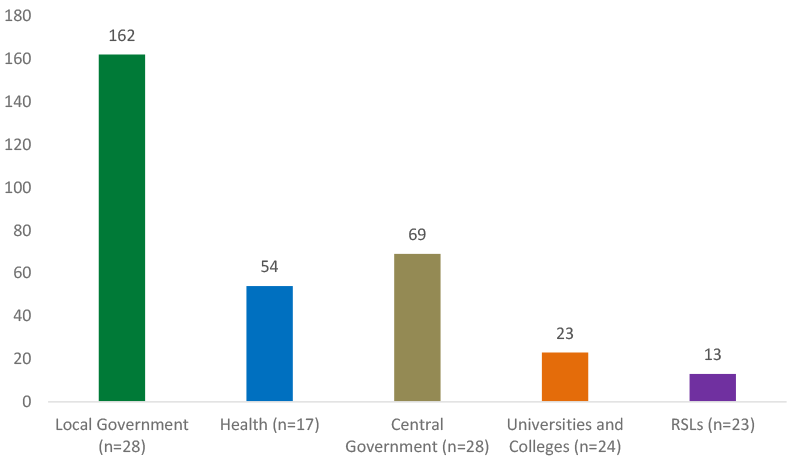
A total of 120 public bodies (97%, n=124) provided information on the number of regulated contracts awarded in 2023 to 2024 with a value of £4 million or greater which contained community benefit requirements. This represented a reported total of 321 regulated contracts, which is an average of 3 per public body.
As figure 5.1 shows, local government was the sector with the highest reported number of regulated contracts awarded with a value of £4 million or greater that contain community benefit requirements, with a reported total of 162 (n=28).
Source: 2023 to 2024 annual procurement reports
Base: n=120. Including all respondents who inserted a numerical value including (0) but excluding those entries which are blank or "N/A"
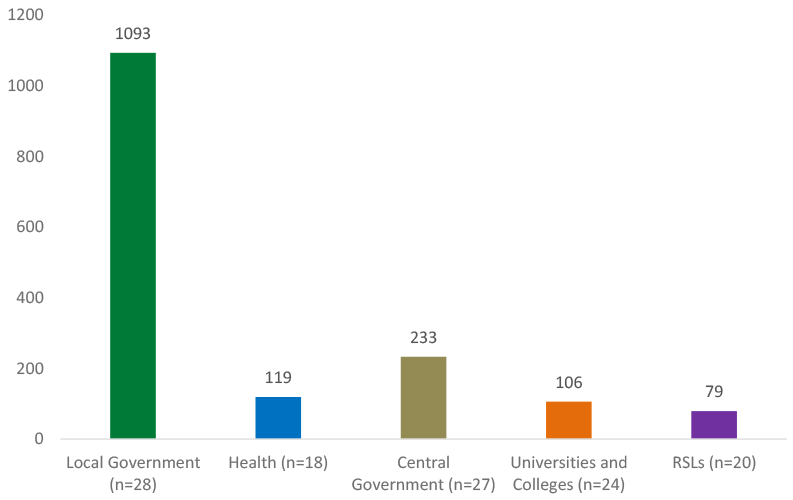
A total of 118 annual procurement reports (94%, n=124) provided information on the number of regulated contracts awarded in 2023 to 2024 with a value of less than £4 million which contained community benefit requirements. This represents a reported total of 1,630 regulated contracts, an average of 13 per public body.
As Figure 5.2 shows, local government reported the highest number of regulated contracts awarded with a value of less than £4 million that contain community benefit requirements (1,093, n=28).
Source: 2023 to 2024 annual procurement reports
Base: n=117. Including all respondents who inserted a numerical value including (0) but excluding those entries which are blank or "N/A"
5.3 Summary of community benefits delivered
A total of 123 annual procurement reports (98%, n=125) contained a summary of community benefit requirements included in public sector contracts within the 2023 to 2024 reporting period. Examples of some community benefits for the relevant period are provided below.
“A noticeboard and planters were provided for the village square, along with kids gardening tools. A mobile cooking station was provided to the local primary school. Two site visits were arranged for level 4 and 5 foundation classes at Borders College. Three classroom talks, providing presentations on careers and interview advice along with meet the apprentice sessions were also given to these students. Borders College students also benefited from a Science, Technology, Engineering and Maths (STEM) group practical demonstration on how building drawings and measurements skills are used in industry and why they are used. Our legal Services tender secured £3,000 of financial support which will be used to benefit community-based projects identified by the association.”
Eildon Housing Association Annual Procurement Report For the Period 1 April 2023 – 31 March 2024 (Eildon Housing, 2024)
“The East Ayrshire Community Defibrillator Initiative was launched by East Ayrshire Council (April 2022) in partnership with the Corporate Procurement Team, Health and Safety Team and donating companies who hold term contracts with the Council as part of their community benefit/social value contractual obligations. The initiative provides eligible community organisations with access to a defibrillator who would otherwise be unable to afford this equipment. The initiative is wholly funded through the outstanding support of the Council's contractors. The Council's goal was to make East Ayrshire a community defibrillator authority by 2026, where all communities who aspire to have access to this life-saving equipment can do so. Our groundbreaking work has been endorsed by the Save a Life for Scotland Partnership, who have recognised the Council’s efforts in helping other local authorities to put in place similar initiatives.”
East Ayrshire Council Annual Procurement Report 1 April 2023 to 31 March 2024 (East Ayrshire Council, 2024)
“Contracts we have awarded include commitments by our contractors to: provide approved work placements for secondary school pupils and support for events to promote and encourage entrepreneurship; provide opportunities for modern apprentices to be involved in the delivery of contracts; to work with us in supporting charitable causes; to participate in the Dundee Accelerator Programme and provide financial and specialist business improvement advice to assist fledgling companies to become market and investor ready; recruit school leavers providing opportunities to access Association of Accounting Technicians (AAT) and Institute of Chartered Accountants of Scotland (ICAS) professional training and membership.”
Care Inspectorate Annual Procurement Report 2023/24 (Care Inspectorate, 2024)
“The ScottishPower Apprenticeship Programme provides a fantastic way to realise potential and get multiple career routes off to the best possible start. Bringing learning and earning together. Employees study towards a nationally recognised qualification, earn a good salary, develop new skills and gain invaluable knowledge and experience. During the programme, selected candidates will join our workforce, contribute to the company goals and have the opportunity to help their career in a number of ways too.”
Police Scotland Annual Procurement Report 2023 - 2024 (Scottish Police Authority, 2024)
“Modern Apprenticeships and Trainee programmes; Establishing workforce Equality and Diversity Ambassadors; Employment of individuals from disadvantaged groups; Knowledge exchange and research collaboration; Supporting farmers to reduce antibiotic use; Direct support for student activities including hosting farm and mill visits and provision of speakers for meetings and lectures.”
Scotland’s Rural College (SRUC) Annual Procurement Report 2023-24 (SRUC, 2024)
5.4 Type of community benefits delivered
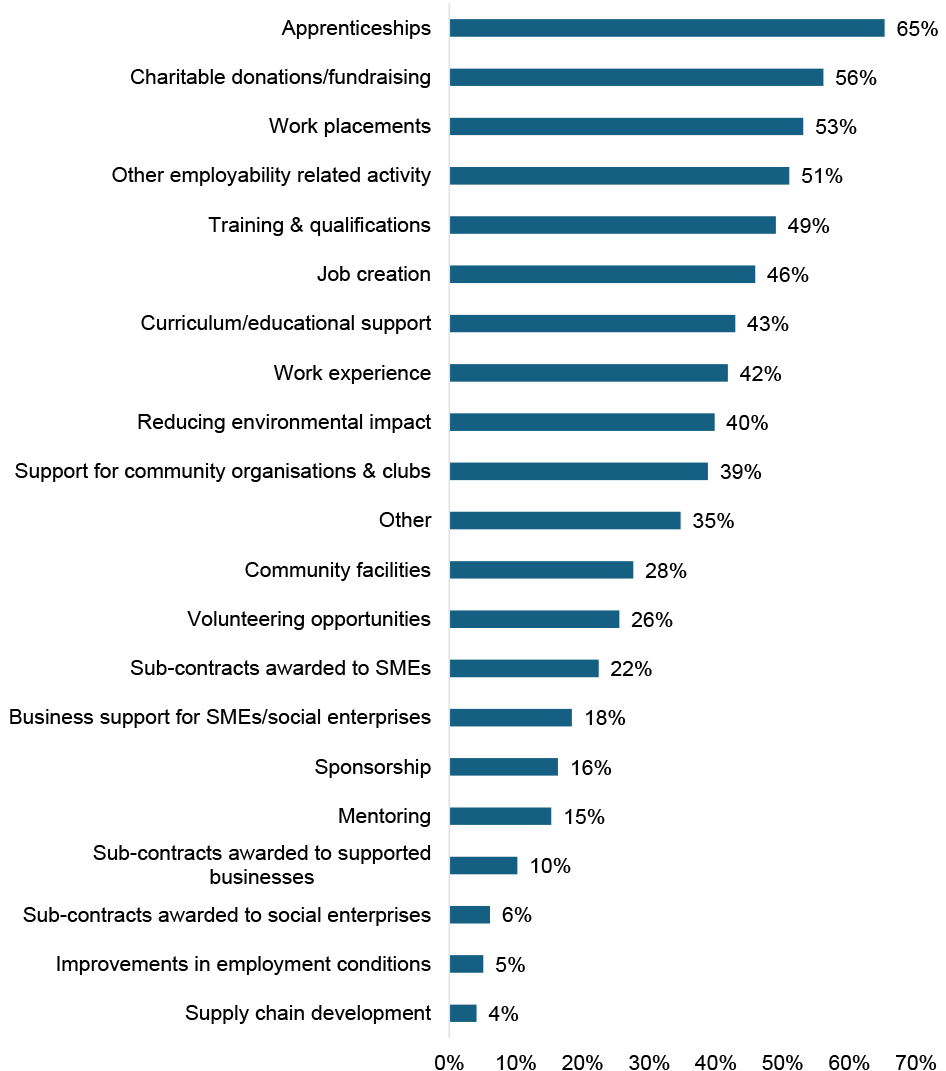
Over three-quarters of public bodies (98, 78%, n=125) provided detail within their 2023 to 2024 procurement reports on the types of community benefits delivered. A breakdown of the different types of community benefits delivered by these 98 public bodies is outlined in Figure 5.3.
For this reporting period, the most common types of community benefits delivered were: Apprenticeships (64, 65%, n=98), charitable donations/fundraising (55, 56%), work placements (52, 53%), other employment related activity (e.g. careers talks at schools/universities) (50, 51%), and training and qualifications (48, 49%).
Source: 2023 to 2024 annual procurement reports
Base: n=98
Some public bodies delivered community benefits that did not fit into one of the categories as displayed in Figure 5.3. Examples of the ‘other’ community benefits (34, 35%, n=98) included:
- Employability support and opportunities targeted at disadvantaged groups, such as disabled people (Social Security Scotland, 2024).
- Intensive support to cope with wide-ranging and complex social, emotional and mental wellbeing concerns (Clackmannanshire Council, 2024).
- Collaboration with College Student Services to deliver an end of year Equality, Inclusion and Diversity Festival Celebration (Edinburgh College, 2024).
Over half of the public bodies (72, 58%, n=124) provided information on the number of jobs achieved as a result of community benefit requirements. This came to a reported total of 805 jobs (Table 5.1) across 2023 to 2024.
A reported total of 268 apprenticeships were achieved through community benefit requirements in 2023 to 2024 (n=72), the majority of which (210, 78%, n=17) were accounted for by the local government sector.
The number of work placements achieved through community benefit requirements was reported by 71 public bodies (57%, n=124) in 2023 to 2024, representing a reported total of 342.
Less than half of public bodies (60, 48%, n=124) reported on the number of qualifications achieved for priority groups through training. The total reported number for 2023 to 2024 was 435.
| Sector | Number of jobs | Number of apprenticeships | Number of work placements | Number of qualifications achieved through training |
|---|---|---|---|---|
| Local government | 540 | 210 | 257 | 396 |
| Health | 5 | 1 | 2 | 0 |
| Central government | 183 | 40 | 73 | 37 |
| University and colleges | 16 | 4 | 6 | 0 |
| RSLs | 61 | 13 | 4 | 2 |
| Total | 805 | 268 | 342 | 435 |
| Base | N=72 | N=72 | N=71 | N=60 |
Source: 2023 to 2024 annual procurement reports
Fifty-three annual procurement reports (42%, n=124) provided data on the total value of contracts sub-contracted to SMEs, which amounted to a reported total of £195.8 million for 2023 to 2024. This represents a higher figure than what was reported in 2022 to 2023 (£166.9 million) despite fewer annual procurement reports being received. Seventeen public bodies account for all reported sub-contracted spend with SMEs; the remainder of those who provided data (36 out of 53, 68%) confirmed that the total value of contracts they sub-contracted to SMEs was £0.
Fifty-one annual procurement reports (41%, n=124) detailed the total reported value of contracts sub-contracted to social enterprises, which came to £1.7 million for 2023 to 2024. However, this reported total relates solely to the four public bodies that provided a value over £0, as shown below in Table 5.2.
| Public body | Sector | Value £ |
|---|---|---|
| Highlands and Islands Enterprise | Central government | £19,609 |
| Scottish Canals | Central government | £38,300 |
| Scottish Government | Central government | £1,078,398 |
| Transport Scotland | Central government | £533,827 |
| Total |
|
£1,670,134 |
Source: 2023 to 2024 annual procurement reports
Fifty-one public bodies (41%, n=124) detailed the reported value of contracts sub-contracted to supported businesses. The total reported value for 2023 to 2024 was £0.2 million, which is less than what was reported in 2022 to 2023, when the total reported value was £6.3 million. However, the majority of those who provided data on this (49 out of 51, 96%) reported a value of £0, with only two annual procurement reports providing a value above £0 (Table 5.3).
| Public body | Sector | Value £ |
|---|---|---|
| NHS Lanarkshire | Health | £82,750 |
| Scottish Government | Central government | £129,227 |
| Total |
|
£211,977 |
Source: 2023 to 2024 annual procurement reports
5.6 Community wealth building
Community wealth building is a people-centred approach to local economic development which redirects wealth back into the local economy, and places control and benefits into the local community.[24] Terms such as ‘building the local economy’ are sometimes used instead of or in addition to community wealth building.
Just under three-quarters of public bodies (91, 73%, n=125) provided information on community wealth building within their 2023 to 2024 annual procurement reports. This reflects an increase in the use of the term and related actions, with a higher proportion of annual procurement reports incorporating this than the previous year (65%).
Some examples from annual procurement reports of community wealth building and the relevant activities undertaken are detailed below.
“The Council continues this engagement, liaison and dialogue at various stages of the procurement process where appropriate. This is fundamental to support transparency as well as community wealth building and inclusive local and regional growth, we continue to work closely with Economic Development and our other local ‘anchor’ organisations to harness our spending power in terms of buying from local businesses within the supply chain, maximising employment opportunities and reviewing the use of land and property assets to benefit our local economy.”
Argyll & Bute Council, Annual Procurement Report 2023/24 (Argyll & Bute Council, 2024)
“Procurement plays a vital role in community wealth building by maximising local spend. By prioritising purchases from local businesses, organisations can stimulate economic circulation within the community, retaining wealth and creating job opportunities. This approach supports the growth and sustainability of local businesses, fosters diversity among suppliers, strengthens community networks, reduces environmental impact, and generates tax revenue for public services. Overall, local spend promotes economic resilience, equity, and prosperity at the local communities. This is a key area of focus for PHS both in terms of maximising not only our own local expenditure but working with partners including Scottish government and other Health Boards to develop approaches to increasing local progressive procurement through the Anchors network in NHS Scotland. During the reporting year, 83% of regulated procurements and 100% of Quick Quote awards were made to Scottish suppliers. This reflects our commitment to supporting and nurturing local enterprises, contributing to the economic growth and prosperity of the communities we serve.”
Public Health Scotland Annual Procurement Report 2023-24 (Public Health Scotland, 2024)
“Procurement plays a vital role in community wealth building by maximising local spend. By prioritising purchases from local businesses, organisations can stimulate economic circulation within the community, retaining wealth and creating job opportunities. This approach supports the growth and sustainability of local businesses, fosters diversity among suppliers, strengthens community networks, reduces environmental impact, and generates tax revenue for public services. Overall, local spend promotes economic resilience, equity, and prosperity at the local level, making it a crucial strategy for building and retaining wealth within communities. NHS Shetland spent approximately £2.6m with local suppliers this year.”
NHS Shetland Annual Procurement Report April 2023 – March 2024 (NHS Shetland, 2024)
Further examples of measures outlined by public bodies within their 2023 to 2024 annual procurement reports to achieve community wealth building outcomes through procurement included:
- Data on the number of local suppliers involved and the percentage of spend with local suppliers (Angus Housing Association, 2024).
- Encouragement of suppliers paying employees the real Living Wage and to adopt Fair Working practices to support community wealth building (SRUC, 2024).
- Looking at spend with local suppliers and how they might grow this (NHS Greater Glasgow and Clyde, 2024).
- Increasing the visibility of local projects and promotion of a community benefit gateway in collaboration with other organisations (NHS Highland, 2024).
- Use of local suppliers, sub-contractors and employees (Forestry and Land Scotland, 2024).
- Hosting of a Meet the Buyer event for local businesses (Renfrewshire Council, 2024).
Contact
Email: socialresearch@gov.scot