
Public body procurement reports and strategies 2023 to 2024: analysis
An analysis of Scottish public bodies’ annual procurement reports and strategies for the 2023 to 2024 financial year.
3. Compliance with general duties
The 2014 Act describes the general duties, outlining that contracting authorities are required to undertake the following actions for all regulated procurements:
“A contracting authority must, in carrying out a regulated procurement—
(a) treat relevant economic operators equally and without discrimination,
(b) act in a transparent and proportionate manner.”
Procurement Reform (Scotland) Act 2014 (asp 12), Section 8(1) (Scottish Government, 2014)
This chapter describes the extent to which annual procurement reports and strategies demonstrated compliance with the general duties of equal treatment and non-discrimination, transparency, and proportionality.
3.1 Coverage of the general duties in strategies and reports
Figure 3.1 shows that a slightly higher proportion of annual procurement reports and strategies provided information on how regulated procurements were carried out in accordance with each of the general duties than in previous years. The exception to this was annual procurement reports’ coverage of the general duty of proportionality. This remains the same at 86%, with 108 reports (n=125) providing this information in 2022 to 2023 and 2023 to 2024.
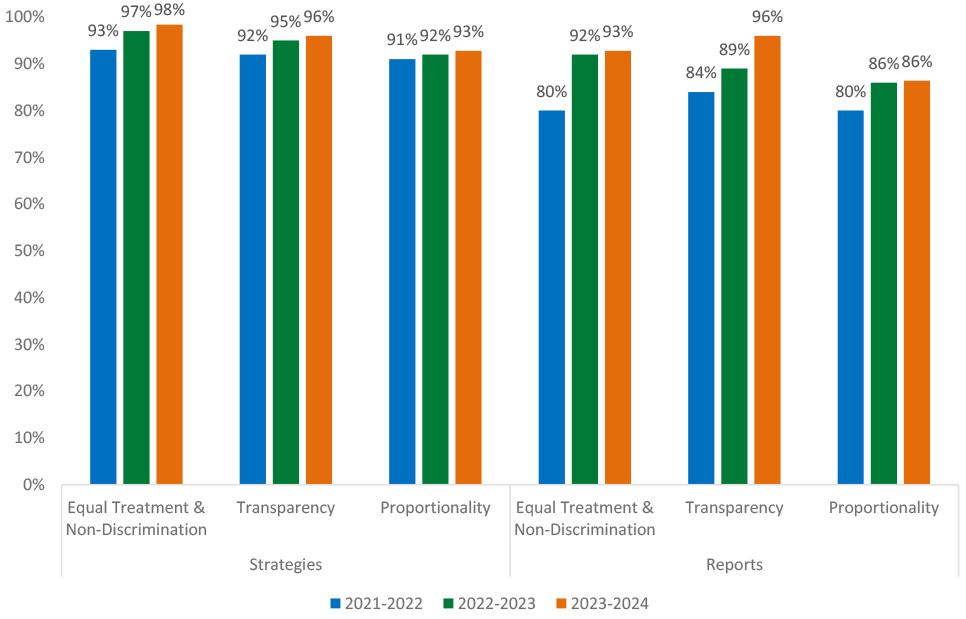
Source: 2021 to 2024 annual procurement reports
Base: 2021 to 2022 (n= 132), 2022 to 2023 (n=133) and 2023 to 2024 (n=125)
3.2 Equal treatment & non-discrimination
The 2014 Act’s general duties of equal treatment and non-discrimination refer to the requirement to ensure that all economic operators are treated fairly and that no suppliers receive unfair advantages or disadvantages.
Nearly all of the 2023 to 2024 procurement strategies (123, 98%, n=125) covered compliance with the general duties of equal treatment and non-discrimination. Most annual procurement reports also contained evidence of compliance with these general duties, with 93% (116, n=125) meeting this requirement in 2023 to 2024.
Some public bodies provided a broad, overarching statement confirming that compliance with the general duties is achieved through strict adherence to all relevant legislation and policies. However, many annual procurement reports and strategies detailed specific examples of measures taken to ensure equal treatment and non-discrimination in procurement processes. These included:
- Advertising all regulated contracts on electronic procurement platforms and e-tendering systems such as Public Contracts Scotland (PCS) and Find a Tender (Scottish Government, n.d.; UK Government, n.d.)
- Following the Scottish Government’s standardised Procurement Journey templates (Scottish Government, n.d.)
- Participating in Supplier Forums or Meet the Buyer events (Supplier Development Programme, n.d.)
- Ensuring all procurement staff are adequately trained to deliver high quality procurement
- Setting and adhering to clear evaluation criteria for bids on public sector contracts
- Using clear and precise language in all procurement documentation
- Working with the Supplier Development Programme to help SMEs and supported businesses to bid for future contracts and supply-chain opportunities (Supplier Development Programme, n.d.)
- Developing and publishing guidance and advice for potential suppliers
- Implementing policies which ensure impartiality, independence and integrity in procurement procedures
- Conducting equality impact assessments as part of the procurement process
In the example below, Southside Housing Association outlines how they ensure that all potential bidders on their contracts have access to the same tendering information.
“For all regulated procurement activities undertaken where possible, the Association advertised contracts at each relevant stage on the Public Contracts Scotland Portal and, when required, in the Official Journal of the European Union (OJEU). All questions raised in procurement exercises were dealt with through the portal so that all bidders had the same information.”
Southside Housing Association Annual Procurement Report, Report Period 01/04/2023 – 31/03/2024 (Southside Housing Association, 2024)
3.3 Transparency
The general duty of transparency relates to the requirement to ensure open, clear and accurate communication with potential suppliers throughout the procurement process.
Steps taken to address the duty of transparency were described in 120 2023 to 2024 annual procurement reports (96%, n=125) and 120 strategies (96%, n=125). Some of the reports and strategies combined information on their actions in relation to this duty with descriptions of acting in accordance with the other general duties. However, many public bodies described specific actions taken to ensure transparency in procurement. Examples included:
- Advertising all regulated contracts on PCS to ensure that all potential suppliers have access to the same information and can participate in the procurement process
- Publishing and circulating responses to any questions asked on invitations to tender
- Publishing and maintaining online contract registers to provide information on current opportunities and contract awards
- Using clear and precise language in all procurement documentation
- Undertaking supplier engagement activities including webinars, forums and Meet the Buyer events
The example below, from Highlands and Islands Enterprise’s procurement strategy, provides a detailed description of their approach to ensuring transparency in procurement.
“Our Forward Plan of Regulated Procurements is published on a quarterly basis on our website and is referred to in our PCS buyer profile. For appropriate procurements, as well as advertising the opportunity via PCS we will develop and publish a recorded webinar and promote this via our social media platforms. We will continue to signpost suppliers to the Supplier Development Programme to help raise awareness of the events and services provided to help suppliers bid for public sector contracts.”
HIE Procurement Strategy, 2024-2028 (HIE, 2024)
3.4 Proportionality
The general duty of proportionality refers to ensuring that tendering requirements are set in accordance with, and are proportional to, the needs of the contract in question. Explanations of how procurement activity is delivered in accordance with the general duty of proportionality were provided in 116 strategies (93%, n=125) and 108 annual procurement reports (86%, n=125) across the 2023 to 2024 period.
Examples of how public bodies ensure that procurement is delivered in a proportionate manner include:
- Splitting frameworks into regional lots to make them more accessible to SMEs
- Ensuring the tendering process and information requested from suppliers is proportionate to the needs of the contract
- Reducing insurance and professional indemnity requirements where risk assessment allows
- Reducing annual turnover requirements imposed for a supplier to be eligible to bid for certain public contracts
- Using the Quick Quote function on PCS[13]
- Applying Fair Work and Community Benefit clauses only where proportionate
The following examples demonstrate two different approaches to ensuring proportionality in procurement.
“We will ensure that contract requirements are proportionate and will not unfairly penalise SMEs, in particular requirements around annual turnover, insurance cover and resources should be proportionate to the to the sizes and complexity of the contract being procured.”
Almond Housing Association Procurement Strategy 2023-2026 (Almond Housing Association, 2023)
“The University shall utilise tendering portals, including PCS and PCS-T, to publish its procurement opportunities and shall strive to ensure appropriate use of lotting, output based specifications and clear evaluation criteria to ensure the procurement is accessible to as many bidders as possible.”
Heriot Watt University Procurement Strategy & Action Plan (Heriot Watt University, 2024)
Contact
Email: socialresearch@gov.scot