
Public body procurement reports and strategies 2023 to 2024: analysis
An analysis of Scottish public bodies’ annual procurement reports and strategies for the 2023 to 2024 financial year.
4. Sustainable Procurement
The 2014 Act’s Sustainable Procurement Duty outlines the ways in which public bodies should carry out the following actions in relation to their procurement activity:
“For the purposes of this Act, the sustainable procurement duty is the duty of a contracting authority—
(a) before carrying out a regulated procurement, to consider how in conducting the procurement process it can—
(i) improve the economic, social, and environmental wellbeing of the authority's area,
(ii) facilitate the involvement of small and medium enterprises, third sector bodies and supported businesses in the process, and
(iii) promote innovation.”
Procurement Reform (Scotland) Act 2014 (asp 12), Section 9(1) (Scottish Government, 2014)
This chapter presents findings in relation to procurement strategies’ and annual procurement reports’ incorporation of the Sustainable Procurement Duty.
Table 4.1 shows a year-on-year comparison of the percentage of procurement strategies that addressed key elements of the Sustainable Procurement Duty.
| Element of the duty | 2021 to 2022 | 2022 to 2023 | 2023 to 2024 | Percentage point change from 2022 to 2023, to 2023 to 2024 |
|---|---|---|---|---|
| Economic, social and environmental wellbeing/reducing inequalities | 95% | 100% | 97% (121) | -3 |
| Facilitating the involvement of SMEs | 94% | 96% | 98% (122) | +2 |
| Facilitating the involvement of supported businesses | 86% | 85% | 80% (100) | -5 |
| Facilitating the involvement of third sector organisations | 86% | 82% | 78% (97) | -4 |
| Promoting innovation | 87% | 86% | 99% (124) | +13 |
Source: 2021 to 2024 procurement strategies
Base: 2021 to 2022 (n= 132), 2022 to 2023 (n=133) and 2023 to 2024 (n=125).
Table 4.2 shows the percentage of annual procurement reports that provided evidence of compliance with key elements of the Sustainable Procurement Duty.
| Element of the duty | 2021 to 2022 | 2022 to 2023 | 2023 to 2024 | Percentage point change from 2022 to 2023, to 2023 to 2024 |
|---|---|---|---|---|
| Economic, social and environmental wellbeing/reducing inequalities | 83% | 93% | 94% (117) | +1 |
| Facilitating the involvement of SMEs | 83% | 90% | 90% (113) | No change |
| Facilitating the involvement of supported businesses | 87% | 89% | 91% (114) | +2 |
| Facilitating the involvement of third sector organisations | 66% | 69% | 63% (79) | -6 |
| Promoting innovation | 63% | 69% | 86% (108) | +17 |
Source: 2021 to 2024 annual procurement reports
Base: 2021 to 2022 (n= 132), 2022 to 2023 (n=133) and 2023 to 2024 (n=125).
Several annual procurement reports included information on training or the use of centralised tools to increase organisational capacity in delivering sustainability in procurement activity. These included:
- Using national tools, such as Scotland’s Public Procurement Prioritisation Tool, Prioritisation Methodology, Life Cycle Impact Mapping, the Sustainability Test, and the Flexible Framework Self-Assessment Tool (FFSAT) to assist with the creation of a Sustainable Action Plan[16]
- Providing other training for procurement staff, such as climate literacy training
The discussion below provides greater detail and further examinations of the coverage of each of the five key elements of the Sustainable Procurement Duty, as well as findings on evidence related to social enterprises, environmental wellbeing and the circular economy.
4.1 Economic, social and environmental wellbeing
Before undertaking a regulated procurement exercise, the Sustainable Procurement Duty requires public bodies to consider how the process might “improve the economic, social and environmental wellbeing of the authority’s area” (Scottish Government, 2014). The 2014 Act then requires strategies to include information on how this consideration will be carried out, and annual procurement reports on how it was carried out(Scottish Government, 2014).
Almost all procurement strategies (121, 97%, n=125) for the 2023 to 2024 period addressed how regulated procurement will be carried out in accordance with the economic, social and environmental wellbeing elements of the Sustainable Procurement Duty.
The percentage of 2023 to 2024 annual procurement reports providing information on their activities to address the economic, social and environmental wellbeing elements of the Sustainable Procurement Duty in their reports was 94% (117, n=125).
Evidence provided across the strategies and reports was wide-ranging and included many references to policies and practices implemented to meet sustainability goals, help the local economy flourish, and ensure employees and procurement specialists are upskilled in issues surrounding diversity, equity and inclusion. For example, Social Security Scotland detailed their policies across a number of different areas related to economic, social and environmental factors in their report.
“Our specifications for services included statements on our commitment to reducing Scotland’s environmental impact and creating a cleaner, greener and healthier country. We include relevant information in our Invitation to Tender documents relating to climate change and the Net Zero aims of the Scottish Government. Our tender documents included relevant questions related to supplier approaches to reducing emission levels. We have supported our procurement officers to develop their knowledge of the sustainable duty requirements for public sector procurements. Our procurement officers have completed the Scottish Government’s Climate Literacy for Procurers eLearning that provides buyers with an understanding of the climate emergency challenges and how their procurement activity can contribute to the Net Zero carbon emission target. We actively worked with our Place Services Team to support and address climate change duties on behalf of our organisation and ensured that the goods and services we purchase reduce our emissions and are an efficient use of resources wherever possible.”
Social Security Scotland Annual Procurement Report 2023-2024 (Social Security Scotland, 2024)
A total of 107 public bodies (86%, n=125) provided evidence of how their regulated procurements had been carried out in 2023 to 2024 in a way that considers environmental wellbeing and climate change. Many made general commitments to reducing carbon emissions or making wider changes over time. Others provided more explicit examples, including:
- Subscribing to Advanced Procurement for Universities and Colleges’ (APUC) Sustain supply chain web portal (APUC, n.d.)
- Working with external organisations to reuse end-of-life equipment
- Monitoring and reporting progress on compliance with public bodies climate change duties
- Reviewing energy efficiency standards, particularly in relation to social housing
- Encouraging hybrid working to minimise commuting
- Procuring with contractors that are climate conscious, such as contractors that use recyclable packaging
- Transitioning car fleets to electric vehicles
- Including sustainable considerations in all tendering, with target criterion for all tenders
- Encouraging reuse of materials and minimisation of waste, with some mentioning creating a zero waste prioritisation plan
- Work with third sector organisations, like Sustainable Scotland Network (Sustainable Scotland Network, n.d.)
- Considering Energy Performance Certificate (EPC) in relevant contracts
Education Scotland, for example, acknowledges the remit of the organisation means that they are required to travel quite frequently around Scotland. They are attempting to develop innovative solutions to reduce their carbon footprint related to travel.
“Education Scotland’s staff undertake a significant amount of travel relative to the size of the Organisation. Its role in supporting quality and improvement in Scottish education means that staff must travel to all parts of Scotland to conduct inspection and review activities. Many of Education Scotland’s emissions are related to travel, which is linked to the way our business is conducted. Education Scotland continue to explore workable solutions as part of our plan to use clean transport and publish data of our carbon emissions used in our business travel activity. Education Scotland continued to participate in the Scottish Government Carbon Emissions Scheme whereby a mandatory £1 levy is charged when a hire car is booked for official business. The levy is returned to the Scottish Government’s carbon levy ‘pot’ for donation to an environmental cause.”
Education Scotland: Procurement Annual Report, 1 April 2023 – 31 March 2024 (Education Scotland, 2024)
Fifty-four public bodies (43%, n=125) included a specific reference to the circular economy, minimising waste, or reusing materials in their 2023 to 2024 annual procurement reports. This is a higher proportion than the previous reporting period, when 28% of public bodies provided information on the circular economy in their 2022 to 2023 reports.
4.2 Facilitating involvement of SMEs
Approaches to facilitating the involvement of SMEs were described in 122 strategies (98%, n=125) and 113 annual procurement reports (90%, n=125) in 2023 to 2024. Strategies and reports often highlighted the use of PCS or the Quick Quote function as a way to involve more SMEs in their procurement processes. Participating in the Supplier Development Programme, hosting training sessions and networking opportunities were also highlighted by several public bodies as means to encourage more SMEs to be involved in bidding for public contracts.
Some annual procurement reports mentioned the use of market research, Prior Information Notices (PINs) or a Request For Information (RFI) to better understand the potential of SMEs to fulfil certain contracts. Some public bodies highlighted the value of working with SMEs, particularly local SMEs, to ensure procurement is benefitting local community development. In the example below, Argyll and Bute Council’s annual procurement report highlights the success of local SMEs in winning council contracts.
“The Council monitors the percentage of contracts awarded to local suppliers and SMEs. The Council is a member of the Supplier Development Programme which provides free advice and training to local SMEs and, alongside this, the Procurement function is continually reviewing its processes to ensure that local SMEs are not at a disadvantage when bidding for contracts. In 2023/24, 82.9% of SMEs were successful in winning a bid. The sub-contracting opportunities for local contractors were captured to highlight the economic impact within the Council area. As at March 2024, local sub-contractors were used within 19 contracts, which were also awarded to local main contractors.”
Argyll and Bute Council, Annual Procurement Report 2023/24 (Argyll and Bute Council, 2024)
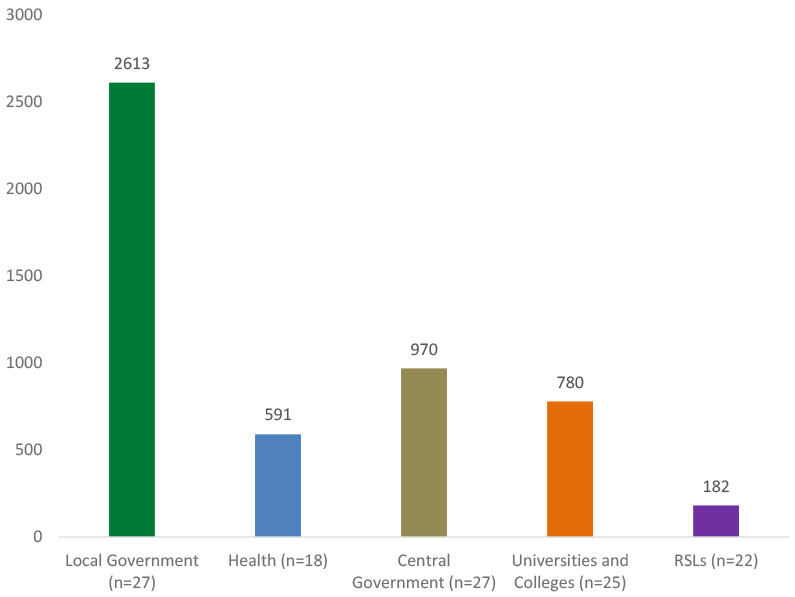
Figure 4.1 shows the total reported number of SMEs awarded a place on a regulated contract broken down by sector. A total of 5,136 SMEs were awarded a place on a regulated contract in 2023 to 2024. This was reported by 119 public bodies (95%, n=124). Local government accounted for over half (2,613, 51%, n=27), with central government and universities and colleges accounting for 19% (970, n=27) and 15% (780, n=25) respectively.
Source: 2023 to 2024 annual procurement reports
Base: n=119. Including all respondents who inserted a numerical value including (0) but excluding those entries which are blank or "N/A"
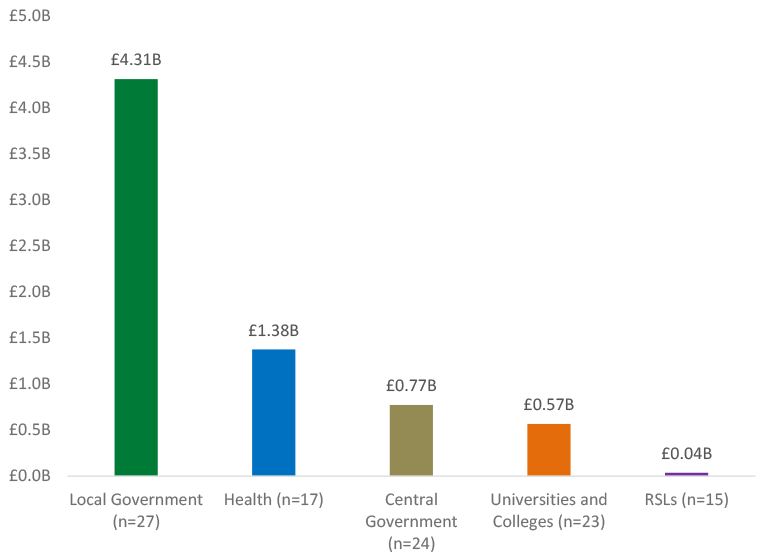
One hundred and six annual procurement reports (85%, n=124) included information on total reported procurement spend with SMEs. This represented a combined reported total of £7.1 billion spent with SMEs in the 2023 to 2024 financial year. This is a higher reported spend with SMEs compared to what was reported in the previous year (£6.6 billion in 2022 to 2023). As shown in Figure 4.2, local government had the highest reported spend with SMEs, and while health reported awarding fewer contracts, the contracts had a higher reported combined value than those reported as awarded by central government or universities and colleges.
Source: 2023 to 2024 annual procurement reports
Base: n=106. Including all respondents who inserted a numerical value including (0) but excluding those entries which are blank or "N/A"
Just over two-fifths of public bodies (53, 42%, n=124) provided information in their annual procurement reports about the value of contracts sub-contracted to SMEs in the 2023 to 2024 period. Of those providing data, 18 bodies awarded sub-contracts to SMEs, totalling £195.8 million.[17] Some annual procurement reports also highlighted how they had adapted their tendering processes to encourage or ensure that sub-contract opportunities went to SMEs. For example, Police Scotland noted that they “ensure that major contracts make sub-contracting opportunities accessible to Scottish SMEs” and Transport Scotland mentioned that “clauses are included in tender documentation for procurements to ensure sub-contracting opportunities are advertised on the PCS website, to allow SMEs and local businesses access to opportunities” (Scottish Police Authority, 2024; Transport Scotland, 2025).
4.3 Facilitating involvement of supported businesses
The Scottish Government legally defines supported businesses as “having the purpose of promoting the social and professional integration of disabled or disadvantaged persons while employing at least 30% of its workers from these groups”.[18]
As noted in Table 4.1, 80% of the 125 procurement strategies (100) detailed how public bodies planned to facilitate the involvement of supported businesses. Ninety one percent of annual procurement reports (114, n=125) provided evidence of actions to facilitate the involvement of supported businesses, as seen in Table 4.2.
A total of 122 annual procurement reports (98%, n=124) provided information on the number of regulated contracts awarded to supported businesses during the 2023 to 2024 period. Of those who reported, 16 public bodies awarded 19 regulated contracts to supported businesses.[19] As is shown in Table 4.3, central government awarded the most contracts to supported businesses, with eight awards reported (n=28). Local government and universities and colleges reported awarding six (n=28) and five contracts (n=25) respectively.
| Sector | Total reported number of regulated contracts awarded to supported businesses |
|---|---|
| Local government | 6 |
| Health | 0 |
| Central government | 8 |
| Universities and colleges | 5 |
| RSLs | 0 |
| Total | 19 |
| Base | N=122 |
Source: 2023 to 2024 annual procurement reports
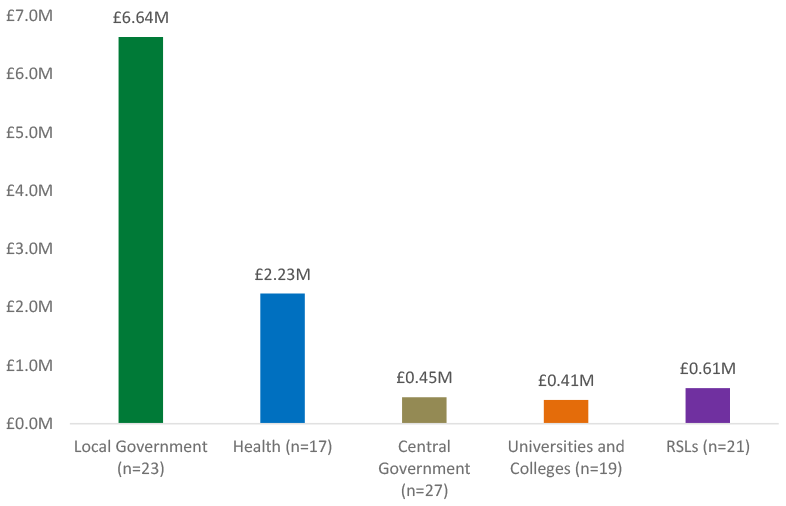
Overall spend with supported businesses during the reporting period amounted to a total of £22.1 million (n=113), £10.3 million of which was regulated spend (n=107) (Figure 4.3).
Source: 2023 to 2024 annual procurement reports
Base: n=107. Including all respondents who inserted a numerical value including (0) but excluding those entries which are blank or "N/A"
Fifty-one public bodies (41%, n=124) provided information about sub-contracts awarded to supported businesses in the 2023 to 2024 period. In total, three public bodies reported awarding sub-contracts to supported businesses, amounting to a total reported spend of £200,000.[20]
Public bodies provided many examples of ways they engage with supported businesses. In addition, many organisations who did not procure with supported businesses in the past year highlighted avenues for future engagement. Examples included:
- Joining frameworks and professional forums to identify future procurement opportunities with supported businesses
- Use of the Scottish Government’s dynamic purchasing system (DPS) for supported businesses
- Creation of sourcing strategies that mandate consideration of supported businesses in all regulated procurement, such as setting goals for annual spending with supported businesses or promoting awareness of supported businesses internally
Scottish Borders Council provided an explanation of the different considerations related to supported businesses in their procurement process.
“The development of every procurement strategy considers the involvement of a supported business or social enterprise as a delivery option and, as appropriate, we utilise the Scottish Government Supported Business DPS or our local providers to consider innovative ways of ensuring supported business and social enterprises have the opportunity to work with us. The Council also works closely with Scottish Borders Social Enterprise Chamber (SBSEC) to encourage supported business and other third sector organisations to access Council contract opportunities. This active role allows us to keep members updated with contract and community benefit opportunities. The Council will continue to look for opportunities for supported businesses, investigating all procurement avenues to identify appropriate providers and matching them with our contract opportunities. Community benefit clauses also provide an opportunity to direct our third party contractors/ suppliers to consider supported businesses in their supply chain."
Scottish Borders Council Annual Procurement Report 2023-24 (Scottish Borders Council, 2024)
4.4 Facilitating involvement of third sector organisations
The Scottish Government defines third sector organisations as “organisations (other than bodies established under an enactment) that exist wholly or mainly to provide benefits for society or the environment. This includes a charity, with the exception of public bodies, a voluntary organisation or a social enterprise.”[21]
Over three quarters of procurement strategies (97, 78%, n=125) included information on facilitating involvement of third sector organisations in the public body’s procurement activities for the 2023 to 2024 financial year. Annual procurement reports were less likely to contain this information, with 79 of these (63%, n=125) providing information on the involvement of third sector organisations in the public body’s procurement activities.
One hundred and eight annual procurement reports (87%, n=124) included information on the number of third sector organisations which were awarded places on regulated contracts in the 2023 to 2024 financial year. This represented a combined reported total of 398 third sector organisations.
Annual procurement reports detailed a variety of different approaches to facilitating the involvement of third sector organisations in procurement activities. For example, Social Security Scotland’s annual procurement report outlined the activities they undertook to reduce barriers for SMEs, third sector organisations and supported businesses to participate in tender opportunities.
“Our procurement strategies for all regulated procurements require consideration of lotting and lot-limiting approaches to facilitate the involvement of small to medium-sized enterprises, third-sector organisations and Supported Businesses.
“We proactively encourage small to medium-sized enterprises, third-sector organisations and Supported Businesses operating in Dundee and Glasgow to consider our tender opportunities (both regulated and non-regulated contracts) through forums such as the ‘Meet the Buyer’ events and other local forums.”
Social Security Scotland Annual Procurement Report, April 2023 – March 2024 (Social Security Scotland, 2024)
Many of the resources public bodies highlighted in their annual procurement reports as useful in facilitating engagement with SMEs were also mentioned as useful for engaging third sector organisations. These included:
- Use of PCS and Quick Quotes
- Raising awareness through PINs
- Supplier Development Programme
- Pre-market engagement opportunities
- Encouraging PCS registration
- Meet the Buyer events
4.5 Facilitating involvement of social enterprises
Social enterprises are a type of third sector organisation. The Scottish Government defines them as “businesses with a social or environmental purpose, and whose profits are re-invested into fulfilling their mission. They empower communities, tackle social problems, and create jobs - particularly for people who are at a disadvantage in the standard jobs market.”[22]
Thirty four percent (42, n=125) of procurement strategies included information on facilitating the involvement of social enterprises in the public body’s procurement activities. A slightly higher proportion of 2023 to 2024 annual procurement reports included this information, with 55 (44%, n=125) describing steps taken to involve social enterprises in the public body’s procurement activities.
Public bodies often referenced their engagement with social enterprises alongside their engagement with the third sector and supported businesses. Many highlighted the importance of supporting community projects and developing and improving engagement with local producers and businesses.
For example, Glasgow Clyde College mentioned the use of Social Enterprise Network Scotland (SENScot): “an organisation set up to work with social enterprises in Scotland to ensure they have the support they need to deliver positive outcomes in their communities.” (Glasgow Clyde College, 2024)
For example, Scottish Social Services Council noted in their annual procurement report how they use a social enterprise supplier to meet environmental sustainability goals.
"Our office supplies contractor partners with a social enterprise to provide closed loop recycling and prevent the use of single use plastic in their supply chain."
Scottish Social Services Council Annual Procurement Report 23/24 (Scottish Social Services Council, 2024)
4.6 Promoting innovation in procurement
Almost all 2023 to 2024 strategies (124, 99%, n=125) provided information on promoting innovation in procurement, while 108 (86%, n=125) reports provided evidence of promoting innovation. This is higher than the previous reporting period, when 86% of public bodies spoke about innovation in their strategy and 69% provided evidence in their annual procurement reports, as detailed in Tables 4.1 and 4.2 at the start of this chapter.
Examples of different types of innovation were provided in annual procurement reports, although depth and detail varied. Descriptions of innovation in annual procurement reports included references to technological, digital or infrastructure developments. Examples included increased use of e-procurement systems, such as digital trackers, integration of AI for time management, and building to Passivhaus and Royal Institute of British Architects 2030 Climate Challenge standards (Passivhaus Trust, n.d.; Royal Institute of British Architects, n.d.).
“The Service is actively working on remote monitoring systems, use of drones, use of Artificial Intelligence in our ambulance control centres and engaged in a number of research projects with Academia. Our service leads are also actively engaged with other Blue light Services in several areas trialling new and innovative solutions, example areas are body worn cameras, drone technology and telecommunication airwave systems.”
Scottish Ambulance Service Procurement Annual Report 2023/24
Contact
Email: socialresearch@gov.scot