
Young People and the Future of Scotland: participatory horizon scanning engagement
As part of its Horizon Scanning work, Scottish Government worked with Demos Helsinki, the Scottish Youth Parliament (SYP) and the UK Government Office for Science to undertake a futures-focused engagement with young people aged 14-19. The engagement findings and the methodology are presented in this report.
Appendix 1: Detailed methodology and approach
This appendix sets out the methodology which was developed for the ‘Young People and the Future of Scotland’ engagement in more detail, specifically focusing on the workshop phases 2-4, including additional examples and larger images of some examples of the materials used. Appendix 2 shows the trend cards that were developed for use during the engagement.
Throughout the engagement workshop, a ‘double-layered’ facilitation approach was taken. Demos Helsinki’s experts primarily focused only on facilitating any aspects which required specialist futures expertise – for example, explanations, ensuring comprehension of exercises and their purpose and facilitating whole group reflective discussions and sharing, including prompting clarifications on any views expressed and diving deeper into questions. Throughout each exercise, as much leadership opportunity was taken by the Investigation Team as possible in order to prioritise a youth-led experience and ensure accessible discussions; this was especially key in facilitating small group discussions and exercises, as well as guiding participants at futures state gallery stations in phase 3 of the workshop.
Throughout the workshop, we utilised multiple methods of documentation to capture young people’s views. This often included participants’ own written documentation including in their investigation logs (individual note sheets), the Investigation Team’s notes of small group discussions, the participants’ own canvases (priority wheels) and the notes of Demos Helsinki’s experts and observations of any others present. Participants were always given the opportunity to use materials to document their thoughts in different ways if they wanted to.
The workshop was designed around four structured phases, each providing a different lens through which participants could explore and influence Scotland’s future:
1. Introducing futures thinking
2. Evidence generation using trend cards
3. Exploring future states through an immersive gallery approach
4. Mapping priorities for policy action.
Each phase built on the previous one, creating a layered and immersive process that moved participants from understanding the relevance of foresight, to analysing evidence, to imagining alternative futures, and finally to articulating concrete priorities for Scotland’s future.
Workshop Phase 1: Introducing futures thinking
The workshop began with ‘Workshop Phase 1: Introducing futures thinking’ which helped participants to explore why and how we think about the future, framing foresight as a practical tool rather than an abstract idea. The workshop began by introducing the aims of the engagement, explaining how participant contributions would be used, and setting out ethical and safeguarding procedures. Participants were then introduced to strategic foresight via an introductory presentation by Demos Helsinki’s experts before participating in two short exercises. This utilised an experiential approach in which participants participated in a short visioning exercise to begin to introduce themselves to futures thinking and helped participants see that futures are shaped by present choices, rather than being predetermined. They were guided to imagine their lives in a future Scotland – where they lived, worked and the societal changes they had seen. This helped uncover young people’s hopes, fears and expectations, and highlighted both personal and collective perspectives on the future. The group then discussed why people imagine different futures, considering how personal experiences, culture and society shape these views.
This session introduced the concept of ‘trends’ and laid the ground for later exercises. In this session – and again at the end of the workshop – participants took part in an exercise gathering their feelings related to the future of Scotland and the world more broadly in 2040 (see Figure 1 in Young People and the Future of Scotland: A Participatory Horizon Scanning Engagement). The aim of this was to gain some insights, as well as a low-fidelity indication of how structured engagement in futures thinking affected participants’ feelings of positivity and agency. This was enriched by short whole-group discussions of the results for both instances.
Workshop Phase 2. Evidence generation using trend cards
To anchor discussions in research-based insights, participants engaged in an evidence-generation session using trend cards developed based on research conducted by the Scottish Government. Prior to the engagement, as part of its wider Horizon Scanning project, the Scottish Government had undertaken a rapid review of evidence relating to horizon trends with specific relevance for children and young people in Scotland. Demos Helsinki’s experts identified some of the most significant trends and clusters of trends which had some connection to one another; this formed the basis for an original group of trend cards.
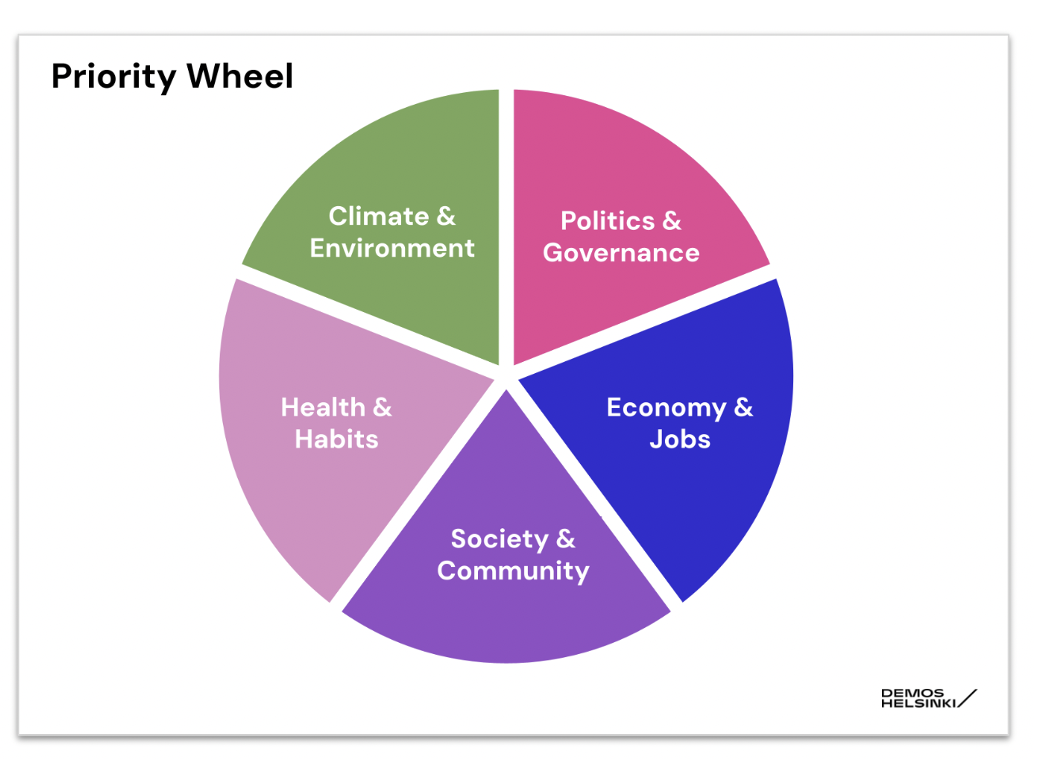
Grouping trends can help participants to organise thoughts, discuss expected connections and consider whether more unexpected connections can be formed between trend groups. Typical methods for grouping and analysing trends include the PESTLE acronym – Political, Economic, Sociological, Technological, Legal and Environmental. These terms seemed less accessible to young people, so it was decided to use five broader groups using more everyday language: Climate and Environment; Economy and Jobs; Politics and Governance; Society and Community; and Health and Habits.
After discussion with both the Scottish Government (as experts in the research the trend cards were based on) and the Investigation team (as experts in how to make materials accessible and interesting to young people, as well as whether any relevant trends were missing), the final 27 trend cards were defined and edited iteratively. These cards formed the main resource from which other materials, such as the future states and artefacts, were based on. It is important to note that the trends were based on research which contained a high level of detail, including statistics, yet we chose to not include this kind of information on the trend cards themselves. Despite using this to inform their development, we felt elements like statistics may present potential future trends as too ‘fixed’ and potentially could stop participants from voicing a contrasting personal experience or suggesting an alternative vision for a new direction they would like to see the trend progress in.
Each trend card contained:
- A title and short description of the trend
- An overview of its potential impact on Scotland’s future
- A set of guiding questions to prompt discussion.
Participants worked in small groups, each facilitated by a member of the Investigation Team. The session was designed as a game-based format, where each participant selected a trend card in turn and led a discussion, reflecting on its implications and connections with other trends. This approach ensured that all participants actively engaged with multiple trends, rather than passively absorbing information. In each group, a member of the Investigation Team facilitated the exercise and discussion, capturing key insights, emerging themes and areas of agreement or divergence. Given additional time, this game-based format utilising the trend cards could have been played many more times and with additional format elements.
After a few rounds of discussion – ensuring that each participant had led the discussion on at least one trend card – the session transitioned into a creative task. To deepen engagement with the trends, participants were invited to create their own ‘artefact from the future’, a representation of how the trends they explored might shape life in Scotland in 2040. This creative task (see Figure 1 below) allowed participants to move beyond abstract discussion and imagine future scenarios in a more personal and experiential way. Each group was tasked with designing a fictional object, message or story from 2040, inspired by the trends they explored. The goal was to make the future more real and to provoke deeper discussion about how today’s choices might shape tomorrow’s realities. Participants were free to choose from a range of formats, including:
- A newspaper headline from 2040 announcing a major societal change
- A social media post or meme from the future capturing public sentiment
- A diary entry from a young person in 2040, reflecting on daily life
- A futuristic invention or product advertisement, showcasing new technologies
- A voting ballot for a referendum on a key issue of the future
- A travel guide for visitors to Scotland in 2040, illustrating how society has changed.
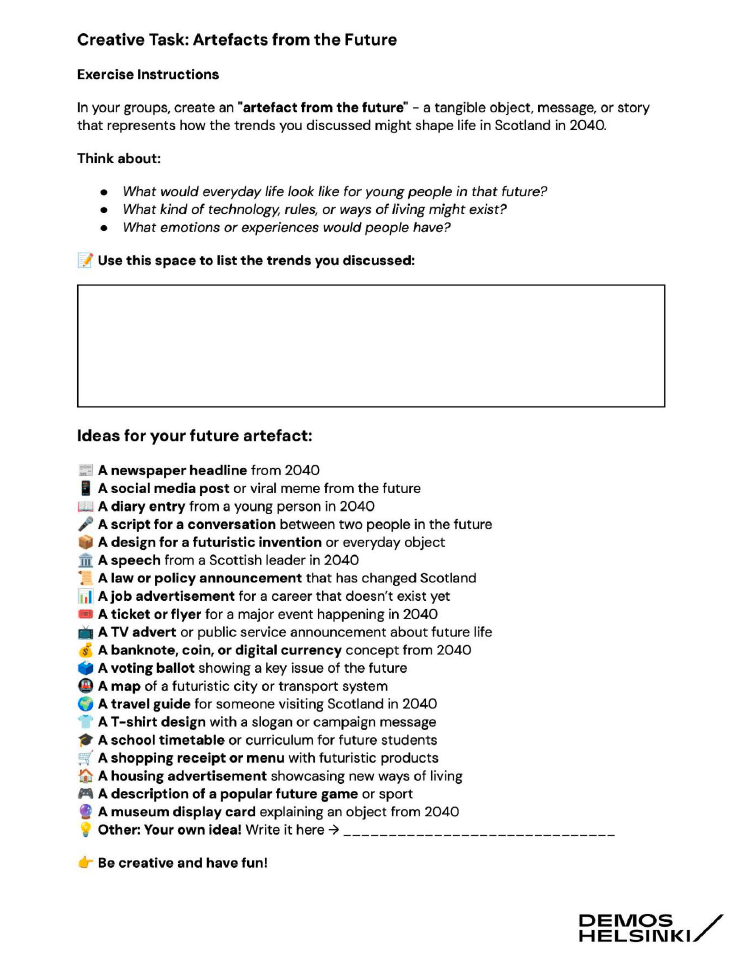
These artefacts would later be integrated into Phase 3: Exploring Future States, matching them to the most relevant future states where participants encountered them again in a gallery-style experience. At this stage, however, participants did not yet know how their creations would be used. This added an element of surprise and reinforced the idea that foresight is an iterative process, where ideas evolve and connect in unexpected ways. Given additional time, there could have been more complex facilitation to help participants create more detailed artefacts.
Workshop Phase 3. Exploring future states through an immersive gallery approach
Building on the insights generated in the previous phases, participants moved beyond individual trends to explore how different forces might interact to shape Scotland’s future. This phase introduced four distinct future states for Scotland in 2040, allowing participants to engage with alternative possibilities through a gallery-style experience. The gallery was formed using future states and artefacts pre-prepared by Demos Helsinki, based on the trend cards and designed to illustrate how key trends might evolve in different directions. In addition, the artefacts produced by participants during the previous creative task (Phase 2) were also integrated into the gallery, creating a layered and evolving exploration of the future.
Each future state was built around two critical uncertainties shaping Scotland’s long-term trajectory:
1. Climate developments – Whether Scotland successfully adapts to climate change and becomes a leader in sustainability, or whether it struggles with environmental crises and resource scarcity.
2. Technology and societal developments – Whether technology and digitalisation create a more connected and inclusive Scotland, or whether they lead to fragmentation, misinformation and deepening social divisions.
By combining different outcomes along these two axes, and weaving in different elements from the 27 trend cards, four contrasting future states were developed:
- The Green Jobs Revolution – A Scotland that has successfully transitioned to a sustainable economy, leading in green industries and innovation.
- The Climate Reckoning – A future where Scotland struggles with extreme weather, food shortages and environmental crises, requiring communities to adapt or relocate.
- The Hyper-Connected Society – A digitally advanced, globally connected Scotland where technology enhances daily life, migration strengthens the economy and social networks are fluid and open.
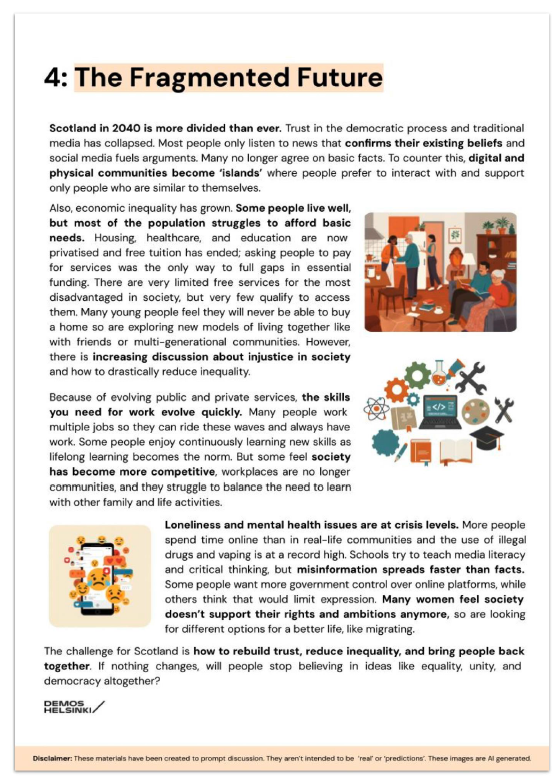
- The Fragmented Future – A deeply divided Scotland where misinformation spreads, trust declines and inequality fractures society, creating growing isolation and economic disparity.
It is important to understand that the purpose of these future states was to act as a stimulus for the participants’ discussions and therefore understanding their insight of potential trends better. They are not in themselves intended to be outputs of the project, and also are intentionally simplified in order to prompt stronger and clearer reactions from participants. Offering complexly nuanced future states would take much longer for participants to unpick and could lead to more uncertain reflections. Each state offered a relatively clear version of the future, with one or two unexpected or more complex elements to help participants explore underlying tensions or questions.
Each future state was presented as a physical station within a gallery-style setup in the workshop room. Each station featured:
- A written description outlining the societal landscape in 2040
- A profile of a young person living in that future, detailing their work, lifestyle and perceptions of society
- Three to four artefacts from the future, ranging from AI-generated images to fictional products and media content, offering tangible representations of daily life in that future state. Participants’ own artefacts created during the preceding phase were also added.
AI-generated images and visual templates were used to help participants immerse themselves deeper into the future states, as well as lend a credibility and ‘reality’ to them. We always disclosed the use of AI-generated images so this was transparent. Participants expressed that they found this exercise very interesting and thought-provoking. Although the materials weren’t intended to be read fully, participants still reflected that less text, other formats or more time to absorb the materials would have been beneficial.
The future states are not intended to be predictive or realistic; however, we have included them below as illustrative examples (see Figures 2-5 below)
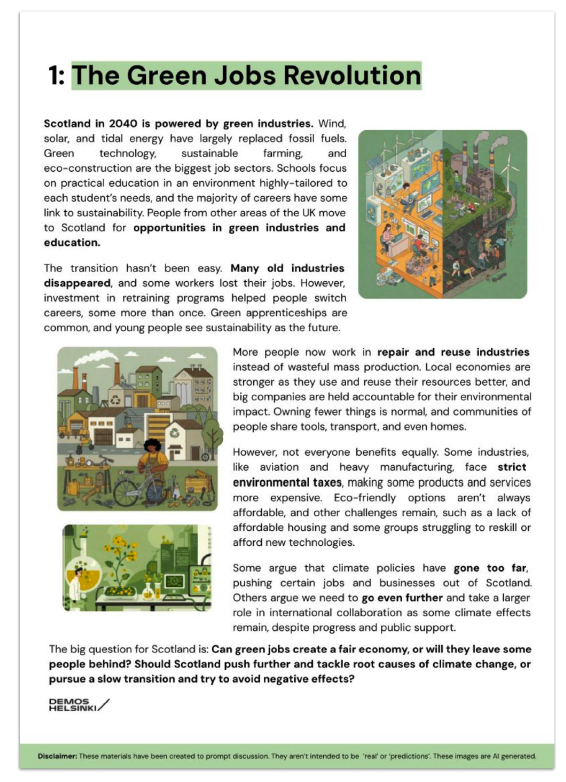
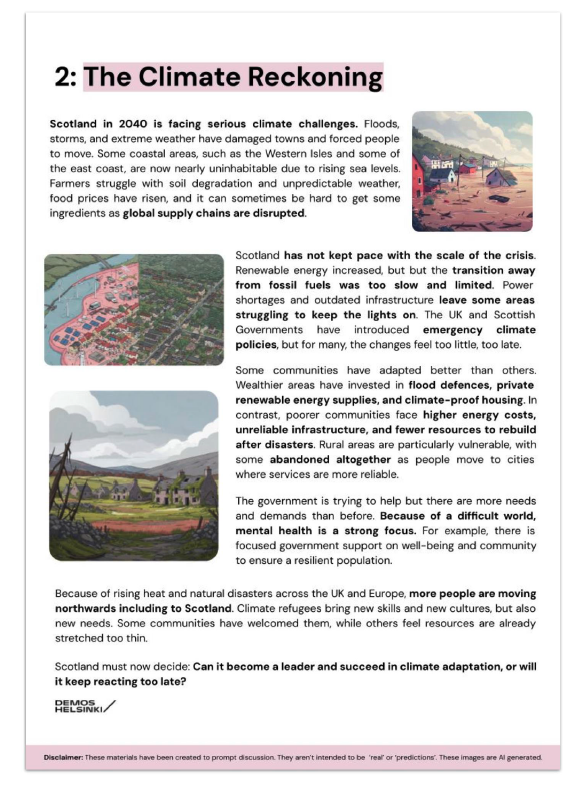
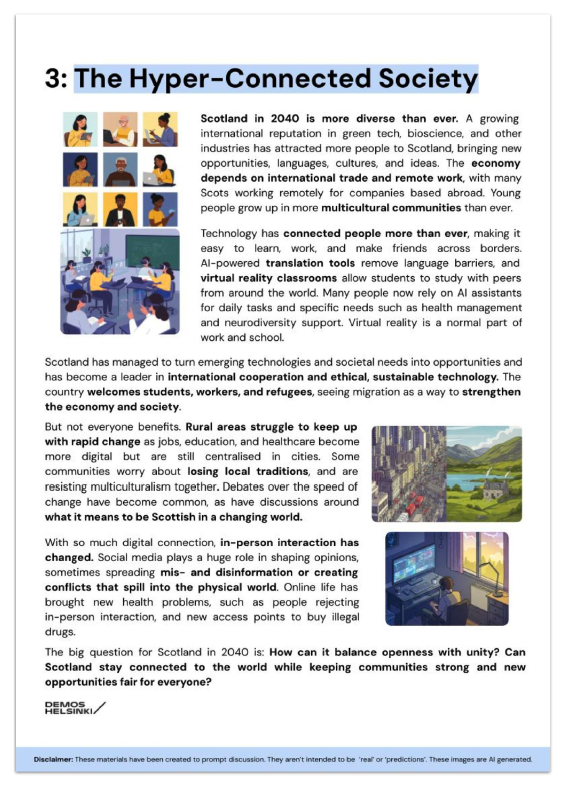
Additionally, below is an example of one of the profiles used in the gallery, specifically from the Green Jobs Revolution future state.
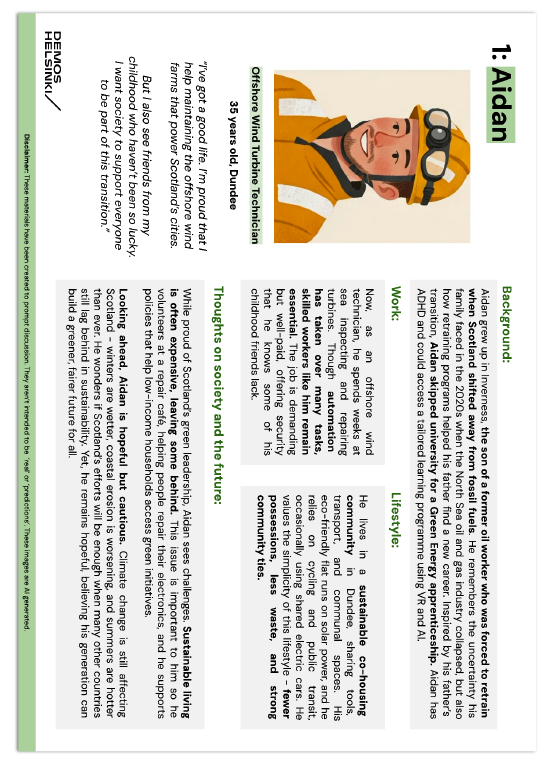
These profiles aimed to provide many details, allowing participants to pick up on aspects that were relevant or interesting to them, rather than expecting full comprehensive review and reflections. The profiles of future citizens were made to be the age that the participants will be in 2040 to help prompt personal reflection.
Some examples of artefacts used in the gallery included:
- The Green Jobs Revolution: 2040 Green Jobs Careers Guide. A government-issued booklet showcasing emerging careers in Scotland’s fully circular economy, featuring roles such as circular economy designers, wind turbine technicians and urban vertical farmers
- The Climate Reckoning: 2040 Business and Product Labels. A collection of product standards and trade labels covering topics such as water use, carbon tax, circular economy, renewable energy use and repair and reuse.
- The Hyper-Connected Society: The Death of Traditional Funerals – Why Scotland Now Mourns in the Metaverse. An investigative news article detailing how digital mourning has replaced physical funerals, with AI-generated replicas of the deceased continuing to interact with loved ones.
- The Fragmented Future: The Last Human Teacher Retires. A feature article marking the retirement of Scotland’s final human educator, reflecting debates about AI’s role in education and the loss of human mentorship.
As participants toured the gallery in small ‘tour groups’, the ‘investigation logs’ were a key way to gain individual documentation. In workshop exercises, group discussion always has the potential to lose nuance or leave some views unheard, for example, if a participant is cautious to ‘go against’ what they perceive to be a group consensus, or if they have a more personal reflection that is hard to express or share. These logs were also a way to ensure all participants had the direct opportunity for their views to be heard and documented in their own terms. The aim of making these logs anonymous was to enable participants to share their perspectives freely and without any concern of personal judgement. After the workshop, the logs were collected and analysed by our team, contributing to the findings presented in Young People and the Future of Scotland: A Participatory Horizon Scanning Engagement.
Workshop Phase 4. Mapping priorities for policy action
The final phase of the workshop focused on identifying and prioritising key areas for action, enabling participants to translate their reflections into concrete policy considerations. This phase was designed to surface young people’s priorities across multiple areas, ensuring that discussions about the future were not only theoretical but also linked to present-day decision-making. It aimed to provide a direct opportunity for young people to advocate for their main priorities and actions they would wish to see, ensuring very concrete views were gathered. Other exercises in the workshop revealed nuanced perceptions and insights, yet direct expressions were highly valuable in clearly determining the highest priorities.
Participants worked in small groups, each facilitated by a member of the Investigation Team (Members of the Scottish Youth Parliament). The session was structured around three key activities:
1. Revisiting the trend cards – Participants revisited the trends they had explored earlier in the workshop, sorting them into categories of exciting, neutral or concerning, and adding written justifications for their choices. This exercise helped identify which trends participants viewed as opportunities and which they considered as risks, offering a clearer sense of where they felt action was most needed. Participants mentioned that returning to the trend cards as a core material – after their imaginations and perceptions had evolved based on the other exercises – helped them find new perspectives.
2. Developing a priority wheel – Each group then constructed a priority wheel (see Figure 7 below), mapping key areas where they believed policy action was most urgently required across five domains: Climate and Environment; Politics and Governance; Economy and Jobs; Society and Community; and Health and Habits. Within each category, participants placed post-it notes identifying their top policy priorities. Importantly, participants were asked to first express only one priority per domain in order to focus on determining which action or change they saw as most vital for the future. After doing this, they could then add one or two additional actions. They were also encouraged to add actions between these areas if they wished to; the domains aimed to aid thinking, not limit it.
3. Collective prioritisation exercise – To identify the most pressing issues across all groups, participants were invited to tour the work of all groups and given three votes (stickers) to place on the priorities they felt were most urgent or impactful. At this stage, they were asked to tour as individuals, not with the small group they made their priority wheel with; this aimed to ensure voting wasn’t determined by group thinking tendencies where participants may confirm each other’s votes. This stage of the exercise surfaced a strong understanding of the highest priorities. Open whole group discussion prompted further reflection on what the priority wheels revealed, and gave participants a further chance to add to, clarify, explain or challenge any aspects they wished to. Overall, strong alignment on issues was found.
The details of the methodology and engagement method, including the rationale, process and example materials, are provided in order to share insights with others wishing to engage groups such as young people in futures thinking exercises. Futures processes can be designed and contextualised in numerous ways. The core successes of this methodology and engagement lie in its strong foundation of co-creation with young people themselves; the development of research-based trend cards as a core material to prompt discussion in an accessible, engaging way; and utilising creative, experiential and unexpected approaches to collective dialogue.
Contact
Email: foresight@gov.scot