
Young People and the Future of Scotland: participatory horizon scanning engagement
As part of its Horizon Scanning work, Scottish Government worked with Demos Helsinki, the Scottish Youth Parliament (SYP) and the UK Government Office for Science to undertake a futures-focused engagement with young people aged 14-19. The engagement findings and the methodology are presented in this report.
Part 1: A Methodology for Engaging Young People in Foresight
Introduction
Horizon Scanning aims to identify emerging trends, risks and opportunities to inform long-term decision-making. It helps policymakers prepare for change rather than react to it, ensuring strategic resilience in the face of uncertainty. The effectiveness of Horizon Scanning, however, depends on the breadth and diversity of perspectives that inform it. The more inclusive the process, the more likely it is to capture a wide range of signals of perceived changes happening, challenging assumptions and mitigating the risk of blind spots. Futures research has consistently demonstrated that diverse perspectives enhance the robustness of foresight exercises by introducing alternative ways of seeing, questioning existing narratives and surfacing underexplored dynamics that might otherwise go unnoticed.
Young people represent a particularly crucial perspective in foresight. They are not merely future stakeholders – they are actively shaping the present, influencing social, technological and economic developments in ways that will have long-term consequences. Despite this, their voices are often absent from formal foresight processes. There are several reasons why their inclusion is essential:
- Young people experience societal transformations differently from older generations. Their engagement with emerging technologies, education systems and labour markets means that they are at the leading edge of many of the trends Horizon Scanning seeks to understand. Their lived experiences offer first-hand insights into shifting cultural norms, behavioural changes, and the reconfiguration of work, learning and social interaction in an increasingly digitalised world.
- Young people bring diverse perspectives to foresight. Research in futures thinking and social innovation has highlighted that established decision-making bodies, like governments, tend to privilege certain types of expertise while marginalising others,[3] such as the expertise of young people. Younger generations often challenge institutions’ status quo and resistance to change, questioning assumptions that older stakeholders may take for granted, which can spark new ideas or changes. Their perspectives can introduce creative and disruptive approaches to problem-solving. This is particularly important in addressing complex and systemic challenges such as climate change, inequality and technological transformation, where traditional policy responses may be insufficient.
- Engaging young people in Horizon Scanning strengthens the democratic legitimacy of foresight processes. The issues being considered will have consequences well into their lifetimes, making their inclusion a matter of intergenerational justice: those who will be most affected by long-term policy decisions have a right to have a say in shaping them.
Given these factors, embedding young people’s perspectives into Horizon Scanning is a strategic necessity. Recognising this, the Scottish Government has taken steps to engage young people in its Horizon Scanning work. This also links to Scotland’s unique position in relation to children and young people’s rights, as the first devolved nation in the world to directly incorporate the United Nations Convention on the Rights of the Child (UNCRC) into domestic law, within the limits of devolved competence.[4]
The intent behind the UNCRC (Incorporation) (Scotland) Act 2024 is to deliver a proactive culture of everyday accountability for children’s rights across public services in Scotland so that we respect, protect and fulfil children’s rights. Central to implementation of the Act is children and young people’s right to express their views freely in all matters affecting them, with their views being given due weight, and to have their views considered and taken seriously.
This engagement has supported the development and testing of a structured approach for engaging young people in foresight, ensuring that their voices contribute meaningfully to Scotland’s long-term strategic thinking.
Project approach: co-creation as a foundation
The core engagement of this project was designed to develop and test a methodology for integrating young people’s perspectives into the Scottish Government’s broader Horizon Scanning efforts. An engagement workshop was held in Edinburgh, bringing together a small group of fifteen young people aged 14-19, as well as the Investigation Team of three Members of Scottish Youth Parliament. The workshop was structured as an insight-gathering exercise. While a single workshop cannot produce representative results, it can surface some immediately useful insights as well as key directions for further exploration. The engagement was designed to allow participants to critically engage with trends, reflect on alternative futures, and articulate their priorities for Scotland’s long-term trajectory.
At the heart of the project was a co-creation process involving Demos Helsinki, and an ‘Investigation Team’ formed of four Members of the Scottish Youth Parliament, and with oversight and feedback from the Scottish Government. They directly contributed to the design of the session, materials and facilitation approach, as well as being co-facilitators in delivery and informing the analysis and report. Co-creation was a core foundation of the methodology, ensuring that young people were active leaders during the design and delivery of the project. This recognises that the ‘subjects’ of futures work should also be the ‘agents’ of it. The Investigation Team was composed of Members of Scottish Youth Parliament (MSYPs). MSYPs are young people who represent different constituencies or organisations within Scotland and are strong young leaders, experienced in advocating for and meaningfully engaging young people. The Investigation Team assumed several important responsibilities through the process, including:
- co-creating the trend cards as a core resource;
- co-creating the engagement workshop;
- co-facilitating the workshop, including leading group discussions and taking notes; and
- inputting on and reviewing the final report to ensure it is accessible and accurately reflects the views that young people shared during the engagement.
Their views and expertise as young people have directly influenced the materials and methods used, as well as the outputs of the project. Their role in facilitating the engagement discussions helped to create a supportive environment where young people felt their views would be heard, respected and taken seriously.
Our workshop approach combined foresight methods with participatory and co-creation techniques. This ensured that young people were not just reacting to trends but engaging with them in an active, structured and imaginative way. By using accessible, interactive and creative materials, we sought to support young people to engage deeply with the themes – as active contributors in shaping Scotland’s future.
Workshop participants were recruited through the Scottish Youth Parliament’s networks, including through the current SYP membership and partner organisations. Before the workshop, 22 young people had signed up to attend; on the day 15 young people participated (others were unable to attend due to caring responsibilities, or unexpected work or family commitments). This project required a short timeframe, with recruitment taking place over a one-month period ahead of the workshop. Combined with a period of holiday for Scottish schools and youth groups, this may have limited the number and diversity of participants who were able to attend on the day.
The approach to recruitment to the workshop aimed to ensure that the participant group would include young people from different backgrounds and experiences. The approach to recruitment aimed to achieve gender balance, and ensure some diversity of socio-economic background and geographical location. In addition, there was a wish to try to ensure that the young people involved did not have strong prior experience of engagement on the topics or in policy/engagement activities. To support participation, participants’ travel costs and meals were paid for and, as an incentive, each participant was given a £25 voucher after the workshop.
Participant recruitment was fairly successful in engaging a diverse group of participants. Participants were drawn from a range of geographical locations across Scotland, from areas representing different levels of deprivation and from a mix of urban and rural areas. There was ethnic diversity within the group, as well as diverse life experiences, including caring experience and experience of disability. Given the group size, there were some limitations and imbalances, notably:
- Although this workshop was originally aimed at 14-17-year-olds, the age range was extended to include 18 and 19-year-olds in the week leading up to the event, to enable more interested young people to participate. As such, younger age groups were less strongly represented than originally intended.
- Young people identifying as men/boys were underrepresented.
- Several of the young people had prior experience as MSYPs, which meant that the group as a whole may have higher levels of prior policy engagement/interest than the wider population.
Of the fifteen participants who took part in this workshop:
- Age: Two were aged 14-15, eight were aged 16-17, and six were aged 18-19.
- Gender: Eight identified as girl/woman, five identified as boy/man and three identified as non-binary.
- Scottish Index of Multiple Deprivation (SIMD): Five lived in the most deprived areas of Scotland (SIMD Quintile 1). One lived in the least deprived areas of Scotland (SIMD Quintile 5). Three lived in each of SIMD Quintiles 2, 3 and 4.
- Locations: Six participants lived in large urban areas, five lived in other urban areas and four lived in remote and/or rural towns or areas. Participants attended from a range of regions across Scotland.
- Disability: Five participants considered themselves to have a visible or invisible disability and two were not sure.
- LGBTQIA+: Nine identified as LGBTQIA+ and three were unsure or preferred not to say.
- Education status (full-time or part-time): 14 of the 15 participants were in full or part-time education.
- Ethnicity: Participants were given a list of options based on the 2022 Scottish census; only those chosen by participants are included. Ten participants said they were White – Scottish. Five indicated that they belonged to other ethnic groups.
- Religious denomination or faith: Three belonged to a religious denomination or faith, nine did not and three either preferred not to say or were not sure.
- Experience of care (being looked-after, leaving care, or are a care leaver): The group included experience of care.
- Young carer status: The group included participants with young carer status.
- Scottish Youth Parliament membership: Five were current MSYPs, three were former MSYPs and seven had never been a member of the Scottish Youth Parliament.
The Scottish Youth Parliament was responsible for ensuring that the safeguarding, ethics, data protection and inclusion requirements for the project were met and delivered in line with SYP policies, good practice guidance for engaging with young people and Scottish Government requirements. This work was underpinned by SYP’s Participation Framework to ensure young people’s meaningful and informed participation.
In line with the Scottish Youth Parliament’s Participation Framework, a project risk assessment, Equalities Impact Assessment (EQIA) and Child Rights and Wellbeing Impact Assessment (CRWIA) were produced and agreed with Demos Helsinki and Scottish Government colleagues.
A participant information and informed consent form was designed for all young people involved in the project, clearly outlining the aims of the project. These provided detailed information for participants to make an educated decision and give informed consent regarding their involvement. The contents of these documents were agreed with Demos Helsinki and the Scottish Government. Ahead of the workshop, informed consent forms were completed by all participants and their parents or carers if participants were under the age of 16.
The co-creation and facilitation of this project by SYP’s Investigation Team and Demos Helsinki enabled partners to ensure the workshop contents and activities were relevant and designed to be inclusive and engaging. A range of different activities and adaptations ensured the workshop activities met participants’ needs and interests. SYP’s Deputy Child Protection Coordinator had oversight of all session plans and resources ahead of the workshop, and was present throughout the planning process and workshop delivery to ensure the event was carried out safely, and in line with policies and guidance.
Following the workshop, participants were invited to give feedback on the engagement and report, and were informed on how their perspectives would be used.
For further details, see Appendix 3 in Young People and the Future of Scotland: A Participatory Horizon Scanning Engagement – Methodology Appendices.
The workshop was designed as four phases, each providing a different lens through which participants could explore and influence Scotland’s future:
1. Introducing futures thinking
2. Evidence generation using trend cards
3. Exploring future states through an immersive gallery approach
4. Mapping priorities for policy action
Each part built on the previous one, creating a layered and immersive process. This moved participants from understanding the relevance of foresight, to analysing evidence, to imagining alternative futures, and finally to articulating concrete priorities for Scotland’s future. The following section gives a brief overview of each phase of the workshop, highlighting the role of the Investigation Team and how meaningful engagement of young people was ensured. Appendix 1 in Young People and the Future of Scotland: A Participatory Horizon Scanning Engagement – Methodology Appendices contains a more detailed version of the methodology, including examples of materials used.
By documenting this methodology, we aim to provide a replicable framework that can be adapted for future foresight exercises within Scotland and in other contexts seeking to integrate young people’s perspectives into long-term strategic thinking.
Workshop Phase 1: Introducing futures thinking
The workshop began by exploring why and how we think about the future, framing foresight as a practical tool rather than an abstract idea. This was designed to enable participants to see that futures are shaped by present choices, not predetermined. To start, participants took part in a short visioning exercise, imagining their lives in a future Scotland – where they lived, worked and the societal changes they had seen. This helped uncover young people’s hopes, fears and expectations, and highlighted both personal and collective perspectives on the future. The group then discussed why people imagine different futures, considering how personal experiences, culture and society shape these views. This session introduced the concept of ‘trends’ and laid the ground for later exercises.
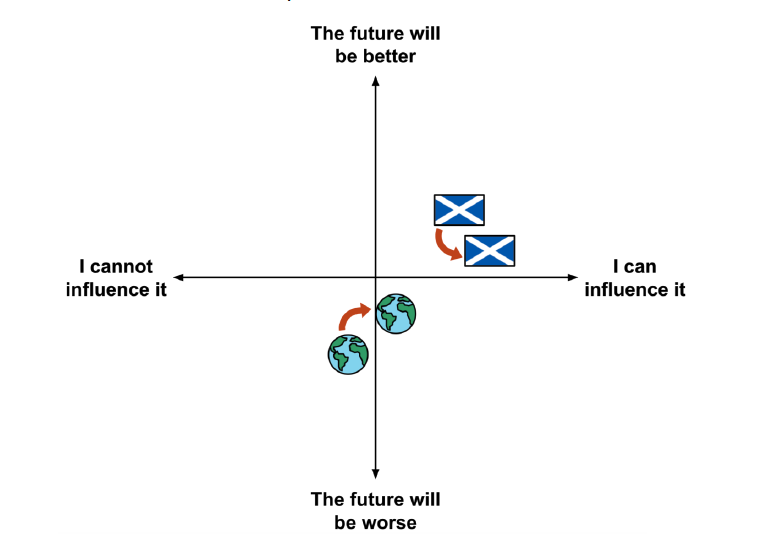
At the start and end of the session, participants took part in an exercise gathering their feelings related to the future of Scotland and the world more broadly in 2040 (see Figure 1 below). This showed they generally feel more positive and more personal agency over influencing the future of Scotland than broader global factors. By the end of the workshop, their sense of agency over both the future of Scotland and the world increased. However, their sense that Scotland’s future would be better slightly decreased and their sense that the world’s future would be better slightly increased. This exercise lightly demonstrates how engagement in futures work can increase feelings of agency, while causing other views to change, potentially due to increased awareness of potential future trends.
Workshop Phase 2: Evidence generation using trend cards
To anchor discussions in research-based insights, participants engaged in an evidence-generation session using trend cards developed based on research conducted by the Scottish Government. Prior to the engagement, as part of its wider Horizon Scanning project, the Scottish Government had undertaken a rapid review of evidence relating to horizon trends with specific relevance for children and young people in Scotland.
The 27 trend cards were developed based on trends and clusters of trends articulated across five key themes: politics and governance; economy and jobs; society and community; health and habits; and climate and environment. Demos Helsinki developed initial cards based on the Scottish Government’s research. These were then refined with input from the Investigation Team, SYP and Scottish Government. Each trend card contains a title and short description of the trend, an overview of its potential impact on Scotland’s future and a set of guiding questions to prompt discussion. These trend cards provided structured yet accessible information about key societal trends, along with discussion prompts to help participants deliberate on their significance and potential impact.
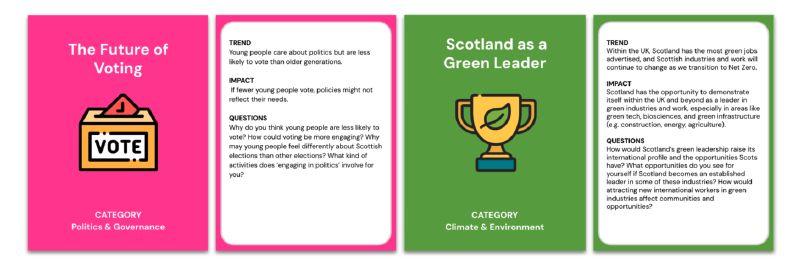
Working in small, facilitated groups, participants took turns selecting a trend card and discussing its implications and connections with other trends. This game-based approach ensured active engagement, with facilitators capturing key insights and emerging themes. In each group, an Investigation Team member facilitated, capturing key insights, emerging themes and areas of agreement or divergence.
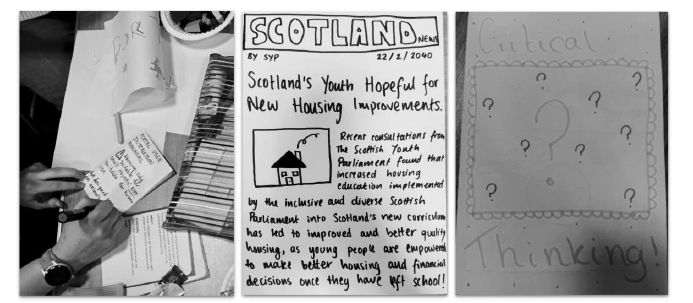
After several discussion rounds and ensuring each group member discussed at least one of their cards, participants transitioned to a creative task. The groups used different materials to create an ‘artefact from the future’ which would illustrate how the trends they had explored might shape Scotland in 2040. Creating these artefacts – such as a future newspaper headline, diary entry, image, model or social media post – helped make abstract ideas clear. This encouraged deeper reflection on how today’s choices influence tomorrow’s realities. The artefacts were revisited in Phase 3: Exploring Future States, reinforcing the iterative nature of foresight and participants’ active role in the day. The trend cards are detailed in Appendix 2 in Young People and the Future of Scotland: A Participatory Horizon Scanning Engagement – Methodology Appendices.
Workshop Phase 3: Exploring future states through an immersive gallery approach
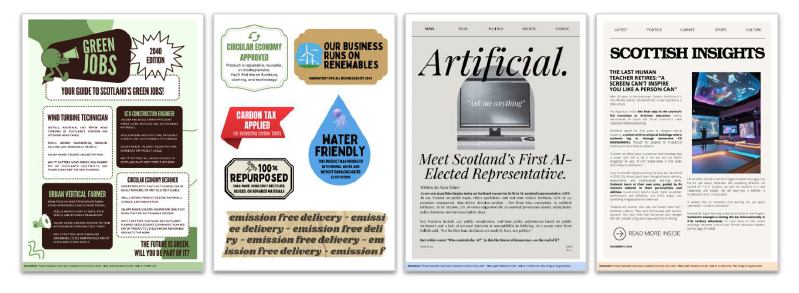
Building on the insights generated in the previous phases, participants moved beyond individual trends to explore how different forces might interact to shape Scotland’s future. This phase introduced four different possible future states for Scotland in 2040, allowing participants to engage with alternative possibilities through a gallery-style experience. The gallery was formed using materials pre-prepared by Demos Helsinki, based on the trend cards and designed to illustrate how key trends might evolve in different directions. Each future state in the gallery contained:
- a written description of the societal landscape in Scotland in 2040;
- a profile of a young person living in that future detailing their work, lifestyle and perceptions of society;
- three to four artefacts from the future, ranging from AI-generated images to fictional products and media content, offering tangible representations of daily life in that future state; and
- participants’ own artefacts (from Phase 2) were added.
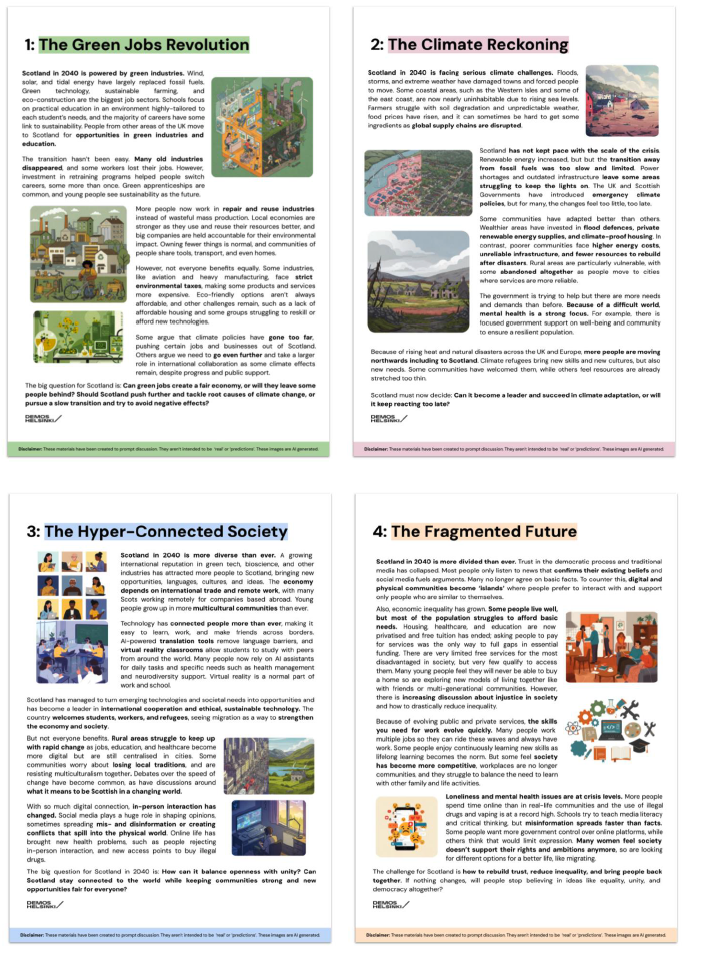
The four contrasting future states are set out in Figure 4 below. For more detail of the logic of how these were developed, see Appendix 1 in Young People and the Future of Scotland: A Participatory Horizon Scanning Engagement – Methodology Appendices.
- The Green Jobs Revolution – A Scotland that has successfully transitioned to a sustainable economy, leading in green industries and innovation.
- The Climate Reckoning – A future where Scotland struggles with extreme weather, food shortages and environmental crises, requiring communities to adapt or relocate.
- The Hyper-Connected Society – A digitally advanced, globally connected Scotland where technology enhances daily life, migration strengthens the economy and social networks are fluid and open.
- The Fragmented Future – A deeply divided Scotland where misinformation spreads, trust declines and inequality fractures society, creating growing isolation and economic disparity.
These future states were not predictions, nor were they intended to represent exhaustive possibilities. Instead, they served as prompts to facilitate discussion, illustrating relatively simplified ways in which trends might interact to create new societal conditions. For further details and images of these materials including examples of artefacts and profiles, see Appendix 1 in Young People and the Future of Scotland: A Participatory Horizon Scanning Engagement – Methodology Appendices.
Participants toured the gallery in small groups, documenting their reactions, questions and emotional responses in anonymous ‘investigation logs’. These logs were designed to capture individual reflections, intended to counter group thinking tendencies, where dominant voices or collective dynamics can sometimes shape discussions or lose nuances.
Workshop Phase 4: Mapping priorities for policy action
The final phase of the workshop focused on identifying and prioritising key areas for action. This allowed young people to connect their reflections on the future with present-day decision-making. Working in small, facilitated groups, participants engaged in three key activities:
1. Revisiting the trend cards – Participants reassessed the trends explored earlier, categorising them as exciting, neutral or concerning – and providing written justifications. This helped distinguish opportunities from risks and identify areas needing action.
2. Developing a priority wheel – Each group created a priority wheel, mapping urgent policy areas across five domains: Climate and Environment; Politics and Governance; Economy and Jobs; Society and Community; and Health and Habits. They could also add actions to be located between these areas if they wished to.
3. Collective prioritisation exercise – Participants toured the groups' work and used three votes (stickers) to mark the most urgent or impactful priorities. Emerging patterns and a whole group discussion revealed strong alignment on issues.
Analysis of workshop results
The primary aim of analysing workshop results was to discover issues that were most important to participants. This identified how often or how strongly trends were discussed, and direct mentions of them being important. It also identified relevant patterns such as areas of agreement, disagreement, uncertainty, nuanced views and which trends participants saw as connected to one another. The analysis aimed to prioritise direct expressions from young people, including quotes or viewpoints they wrote or discussed during the workshop and integrate these as much as possible into the report. Furthermore, analysis has also balanced consideration of the sample size to ensure no viewpoint is over-extrapolated. All Demos Helsinki and SYP facilitators, the Investigation Team and the three Scottish Government staff who were present at the workshop have reviewed the analysis and this report. The draft report was also shared with workshop participants who were invited to comment.
Reflections on the methodology
This first part of the report has outlined the methodology developed to develop and implement engagement of young people in Scotland’s Horizon Scanning efforts. The approach sought to capture insights and to equip young people with the tools to think critically about long-term change.
The young people in the Investigation Team played a key part in ensuring the process was accessible and empowering for the participants. In the workshop, young people were not merely reacting to predefined trends but actively contributing to the exploration of Scotland’s future. The workshop’s four phases – from introducing futures thinking, to trend analysis, to exploring future states, to mapping priorities for action – enabled participants to deliberate, imagine and prioritise in ways that were both structured and open-ended.
This process has already identified useful insights and key directions for further exploration. However, we also recognise limitations. For example, a one-day engagement can only reach a certain level of depth of discussion, and many findings and topics could have been explored further given more time. Furthermore, we recognise that the group engaged was relatively in agreement and often unanimous. Combined with the small sample size, this suggests there are likely views that young people may hold that were not represented in this engagement or were not expressed due to group dynamics. For example, the growing and visible public debate on the political polarisation of young people including potentially rising ambivalence to long-held values including democracy and equality of different groups.[5] This is one example of a group to try to engage with and understand further in any future engagement or analysis. Finally, given a longer timespan, co-creation with young people could have been conducted at an even deeper level. Nevertheless, the insights gathered through interactive exercises, individual reflections and group deliberation offer a rich starting point for understanding young people’s concerns, hopes and expectations for Scotland’s future.
The next part of this report presents the findings from the workshop, exploring the emerging themes, recurring priorities and areas of tension or consensus that arose during the discussions.
Contact
Email: foresight@gov.scot