
Wild Salmon Strategy Implementation Plan: annual progress report 2025
The third annual progress report under the Scottish wild salmon strategy implementation plan covering progress in 2025.
The Status of Salmon in Scotland in 2025
As outlined in previous annual progress reports, the Scottish Government publishes an annual overview of the status of wild Atlantic salmon in Scotland, based on data collected from rod fisheries and fish counters to support national and international management and conservation efforts.
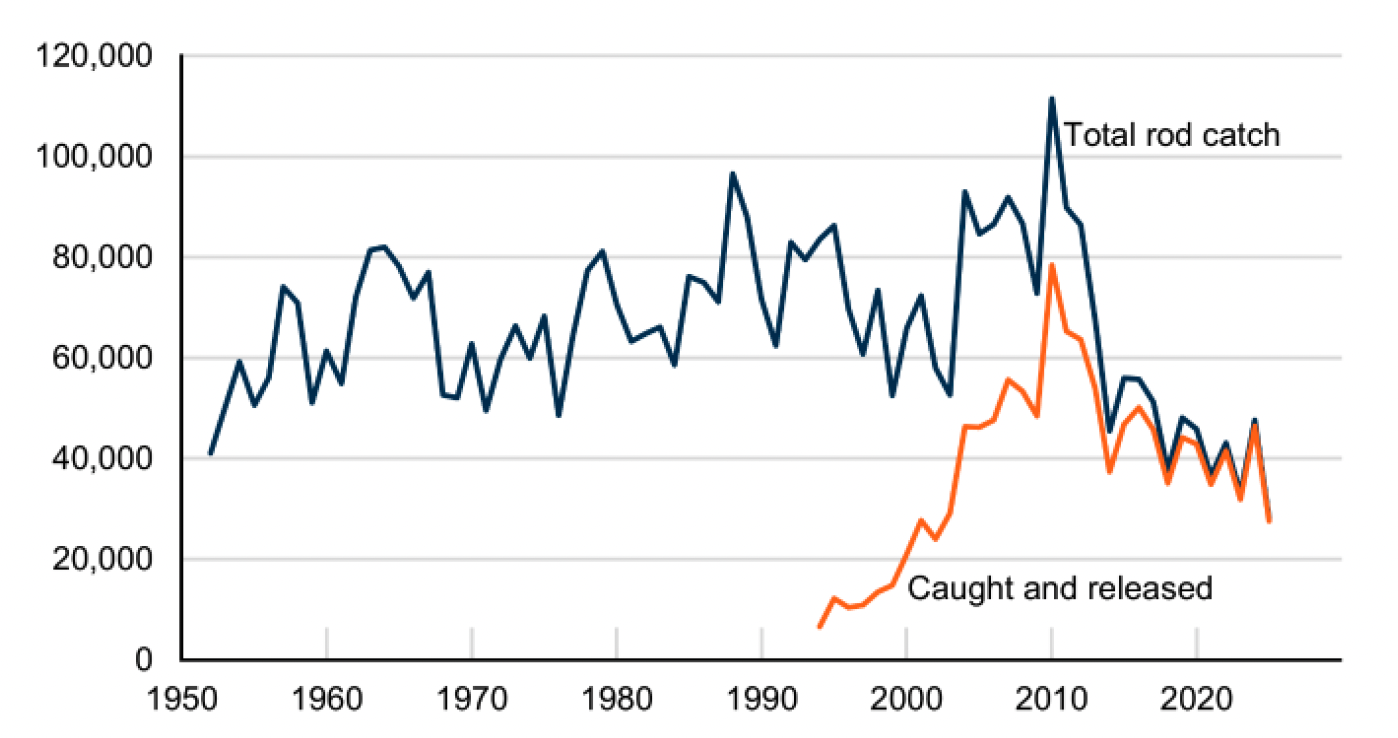
The most recent annual overview, published in August 2026 (adding data from 2025), continues to show that the total number of salmon returning to Scottish coastal waters varies from year to year with a downward trend since estimates began in the 1970s. Similar declines have been observed throughout the North Atlantic, and have been partially attributed to climate change affecting oceanic conditions. Initially, interventions such as the promotion of catch and release and a substantial reduction in exploitation by the commercial net fishery helped maintain broadly stable numbers of spawners, despite a decline in the numbers of fish returning to the coast. However, spawner abundance has also declined in recent years (Figure 1). Although there are year-to-year fluctuations in catches and counts – including an increase in 2024 - there is no evidence of a change in the long-term downward trend.
The conservation status of salmon stocks in Scotland is assessed on a river-by-river basis, except for those areas where fishery catch cannot be assigned to individual rivers. In such cases, rivers are combined to form assessment groups. Special Areas of Conservation which have salmon as a qualifying feature are also assessed separately. For the 2026 angling season, the majority (66%) of the 173 salmon stocks were assessed to be in poor conservation status. Only 18% of stocks were in good conservation status (down from 35% in 2017) but it should be noted that this 18% of stocks contains approximately 84% of Scotland's salmon production.