
Transforming Roles paper 9: allied health professions advanced practice
Guidance for developing Allied Health Professions (AHP) advanced practice roles in Scotland. Outlines policy context, role definition, education pathways, governance, and impact metrics to support consistent, sustainable workforce transformation across health and social care.
Introduction
Allied Health Professions (AHP) advanced practice in Scotland is an increasingly important component of the delivery of safe, high quality and sustainable services across our health and social care system. This paper outlines the current landscape of AHP advanced practice roles and the policy context that underpins the development of these roles. It offers guidance on the future development and implementation of AHP advanced practice to establish a consistent, national approach and maximise the impact of these roles in improving the health of our Nation.
Policy context
Good physical and mental health is central to the Scottish Government’s vision for a successful Scotland, focused on preventing ill health, reducing waiting times and inequalities and tackling economic inactivity. In 2025, three refreshed policy documents were published:
- NHS Scotland Operational Improvement Plan[1] (OIP)
- Scotland’s Population Health Framework 2025–2035[2] (PHF)
- Health & Social Care Service Renewal Framework 2025-2035[3] (SRF)
AHPs are central to delivering the preventative, person-centred, community-focussed care model embedded in these documents.
- The OIP prioritises improved access to treatment such as increasing capacity and reducing backlogs and shifting the balance of care to reduce pressures on hospital and offer care closer to home. There is also a focus on prevention and digital innovation. AHPs lead service redesign, using innovative technology-enabled care to improve access, reduce waiting times and deliver care in community settings.
- The PHF promotes a whole-system approach to improving health outcomes and reducing inequalities. AHPs contribute significantly to its five drivers, especially in prevention, healthy living and equitable access.
- The SRF outlines a vision for sustainable, efficient, high-quality services. AHPs play a key role in shifting care from hospitals to communities, supporting independent living and delivering value-based care aligned with the Getting It Right For Everyone[4] (GIRFE) principles.
These policies build on previous strategies including A National Clinical Strategy for Scotland[5], Realistic Medicine[6], the Rehabilitation Framework[7] and The Six Principles of Good Rehabilitation[8].
Delivery of the ambitions outlined in these documents requires an effective, integrated, multidisciplinary health and social care workforce.
The National Workforce Strategy for Health and Social Care in Scotland[9] sets out a clear vision for workforce growth and transformation, recognising the need for a skilled, sustainable workforce capable of managing increasingly complex health needs driven by demographic changes. Building on this, the AHP Education and Workforce Policy Review[10] makes recommendations to strengthen education reform, workforce planning and advancing practice to enable AHPs to meet Scotland’s evolving health needs.
As the third-largest clinical workforce, comprising 14 distinct professions, AHPs deliver versatile, high-quality care across the lifespan. From pre-birth through to older age, they play a vital role in prevention, prehabilitation, assessment, diagnosis, treatment and rehabilitation. Working across primary and secondary care and in partnership with third-sector organisations, AHPs provide seamless, integrated care. To fully harness their skills and maximise their impact, a clear strategy for role development and transformation is essential, underpinned by integrated service planning, strategic workforce planning and digital enablement.
The original Transforming Roles paper[11] called for strategic oversight to:
- Develop and transform Nursing, Midwifery and Health Profession (NMaHP) roles to meet current and future health and care needs.
- Ensure consistent, sustainable and progressive roles, education and career pathways.
This direction remains clear: transforming roles across the AHP workforce is essential to unlock their full potential to improve population health and support the people of Scotland to live longer, healthier lives.
AHP advanced practice roles
The National Workforce Strategy for Health and Social Care in Scotland[9] acknowledges the vital role of AHPs in supporting health and wellbeing and emphasises the need to both strengthen existing roles and develop new ones, such as advanced practice. Aligned to Level 7 of the Skills for Health Career Framework[12] (Annex 1), advanced practice roles maximise workforce potential by appropriately extending the professional and/or individual’s scope of practice, while continuing to meet regulatory requirements that protect the public. By working at an advanced level across all four pillars of practice (Figure 1), they are able to lead service redesign, enhance quality and improve outcomes[13].
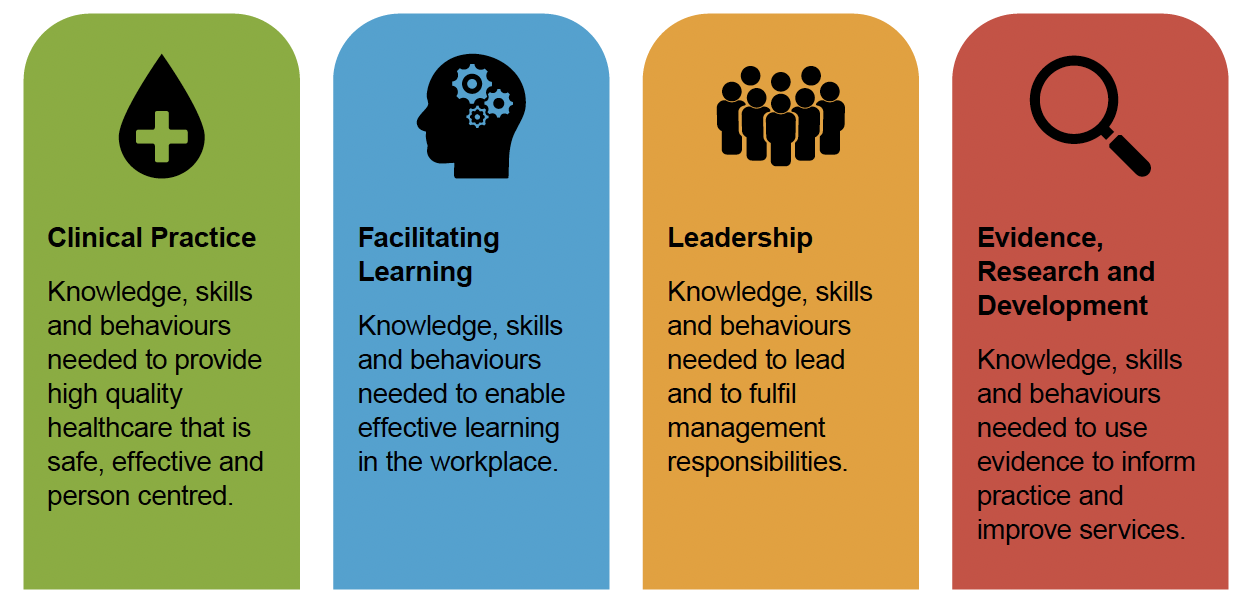
Clinical Practice
Knowledge, skills and behaviours needed to provide high quality healthcare that is safe, effective and person centred.
Facilitating Learning
Knowledge, skills and behaviours needed to enable effective learning in the workplace.
Leadership
Knowledge, skills and behaviours needed to lead and to fulfil management responsibilities.
Evidence, Research and Development
Knowledge, skills and behaviours needed to use evidence to inform practice and improve services.
Systematic reviews[14],[15] demonstrate that advanced practice AHPs provide safe, effective care with outcomes comparable to or better than traditional models. Evidence also shows high levels of patient satisfaction, particularly in relation to improved access to care[16], confidence and trust in clinical competence[17] and the person-centred approach and advanced communication skills that experienced practitioners bring to these roles[18]. Examples of the impact of AHP advanced practice roles in Scotland are shown below and further examples linked to policy are highlighted in Annex 2.
Advanced Practice in Action: Remission of Type 2 Diabetes
Advanced Practice Dietitians led a 12-month pilot remission programme as part of the Scottish Government’s Type 2 Diabetes Healthier Future Framework. The programme included assessment of medical suitability and emotional and physical wellbeing, Total Diet Replacement, structured food reintroduction and support to maintain lifestyle changes. It specifically targeted patients from areas of deprivation and ethnic minority backgrounds.
Results showed significant weight loss, improved glycaemic control, reduced medication use and remission rates comparable to clinical trials. By reaching underserved populations, the programme also contributed to reducing health inequalities. Plans are now underway to scale up remission support through the national digital type 2 diabetes remission programme.
Clinical Outcomes at Year 1
10.5 kg Average weight loss
45% in remission
83% no longer on diabetes medications
45% no longer on hypertension medications
Advanced Practice in Action: Enhancing Frailty Care
Advanced Practice AHPs in Frailty are highly skilled professionals working across acute and community settings. They operate with a high degree of autonomy and clinical decision-making capacity, delivering holistic, person-centred care to individuals living with frailty.
The Advanced Practice Frailty role was developed in response to a growing elderly population with increasing demand for complex care. They aim to reduce hospital admissions, improve outcomes and minimise the risk of adverse events associated with prolonged or unnecessary hospital stays.
Key role responsibilities:
- Early identification and assessment of frailty
- Coordinate multidisciplinary care to prevent hospital admission and support early discharge
- Developing and implementing personalised future care plans
- Leading service transformation and contributing to research and innovation
Frailty identification across primary care
49% of patients aged 75+ safely managed in primary care at the front door. 36% discharged within 72 hours
Over 20,000 bed days saved, more than £8 million in cost savings
A fully funded postgraduate education programme (pgCert and MSc) developed with Glasgow Caledonian University
Current landscape in Scotland
NHS Education for Scotland’s (NES) Scoping of AHP Advanced Practice in Scotland report[19] revealed support for AHP advanced practice roles within some NHS Boards, including:
- Establishment of AHP advanced practice lead roles providing strategic oversight of role development
- Local workforce policies and strategies to embed roles
- Use of metrics to demonstrate impact of advanced practice roles
- Creation of local advanced practice networks to support role development
While this is encouraging progress, the lack of a national definition, wide variation in job titles used, and limitations in workforce data, had a significant impact on workforce and job planning to support the scaling of existing and development of new roles. It was also noted that there is no systematic approach to developing roles through education frameworks and career pathways, or to evaluating their impact. Many practitioners and Service Leads were not aware of national resources such as the NES Multiprofessional Advanced Practice Toolkit[20] and the Advanced Practice Academies[21].
These findings and the AHP Education and Workforce Policy Review[10] highlight the need for:
1. A consistent national definition of AHP advanced practice
2. A consistent national job title format for AHP advanced practice roles
3. Clear national direction to maximise the contribution of AHP advanced practice roles in Scotland
4. Robust systems for developing knowledge, skills and behaviours (KSB) frameworks in priority areas of AHP practice
Guidance to progress AHP advanced practice
Annex 3 consolidates the preceding information and the sections that follow, into detailed guidance for employers to progress AHP advanced practice, structured around the five pillars of the workforce journey:
Plan – Understand current workforce and future needs; align with national strategies and service drivers
Attract – Promote AHP advanced practice as a career; build interest and opportunities
Train – Develop capabilities through education, training and supervision
Employ – Establish clear processes for recruitment, deployment and governance
Nurture – Support and retain staff through Continuing Professional Development (CPD), wellbeing initiatives and recognition
Contact
Email: cno@scot.gov