
Scottish Social Attitudes Survey 2025: Core module
This report presents findings from the Scottish Social Attitudes Survey core module 2025. In 2025 the core module asked questions covering attitudes to: trust in government, the health service, the standard of living, democratic engagement, and tax, spending, and redistribution of income.
First published: 17 June 2026
Last updated: 9 September 2026
Tax, spending and redistribution
Taxes and spending
Respondents were presented with three options and asked to pick which one they thought government should choose – whether to ‘reduce taxes and spend less on health, education and social benefits’, ‘keep taxes and spending on these services at the same level’ or ‘increase taxes and spend more on health, education and social benefits’.
In 2025, just under half (45%) of respondents thought government should increase taxes and spending; 39% thought that government should keep taxes and spending at the same level, and 12% thought that taxes and spending should be reduced.
|
Table |
(%) |
|---|---|
|
Reduce taxes and spend less on health, education and social benefits |
12 |
|
Keep taxes and spending on these services at the same level |
39 |
|
Increase taxes and spend more on health, education and social benefits |
45 |
|
None of these |
1 |
|
Unweighted base (n) |
1,549 |
The percentage of people who said that tax and spending should be increased in 2025 (45%) was in line with that for 2024 (50%); likewise for those who thought it should be decreased (12% compared with 14%). The percentage who said they should be kept the same saw a statistically significant increase, from 33% in 2024 to 39% in 2025.
This question has been asked since 1999 (and most recently in 2023). Over that period, the percentage who thought government should reduce taxes and spending remained low. Between 2006 and 2014, more people said government should keep tax and spend the same than said they should be increased. Outwith these years, more people said to increase tax and spend than to keep them the same.
Figure 16 – Around half of people support increased tax and spending
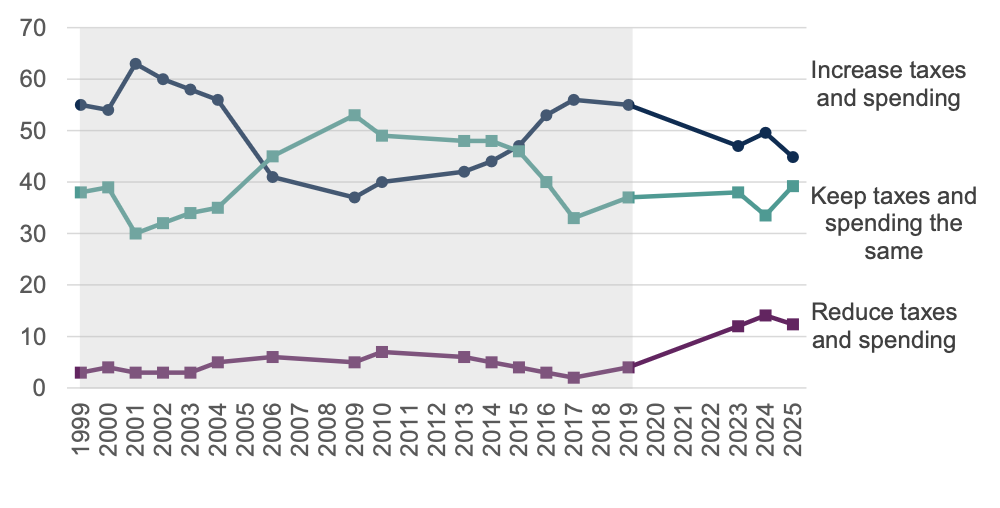
Percentage of people who thought the government should increase, reduce or keep the same tax and spending on health, education and social benefits, 1999 to 2025. N.B. Shading indicates a change in methodology from face-to-face to push-to-web between 2019 and 2023. Findings for 2024 published in Scottish Social Attitudes | 25 years of devolution in Scotland: Public attitudes and reactions (National Centre for Social Research, 2025)
Redistribution of income
Respondents were asked to what extent they agreed with the statement ‘Government should redistribute income from the better-off to those who are less well off’.
In 2025, around half (45%) agreed or agreed strongly with the statement; a quarter (27%) disagreed or disagreed strongly, and a quarter (25%) neither agreed nor disagreed.
|
Table |
(%) |
|---|---|
|
Agree strongly |
18 |
|
Agree |
27 |
|
Neither agree nor disagree |
25 |
|
Disagree |
16 |
|
Disagree Strongly |
11 |
|
Agree strongly/agree |
45 |
|
Disagree/disagree strongly |
27 |
|
Unweighted base (n) |
1549 |
The percentage of people who agreed that government should redistribute income from the better-off to those who are less well off in 2025 was 45%, in line with the 49% from 2023[14]. The percentage who disagreed in 2025 was also in line with the percentage from 2023 (25% in both years) and the percentage whose attitude was neutral in 2025 (27%) was also in line with that for 2023 (23%); no statistically significant differences.
This question has been asked since 1999; respondents have been broadly more likely to agree than disagree since 2009, although the gap appears to have narrowed in recent years.
Figure 17 – More people agree with redistribution of income than disagree
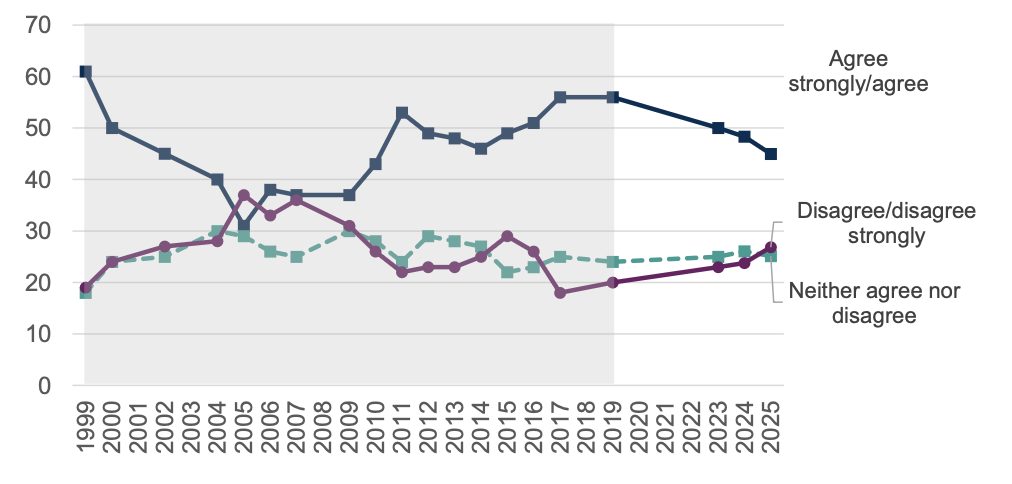
Percentage of people who agree or disagree with the statement ‘Government should redistribute income from the better-off to those who are less well-off’, 1999 to 2025. N.B. Shading indicates a change in methodology from face-to-face to push-to-web between 2019 and 2023. Findings for 2024 collected for (but not published directly in) Scottish Social Attitudes | 25 years of devolution in Scotland: Public attitudes and reactions (National Centre for Social Research, 2025)
Subgroups: Tax, spending and redistribution
Data tables for all subgroups, by demographic, economic and political factors are available in the supplementary tables alongside this report.
In the 2025 survey in relation to tax and spend preferences, respondents who reported having a disability (a long-standing physical or mental health condition or illness) were more likely to respond that the government should choose to increase taxes and spend more on health, education and social benefits (58% compared to the average among all respondents of 45%). Those on the left of the left-right scale were also more likely to report a preference for the government to increase taxes and health, education and social spending (56%), as were Labour (56%), Liberal Democrat (64%), SNP (53%), and Green Party (78%) supporters. Conversely, Conservative (24%) and Reform (21%) supporters were more likely to report a preference for reducing tax and spend compared to the average for all respondents (12%).
On redistribution of income, respondents from households where the household income was in the lowest two groups (less than £450 per week or between £450 and £799 per week) were more likely to agree that ‘government should redistribute income from the better-off to those who are less well off’ (both 50%, compared to the average for all respondents of 45%). Conversely, respondents in the highest household income group (household incomes more than £1,400 per week) were more likely to disagree that governments should redistribute income in this way (42% compared to the average for all respondents of 27%).
Respondents on the left of the left-right scale were more likely to agree that governments should redistribute income from the better-off to those who are less well off (70% compared to the average of all respondents of 45%), while respondents on the right of the scale were more likely to disagree (85% compared to the average of 27%).
Contact
Email: socialresearch@gov.scot