
Scottish Social Attitudes 2025: attitudes to discrimination and positive action
Findings from the 2025 Scottish Social Attitudes survey on discrimination and positive action. It explores attitudes to prejudice, diversity and immigration, trends over time, and identifies groups most at risk, alongside mixed public views on equality and support for positive action in Scotland.
6. Promoting equality and positive action
This chapter explores views on equal opportunities and positive action to support under-represented and equalities groups in the workplace. It looks at whether people believe attempts to provide equal opportunities have gone too far, or not far enough, as well as attitudes towards positive action to help different groups progress in their careers. It also explores how these attitudes have changed over time.
‘Positive action’ refers to lawful measures that may be taken to address disadvantage or under-representation experienced by individuals who share a protected characteristic. This can include steps to improve access to training, development, or employment opportunities.
Under the Equality Act 2010, section 158[31], employers may take proportionate action where they reasonably think that persons who share a particular protected characteristic suffer a disadvantage connected to that characteristic, have different needs from persons who do not share that characteristic and / or are under-represented in particular activities. There are also proportionate actions in relation to recruitment and promotion that can be taken by employers in specified circumstances which are outlined in section 159 of the Equality Act[32]. Such action must be a proportionate means of achieving certain aims such as alleviating the disadvantage experienced by persons sharing a protected characteristic under section 159[33].
Positive action is distinct from positive discrimination, which is, in most situations, unlawful. For example, it is not lawful to advertise for a female senior manager, as this is discriminatory against men, unless an employer can demonstrate that being female is an essential requirement for the job and the requirement is a proportionate means of meeting a legitimate aim[34]. Positive action can lawfully be used to support equal access to employment in certain circumstances. For example, it may be lawful to appoint a woman over a man where both candidates are equally qualified, the decision is a proportionate means of achieving a legitimate aim (such as increasing the representation of women in an under‑represented role), and provided that there is no policy of automatically preferring women over men. There is an exception to this in relation to disability. Under the Equality Act 2010, it is not unlawful to treat disabled people more favourably than non-disabled people. For example, an employer may advertise a role specifically for disabled people, and a candidate who is rejected because they are not disabled would not be able to bring a disability discrimination claim on that basis. However, this exception does not permit more favourable treatment of a person with a particular disability over someone else with a different disability.
Equal opportunities
Since 2002, SSA has included questions on whether people ‘think attempts to give equal opportunities have gone too far or not gone far enough’ for…?
- Women in Scotland
- Black and Asian people
- Lesbian, gay and bisexual people
Possible responses were ‘Gone much too far’, ‘Gone too far’, ‘About right’, ‘Not gone far enough’ and ‘Not gone nearly far enough’. Throughout the report we use the term gone too far to refer to ‘gone much too far’ and ‘gone too far’ combined and not gone far enough to describe ‘not gone far enough’ and ‘not gone nearly far enough’ combined.
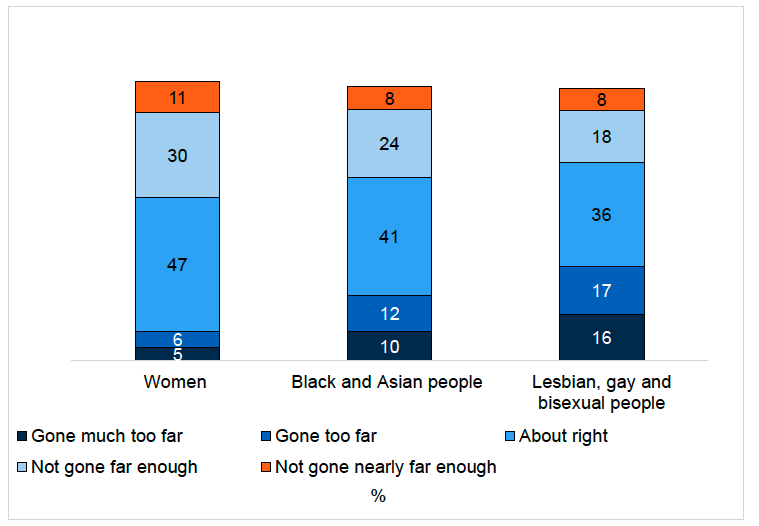
In 2025, four in ten adults (40%) felt that attempts to give equal opportunities for women had not gone far enough, while only one in ten (10%) felt they had gone too far. For Black and Asian people, a greater proportion felt that attempts had not gone far enough (32%) than thought they had gone too far (23%). Conversely, in relation to lesbian, gay and bisexual people, a higher proportion felt that attempts to give equal opportunities had gone too far (33%) than felt they had not gone far enough (26%). In all three cases, the most commonly held view was that attempts to give equal opportunities were ‘about right’, for example, 41% thought that attempts to give equal opportunities to Black and Asian people were ‘about right’ (Figure 6.1).
Figure 6.1 Respondents’ views on whether equal opportunities have gone too far or not gone far enough (2025)
Base: All respondents to discrimination module, unweighted = 1,549
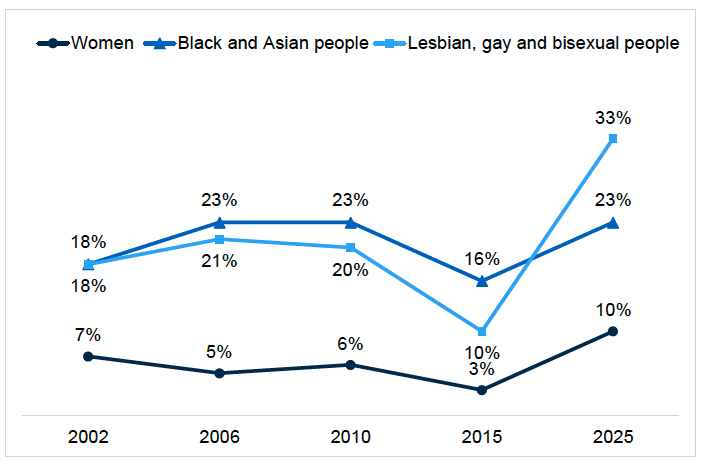
The proportion who felt that attempts had gone too far was significantly higher in 2025 than in 2015 for all three groups, with the largest increase for lesbian, gay and bisexual people (Figure 6.2). This follows a significant decrease in the proportion who felt that attempts had gone too far across all three groups between 2010 and 2015 after a period of relative stability between 2002 and 2010. Overall, we can see that while the proportion of people who felt that attempts to give equal opportunities to all three groups had gone too far decreased significantly in 2015, this trend has now reversed, with 2025 showing the highest proportions on record of people thinking attempts to give equal opportunities have gone too far.
Figure 6.2 Proportion of respondents who feel attempts to give equal opportunities have gone too far (2002-2025)
Base: All respondents to discrimination module, unweighted = 1,549
How do attitudes to promoting equal opportunities vary between groups?
Views on whether attempts to give equal opportunities to women, Black and Asian people, and lesbian, gay and bisexual people have gone too far varied by socio-demographic factors and attitudes to diversity and immigration.
Attitudes to diversity and immigration, and knowing someone from an equalities group
Those who preferred to live in a less diverse area were more likely than those who preferred to live in a more diverse area to say that attempts to give equal opportunities had gone too far for all three groups. For example, 46% of those who preferred to live in a less diverse area felt that attempts to give equal opportunities to Black and Asian people had gone too far, compared with 9% of those who preferred to live in a more diverse area.
Similarly, those who ‘disagreed’ or ‘disagreed strongly’ that ‘People from outside Britain who come to live in Scotland make the country a better place’ were more likely than those who ‘agreed’ or ‘agreed strongly’ to say that attempts to give equal opportunities had gone too far for all groups. For example, 74% of those who ‘disagreed strongly’ with this statement felt that attempts to give equal opportunities had gone too far for lesbian, gay and bisexual people, compared with 9% of those who ‘agreed strongly’.
Attitudes towards equal opportunities also differed by whether they personally knew someone from the relevant equalities group. For example, those who did not know anyone from a different racial or ethnic background were more likely than those who did to feel that attempts to give equal opportunities to Black and Asian people had gone too far (31% compared with 21%). Similarly, those who did not know anyone who is lesbian, gay or bisexual were more likely than those who did to feel that attempts to give equal opportunities to lesbian, gay and bisexual people had gone too far (50% compared with 30%).
Sex, age, and education
Views on whether attempts to give equal opportunities had gone too far also varied by socio-demographic factors such as sex, age, and education. Generally speaking, men were more likely than women to say that attempts to give equal opportunities had gone too far for all groups (Table 6.1).
Older people were more likely than younger people to think that attempts to give equal opportunities to both Black and Asian people and to lesbian, gay and bisexual people had gone too far. For example, 39% of those aged 65 and over thought equal opportunities had gone too far for lesbian, gay and bisexual people, compared with 24% of those aged 16-24.
Those with lower levels of formal qualifications, or no formal qualifications, were more likely than those with higher levels to think that attempts to give equal opportunities to both Black and Asian people and to lesbian, gay and bisexual people had gone too far. For example, 42% of those with no formal qualifications believed that attempts to give equal opportunities to Black and Asian people had gone too far, compared with 13% of those with a degree equivalent qualification or above.
| Views on equal opportunities | Men | Women |
|---|---|---|
| Equal opportunities for women have gone too far | 13 | 8 |
| Equal opportunities for Black and Asian people have gone too far | 25 | 20 |
| Equal opportunities for lesbian, gay and bisexual people have gone too far | 38 | 28 |
| Bases (unweighted) | 657 | 845 |
Base: All respondents to discrimination module who answered this question and provided their gender (1,502).
Religious identity
People’s current religious identity was associated with their views about equal opportunities for Black and Asian people and for lesbian, gay and bisexual people, but not with views on equal opportunities for women. People who identified as belonging to a religion were more likely than those who did not belong to a religion to feel that attempts to give equal opportunities had gone too far, for both Black and Asian people (27% compared with 19%) and for lesbian, gay and bisexual people (41% compared with 26%).
Positive action
The Equality Act 2010 states that employers can, in certain situations, take steps to help groups that share protected characteristics access employment or training. This is referred to as positive action. Positive action is distinct from positive discrimination, which is usually unlawful.
Positive action was explored through three questions on SSA 2025, the first two were:
- A company has fewer women than men in senior jobs and decides to give its women employees extra opportunities to get training and qualifications. Do you think this would be fair or unfair?
- A company has few Black and Asian people in senior jobs and decides to give Black and Asian people it employs extra opportunities to get training and qualifications. Do you think this would be fair or unfair?
Possible responses were ‘Definitely fair’, ‘Probably fair’, ‘Probably unfair’ and ‘Definitely unfair’.
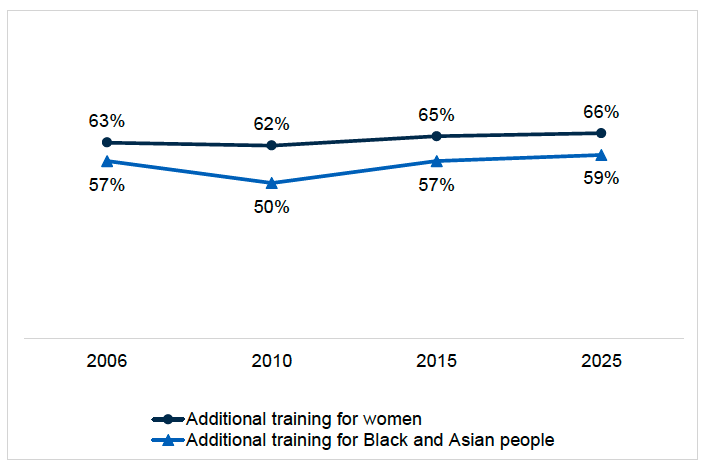
When asked about providing extra opportunities for women to get training and qualifications in the workplace, two-thirds (66%) felt that this was ‘definitely’ or ‘probably’ fair, and one third (33%) ‘definitely’ or ‘probably’ unfair. A slightly lower proportion (59%) felt that such positive action for Black and Asian people was fair. Figure 6.3 shows that these proportions are fairly consistent with previous findings from SSA. There were no significant differences between subgroups in relation to these two questions.
Figure 6.3 Proportion who believe it is ‘definitely’ or ‘probably’ fair to give extra opportunities for training and qualifications to women and Black and Asian people (2006-2025)
Base: All respondents to discrimination module, unweighted = 1,549
In addition, SSA 2025 included a question about a different approach to promoting equality, automatically giving a disabled person an interview for a job:
‘Several people apply for a job, including a disabled person. They all meet the necessary requirements for the job. Do you think it would be fair or unfair to automatically give the disabled person an interview for the job even if other candidates appear to be better qualified?’
Possible responses were ‘Definitely fair’, ‘Probably fair’, ‘Probably unfair’ and ‘Definitely unfair’.
The findings show that people in Scotland were less supportive of this approach to promoting equality in recruitment than they were of providing extra training opportunities. Only a third (33%) felt that it was fair to automatically offer a disabled person an interview when other candidates appear to be better qualified, with 37% feeling it was ‘probably unfair’ and 29% that it was ‘definitely unfair’.
How do attitudes to positive action vary between groups?
Similar to views on equal opportunities, views on positive action varied by attitudes to diversity and some socio-demographic factors.
Women were more likely than men to feel that the positive action of giving extra opportunities for training and qualifications was ‘definitely’ or ‘probably’ fair for women (75% of women compared with 57% of men) and for Black or Asian people (66% of women compared with 51% of men). There was no difference by gender for views on the positive action of offering job interviews to disabled people who are not as well qualified as other candidates.
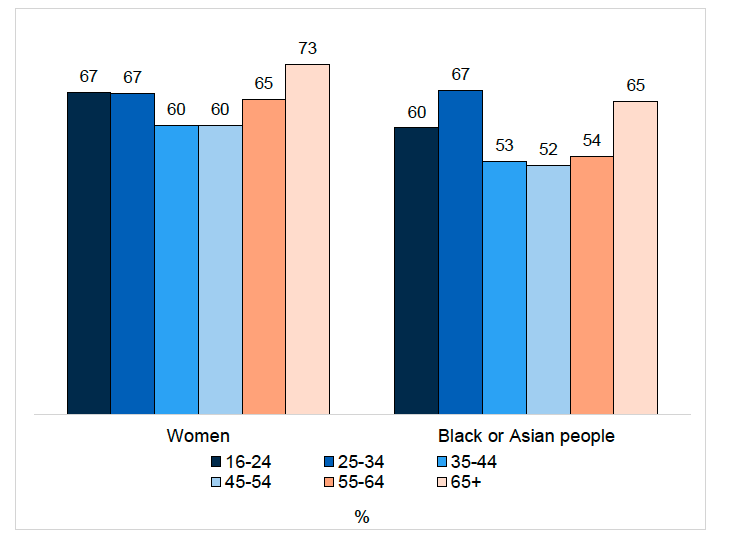
The proportion of people who felt that it was fair to give extra opportunities for training and qualifications for both women and for Black and Asian people was higher among younger people, aged between 16 and 34 (67% and 60% respectively) and for older people, aged 65 and above (73% and 65%, respectively) compared with those aged 35 to 64 (60% and 53%, respectively) (Figure 6.4).
Figure 6.4 Proportion who felt giving extra opportunities for training and qualifications for women and Black or Asian people was ‘definitely’ or ‘probably’ fair, by age
Base: All respondents to discrimination module, unweighted = 1,549
As with views on equal opportunities, those who preferred to live in a more diverse area were more likely than those who preferred to live in a less diverse area to feel that positive action was fair for all groups. For example, 36% of those who preferred to live in a more diverse area felt that positive action offering disabled people a job interview was fair, compared with 28% of those who preferred to live in a less diverse area.
Views on immigration were also associated with attitudes towards positive action. Those who agreed that ‘People from outside Britain who come to live in Scotland make the country a better place’ were more likely than those who disagreed with this statement to feel that positive action was fair for all groups. For example, 80% of those who ‘agree strongly’ with this statement felt that positive action for Black and Asian people was fair, compared with 28% of those who ‘disagreed strongly’.
Equal opportunities for mothers
To further explore people’s views on equality in the workplace, SSA included a scenario describing two different female employees and asked respondents to decide whether one of them is more deserving of a promotion:
‘Say that two women are being considered for promotion to a more senior position at work. Both have the skills needed for the job and both have worked for the company for five years. During that time one of the women took a year off work after having a baby. Which of the following statements comes closest to your view?
- Both women are equally deserving of the promotion
- The woman who has not taken time off is more deserving of the promotion
- The woman who has taken time off is more deserving of the promotion’
The vast majority of people (90%) felt that both women were equally deserving of the promotion. Only 8% felt that the woman who had not taken time off was more deserving of the promotion, and only 1% felt that the woman who had taken time off for maternity leave was more deserving of the promotion. These figures have remained consistent since 2015.
How do attitudes to equal opportunities for mothers vary between groups?
Men were more likely than women to think that the woman who had not taken time off was more deserving of the promotion (11% of men, compared with 5% of women). People of Black, Asian, mixed or other minority ethnicity were also more likely than White people to think this (23% and 7% respectively).
As has been seen throughout this chapter, attitudes to diversity and immigration were associated with people’s views on equal opportunities, irrespective of the situation or group under consideration. This was also true with regards to opportunities for promotion. Those who preferred to live where most people were similar to themselves were more likely than those who preferred to live in a diverse area to feel that the woman who had not taken time off was more deserving of the promotion (15% compared with 5%). Similarly, those who disagreed that ‘People from outside Britain who come to live in Scotland make the country a better place’ were more likely than those who agreed to feel that the woman who had not taken time off was more deserving of the promotion (17% who ‘disagreed strongly’ and 15% who ‘disagreed’, compared with 6% who ‘agreed’ and 4% who ‘agreed strongly’).
Contact
Email: socialresearch@gov.scot