
Scottish Social Attitudes 2025: attitudes to discrimination and positive action
Findings from the 2025 Scottish Social Attitudes survey on discrimination and positive action. It explores attitudes to prejudice, diversity and immigration, trends over time, and identifies groups most at risk, alongside mixed public views on equality and support for positive action in Scotland.
1. Introduction
This report presents findings from the 2025 Scottish Social Attitudes survey (SSA). It explores the current state of public attitudes towards discrimination and positive action in Scotland. As this is the fifth time that SSA has included questions on attitudes to discrimination and positive action, following previous studies in 2002, 2006, 2010 and 2015, this report also provides insight into how public attitudes have changed over time.
In 2025, SSA included questions on general attitudes towards prejudice, personal relationships, employment and equality of opportunity in the labour market, positive action and promoting equality in the workplace, and attitudes towards immigration. These questions were funded by the Scottish Government.
Definitions
Discriminatory attitudes
The definition of a ‘discriminatory attitude’ used throughout this report was first developed as part of the 2002 SSA discrimination module. For the purposes of this report a ‘discriminatory attitude’ is defined as:
‘One that directly or indirectly suggests that some social groups may not be entitled to engage in the full panoply of social, economic and political activities that are thought to be the norm for most citizens. In short, it is an attitude that openly or tacitly legitimates some form of social exclusion.’
This definition does not reflect any legal definition of discrimination, but encompasses any attitude that indicates a reluctance to allow people from particular groups to participate in activities which would not be denied to (most) other people, irrespective of whether or not it is legal to deny people such opportunities.
It is important to note that this report focuses on discriminatory attitudes rather than discriminatory behaviour. Discriminatory behaviour is behaviour by individuals and institutions ‘that either deliberately or inadvertently excludes particular groups from enjoying the rights, dignity, services and resources available to others’.[3] While it is possible for discriminatory behaviour to occur in the absence of individual discriminatory attitudes, for example as a result of institutional bias, in practice discriminatory attitudes often underpin discriminatory behaviour.
If people believe that certain groups in society should not be entitled to the same rights and resources as others, they may be more likely to express this through actions that exclude members of that group. Even where discriminatory attitudes do not translate into particular discriminatory behaviours, reducing the prevalence of such attitudes remains an important part of building and maintaining positive relationships across society.
Positive action
The definition of ‘positive action’ used throughout this report reflects sections 158 and 159 of the Equality Act 2010.[4] Positive action refers to proportionate measures that may be taken, in certain circumstances, to address disadvantage, meet different needs, or increase participation among people who share a protected characteristic. In limited circumstances, the Act also permits the use of positive action in recruitment or promotion where specific statutory conditions are met.[5]
Positive action can be lawful under the Equality Act 2010 and is most applied in an employment context to provide people who share particular protected characteristics (sometimes referred to in this report as ‘equalities groups’) with equal access to employment or training opportunities. Positive action is described by the Equality and Human Rights Commission (EHRC) as an action to ‘encourage people from groups with different needs or with a past track record of disadvantage or low participation to take up training, development, promotion or transfer opportunities’.[6]
Positive action in the workplace can include providing access to specific schemes to those from equalities groups and encouraging candidates from equalities groups to apply for positions within an organisation where those groups are under-represented.
Positive action is distinct from positive discrimination. Positive discrimination is generally unlawful under the Equality Act 2010 which prohibits the treatment of someone more favourably because of their protected characteristic to the detriment of others. For example, it is generally unlawful to advertise for a female senior manager, as this would amount to direct discrimination on grounds of sex, unless an employer can demonstrate that being female is an occupational requirement and that the application of that requirement is a proportionate means of achieving a legitimate aim.[7] There is an exception to this in relation to disability. Under the Equality Act 2010, it is lawful to treat disabled people more favourably than non-disabled people. For example, an employer may advertise a role specifically for disabled people, and a candidate who is rejected because they are not disabled would not be able to bring a disability discrimination claim on that basis. However, this exception does not permit more favourable treatment of a person with a particular disability over someone else with a different disability.
Policy context
SSA first included questions on discrimination in 2002. Since then, there have been considerable changes to equality legislation, and public and media debate about equality and discrimination (see Figure 1.1 for a summary of some key changes between 2010 and 2025) but please note this is not a complete or definitive list as it may have unintentionally omitted some important information.
The structure of Scotland’s society has also changed between 2002 and 2025. Figures from the 2022 Census show that the proportion of Scotland’s population who are older, have a long-term illness, disease or condition, are from a minority ethnic background, or have no religion have all increased since 2001. Older people (aged 65 and above) accounted for around 20.1% of the Scottish population in 2022, compared with 15.9% in 2001.[8] The 2022 Census also shows that the proportion of Scotland’s population who have a long-term illness, disease or condition has increased since 2011 (21.4% compared with 18.7%). The percentage of those reporting a mental health condition increased from 4.4% in 2011 to 11.3% in 2022, making this the second most commonly reported long-term condition. Younger people drove this increase in reports of mental health conditions, with 15.4% of those aged 16-24 reporting a mental health condition, up from 2.5% in 2011[9].
The proportion of people in Scotland with a minority ethnic background increased from 4.5% in 2001 to 12.9% in 2022. The proportion with no religion increased from 27.5% in 2001 to become the majority (51.1%) in 2022. The 2022 Census collected data on sexual orientation and gender identity for the first time and showed that 4% of Scotland’s population aged 16 and over identified as lesbian, gay, bisexual, or other sexual orientation and 0.4% identified as trans or as having a trans history.[10]
Net migration into Scotland from overseas in 2024 was 42,600, one of the highest figures on record but around 16% lower than the previous year (63,500).[11] Net migration includes those who have moved to Scotland from outside the UK, and those who have moved to Scotland from within the rest of the UK.
The EHRC’s recent report ‘Is Scotland Fairer?’ details a mixed picture on progress in equality.[12] There have been improvements in ethnic minority representation in the Scottish Parliament, and the proportion of women on public boards met the Scottish Government’s 50% target in 2019/20, 2020/21, and 2021/22. However, there is continued evidence that the disadvantage experienced by these equalities groups remains, for example in educational attainment, employment opportunities, health outcomes, and socio-economic deprivation.
The Scottish Government has committed to ‘a fairer society in which no-one experiences discrimination and people are able to realise their rights, and live safely in inclusive communities’.[13] They have committed to achieve this by ‘addressing systemic inequalities and embedding equality at the heart of [their] work’[14] through an integrated approach incorporating equality and intersectional evidence, lived experience, and equality impact assessments.
While there has been progress in tackling inequality, the Scottish Government recognises that there is still much to be done to achieve a fully inclusive society. In addition to recognising the wider importance of challenging discriminatory attitudes in Scotland, the Scottish Government has also made specific commitments to investing in employability services to remove barriers for those furthest from the labour market; to achieving race equality by 2030 under the race equality framework for Scotland (2016-2030); to advancing equality for and promoting, protecting and realising the rights of lesbian, gay, bisexual and trans people; and to supporting organisations to promote interfaith dialogue and support faith and belief communities.
The Disability Equality Plan[15], published in June 2025, sets out the Scottish Government’s priorities for advancing equality and human rights for disabled people, including actions on independent living, accessible services and participation. The Government has committed to reviewing and further developing the Disability Equality Plan so it remains evidence‑led and shaped by disabled people. This includes continued support and funding for Disabled People’s Organisations, recognising their crucial role in representing lived experience, strengthening accountability, and driving rights‑based change.
In key areas such as employment, the Scottish Government published its Fair Work Action Plan in 2022 to support the advancement of fair work in Scotland and address workplace inequalities. It incorporates the actions from the Gender Pay Gap and Disability Employment Gap action plans and the Anti-Racist Employment Strategy.
Since 2015, the Scottish Government has established a range of policies aimed at tackling inequality in Scotland. For example, the Race Equality Framework for Scotland (2016-2030) sets out the government’s high-level approach to promoting race equality and tackling racism and inequality. The Anti-Racism Delivery Plan 2026-2030 takes this forward by focusing on government-led actions, including systemic change and specific commitments to support Gypsy/Traveller communities. The 2023 Faith and Belief Engagement Strategy also commits to improving the EQIA process - enhancing how impacts on faith and belief communities are assessed, ensuring their needs are actively considered in policy development.
The Scottish Government in partnership with Scottish Refugee Council and COSLA developed and published the third New Scots Refugee Integration Strategy in March 2024 reflecting ongoing commitment to supporting those fleeing war and persecution. The strategy sets out Scotland’s approach to integration based on key principles including support from day 1 of arrival, a rights-based approach, restorative and trauma informed practice, the involvement of lived experience of forced displacement, inclusive and intercultural communities and partnership and collaboration. To support the implementation of the Strategy, a Delivery Plan was published in July 2024 reflecting over 70 actions committed by a wide range of partners which seek to address key themes of integration including housing, mental health, employment, language and education. The plan also ensures cross policy engagement where policies can also impact on New Scots. For example, this includes engagement with Hate Crime, Violence Against Women and Girls and Human Trafficking policy.
In November 2023, the Scottish Government launched the Hate Crime Strategy Delivery Plan, setting out initial actions to implement Scotland’s Hate Crime Strategy. A subsequent implementation review[16] highlights which actions have been taken to improve support for victims, improve data and evidence, and prevent hate crime.
The Scottish Government also committed in 2016 to develop a Gender Equality Index, which was first published in 2020, updated in 2023, and is due to be re-run in 2026, to help measure and understand barriers to sex and gender equality. The First Minister also formed the National Advisory Council on Women and Girls (NACWG) to provide independent strategic advice to the First Minister and make recommendations to tackle gender inequality across Scotland and this has concluded its second phase (2022-2026).
Each of these policies sit alongside the Scottish Government’s overarching Equality Evidence Strategy, which underlines the importance of robust and comprehensive equality evidence for designing and delivering inclusive policies and services.
The following timeline aims to provide a summary of key policy developments. This may have unintentionally omitted some important information and does not represent a comprehensive record of all milestones
Figure 1.1 Timeline of key developments, legislative changes, media and other events
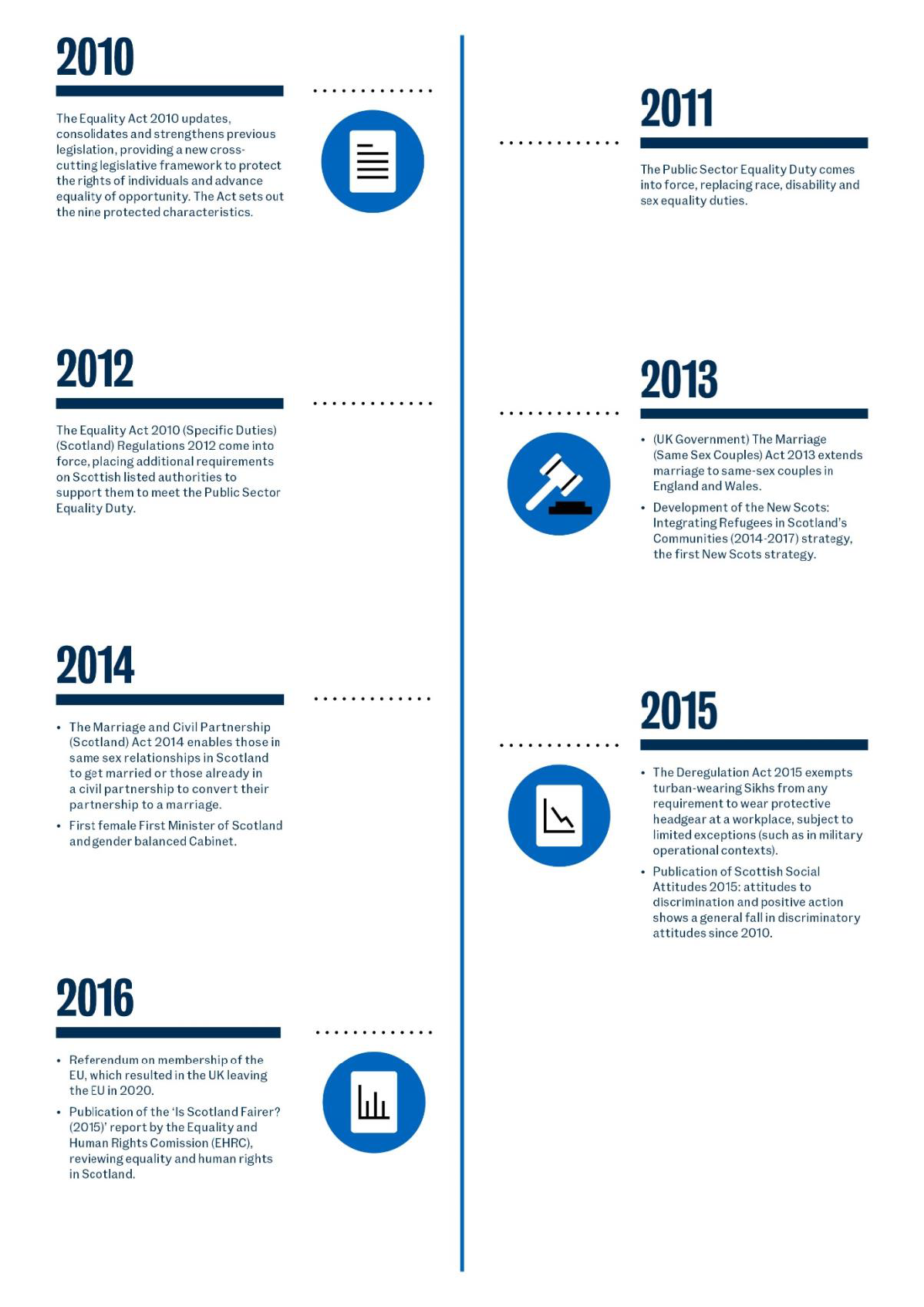
2010
The Equality Act 2010 updates, consolidates and strengthens previous legislation, providing a new crosscutting legislative framework to protect the rights of individuals and advance equality of opportunity. The Act sets out the nine protected characteristics.
2011
The Public Sector Equality Duty comes into force, replacing race, disability and sex equality duties.
2012
The Equality Act 2010 (Specific Duties) (Scotland) Regulations 2012 come into force. placing additional requirements on Scottish listed authorities to support them to meet the Public Sector Equality Duty.
2013
- (UK Government) The Marriage (Same Sex Couples) Act 2013 extends marriage to same-sex couples in England and Wales.
- Development of the New Scots: Integrating Refugees in Scotland's Communities (2014-2017) strategy. the first New Scots strategy.
2014
- The Marriage and Civil Partnership (Scotland) Act 2014 enables those in same sex relationships in Scotland to get married or those already in a civil partnership to convert their partnership to a marriage.
- First female first Minister of Scotland and gender balanced Cabinet.
2015
- The Deregulation Act 2015 exempts turban-wearing Sikhs from any requirement to wear protective headgear at a workplace, subject to limited exceptions (such as in military operational contexts).
- Publication of Scottish Social Attitudes 2015: attitudes to discrimination and positive action shows a general fall in discriminatory attitudes since 2010.
2016
- Referendum on membership of the EU, which resulted in the UK leaving the EU in 2020.
- Publication of the 'Is Scotland Fairer?(2015)' report by the Equality and Human Rights Comission (EHRC), reviewing equality and human rights in Scotland.
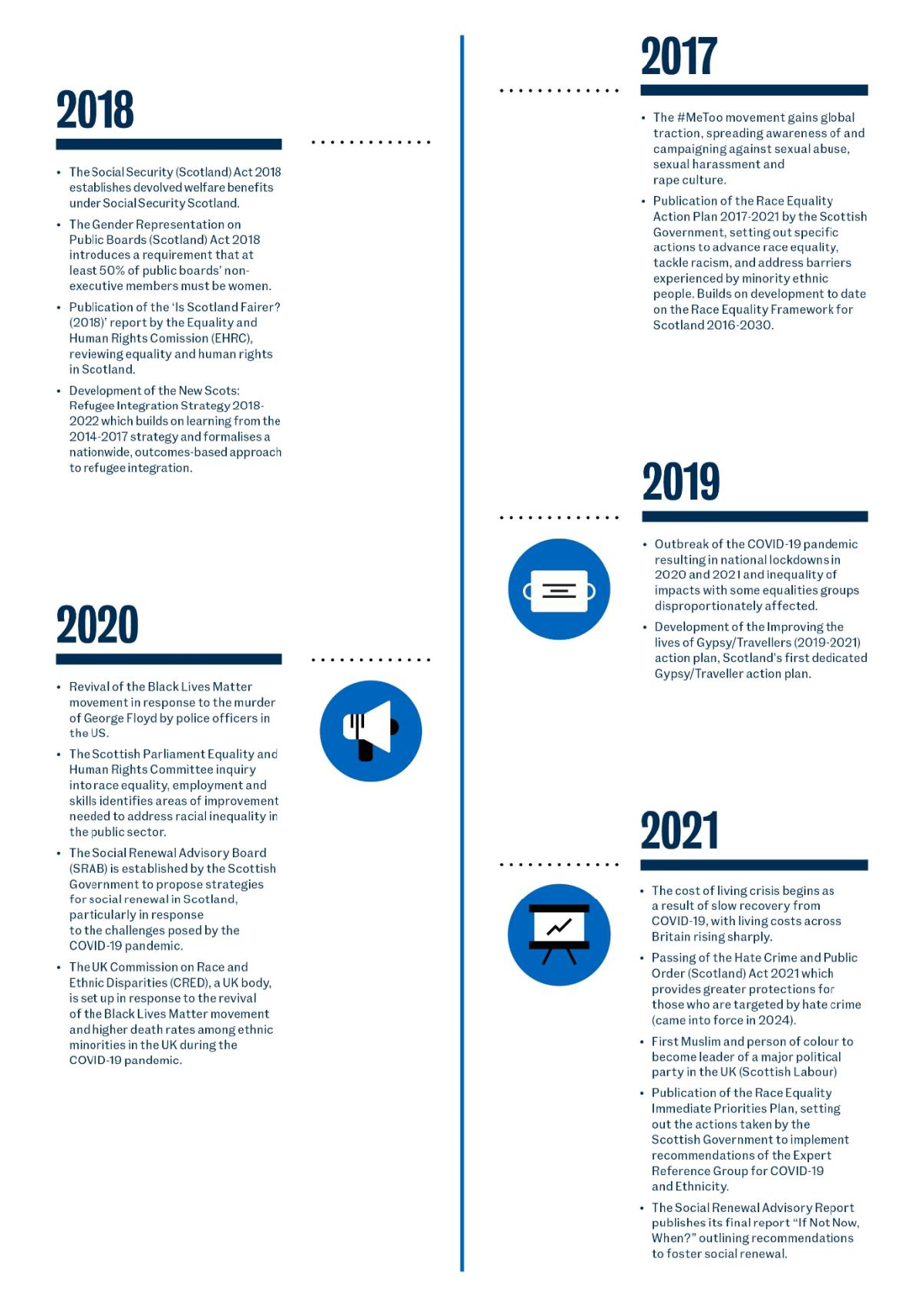
2017
- The #Me Too movement gains global traction, spreading awareness of and campaigning against sexual abuse, sexual harassment and rape culture.
- Publication of the Race Equality Action Plan 2017-2021 by the Scottish Government, setting out specific actions to advance race equality, tackle racism, and address barriers experienced by minority ethnic people. Builds on development to date on the Race Equality Framework for Scotland 2016-2030.
2018
- The Social Security (Scotland) Act 2018 establishes devolved welfare benefits under Social Security Scotland.
- The Gender Representation on Public Boards (Scotland) Act 2018 introduces a requirement that atleast 50% of public boards' non-executive members must be women.
- Publication of the 'Is Scotland Fairer? (2018)' report by the Equality and Human Rights Comission (EHRC), reviewing equality and human rights in Scotland.
- Development of the New Scots: Refugee Integration Strategy 2018-2022 which builds on learning from the 2014-2017 strategy and formalises a nationwide, outcomes based approach to refugee integration.
2019
- Outbreak of the COVID-19 pandemic resulting in national lockdowns in 2020 and 2021 and inequality of impacts with some equalities groups disproportionately affected.
- Development of the Improving the lives of Gypsy/Travellers (2019-2021) action plan, Scotland's first dedicated Gypsy/Traveller action plan.
2020
- Revival of the Black Lives Matter movement in response to the murder of George Floyd by police officers in the US.
- The Scottish Parliament Equality and Human Rights Committee inquiry into race equality, employment and skills identifies areas of improvement needed to address racial inequality in the public sector.
- The Social Renewal Advisory Board (SRAB) is established by the Scottish Government to propose strategies for social renewal in Scotland, particularly in response to the challenges posed by the COVID-19 pandemic.
- The UK Commission on Race andEthnic Disparities (CRED), a UK body, is set up in response to the revival of the Black Lives Matter movement and higher death rates among ethnic minorities in the UK during the COVID-19 pandemic.
2021
- The cost of living crisis begins as a result of slow recovery from COVID-19, with living costs across Britain rising sharply.
- Passing of the Hate Crime and Public Order (Scotland) Act 2021 which provides greater protections for those who are targeted by hate crime (came into force in 2024).
- First Muslim and person of colour to become leader of a major political party in the UK (Scottish Labour)
- Publication of the Race Equality Immediate Priorities Plan, setting out the actions taken by the Scottish Government to implement recommendations of the Expert Reference Group for COVID-19 and Ethnicity.
- The Social Renewal Advisory Report publishes its final report "If Not Now, When?" outlining recommendations to foster social renewal.
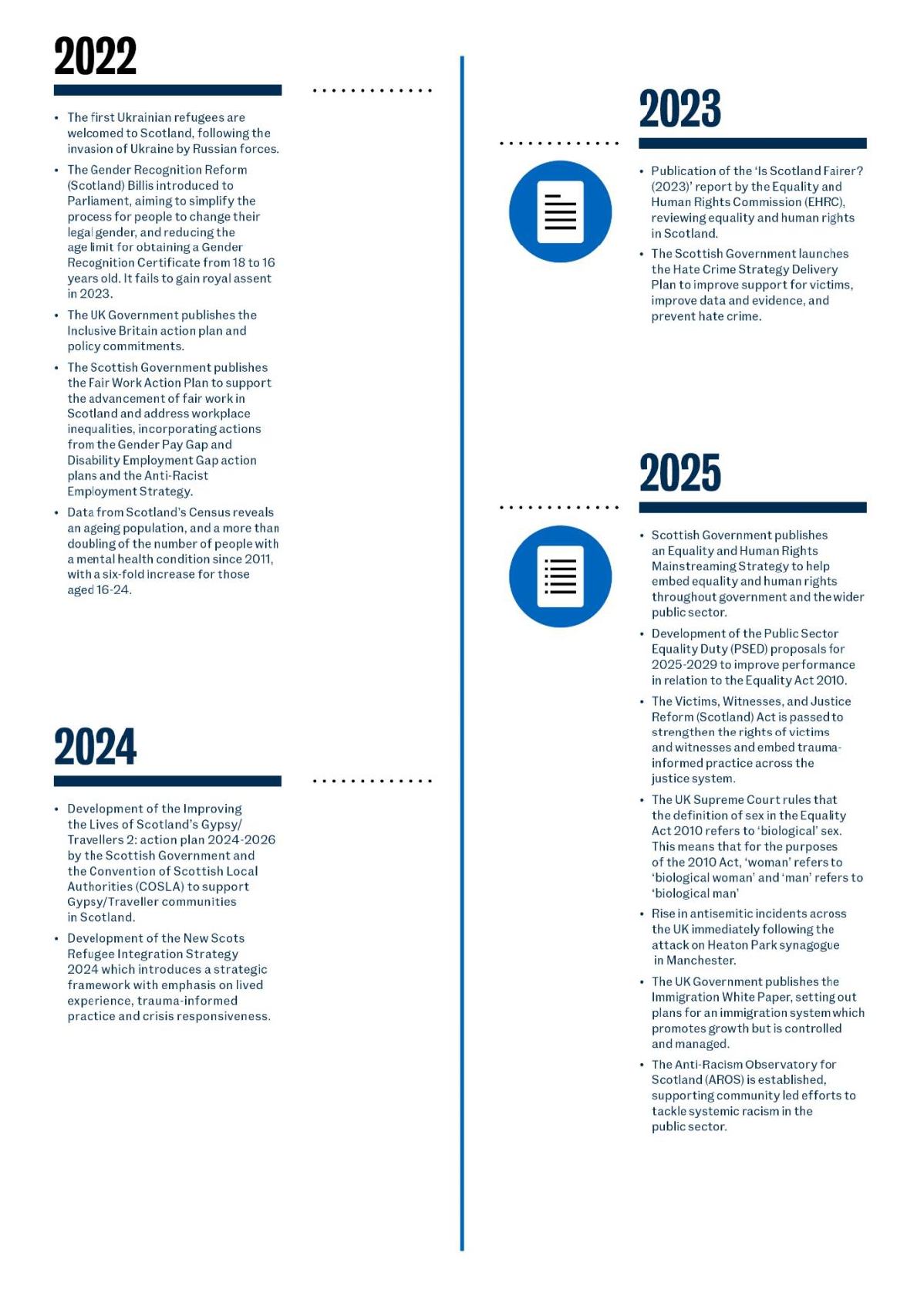
2022
- The first Ukrainian refugees are welcomed to Scotland. following the invasion of Ukraine by Russian forces.
- The Gender Recognition Reform (Scotland) Bill is introduced to Parliament, aiming to simplify the process for people to change their legal gender, and reducing the age limit for obtaining a Gender Recognition Certificate from 18 to 16 years old. It fails to gain royal assent in 2023.
- The UK Government publishes the Inclusive Britain action plan and policy commitments.
- The Scottish Government publishes the Fair Work Action Plan to support the advancement of fair work in Scotland and address workplace inequalities, incorporating actions from the Gender Pay Gap and Disability Employment Gap action plans and the Anti-Racist Employment Strategy.
- Data from Scotland's Census reveals an ageing population, and a more than doubling of the number of people with a mental health condition since 2011, with a six-fold increase for those aged 16-24.
2023
- Publication of the 'Is Scotland Fairer? (2023)' report by the Equality and Human Rights Commission (EHRC), reviewing equality and human rights in Scotland.
- The Scottish Government launches the Hate Crime Strategy Delivery Plan to improve support for victims, improve data and evidence, and prevent hate crime.
2024
- Development of the Improving the Lives of Scotland's Gypsy/ Travellers 2: action plan 2024-2026 by the Scottish Government and the Convention of Scottish Local Authorities (COSLA) to support Gypsy/Traveller communities in Scotland.
- Development of the New Scots Refugee Integration Strategy 2024 which introduces a strategic framework with emphasis on lived experience, trauma-informed practice and crisis responsiveness.
2025
- Scottish Government publishes an equality and Human Rights Mainstreaming Strategy to help embed equality and human rights throughout government and the wider public sector.
- Development of the Public Sector Equality Duty (PSED) proposals for 2025-2029 to improve performance in relation to the Equality Act 2010.
- The Victims, Witnesses, and Justice Reform (Scotland) Act is passed to strengthen the rights of victims and witnesses and embed trauma-informed practice across the justice system.
- The UK Supreme Court rules that the definition of sex in the Equality Act 2010 refers to 'biological' sex. This means that for the purposes of the 2010 Act, 'woman' refers to 'biological woman' and 'man' refers to 'biological man'
- Rise in antisemitic incidents across the UK immediately following the attack on Heaton Park synagogue in Manchester.
- The UK Government publishes the Immigration White Paper, setting out plans for an immigration system which promotes growth but is controlled and managed.
- The Anti-Racism Observatory for Scotland (AROS) is established, supporting community led efforts to tackle systemic racism in the public sector.
The 2025 survey aims
Within this context of legislative and social change, and with a decade having passed since these questions were last included in SSA, the main aims of the questions on discrimination and positive action included in SSA 2025 were:
- To measure the extent and character of discriminatory attitudes in Scotland in 2025, including comparing attitudes towards different groups in different contexts
- To explore the extent of support for positive action to try and achieve equality for different groups
- To investigate public attitudes towards immigration to Scotland, and
- To examine how attitudes have changed over time
As in 2015, the 2025 survey explored attitudes towards men and women, people from ethnic minority groups, disabled people, gay, lesbian and bisexual people, people of different faiths, older people and transgender people (shortened throughout this report to refer to trans). Major additions since the 2015 survey were:
- Inclusion of Protestants, Catholics, and refugees as additional demographic groups.
- Including two different types of mental health problems, schizophrenia and depression, where previously SSA had only included someone with depression.
- Amending terminology used: first use of term ‘trans people’ and the addition of bisexual people alongside gay and lesbian people.
- Additional questions about whether immigration to Scotland should be increased or reduced, and the impact of immigration on Scotland’s economy and cultural life.
In 2006, 2010 and 2015, respondents of SSA were asked their views about someone who has had a sex change operation, as there was not widespread understanding of the term ‘trans’ at this time. In 2025, the phrase ‘someone who has had a sex change operation’ was dropped and instead questions were asked about a trans person. This change in wording means that caution should be applied when interpreting any changes over time.
It is important to note that in a general population survey there is relatively limited scope for subgroup analysis to explore the views of those with protected characteristics. Although this year’s sample of 1,549 is large enough to allow detailed statistical analysis of the views of the Scottish population as a whole, and for larger groups within society (for example, men and women, or people of different ages), smaller groups within society are represented by smaller proportions of the sample, meaning the sample size for these groups is too small to provide detailed statistical analysis.
About the data
The Scottish Social Attitudes (SSA) survey has been run by the Scottish Centre for Social Research since 1999. SSA provides a robust and reliable picture of changing public attitudes over time. SSA has historically been based on face-to-face interviews. During the Covid pandemic SSA moved to a telephone survey in 2021/22 and since 2023 has followed the same methodology as the British Social Attitudes survey and has been run as an online survey. SSA collects data from a representative random probability sample of those aged 16 and over in Scotland. In 2025 the sample size was 1,549, with fieldwork taking place between September and November 2025. Data are weighted to correct for non-response bias and to ensure they reflect the age-sex profile of the Scottish population. Further details about the survey methodology are published in a separate SSA 2025 technical report. This report also includes data from previous years of SSA that included a module of questions on discrimination. All previous years data of SSA included in this report was collected face-to-face using a random probability sample and is weighted to correct for non-response bias and reflect the age-sex profile of the Scottish population. This allows us to robustly compare findings at several different time points.
All percentages presented in this report are based on the weighted data and are rounded to the nearest whole number. All differences described in the text (between years, or between different groups of people) are statistically significant at the 95% level or above, unless otherwise specified. This means that the probability of having found a difference of at least this size if there was no actual difference in the population is 5% or less. The term ‘significant’ in this report refers to statistical significance and is not intended to imply substantive importance. Further details of significance testing and analysis can be found in the technical report.
Report structure and conventions
The remainder of this report is structured as follows:
Chapter 2. Discusses general attitudes to prejudice in Scotland, and explores differences in the kinds of people who are more or less likely to hold discriminatory views.
Chapter 3. Explores discriminatory attitudes in the context of personal relationships, comparing opinions on people from different groups forming a long-term relationship with a family member.
Chapter 4. Explores attitudes towards immigration into Scotland, including whether immigration should be increased or reduced, and the perceived impact of immigration on Scotland’s economy and cultural life.
Chapter 5. Examines discriminatory attitudes in the context of employment, comparing views on how suitable people from different groups are as a primary school teacher. This chapter also explores attitudes towards paid parental leave and forced retirement.
Chapter 6. Discusses attitudes to different kinds of positive action, including attempts to promote equal opportunities and attitudes toward promotion opportunities.
Chapter 7. Summarises the main conclusions of the report.
Contact
Email: socialresearch@gov.scot