
Scottish Social Attitudes 2025: attitudes to discrimination and positive action
Findings from the 2025 Scottish Social Attitudes survey on discrimination and positive action. It explores attitudes to prejudice, diversity and immigration, trends over time, and identifies groups most at risk, alongside mixed public views on equality and support for positive action in Scotland.
5. Equity and participation in the labour market
This chapter is the first of two focusing on discriminatory attitudes in the context of employment. First, views on whether different groups of people would be suited to the job of being a primary school teacher are explored, including a comparison between these views and feelings around someone from the same group marrying or forming a long-term relationship with a close relative. The chapter then explores views on parental leave and whether older people should, or should not, be made to retire on the basis of their age.
Views on the suitability of different people as a primary school teacher
To explore people’s views on different demographic and equalities groups within an employment context, the example of a primary school teacher was used. This context was chosen in 2002, as working with young children was thought to be a particularly sensitive form of employment and therefore potentially more likely to elicit discriminatory views than, for example, working in the retail sector. It also allows, for some of the groups, comparisons with previous findings from 2006, 2010 and 2015.
The question asked respondents ‘How well do you think people from the following groups would be suited to the job of being a primary school teacher?
- A gay, lesbian or bisexual person
- A Black or Asian person
- Someone aged 70
- A Muslim person
- A Jewish person
- A Protestant person
- A Catholic person
- A trans person
- A Gypsy/Traveller’
Respondents could select 5 possible answer options; ‘very suitable’, ‘fairly suitable’, ‘neither suitable nor unsuitable’, ‘fairly unsuitable’, and ‘very unsuitable’. Throughout the report we use the term suitable to describe ‘very suitable’ and ‘fairly suitable’ combined and unsuitable to describe ‘fairly unsuitable’ and ‘very unsuitable’ combined.
| Demographic or equalities group | Very/ fairly suitable | Neither suitable nor unsuitable | Very/ fairly unsuitable | Can't choose/ Don't know/ Not answered |
|---|---|---|---|---|
| Someone aged 70 | 31 | 29 | 35 | 5 |
| A trans person | 38 | 30 | 25 | 8 |
| A Gypsy/Traveller | 43 | 24 | 25 | 7 |
| A Muslim person | 54 | 29 | 11 | 7 |
| A gay, lesbian or bisexual person | 56 | 28 | 9 | 7 |
| A Jewish person | 56 | 33 | 6 | 6 |
| A Black or Asian person | 62 | 28 | 3 | 6 |
| A Catholic person | 62 | 30 | 3 | 5 |
| A Protestant person | 62 | 31 | 2 | 5 |
Base: All respondents to discrimination module, unweighted = 1,549
Do different groups of people have different views?
Knowing someone from one of the groups considered had a large impact on people’s views on whether someone with similar characteristics would be suitable as a primary school teacher. For example, only 6% of people who knew a gay, lesbian or bisexual person said that such a person would be unsuitable as a primary school teacher, compared with 24% of those who did not know such a person. Similarly, 13% of people who knew a trans person said a trans person would be unsuitable as a primary school teacher, compared with 31% of those who did not.
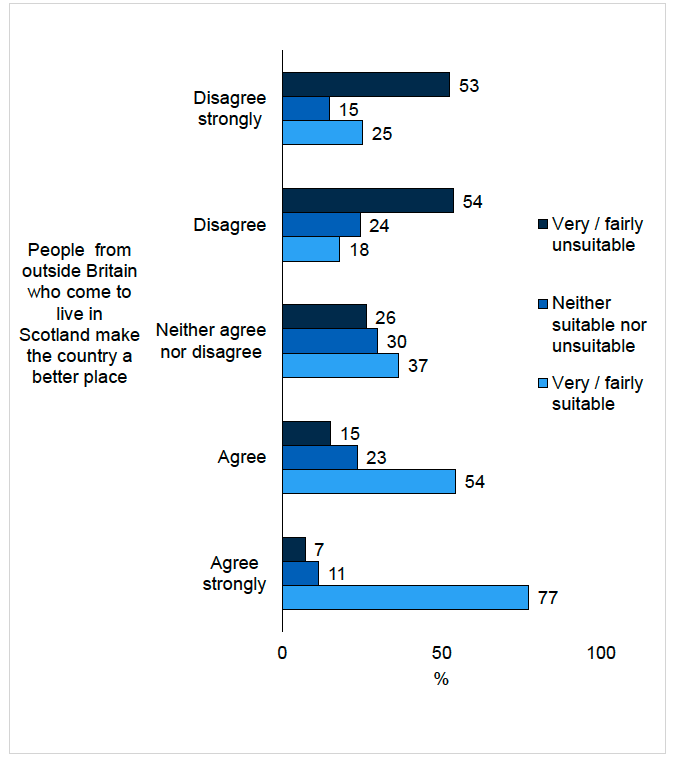
People with more liberal views towards immigration and the contribution of people from outside Britain to Scotland (see Chapter 4) also tended to have more liberal views towards members of other minority groups as to their suitability as a primary school teacher. For example, Figure 5.1 shows that 53-54% of those who ‘disagreed’ or ‘disagreed strongly’ that ‘people from outside Britain who come to live in Scotland make the country a better place’ said a trans person would be unsuitable as a primary school teacher, compared with 7-15% of those who ‘agreed’ or ‘agreed strongly.’
Figure 5.1: Suitability of a trans person as a primary teacher by level of agreement that ‘people from outside Britain who come to live in Scotland make the country a better place’ (2025)
Base: Agree strongly = 256, Agree = 406, Neither agree nor disagree = 625, Disagree = 160, Disagree strongly = 83
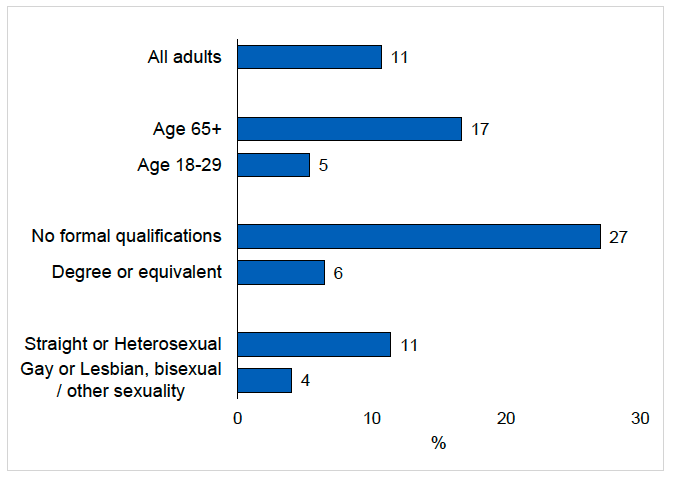
There were also several differences by age, sex, sexuality and level of education, although differences by such demographics were not as large as those noted above. Figure 5.2 shows that older people, heterosexual people and those with no formal qualifications were more likely than younger people, gay, lesbian or bisexual people and those with any type of formal qualification to think a Muslim to be unsuitable as a primary teacher. Similar patterns were seen with regards to the suitability of a Jewish person, a gay, lesbian or bisexual person, a trans person and a Gypsy/Traveller as a primary school teacher. Men were also more likely than women to believe someone from each of the last three groups were unsuitable as a primary school teacher.
Figure 5.2: Proportion who believe that a Muslim person would be ‘fairly unsuitable’ or ‘very unsuitable’ as a primary teacher by age, educational qualifications and sexuality (2025)
Base: All respondents to discrimination module, unweighted = 1,549
There was very little variation between subgroups in the proportion who felt someone aged 70 would be unsuitable as a primary school teacher, with 28% or more of all the groups considered saying they would be ‘fairly’ or ‘very unsuitable’. The highest proportion was for those aged 16-24, with 52% saying they were unsuitable, compared with 29-35% of other age groups. None of the other sociodemographic or economic factors considered demonstrated significant associations with this belief.
As overall proportions were small regarding the unsuitability of Black or Asian people, Protestants and Catholics as primary school teachers, it is unsurprising that there were few differences by subgroups. However, in each of these cases, those with no formal qualifications were significantly more likely than other adults to say the person was unsuitable to be a primary school teacher. Those who were more negative about immigration and diversity were more likely to think that a Black or Asian person was unsuitable as a primary school teacher compared with those with more positive views.
How attitudes have changed over time
The question about views on the suitability of different people as a primary school teacher has been asked on SSA in 2002, 2006, 2010 and 2015. There have been a number of changes in the types of equalities groups included in the question and the wording, so comparison with 2002 data is not possible.
Of the six groups considered in each of the years, a Gypsy/Traveller was the person deemed unsuitable by the largest proportion in both 2010 (46%) and 2015 (34%). In 2025, this proportion had fallen further to 25%. Views on the unsuitability of a gay, lesbian or bisexual person[28] have followed a similar pattern, with the proportion saying that such a person would be unsuitable falling from 21% in 2006 to 9% in 2025.
The proportion of people who believe someone aged 70 would be unsuitable in 2025 (35%) was similar to the proportions in 2015 and 2010, although lower than in 2006 (49%). The proportion who believed a trans person would be unsuitable in 2025 (25%) was slightly higher than the proportion who believed that ‘someone who has had a sex change operation’ would be unsuitable in 2015 (20%), but lower than in 2006 (30%) and 2010 (31%).
Attitudes towards the suitability of Muslims and Black or Asian people as primary school teachers have been fairly consistent over time. Between 11% and 15% in each of the years from 2006 felt that Muslims were unsuitable, and between 3% and 6% felt that Black or Asian people were unsuitable.
| Demographic or equalities group | 2006 | 2010 | 2015 | 2025 |
|---|---|---|---|---|
| Someone aged 70 | 49 | 39 | 31 | 35 |
| A trans person | 30 | 31 | 20 | 25 |
| A Gypsy/Traveller | 48 | 46 | 34 | 25 |
| A Muslim person | 15 | 15 | 13 | 11 |
| A gay, lesbian or bisexual person | 21 | 18 | 13 | 9 |
| A Black or Asian person | 4 | 6 | 3 | 3 |
Base: All respondents to discrimination module, unweighted = 1,437 (2006); 1,366 (2010); 1,234 (2015); 1,549 (2025)
Different contexts, different attitudes?
Of the nine groups discussed in relation to suitability as a primary school teacher, eight were also considered in Chapter 3 in terms of how happy someone would be if a close relative married or formed a long-term relationship with such a person.
| Demographic or equalities group | Thinking unsuitable as a primary school teacher | Would be unhappy if close relative married/ formed a long-term relationship with… |
|---|---|---|
| A trans person | 25 | 30 |
| A Gypsy/Traveller | 25 | 31 |
| A Muslim person | 11 | 15 |
| A gay, lesbian or bisexual person | 9 | 10 |
| A Jewish person | 6 | 7 |
| A Black or Asian person | 3 | 6 |
| A Catholic person | 3 | 3 |
| A Protestant person | 2 | 4 |
Base: All respondents to discrimination module, unweighted = 1,549 for suitability as a teacher. Bases are smaller for the relationship question as a Muslim person, a Jewish person, a Catholic and a Protestant were not asked about people of their own religion.
The regression analysis reported in Chapter 3 identifying key drivers of a being unhappy if a close relative married or formed a long-term relationship with someone who is trans noted a very strong association between this and thinking a trans person unsuitable as a primary school teacher. While Table 5.4 does show that context makes some difference, we should recognise that someone who is prejudiced against a trans person in one context is likely to be prejudiced against a trans person in other situations.
Right to paid leave when a child is ill
Two questions on the right to paid parental leave were included in both SSA 2015 and SSA 2025.[29]
‘Do you think that fathers of children under five should, or should not, be able to take up to five days paid leave a year to look after their child when they are ill?’
‘Do you think that mothers of children under five should, or should not, be able to take up to five days paid leave a year to look after their child when they are ill?’
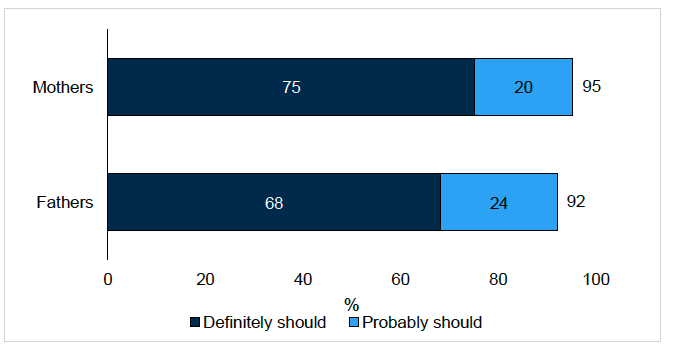
The vast majority of people thought that both mothers and fathers of children under the age of five should be entitled to take up to five days of paid leave a year when their child is ill. Figure 5.3 shows that 95% of adults thought that mothers of young children should be entitled to such leave (75% thought they definitely should), while 92% thought that fathers should (68% definitely should). While the difference between these figures is statistically significant, it shows that there is very little difference between views on mothers or fathers having an entitlement to some paid leave due to their caring responsibilities.
Figure 5.3: Proportion who believe that mothers / fathers of children under the age of five should be entitled to take up to five days of paid leave per year when their child is ill (2025)
Base: All respondents to discrimination module, unweighted = 1,549
In general, differences between views on mothers and fathers for each of the subgroups considered were in line with the differences for all adults where overall, 7% thought men should not be entitled and 4% thought women should not. The largest relative differences were among people aged 65 and above, with 12% believing men should not be entitled to such leave, compared with 4% believing women should not.
Whether older people should be made to retire
The following question was asked to explore people’s views on whether people should be made to retire based on their age.
‘Some people say that it is wrong to make people retire just because they have reached a certain age. Others say that older people[30] should be made to retire to make way for younger age groups.
What about you? Which of the following statements comes closest to your view?
- It is wrong to make people retire just because they have reached a certain age.
- Older people should be made to retire to make way for younger age groups.’
A quarter (26%) of people said that older people should be made to retire to make way for younger age groups. Nearly three-quarters (72%) said it is wrong to make people retire just because they have reached a certain age. These figures did not vary significantly by age.
The 26% who felt that older people should be made to retire is significantly lower than the 35% who felt that someone aged 70 would be unsuitable as a primary school teacher. This suggests that there is a proportion of people who do not think older people should be made to retire in general, but that they may not be suitable for certain types of work.
There was very little variation between subgroups in response to this question. Those from Black, Asian, mixed or other minority ethnic groups were more likely than White people to say that older people should be made to retire (38% and 25%, respectively). Those living in the most deprived areas were more likely than those in all other groups to say this (35%, compared with 22-26%).
Contact
Email: socialresearch@gov.scot