
Scottish Social Attitudes 2025: attitudes to discrimination and positive action
Findings from the 2025 Scottish Social Attitudes survey on discrimination and positive action. It explores attitudes to prejudice, diversity and immigration, trends over time, and identifies groups most at risk, alongside mixed public views on equality and support for positive action in Scotland.
4. Immigration
This chapter explores attitudes towards immigration and how these attitudes vary between groups in society. Respondents were asked their views on the impact of migrants on Scotland’s economy and cultural life, their views on the number of immigrants to Scotland nowadays and whether migrants make Scotland a better place[27].
Agreement that people from outside Britain who come to live in Scotland make the country a better place
In SSA 2025, respondents were asked how much they agree or disagree ’that people from outside Britain who come to live in Scotland make the country a better place.’ (See Chapter 2 for details on findings and socio-demographic differences).
There was a strong correlation between other discriminatory attitudes and views on immigration. For example, 54% of those who said ‘Scotland should do everything it can to get rid of all kinds of prejudice’ agreed that ‘people from outside Britain make Scotland a better place’, compared with 11% of those who said ‘sometimes there is good reason for people to be prejudiced against certain groups’.
Being from a minority ethnic background or knowing someone from a different ethnic background were also associated with more positive views on the impact of people from outside Britain coming to live in Scotland. Two-thirds (65%) of those who identified as Black, Asian, mixed or of other ethnic origins agreed with the statement, compared with 37% of those who identified as White. Similarly, 43% of those who knew someone from a different ethnic background agreed with the statement, compared with 20% of those who did not know anyone from a different ethnic background to themselves.
A regression model was also constructed to examine disagreement that people from outside Britain who come to live in Scotland make the country a better place. All variables included in the model were associated with disagreement that ‘people from outside Britain who come to live in Scotland make the country a better place’ and the direction of the relationships are shown in the list below.
Key drivers of disagreement that ‘people from outside Britain who come to live in Scotland make the country a better place’:
- Being aged 16-64
- Having no qualifications / qualifications below degree level
- Being from a White ethnic group
- Struggling on present income
- Preferring to live in an area where most people are similar to you
- Believing that sometimes there is good reason for people to be prejudiced against certain groups
- Not knowing anyone from a different racial or ethnic background to you
- Mentioning that would be unhappy if a close family member married or formed a long-term relationship with someone from at least 2 of the groups
The factors which showed the strongest associations with disagreement that ‘people from outside Britain who come to live in Scotland make the country a better place’ were belief that sometimes there is good reason for people to be prejudiced against certain groups, and unhappiness if a close family member married or formed a long-term relationship with someone from at least 2 of the groups considered. Preferring to live in an area where most people are similar to you was also associated with disagreement that ‘people from outside Britain who come to live in Scotland make the country a better place irrespective of their other characteristics.
A number of the demographic variables were also identified as key drivers. Someone with no qualifications or qualifications below degree level is more likely than those with qualifications above degree level to disagree that ‘people from outside Britain who come to live in Scotland make the country a better place’.
Being from a White ethnic group and not knowing someone from a different racial or ethnic background also means that you are more likely to disagree with this statement, as does struggling on your current income or being aged 16-64.
Views on the impact of migrants on Scotland’s economy and cultural life
Two new questions, exploring views on the impact of migrants on Scotland’s economy and cultural life, were included in SSA 2025:
- On a scale of 0 to 10, where 0 is extremely bad and 10 is extremely good, would you say it is generally bad or good for Scotland's economy that migrants come to Scotland from other countries?
- On a scale of 0 to 10, where 0 is undermined and 10 is enriched, would you say that Scotland's cultural life is generally undermined or enriched by migrants coming to live here from other countries?
Views on the cultural and economic impact of migrants were similar, with the mean score on the economy scale 5.2 and on the cultural life scale 5.3, showing that overall attitudes towards migrants’ impact on Scotland’s economy and cultural life were positive. However, one in eight (12%) said that migrants are ‘extremely bad’ (score of 0) for Scotland’s economy and a similar proportion (13%) said that Scotland’s cultural life is ‘undermined’ (score of 0) by migrants.
Views towards the impact of migrants on Scotland’s economy and cultural life, like the previous survey question on immigration, were strongly associated with more general attitudes towards prejudice and diversity. They also varied by demographic and economic factors.
Almost three-quarters (72%) of those who identified as Black, Asian, mixed or other ethnic origin said that migrants were good for Scotland’s economy (score of 6 or above on the scale) and over two-thirds (68%) said that migrants were enriching Scotland’s cultural life. The equivalent views for those who identified as White were only at 45% for both scales.
Knowing someone from a different racial or ethnic background to oneself was also a strong predictor of views. Half (51%) of those who knew someone from a different racial or ethnic background to themselves said that migrants were good for the economy, compared with 27% of those who did not know such a person. Similarly, 52% who knew someone from a different background to themselves said that migrants were enriching the cultural life, compared with 24% of those who did not.
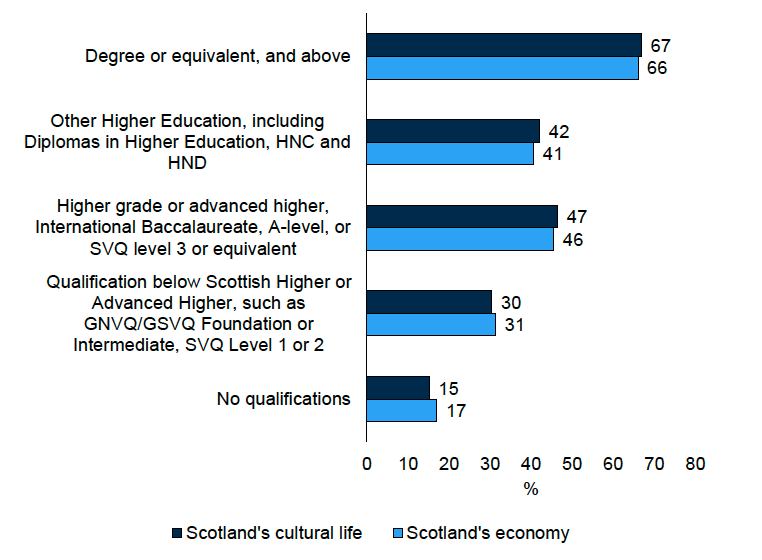
Figure 4.1 shows that those with degree level or equivalent qualifications were more likely to have a positive view on the impact of migration on Scotland’s cultural life (67%) and economy (66%) compared with those with no formal qualifications (15% for cultural life and 17% for the economy).
Figure 4.1: Positive views on migrants’ impact on Scotland’s economy and cultural life (score of 6 or above) by education
Base: All respondents to discrimination module, unweighted = 1,549
Views on the impact of migrants became more positive with increasing household income. Just over a third (36%) of those in the lowest income group said that migrants were good for Scotland’s economy, increasing to 58% among those in the highest income group. Similarly, two-fifths (40%) of those in the lowest income group said migrants were enriching Scotland’s cultural life, increasing to 56% in the highest income group.
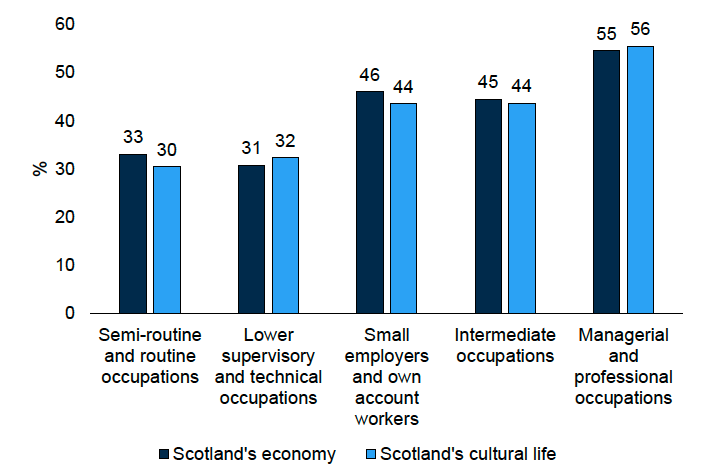
Findings were similar in relation to socio-economic class (see Figure 4.2). Those in routine/semi-routine occupations or lower supervisory roles, who tended to be on lower incomes, were less likely to have a positive view of the impact of migrants on Scotland’s economy and cultural life (33% and 30%, respectively) compared with those in managerial and professional occupations (55% and 56%, respectively).
Figure 4.2: Positive views on migrants’ impact on Scotland’s economy and cultural life by socio-economic class
Base: All respondents to discrimination module, unweighted = 1,549
Views on the number of immigrants to Scotland nowadays
Respondents were asked one final question on immigration, new to SSA in 2025.
‘Do you think the number of immigrants to Scotland nowadays should be…
- increased a lot
- increased a little
- remain the same as it is
- reduced a little
- reduced a lot?
- Can’t choose
Almost half (45%) thought that the number of immigrants to Scotland should be reduced, either ‘a little’ or ‘a lot’. Only 17% thought the number should be increased and 22% thought it should ‘remain the same as it is’, while 16% were unable to choose an answer.
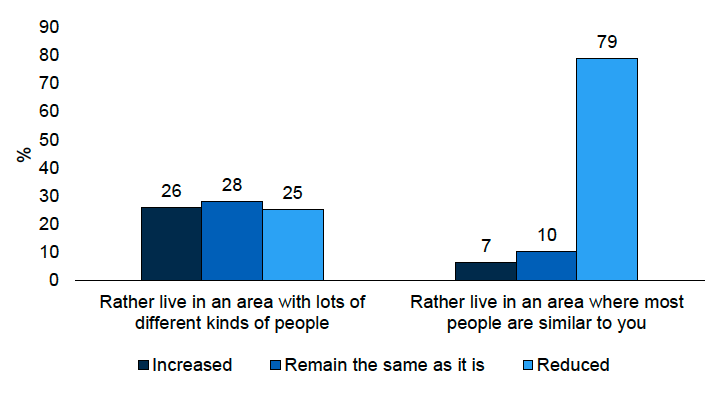
Not surprisingly, there was a strong association between views on the number of immigrants to Scotland and attitudes more generally to prejudice and diversity. For example, 79% of people who said they would rather live in a less diverse area felt that the number of immigrants should be reduced, compared with 25% of people who would rather live in a more diverse area (see Figure 4.3). More strikingly, 95% of people who disagreed strongly with the statement ‘People from outside Britain who come to live in Scotland make the country a better place’ felt that immigration should be reduced, compared with just 5% of those who agreed strongly.
Figure 4.3: Views on whether the number of immigrants to Scotland should be increased, remain the same or reduced by type of area people would rather live in
Base: All respondents to discrimination module, unweighted = 1,549
As with the other questions examined in this chapter, there were associations with demographic and economic factors and with knowing someone from a different ethnic background. Almost half of those who identified as White (48%) said they thought the number of immigrants to Scotland should be reduced ‘a little’ or ‘a lot’, compared with 17% of those who identified as Black, Asian, mixed or other ethnic origin. More than half (55%) of those who did not know anyone from a different ethnic background said that the number of immigrants should be reduced, compared with 43% of those who did.
Those with no formal qualifications (68%) and those with qualifications below Scottish Higher or equivalent (57%) were more likely to say that the number of migrants should be reduced compared with those with a degree or equivalent (29%). Those who said they were ‘struggling’ (53%) or ‘really struggling’ (56%) on their present income were more likely to say that the number of immigrants to Scotland should be reduced compared with those ‘living comfortably’ (39%) or ‘really comfortably’ (30%) on their present income.
A model was constructed to determine the key drivers of believing that the number of immigrants should be reduced a lot. These key drivers are listed below.
Key drivers of believing that the number of immigrants should be reduced a lot:
- Being aged 25-64
- Having no qualifications / qualifications below degree level
- Prefer to live in an area where most people are similar to you
- Believe that sometimes there is good reason for people to be prejudiced against certain groups
- Disagree that people from outside Britain who come to live in Scotland make the country a better place
- Said that someone from at least 4 of the groups would be unsuitable as a primary school teacher
The strongest association demonstrated in the model was between disagreeing that people from outside Britain who come to live in Scotland make the country a better place and believing that the number of immigrants should be reduced a lot. This means that there is a strong correlation between people’s thoughts on immigration and their beliefs about the contribution of immigrants to Scottish society, although it does not indicate any causality in either direction.
Preferring to live in an area where most people are similar to you was also very strongly associated with a desire to reduce the number of immigrants a lot.
Other factors which showed a statistically significant association with believing the number of immigrants should be reduced a lot, irrespective of other characteristics, were being aged 25-64, not having a university degree (or equivalent qualification), believing that sometimes there is good reason for people to be prejudiced against certain groups, and mentioning that someone from at least four of the groups considered would be unsuitable as a primary school teacher (see Chapter 5).
Contact
Email: socialresearch@gov.scot