
Scottish Marine Recovery Fund: consultation analysis report
Key findings from the public consultation 2025 on the Scottish Marine Recovery Fund policy for offshore wind.
Consultation
9 General Questions Consultation Analysis Results
9.1 Introduction
9.1.1 The consultation posed three general questions relating to the Scottish MRF which are discussed below. Question 20 is divided into three components (Q20a, Q20b and Q20c).
9.2 Question 20 a) - To what extent do you agree that establishing a Scottish MRF to streamline offshore wind consenting and deliver strategic compensation measures will help Scotland achieve net zero?
9.2.1 The total number of responses in relation to the multiple choice component of question 20a was 21. 5 respondents did not answer this question. The breakdown by respondent type was 1 individual and 20 organisations. The breakdown of responses is provided in Figure 15.
9.2.2 7 organisational respondents answered ‘Strongly agree’, 9 organisational respondents answered ‘Mostly agree’, 4 organisational respondents answered ‘Don’t Know’, and 1 individual answered ‘Strongly disagree’.
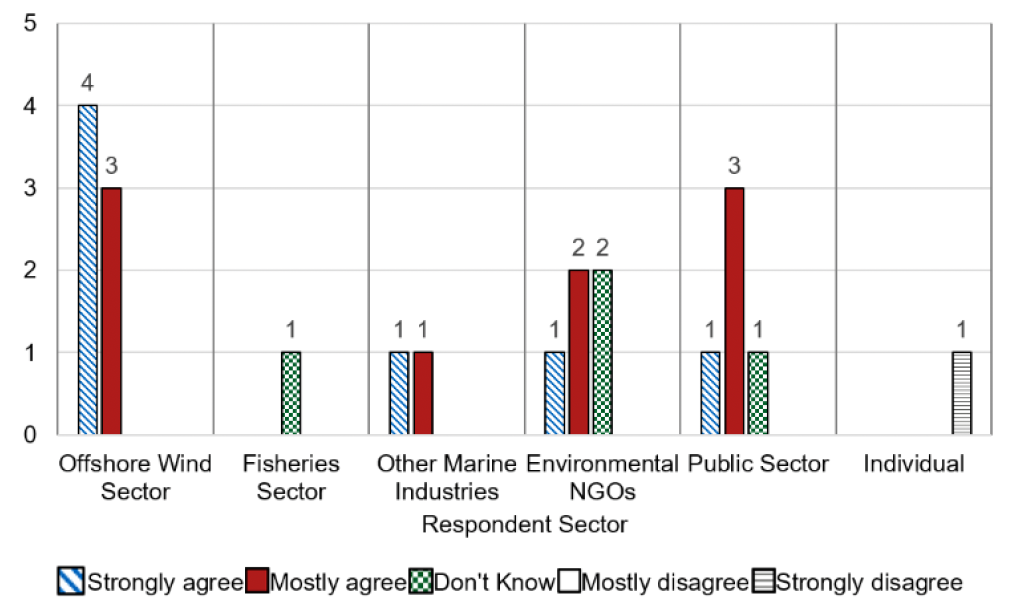
9.2.3 A breakdown by sector shows that the Offshore Wind Sector and Other Marine Industries generally answered, ‘Strongly agree’ or ‘Mostly agree’. Environmental NGOs generally answered ‘Mostly agree’ or ‘Don’t Know’. Respondents from the Public Sector generally answered, ‘Mostly agree’.
9.3 Question 20 b) - To what extent do you agree that establishing a Scottish MRF to streamline offshore wind consenting and deliver strategic compensation measures will be beneficial to the people and environment of Scotland?
9.3.1 The total number of responses in relation to the multiple choice component of question 20b was 21. 5 respondents did not answer this question. The breakdown by respondent type was 1 individual and 20 organisations. The breakdown of responses is provided in Figure 16.
9.3.2 9 organisational respondents answered ‘Strongly agree’, 7 organisational respondents answered ‘Mostly agree’, 4 organisational respondents answered ‘Don’t Know’, and 1 individual answered ‘Strongly disagree’.
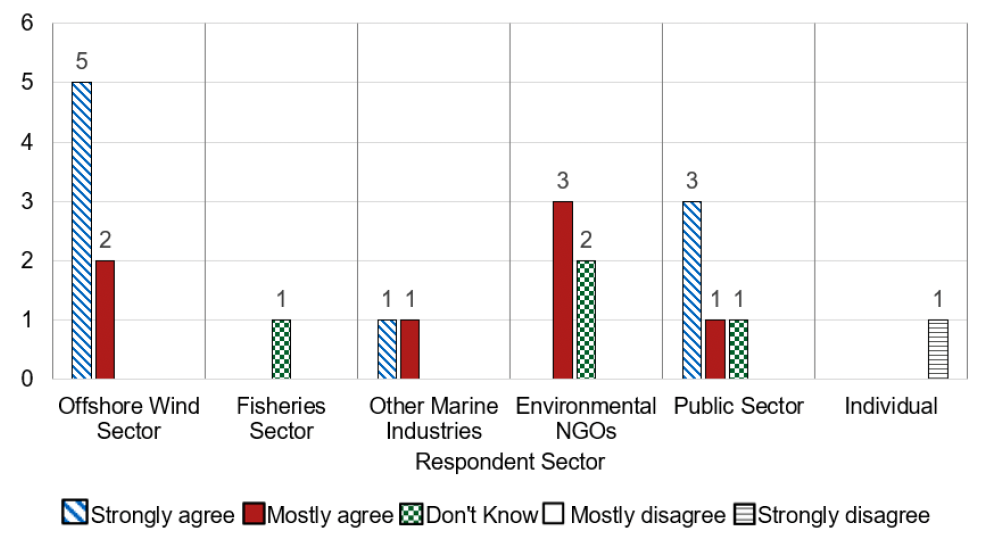
9.3.3 A breakdown by sector shows that the respondents from the Offshore Wind Sector, Other Marine Industries and Public Sector generally answered, ‘Strongly agree’ or ‘Mostly agree’. Environmental NGOs generally answered ‘Mostly agree’ or ‘Don’t Know’. 1 respondent from the Fisheries Sector answered ‘Don’t Know’.
9.4 Question 20 c) - To what extent do you agree that establishing a Scottish MRF to streamline offshore wind consenting and deliver strategic compensation measures will be beneficial to developers of Scottish offshore wind projects?
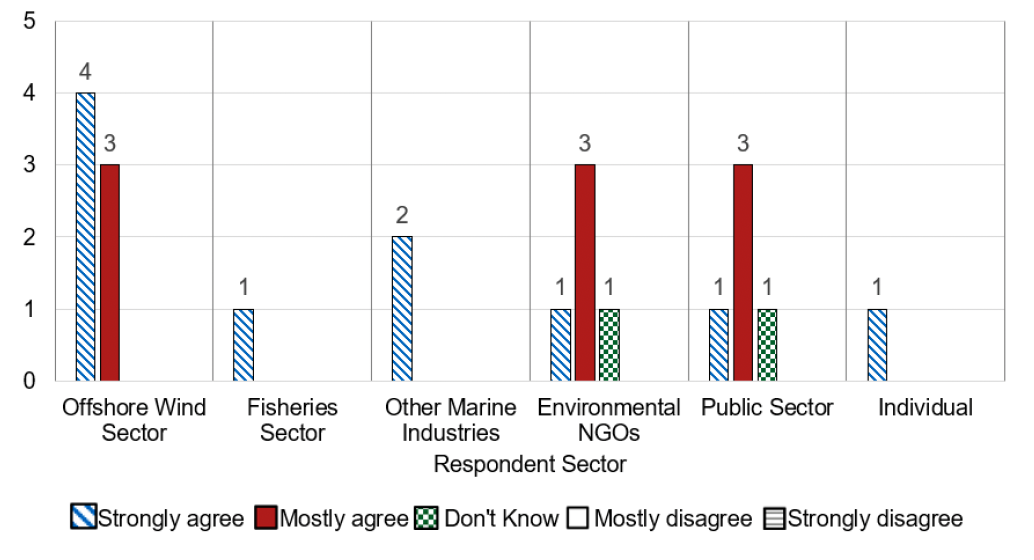
9.4.1 The total number of responses in relation to the multiple choice component of question 20c was 21. 5 respondents did not answer this question. The breakdown by respondent type was 1 individual and 20 organisations. The breakdown of responses is provided in Figure 17.
9.4.2 10 organisational respondents answered ‘Strongly agree’, 9 organisational respondents answered ‘Mostly agree’, and 2 respondents answered ‘Don’t Know’. 9 organisational respondents answered ‘Mostly agree’, 2 respondents answered ‘Don’t Know’.
9.4.3 A breakdown by sector shows that respondents across all sectors generally answered ‘Strongly agree’ or ‘Mostly agree’. One respondent from each of the Public Sector and Environmental NGOs answered ‘Don’t Know’.
9.5 Question 21 - If you were/are developing an offshore wind project would the Scottish MRF be an attractive option to address any adverse environmental effects?
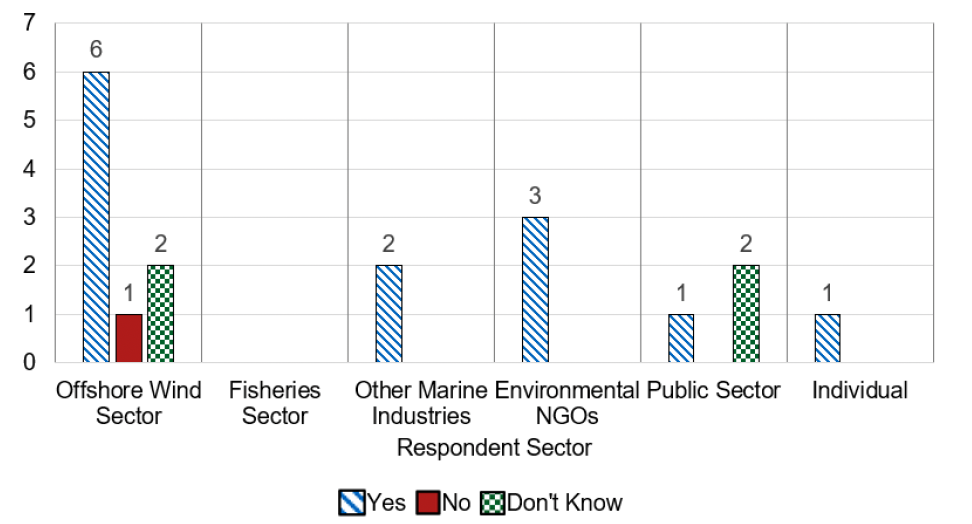
9.5.1 The total number of responses in relation to the multiple choice component of question 21 was 18. 8 respondents did not answer this question. The breakdown by respondent type was 1 individual and 17 organisations. The breakdown of responses by sector is provided in Figure 18.
9.5.2 12 organisational respondents and 1 individual answered ‘Yes’, 1 organisational respondent answered ‘No’, and 4 organisational respondents answered ‘Don’t Know’.
9.5.3 A breakdown by sector shows that the Offshore Wind Sector, Other Marine Industries, and Environmental NGOs generally agreed that the Scottish MRF would be an attractive option to address any adverse environmental impacts.
9.5.4 For the free text component of question 21, there were 22 responses. 4 respondents did not answer this question. The breakdown by respondent type was 1 individual and 20 organisations.
9.5.5 Of the 22 responses received, 3 did not directly address the question and included comments such as ‘N/A’ or similar non-substantive replies.
9.5.6 Reasons for agreement provided by respondents answering ‘Yes’ to question 21 included a positive view that the proposed Scottish MRF is an attractive mechanism for streamlining environmental compensation, particularly for offshore wind projects. Respondents highlighted its potential to simplify consenting processes, reduce administrative burdens, and provide greater certainty regarding compliance and long-term liability. The MRF was seen as a way to offload complex environmental assessment and monitoring responsibilities from developers, allowing them to focus on their core activities. Respondents also noted that the fund could enable more strategic, large-scale compensation measures, which may deliver broader ecological benefits compared to project-specific approaches.
9.5.7 Despite the general support, respondents consistently emphasised that the effectiveness of the Scottish MRF depends on several unresolved details. Key uncertainties included the types of measures the fund will support, the structure and resourcing of the overseeing body, and how the fund will operate across administrative and ecological boundaries. Many respondents stressed the need for greater clarity on these points before the Scottish MRF’s effectiveness can be fully assessed. They also called for transparent processes, competitive costs, and assurance that compensation will be available when required.
9.5.8 The Scottish MRF was widely recognised for its potential to deliver compensation at scale, coordinate actions across projects, and unlock synergies that individual developers might struggle to achieve. Respondents from Environmental NGOs, Public Sector and the Offshore Wind sector noted that this strategic approach could benefit impacted ecological networks and support the adoption of sectoral marine plans. The fund was also seen as a way to ensure more equitable decision-making across projects, rather than relying on case-by-case assessments that may disadvantage certain developers or sectors.
9.5.9 Reasons for disagreement provided by respondents answering ‘No’ to question 21 included the need for alignment with UK-wide mechanisms, ensuring timely access to compensation, and addressing the specific needs of different sectors (such as tidal stream developers). Some respondents expressed concern including process clarity, legal certainty, and adaptive management costs, with respondents indicating that resolving some of these issues would increase support.
9.5.10 Cost-effectiveness emerged as a central concern. Respondents argued that the Scottish MRF must offer competitive costs compared to bespoke, developer-led compensation measures. Early visibility of costs, sustainable funding structures, and the possibility of refunds or adaptive management payments were highlighted as important factors. Without clear and proportionate cost modelling, some respondents warned that developers may be reluctant to opt into the Scottish MRF, especially if direct delivery remains more affordable or flexible.
9.6 Question 22 - Do you have any other comments on the overall proposal for the Scottish MRF?
9.6.1 24 respondents answered question 22. 2 respondents did not answer the question. The breakdown by respondent type was 1 individual and 21 organisations.
9.6.2 Of the 24 responses received, 1 response did not directly address the question and included comments such as ‘No comment’ or similar non-substantive replies.
9.6.3 Most organisational responses primarily came from the Offshore Wind Sector, Public Sector, and Environmental NGOs, representing 10, 5 and 5 responses respectively.
9.6.4 Several respondents discussed the perceived value and potential benefits of the Scottish MRF. Many respondents indicated that the Scottish MRF could serve as an effective mechanism for streamlining environmental compensation, particularly in the context of offshore wind projects. Similar comments and topics were also raised in question 21 and are explored above in Section 9.5.6.
9.6.5 Another topic raised was the conditions necessary for the Scottish MRF’s effectiveness and the uncertainties that remain. Similar comments and topics were also raised in question 21 and are explored above in Section 9.5.7.
9.6.6 Respondents from the Offshore Wind sector argue that the MRF must offer competitive costs compared to bespoke, developer-led compensation measures. Similar comments and topics were also raised in question 21 and are explored above in Section 9.5.10.
9.6.7 The Scottish MRF was widely recognised for its potential to deliver compensation at scale, coordinate actions across projects, and unlock synergies that individual developers might struggle to achieve. Similar comments and topics were also raised in question 21 and are explored above in Section 9.5.8.
9.6.8 While the Scottish MRF is generally viewed as a positive development, respondents identified several challenges and limitations. Similar comments and topics were also raised in question 21 and are explored above in Section 9.5.9.
9.6.9 Another important aspect raised by respondents was the importance of stakeholder engagement and transparent governance. Respondents advocated for the involvement of a broad range of stakeholders in the design and oversight of the MRF, including government agencies, industry representatives, environmental organisations and local communities. Respondents from Environmental NGOs and the Public sector argued that inclusive governance structures would help build trust, ensure accountability, and facilitate the integration of diverse perspectives. Transparent decision-making processes are seen as essential for maintaining confidence in the fund and ensuring that compensation measures are both effective and equitable.
9.6.10 Respondents across sectors emphasised that the MRF should incorporate mechanisms for monitoring, learning, and adjusting compensation measures over time. This adaptive approach is viewed as critical for responding to new scientific information, changing environmental conditions, and evolving industry practices. By embedding flexibility and continuous improvement into the fund’s design, respondents believe the MRF can remain relevant and effective in the face of uncertainty.
9.6.11 In summary, respondents broadly support the concept of the Scottish MRF and recognise its potential to support environmental compensation for offshore wind development. However, they urge that the fund’s design be refined to address outstanding uncertainties, ensure cost-effectiveness, and provide the transparency and flexibility needed to encourage widespread adoption. The collective insights of respondents underscore the importance of strategic planning, stakeholder engagement, and adaptive management in realising the MRF’s objectives.
Contact
Email: MarineRecoveryFund@gov.scot